
TL;DR:
- AI automation enhances local marketing scale, efficiency, and measurable performance results.
- Successful deployment requires thorough readiness assessment and thoughtfully designed frameworks.
- Human oversight remains crucial to preserve authenticity and community trust in AI-generated content.
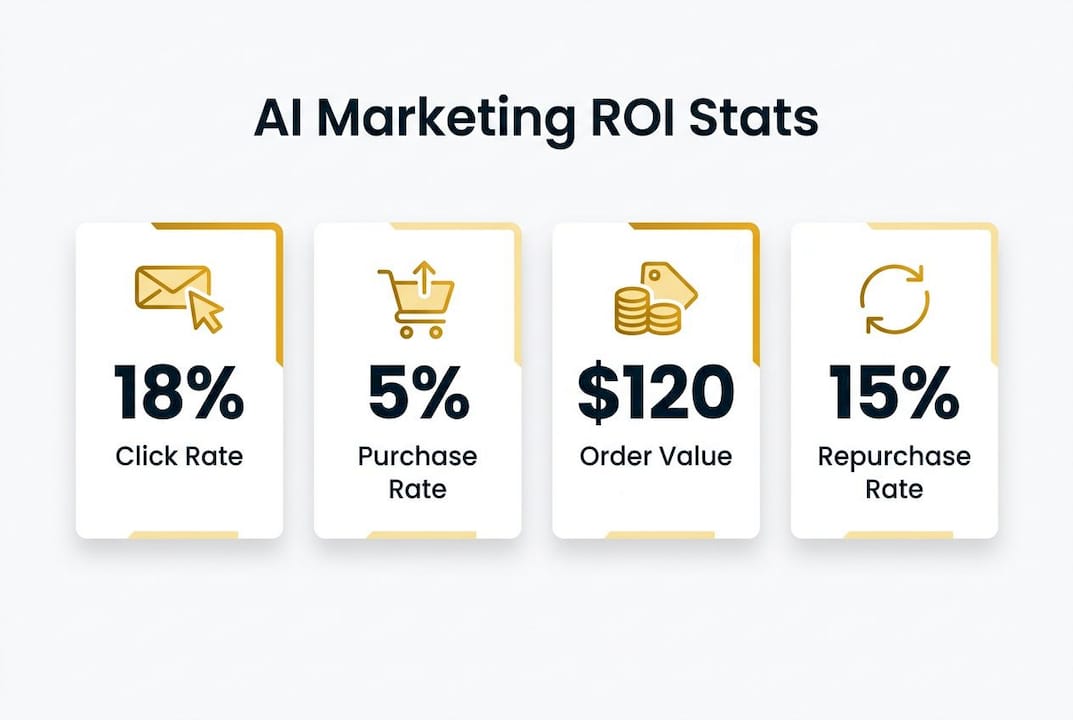
Enterprise marketing teams spend enormous budgets trying to activate local campaigns across dozens or hundreds of markets, only to watch performance plateau because manual localization simply cannot scale. The gap between what a neighborhood audience expects and what a stretched corporate team can deliver is widening every year. AI-driven automation closes that gap decisively: AI marketing yields 18% CTR, 5% purchase rate, $120 order, 15% repurchase rate vs. traditional methods, making the business case for automation impossible to ignore. This guide walks you through every stage of building, executing, and measuring an AI-powered local marketing engine built for enterprise scale.
Table of Contents
- Assessing local marketing needs and readiness
- Designing an AI-powered local marketing framework
- Operationalizing automation and personalization
- Measuring impact and optimizing performance
- Rethinking automation: local impact demands human touch
- Scale your local marketing with smarter automation
- Frequently asked questions
Key Takeaways
| Point | Details |
|---|---|
| AI boosts local ROI | AI-driven automation raises click-through, purchase, and repurchase rates for local campaigns. |
| Personalization at scale | Advanced AI enables context-specific content for each community without losing operational efficiency. |
| Human oversight is vital | Maintaining brand trust and authenticity requires human review of AI-generated local content. |
| Continuous measurement | Data-driven monitoring and iterative optimization deliver superior long-term results. |
Assessing local marketing needs and readiness
With performance goals in mind, the next step is to audit your organization’s current local marketing landscape and readiness for AI-driven transformation.
Before you automate anything, you need an honest picture of where you stand today. Many enterprise teams assume they are ready for AI because they have data. In reality, scattered data, inconsistent brand assets across regions, and disconnected approval workflows are the exact conditions that make automation fail before it starts. A proper readiness audit prevents you from building automation on a cracked foundation.
Start by mapping every touchpoint where local marketing currently happens: paid search, Google Business Profile listings, local landing pages, social media, and email segmented by region. Then ask hard questions about each one. Who owns it? How often is it updated? Is the data feeding it clean and centralized, or is it a patchwork of spreadsheets and regional drives?
Essential readiness checklist:
- Data sources: Are customer location data, purchase history, and behavioral signals unified in one platform or fragmented across tools?
- Creative assets: Do you have modular templates that regional teams can localize without breaking brand standards?
- Brand voice guidelines: Are they specific enough to guide AI-generated copy, or are they vague aspirational statements?
- Approval workflows: Can content be reviewed and published in hours, or does it take weeks of email chains?
- Analytics infrastructure: Can you attribute conversions back to specific local campaigns and channels?
AI automates hyperlocal SEO by analyzing language, seasonal patterns, and search behavior to surface the right keywords for each neighborhood. But that capability only delivers value if your technical foundation, meaning your Google Business Profile data, local landing page structure, and content management system, is already organized. Understanding AI’s role in local SEO helps you see exactly where automation plugs into your existing stack.
| Process area | Manual approach | Automated approach |
|---|---|---|
| Keyword research | Weekly analyst review | Real-time AI scan of local search trends |
| Google Business Profile updates | Regional coordinators update manually | Automated triggers based on hours, inventory, or events |
| Ad copy localization | Copywriter adapts templates per market | AI generates geo-specific variants at scale |
| Performance reporting | Monthly manual reports | Live dashboards with AI-driven anomaly alerts |
| Content approval | Email-based multi-step review | Workflow automation with defined rules and escalations |
Pro Tip: Do not try to automate everything at once. Identify two or three channels where volume is high and complexity is low, such as Google Business Profile updates or localized paid search copy, and automate those first. Early wins build internal confidence and reveal integration gaps before they become expensive problems.
Designing an AI-powered local marketing framework
Once you’ve assessed readiness, it’s time to architect the right framework that leverages what AI does best: automated insight, targeting, and content delivery.
A framework is not a technology stack. It is a set of decisions about data flows, channel priorities, automation rules, and human checkpoints that govern how your local marketing machine operates. Getting this architecture right before you write a single line of automation logic saves months of rework.
Steps to design your AI-first local marketing structure:
- Define your geographic segmentation model. Decide whether you are targeting by city, ZIP code, neighborhood, or radius. The granularity of your segmentation directly determines how specific your AI-generated content can be.
- Map your data inputs. Identify which signals will feed the AI: search query data, foot traffic patterns, weather, local events, competitor pricing, and seasonal demand curves.
- Select your automation rules. Determine what triggers content changes. For example, a spike in “near me” searches for a specific product category should automatically trigger an updated Google Business Profile post and a localized paid ad.
- Choose your content localization approach. Decide how much of the copy AI generates versus how much human editors customize. Most enterprise teams land on a 70/30 split: AI drafts, humans refine.
- Build your feedback loop. Define how performance data flows back into the AI model to improve future targeting and content decisions.
AI automates hyperlocal SEO by analyzing language, seasonal patterns, and search behavior, which means your framework must account for continuous learning, not just one-time setup. Reviewing examples of AI-powered local SEO strategies gives you concrete benchmarks for what good execution looks like across different market sizes.
| Dimension | Traditional campaign setup | AI-driven campaign setup |
|---|---|---|
| Time to launch | 3 to 6 weeks | 3 to 5 days |
| Content variants | 5 to 10 per campaign | Hundreds, dynamically generated |
| Targeting precision | City or DMA level | ZIP code or neighborhood level |
| Optimization cadence | Monthly or quarterly | Continuous, real-time |
| Resource requirement | Large regional teams | Centralized AI team with local reviewers |
“Scaling local marketing with AI does not mean removing the human element. It means redirecting human energy from repetitive production tasks to strategic judgment calls that machines cannot make. The brands that win locally at scale are the ones that use AI to handle volume and use people to handle nuance.”
Semantic relevance is another critical design consideration. AI-generated local content must reflect the actual language your target community uses, not generic marketing copy with a city name inserted. This means training your AI on local review data, community forums, and regional news sources so it understands context, not just geography.

Operationalizing automation and personalization
With a framework in place, next comes the real-world execution, bringing process and automation together for maximum relevance and efficiency.
Execution is where most enterprise local marketing programs either accelerate or stall. The technology works. The failure points are almost always process-related: unclear ownership, inconsistent data inputs, or approval bottlenecks that negate the speed advantage automation provides.
Five steps to launch an AI-driven local campaign:
- Ingest and clean your local data. Pull together location-specific signals including search trends, customer purchase history by ZIP code, and historical campaign performance. Clean and standardize before feeding anything to an AI model.
- Generate localized content variants. Use AI to create geo-specific ad copy, landing page headlines, and Google Business Profile posts. Each variant should reflect local language patterns and seasonal context.
- Set up automated publishing triggers. Define the conditions under which content goes live without manual intervention. For example, a weather-based trigger that activates a rain-gear promotion when precipitation is forecast in a specific market.
- Configure human review checkpoints. Not every piece of content needs human eyes before publishing, but anything touching sensitive topics, local events, or community-specific messaging should. Build this into the workflow, not as an afterthought.
- Activate performance monitoring. Connect your analytics to the campaign from day one so you are collecting data immediately and can start iterating within the first week.
AI automates hyperlocal SEO by analyzing language, seasonal patterns, and search behavior to surface the most relevant keywords for each neighborhood, which directly informs the copy your AI generates for each market. Pairing this with a well-structured Google Business Profile local visibility setup amplifies your organic reach without adding headcount.
Personalization wins at the local level:
- Geo-targeted offers: AI identifies which product categories over-index in specific ZIP codes and surfaces relevant promotions to those audiences.
- Community voice matching: AI trained on local review data and social conversations mirrors the vocabulary and tone that resonates in each market.
- Event-based triggers: Local sports events, festivals, or school calendars automatically activate relevant content variants.
- Dynamic landing pages: Page headlines, imagery, and calls to action update automatically based on the visitor’s location.
Pro Tip: Always run AI-generated content through a cultural sensitivity review before publishing in new markets. What reads as friendly and casual in one region can come across as dismissive or tone-deaf in another. A 15-minute human review can prevent a brand crisis that takes months to repair.
Measuring impact and optimizing performance
Launching campaigns is not the finish line. True ROI comes from tracking performance and continually optimizing each local activation with data-driven feedback.
The most common measurement mistake enterprise teams make is applying national-level KPIs to local campaigns. A campaign performing at average national benchmarks might be dramatically underperforming in a high-value urban market while masking exceptional results in a smaller suburban one. Local marketing demands local measurement.
The four metrics that matter most for local campaign ROI:
AI marketing yields 18% CTR, 5% purchase rate, $120 order, 15% repurchase rate vs. traditional methods, which gives you a clear performance baseline to measure against. Every local market should be tracked against these benchmarks individually, not averaged into a single enterprise number.
Beyond those core KPIs, AI PPC automation delivers 3.2x ROAS through geo-ZIP targeting, predictive demand forecasting, and competitor response, which means your paid local campaigns should be held to a significantly higher return standard than traditional manual approaches. If your current local PPC is not approaching a 3x return, the automation gap is costing you real revenue.
Top AI-enabled analytics tools for local marketing measurement:
- Google Analytics 4 with location dimensions: Segments traffic, conversion, and revenue data by geographic region down to the city level.
- Google Ads performance planner: Uses AI to forecast local campaign outcomes and recommend budget allocation by market.
- BrightLocal: Tracks local search rankings, citation consistency, and Google Business Profile performance across multiple locations.
- Semrush Local: Monitors local keyword positions, competitor visibility, and listing accuracy across markets.
- Northbeam or Triple Whale: Multi-touch attribution tools that help you understand which local touchpoints drive conversion across channels.
The optimization loop is what separates good local marketing from great local marketing. Every two weeks, review performance by market, identify the bottom 20% of locations by CTR and purchase rate, and run AI-generated content experiments specifically for those markets. Understanding AI and SEO visibility outcomes in specific regional contexts gives you a model for how to diagnose and fix underperforming markets systematically.
Continuous optimization also means feeding performance data back into your AI models. When a specific content variant outperforms in a neighborhood, that signal should automatically inform future content generation for similar markets. This is the compounding advantage of AI-driven local marketing: it gets measurably better over time without proportional increases in human effort.
Rethinking automation: local impact demands human touch
The data on AI-driven local marketing is compelling, and the operational efficiency gains are real. But there is a risk that enterprise teams, under pressure to scale fast and cut costs, push automation too far and lose the one thing that makes local marketing work: genuine community connection.
We have seen this pattern repeatedly. A brand deploys AI across 200 local markets, achieves impressive efficiency metrics, and then starts noticing that engagement rates in their highest-value markets are declining. The content is technically correct. The keywords are optimized. The posting cadence is consistent. But something feels off to local audiences, and they disengage. The culprit is almost always over-automation, where AI-generated content that lacks any real understanding of the community it is speaking to.
Edge case: Maintain human oversight in AI content to preserve local authenticity; over-automation risks generic feel eroding community trust. This is not a minor edge case. It is a structural risk that every enterprise local marketing team needs to actively manage.
The teams that get this right treat AI as a production engine and humans as quality directors. AI handles volume, speed, and data processing. Humans handle judgment, cultural nuance, and relationship management. Practically, this means embedding local market managers into the review workflow, not just as approvers but as active contributors who flag when AI-generated content misses the mark and explain why. That feedback loop, how AI and humans can partner in local SEO, is what keeps automation calibrated to real community expectations over time.
The most successful enterprise local marketing programs we have observed share one characteristic: they treat community credibility as a non-negotiable asset, not a soft metric. They measure it through review sentiment, repeat customer rates, and local engagement quality. And they protect it by ensuring that no amount of automation pressure compromises the authenticity of their local voice.
Scale your local marketing with smarter automation
If you’ve worked through this guide, you now have a clear picture of what AI-driven local marketing looks like when it’s built correctly: structured readiness assessment, a scalable framework, disciplined execution, rigorous measurement, and human oversight that keeps automation honest.
Nimblo.ai specializes in exactly this kind of end-to-end operational transformation. Through embedded automation pods comprising AI engineers, workflow architects, and domain experts, Nimblo deploys directly into your marketing operations for a structured 120-day engagement. The result is a fully operational AI-driven local marketing system built around your workflows, your brand standards, and your performance targets. If you’re ready to move from manual localization to scalable, measurable local marketing automation, explore what Nimblo.ai can build for your team.
Frequently asked questions
What is the biggest benefit of using AI in local marketing for large enterprises?
AI enables neighborhood-level campaign personalization at enterprise scale, with AI marketing yields 18% CTR, 5% purchase rate, $120 order, 15% repurchase rate vs. traditional methods demonstrating measurable ROI improvements over manual approaches.
How does AI ensure local relevance in automated campaigns?
AI analyzes community-specific language, seasonal patterns, and local search behavior, and AI automates hyperlocal SEO by analyzing language, seasonal patterns, and search behavior to generate content that reflects each market’s actual vocabulary and intent.
Should enterprises fully automate local marketing or retain human review?
Human oversight is essential at every stage because edge case: Maintain human oversight in AI content to preserve local authenticity; over-automation risks generic feel eroding community trust, particularly in high-value or culturally distinct markets.
Which metrics best show the impact of AI-driven local marketing?
Click-through rate, purchase rate, average order value, and repurchase rate are the most direct indicators, with AI marketing yields 18% CTR, 5% purchase rate, $120 order, 15% repurchase rate vs. traditional methods providing the performance benchmarks to measure against.