
TL;DR:
- Organic leads close at over eight times the rate of outbound leads due to higher buyer intent.
- Effective enterprise SEO requires targeted keywords, quality content, technical optimization, and cross-team alignment.
- Consistent content, conversion optimization, and technical fixes can produce measurable lead growth within 4 to 6 months.
Organic leads close at 14.6% versus 1.7% for outbound marketing. That single number should reframe how your organization thinks about SEO. Most enterprise marketing teams treat organic search as a traffic play, measuring success by sessions and impressions. But the real opportunity is buried deeper: SEO is one of the most powerful lead generation engines available, producing prospects who actively want what you offer. This article walks you through the business case, the core strategic pillars, content execution at scale, and conversion optimization steps that turn search visibility into measurable pipeline and real ROI.
Table of Contents
- The business case for SEO in lead generation
- Key pillars of enterprise SEO for lead generation
- Creating high-conversion content at scale
- Optimizing for conversions: From traffic to qualified leads
- Why most enterprise SEO lead generation efforts fall short
- Supercharge your lead generation with proven SEO solutions
- Frequently asked questions
Key Takeaways
| Point | Details |
|---|---|
| SEO delivers higher quality leads | Organic search leads close at over eight times the rate of outbound marketing. |
| Content is lead generation fuel | Enterprises with quality blogs see over 100 percent more lead growth than those without. |
| Technical SEO drives enterprise ROI | Optimizing Core Web Vitals and technical foundations amplifies qualified lead acquisition. |
| Conversion optimization multiplies SEO value | Improving site conversions ensures traffic turns into measurable business results. |
The business case for SEO in lead generation
Let’s start with the objection every marketing leader hears in the boardroom: “Our sales team needs leads now, not in six months.” Paid channels feel faster. But faster does not mean better, and it rarely means cheaper over time. The SEO impact on lead generation becomes undeniable when you compare cost-per-lead data across channels over a 12-month horizon.
Consider what enterprise SEO statistics consistently show: organic search leads close at over eight times the rate of outbound leads. Why? Because someone who types a specific search query is already in a buying mindset. They are not being interrupted. They came to you.
Here are the core advantages that make SEO a lead generation priority for enterprise teams:
- Higher intent: Organic visitors are actively searching for solutions, not passively scrolling.
- Lower long-term cost: SEO builds equity over time. Paid ads stop the moment budgets drop.
- Better lead quality: Search-driven leads arrive with context and are easier for sales to close.
- Scalable reach: One well-optimized page can generate leads for years without incremental spend.
The common misconception is that SEO produces low-quality, top-of-funnel noise. That belief often comes from teams that measure organic traffic without segmenting by intent or buyer stage. When you align SEO strategy with the buyer journey, the leads you generate are often more sales-ready than those from expensive paid campaigns. Exploring affordable lead generation strategies shows how even constrained budgets can produce impressive pipeline results when SEO is executed with focus.
“The organizations that treat SEO as a revenue channel, not a marketing checkbox, are the ones that build compounding lead pipelines while their competitors keep paying for every click.”
For stakeholders demanding proof, frame it this way: SEO is not a cost center. It is an asset that appreciates.
Key pillars of enterprise SEO for lead generation
Once the business case lands, the next question is always: where do we actually invest? Targeted keyword research, quality content, link building, and technical optimization form the foundation of any enterprise SEO program that moves lead metrics.
Here is how those pillars map across the lead funnel:
| SEO Pillar | Funnel Stage | Lead Generation Impact |
|---|---|---|
| Keyword research | Awareness and consideration | Surfaces buyers early in research phase |
| Quality content | Consideration and decision | Builds trust, answers objections, drives form fills |
| Link building | All stages | Increases authority and search ranking |
| Technical SEO | All stages | Ensures pages load, index, and convert efficiently |
For enterprise teams, long-tail keywords are especially powerful. A phrase like “automated procurement workflow for mid-market manufacturers” might get 200 monthly searches, but every one of those searchers is a qualified buyer. Volume is not the goal. Relevance is.

Technical SEO is where enterprise programs often stall. Large sites with thousands of pages face crawl budget constraints, duplicate content issues, and inconsistent URL structures. Content’s impact on SEO is maximized only when the technical foundation is solid. Core Web Vitals, particularly Largest Contentful Paint and Cumulative Layout Shift, directly affect both rankings and user experience.
Here is the order of operations that produces the fastest lead impact:
- Fix critical technical issues blocking indexation and crawlability.
- Audit existing content for keyword gaps and conversion alignment.
- Build a targeted keyword map tied to buyer intent and marketing funnel optimization.
- Develop a link acquisition strategy focused on authoritative industry sources.
Pro Tip: Do not try to fix everything at once. Triage technical issues by their estimated lead impact. A page that ranks on page two for a high-intent keyword and has a slow load time is worth more attention than fixing a canonical tag on an obscure archive page.
Creating high-conversion content at scale
Companies with blogs generate 126% more lead growth than those without. That stat surprises many executives who still think blogging is a brand awareness play. It is not. Well-structured content that answers specific buyer questions at each stage of the journey directly drives form fills, demo requests, and sales conversations.
Not all content formats perform equally. Here is how common formats compare for enterprise lead generation:
| Content Format | Best Funnel Stage | Lead Conversion Strength |
|---|---|---|
| Long-form guides | Consideration | High: builds authority and captures email |
| Case studies | Decision | Very high: directly addresses ROI concerns |
| Comparison pages | Decision | Very high: captures buyers evaluating vendors |
| Thought leadership posts | Awareness | Medium: builds brand trust over time |
| Video + transcript | All stages | High: improves dwell time and engagement |
Mapping content to buyer stage is not optional at enterprise scale. It is operational discipline. A CMO researching workflow automation solutions needs different content than a procurement manager validating vendor capabilities. If your content strategy does not account for both, you are leaving pipeline on the table.
The editorial process matters as much as the content itself. Enterprise teams that produce high volumes of content without a quality control framework end up with content decay: pages that ranked, converted, and then quietly stopped doing either. The value of content creation compounds only when you maintain and refresh existing assets alongside publishing new ones.
Bullet points for a scalable content operation:
- Assign a single owner for each content asset who is accountable for performance.
- Schedule quarterly content audits to identify pages losing traffic or conversion rate.
- Use intent-specific calls-to-action on every page, not generic “contact us” links.
- Build a internal linking structure that guides buyers from awareness content to decision content.
Pro Tip: Set a 12-month review trigger for every published piece. If a page has not driven a qualified lead or meaningful organic traffic in that period, either refresh it with updated intent-aligned content or consolidate it into a stronger asset. Content decay quietly kills pipelines.
Optimizing for conversions: From traffic to qualified leads
Driving traffic is one thing. Getting that traffic to raise its hand and say “I want to talk” is another. Most enterprise SEO programs underinvest in the conversion layer, which means they are paying for visibility they cannot monetize. Optimization steps post-SEO are what separate teams that report rankings from teams that report revenue.
Here is the step-by-step process for turning organic traffic into qualified leads:
- Segment by intent. Not all traffic converts the same way. Identify which pages attract decision-stage visitors versus early researchers.
- Audit your calls-to-action. Every landing page should have one clear, low-friction action. Remove competing links and distractions.
- Reduce form friction. Ask for the minimum information needed to qualify a lead. Every additional field drops conversion rates measurably.
- A/B test headline and CTA copy. Small language changes on high-traffic pages can produce significant lift.
- Implement lead scoring. Connect your SEO traffic data with CRM signals to prioritize follow-up on the highest-value organic leads.
Conversion optimization guidance consistently shows that enterprise landing pages suffer from the same issues: too many options, weak social proof, and CTAs that ask for too much commitment too soon. Fix those three things and you will see measurable improvement before you change a single SEO tactic.
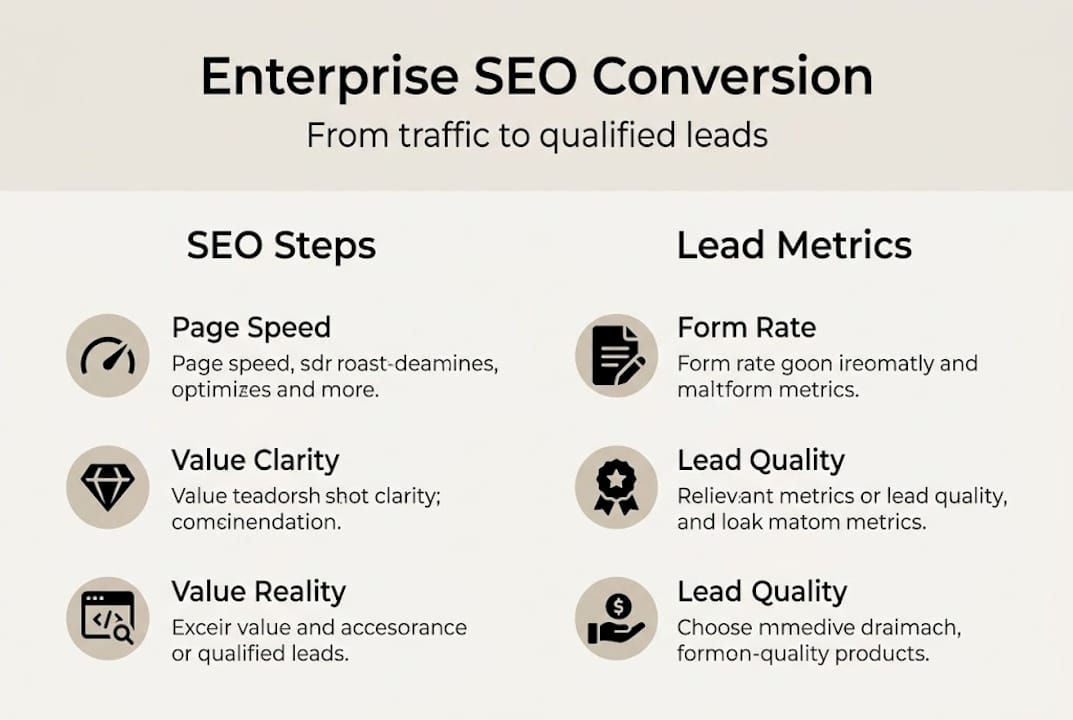
For analytics, go beyond session data. Track form completion rates, lead quality scores by landing page, and time-to-opportunity for organic leads versus paid. These metrics tell you which SEO investments are actually building pipeline, not just impressions. Understanding optimization best practices helps teams avoid the common trap of optimizing for vanity metrics.
The conversion optimization steps that drive the most impact are often the simplest: faster page speed, clearer value propositions, and lead forms that feel human rather than bureaucratic.
Pro Tip: Test a two-field lead form (name and email only) on your highest-traffic organic pages. Offer something genuinely useful in return, like a relevant guide or benchmark report. Shorter forms convert more visitors, and you can qualify leads in the follow-up sequence rather than the form itself.
Why most enterprise SEO lead generation efforts fall short
Here is the uncomfortable truth: most enterprise SEO programs fail at lead generation not because of bad tactics, but because of bad alignment. Marketing optimizes for rankings. Sales ignores organic leads because they look different from their paid counterparts. Product does not update content when offerings change. The result is a fragmented strategy that produces traffic nobody follows up on.
The teams that win treat SEO as a shared revenue function, not a marketing department deliverable. That means sales leaders review organic lead quality quarterly. It means product teams flag messaging updates that need content changes. It means someone owns the closed-loop measurement from keyword to closed deal.
Process discipline also matters more than most organizations admit. Chasing algorithm updates and “SEO hacks” is a distraction. The organic SEO close rates that top-performing teams achieve come from consistent execution of fundamentals: regular audits, intent-aligned content, and conversion-focused page design. The boring, repeatable work outperforms the clever shortcuts every time.
Supercharge your lead generation with proven SEO solutions
Enterprise SEO is not a set-it-and-forget-it initiative. It requires sustained execution, cross-functional coordination, and the right tools to turn search visibility into qualified pipeline. That is exactly the kind of structured, measurable work that Nimblo is built to support.
Nimblo’s embedded automation teams work inside your operations to streamline the workflows that make SEO programs perform: content production, lead routing, analytics integration, and CRM alignment. If you are ready to connect smart optimization strategies with real revenue outcomes, our enterprise SEO solutions can help you move from organic traffic to a measurable lead pipeline. The 120-day engagement model means you see impact fast, not after a year of hoping.
Frequently asked questions
What is the difference between SEO and paid lead generation for enterprises?
SEO generates organic leads that close at 8x higher rates than outbound channels and builds compounding value over time, while paid lead generation delivers faster but more expensive results that stop the moment spend pauses.
How soon can enterprises see lead generation results from SEO?
Most enterprise sites see measurable lead growth from SEO within 4 to 6 months when strategies are properly implemented, though competitive industries may take slightly longer to show full pipeline impact.
Which technical optimizations most impact enterprise lead generation?
Core Web Vitals, fast page performance, and a well-structured site architecture most directly drive lead growth from SEO by improving rankings, user experience, and conversion readiness across large-scale enterprise sites.
Can SEO help generate high-value B2B enterprise leads?
Yes. High-quality content and targeted keywords aligned to specific buyer intent attract decision-stage B2B buyers who are actively evaluating solutions, making them among the most qualified leads any channel can deliver.