
TL;DR:
- Broken qualification processes lead to 80% lost inbound leads in enterprise sales.
- Traditional frameworks like BANT and MEDDIC often fall short in complex environments.
- AI enhances qualification speed, accuracy, and scalability by analyzing diverse data sources continuously.
Enterprise sales teams lose an estimated 80% of inbound leads not because the leads are bad, but because the qualification process is broken. Many organizations still rely on basic, outdated frameworks that were designed for simpler buying cycles, not the layered, multi-stakeholder decisions common in healthcare, finance, and manufacturing. The result is wasted sales capacity, bloated pipelines, and missed revenue. This guide breaks down what lead qualification actually means, which frameworks work for complex enterprise environments, and how AI is fundamentally changing the way organizations identify, score, and act on their best opportunities.
Table of Contents
- What is lead qualification?
- Classic lead qualification frameworks: BANT, MEDDIC, and beyond
- The shift to AI-driven lead qualification
- Applying AI-powered lead qualification in the enterprise
- Why most enterprises get lead qualification wrong—and how to fix it
- Transform your lead qualification with Nimblo AI
- Frequently asked questions
Key Takeaways
| Point | Details |
|---|---|
| Clear qualification definition | Lead qualification separates high-potential prospects from unlikely buyers by assessing fit, interest, and timing. |
| Frameworks have trade-offs | BANT and MEDDIC offer structure but may not scale for enterprise or AI-driven environments. |
| AI powers efficiency | Modern AI tools unify diverse data and automate qualification, improving speed and accuracy. |
| Real-world applications | Enterprises in healthcare, finance, and manufacturing apply AI qualification for compliance and measurable ROI. |
| Continuous optimization needed | No static checklist works forever; review and refine your qualification process regularly with data feedback loops. |
What is lead qualification?
Lead qualification is the structured process of evaluating prospects to determine whether they are worth pursuing and when. It sounds simple, but most enterprises execute it inconsistently, leading to pipeline clutter and misaligned sales effort. At its core, lead qualification evaluates fit, readiness, and likelihood to convert, separating Marketing Qualified Leads (MQLs) from Sales Qualified Leads (SQLs) using criteria like fit, interest, and timing.
Think of it this way: not every company that downloads your whitepaper is ready to buy a seven-figure enterprise software contract. Qualification filters signal from noise.
The three foundational criteria most teams use are:
- Fit: Does the prospect match your ideal customer profile? Industry, company size, tech stack, and regulatory environment all matter here.
- Interest: Has the prospect demonstrated meaningful engagement? Webinar attendance, repeated site visits, or direct inquiries signal real intent.
- Timing: Is there an active buying window? A prospect with budget frozen until Q3 needs a different approach than one evaluating vendors this month.
“Qualification is not about gatekeeping. It is about allocating your most expensive resource, sales time, to the opportunities most likely to close.”
For enterprise organizations, this rigor is non-negotiable. A healthcare system evaluating an EHR upgrade involves procurement, compliance, IT, and clinical leadership. A manufacturing firm sourcing automation equipment needs engineering sign-off alongside finance approval. Without a structured qualification process, sales reps chase the wrong contacts, proposals go to the wrong stakeholders, and deals stall.
Understanding lead scoring basics is a natural first step before building any qualification system, because scoring gives you the numerical language to operationalize these three criteria across your entire pipeline. Qualification without scoring is subjective. Scoring without qualification criteria is arbitrary. The two work together.
MQLs and SQLs represent the two most critical handoff points in any enterprise pipeline. MQLs have shown enough engagement to warrant marketing attention but are not yet ready for a direct sales conversation. SQLs have cleared a higher bar: they fit the profile, have expressed clear intent, and are ready for direct outreach. The gap between these two stages is where most enterprise revenue gets lost.
Classic lead qualification frameworks: BANT, MEDDIC, and beyond
With a definition in place, enterprise buyers must select a qualification model. How do traditional methods stack up?
BANT (Budget, Authority, Need, Timing) was developed by IBM decades ago. It works well for transactional sales where the buyer is clear, the budget is defined, and the decision timeline is short. For simple purchases, BANT moves fast. But in complex enterprise sales, it falls short. A single stakeholder rarely controls budget and authority simultaneously, and “need” is often shaped by internal politics as much as operational reality.
MEDDIC (Metrics, Economic Buyer, Decision Criteria, Decision Process, Identify Pain, Champion) is far more rigorous. It forces reps to map the full buying committee, quantify business impact, and identify an internal champion who will advocate for the deal. The downside: it is resource-intensive and can slow down early-stage qualification when speed matters.
| Framework | Best for | Weakness |
|---|---|---|
| BANT | Simple, transactional sales | Misses complexity in enterprise buys |
| MEDDIC | Complex B2B with long cycles | Resource-heavy, slow to apply at scale |
| Hybrid/AI-layered | Multi-stakeholder enterprise | Requires data integration upfront |
As BANT is seen as outdated for complex enterprise purchases while MEDDIC is more rigorous but resource-intensive, many organizations have moved toward hybrid models that borrow elements from both.
Pro Tip: Do not pick a framework and freeze it. Treat your qualification model as a living document. Review it quarterly against win/loss data and adjust the criteria that are not predicting actual closes.
Hybrid approaches typically layer BANT-style speed filters at the top of the funnel with MEDDIC-style depth checks as deals progress. This tiered qualification keeps early-stage pipelines moving while protecting late-stage resources. Understanding the full lead generation steps helps teams see where qualification fits within the broader acquisition process, so criteria are set at the right stage rather than applied uniformly across all funnel levels.
Key considerations when choosing a framework:
- Number of stakeholders typically involved in a purchase decision
- Average deal size and sales cycle length
- Regulatory requirements that affect buyer behavior (HIPAA, SOX, ISO standards)
- Current CRM and data infrastructure capabilities
The shift to AI-driven lead qualification
Having evaluated traditional frameworks, let’s see how AI is reshaping lead qualification at the enterprise level.
Manual qualification has a ceiling. A rep can review a handful of signals per prospect. An AI system can analyze thousands of data points simultaneously, including firmographic data, behavioral signals, intent data from third-party sources, CRM history, and even sentiment from email threads. The result is qualification that is faster, more consistent, and far less dependent on individual rep judgment.

Hybrid frameworks layered with AI deliver superior operational efficiency in modern organizations. The key word is “layered.” AI does not replace your qualification criteria; it executes them at scale and surfaces patterns that humans miss.
Here is what the shift looks like in practice:
- Data aggregation: AI pulls signals from CRM, marketing automation, web analytics, and external intent platforms into a unified prospect profile.
- Pattern recognition: Models trained on historical win/loss data identify which combinations of signals predict conversion, not just individual criteria.
- Dynamic scoring: Lead scores update in real time as prospects engage, rather than being recalculated weekly by a human analyst.
- Prioritization alerts: Sales reps receive ranked lead lists each morning based on current scores, so they focus on the highest-value opportunities first.
| Qualification method | Time per lead | Data sources analyzed | Score accuracy |
|---|---|---|---|
| Manual BANT | 15 to 30 minutes | 3 to 5 | Moderate |
| Rule-based scoring | 2 to 5 minutes | 5 to 10 | Moderate to high |
| AI-driven qualification | Under 60 seconds | 20 or more | High |
The operational impact is significant. Organizations using AI-assisted qualification report faster response times to high-intent leads, higher average deal quality entering the pipeline, and reduced time sales reps spend on prospects that never convert. Building effective lead qualification workflows is the structural foundation that makes AI execution possible. Without defined workflows, AI has no process to optimize. The two must be designed together.
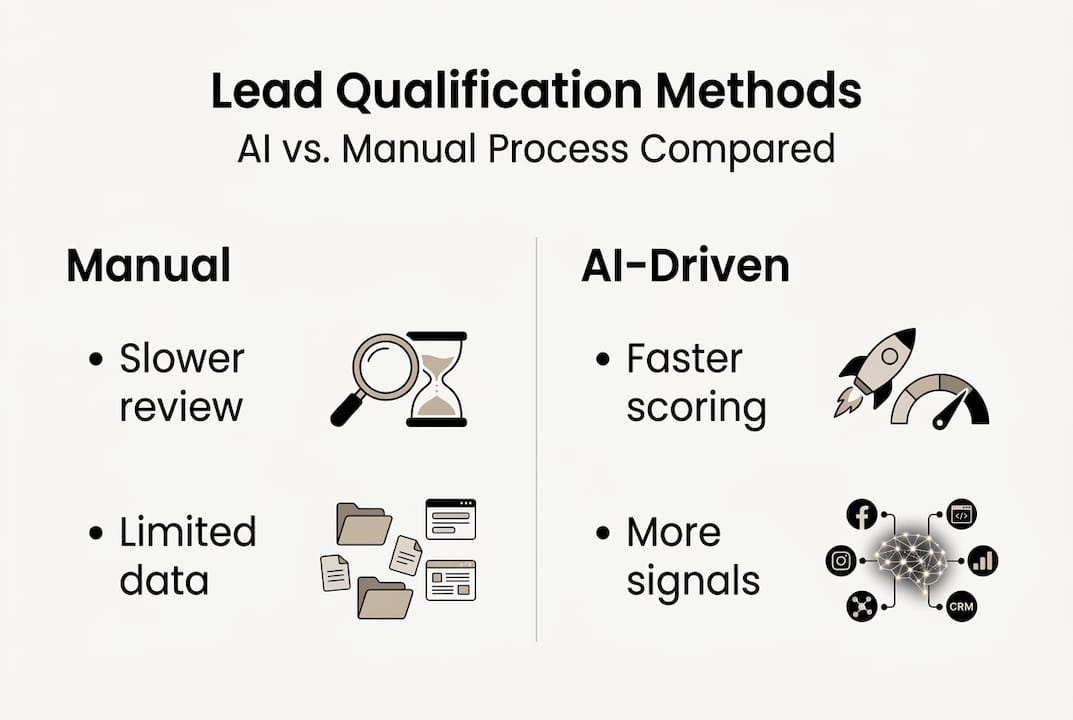
If you are looking to automate lead processes end to end, AI qualification is the highest-leverage starting point because it affects every lead that enters your system.
Applying AI-powered lead qualification in the enterprise
So how can decision-makers roll out AI-driven lead qualification in real-world enterprise environments? Here’s a stepwise approach.
- Data integration: Consolidate CRM, marketing automation, and intent data into a single accessible layer. Fragmented data is the single biggest obstacle to accurate AI qualification.
- Model selection: Choose a qualification model (or hybrid) that reflects your actual buyer journey, not the one that looks best in a vendor demo.
- Pilot rollout: Test AI-assisted qualification on one product line or market segment. Measure MQL-to-SQL conversion rates, sales cycle length, and rep feedback before scaling.
- Full deployment: Expand across teams with clear handoff protocols between marketing and sales, including agreed-upon SQL definitions that both sides honor.
- Continuous improvement: Feed win/loss outcomes back into the model monthly. AI qualification improves with data; static systems decay.
As distinguishing MQLs from SQLs is crucial for complex organizations, AI helps by integrating diverse qualification criteria that no manual process can consistently apply at scale.
Industry-specific applications matter here. In healthcare, AI qualification must respect HIPAA boundaries while still surfacing intent signals from compliant data sources. In finance, regulatory-driven buyer journeys mean qualification criteria must account for procurement cycles tied to fiscal calendars and compliance review periods. In manufacturing, spec-driven sales require AI models trained to recognize technical fit signals, not just engagement metrics.
Pro Tip: Align your SQL definition in writing before deploying any AI qualification system. If marketing and sales disagree on what makes a lead sales-ready, the AI will optimize for the wrong outcome and both teams will blame the technology.
Common pitfalls include relying on data silos that prevent the AI from seeing the full prospect picture, and skipping the feedback loop that keeps models accurate over time. Following a structured marketing automation steps framework helps prevent these gaps. Reviewing lead qualification examples from similar industries also gives teams a practical benchmark for what good qualification looks like before they build their own system.
Why most enterprises get lead qualification wrong—and how to fix it
Having laid out the path to modern lead qualification, here is a hard-won perspective on what actually drives results.
Most enterprises get qualification wrong in one of two directions. They either over-engineer it, building elaborate scoring models that nobody uses consistently, or they under-invest in it, leaving reps to qualify by gut feel. Both paths waste money and time.
The real problem is that conventional wisdom stays stuck on frameworks as the answer. BANT versus MEDDIC debates miss the point entirely. Frameworks are just structure. What drives results is outcome alignment: does your qualification process actually predict which leads close, at what deal size, and in what timeframe?
Winning teams treat qualification as a lead nurturing strategies feedback loop, not a one-time gate. They review their SQL-to-close rate monthly, adjust criteria when patterns shift, and use AI to surface signals their reps would never manually check. The question to ask yourself today is not “which framework should we use?” It is “what can we simplify, automate, or measure better this quarter?”
Transform your lead qualification with Nimblo AI
Ready to move from theory to action? Here’s how Nimblo can help.
Nimblo’s embedded automation pods are built specifically for enterprise operations that need AI-driven qualification without the multi-year implementation timeline. We work directly inside your existing workflows, integrating with your CRM and marketing stack to deploy intelligent qualification systems that align with your industry’s compliance requirements and buyer dynamics.
Whether you are in healthcare managing HIPAA-sensitive pipelines, finance navigating regulatory procurement cycles, or manufacturing handling spec-driven sales, the Nimblo AI platform gives your team a structured 120-day path from pilot to full deployment. You get measurable ROI, not just a technology install. Let’s build a qualification system that actually predicts your best customers.
Frequently asked questions
What are the main differences between MQL and SQL in lead qualification?
MQLs are prospects engaged enough for marketing attention but not yet ready for a direct sales conversation; SQLs meet key criteria based on fit, interest, and timing, and are passed to sales teams for direct outreach.
How does AI improve lead qualification outcomes for enterprises?
AI automates prospect evaluation across dozens of data sources simultaneously, recognizes conversion patterns from historical data, and updates lead scores in real time, improving both accuracy and speed. AI enablement allows more nuanced qualification layers that manual processes cannot replicate at scale.
Which lead qualification framework is best for complex B2B sales?
Hybrid frameworks combined with AI are optimal for complex enterprise sales, blending the speed of BANT-style filters with the depth of MEDDIC-style stakeholder mapping, tailored to your specific industry and buyer journey.