
TL;DR:
- Most local businesses underutilize Google Business Profiles, missing significant traffic opportunities.
- Effective local SEO relies on optimizing profiles, managing reviews, and creating local-specific content.
- Authority, engagement, and content quality outweigh proximity in local search rankings.
Only 30 to 44% of businesses have fully optimized Google Business Profiles or active local SEO plans, which means the majority of your competitors are leaving customers on the table. If you run a local shop, service company, or brick-and-mortar business, this gap is your opportunity. SEO is not just for e-commerce giants or national brands. Local SEO directly connects you to buyers in your area who are already searching for what you sell. This guide breaks down the real benefits of local SEO, explains how it works in plain language, and gives you the practical steps to start winning more foot traffic and sales today.
Table of Contents
- Why local SEO matters more than ever in 2026
- The core mechanics: How local SEO actually works
- Avoiding common pitfalls: What NOT to do in local SEO
- Key drivers: Optimizing for reviews, calls, and real-world engagement
- A fresh perspective on local SEO: What most businesses miss
- Next steps: Power your local SEO journey
- Frequently asked questions
Key Takeaways
| Point | Details |
|---|---|
| Map pack traffic boost | Ranking in the local pack can double your traffic and drive significantly more calls and visits. |
| Reviews drive results | Gathering more high-quality reviews boosts your visibility and conversions online. |
| Avoid harmful shortcuts | Templates and doorway pages can hurt your SEO; unique, relevant local content is essential. |
| Engagement is key | Calls, clicks, and in-person visits signal trust to Google and increase your chances of top rankings. |
Why local SEO matters more than ever in 2026
Let’s be direct: local SEO is no longer optional if you want to compete for walk-in customers. The data backs this up in a significant way. Businesses that appear in the local map pack receive 126% more traffic and 93% more calls, clicks, and directions than businesses ranked lower in the results. That is not a small edge. That is the difference between a full appointment book and a quiet phone.
Mobile search has made this even more urgent. A remarkable 76% of local mobile searches lead to a store visit within 24 hours, and 28% of those result in a purchase. Think about what that means: someone searches “plumber near me” on their phone, and more than three quarters of the time they walk into a business the same day.
“Local SEO is not about tricking Google. It is about making it genuinely easy for nearby buyers to find and choose you.”
For small businesses building an SEO strategy, the local channel is often the fastest return on investment available. The businesses that invest here early tend to dominate their area for years.
Here is what consistent local SEO performance can deliver:
- More qualified traffic: Searchers with local intent are closer to buying than anyone else online.
- Higher conversion rates: Local visitors show up, call, and buy, rather than just browsing.
- Compounding visibility: Good local rankings build over time and are harder for competitors to displace.
- Lower cost per acquisition: Unlike paid ads, organic local traffic does not stop when your budget does.
Real-world results reflect this. Businesses that invest in local search optimization have seen dramatic lifts. Reviewing local SEO ROI case studies shows that tripling website traffic or doubling call volume within a single quarter is achievable with a focused effort, not just a large budget.
The core mechanics: How local SEO actually works
Before you can improve your results, you need to understand what Google is actually looking at when it decides which businesses to show in local results.
Google ranks local results using three core factors: Relevance, Distance, and Prominence. Google Business Profile (GBP) signals account for about 32% of the overall ranking weight. That makes your GBP the single most important asset in local SEO, more influential than your website in many cases.
Key methodologies include GBP optimization, review management, NAP citations (your Name, Address, and Phone number listed consistently across the web), and locally relevant landing pages. Each of these works together to signal to Google that you are a credible, active, and relevant business for a specific area.
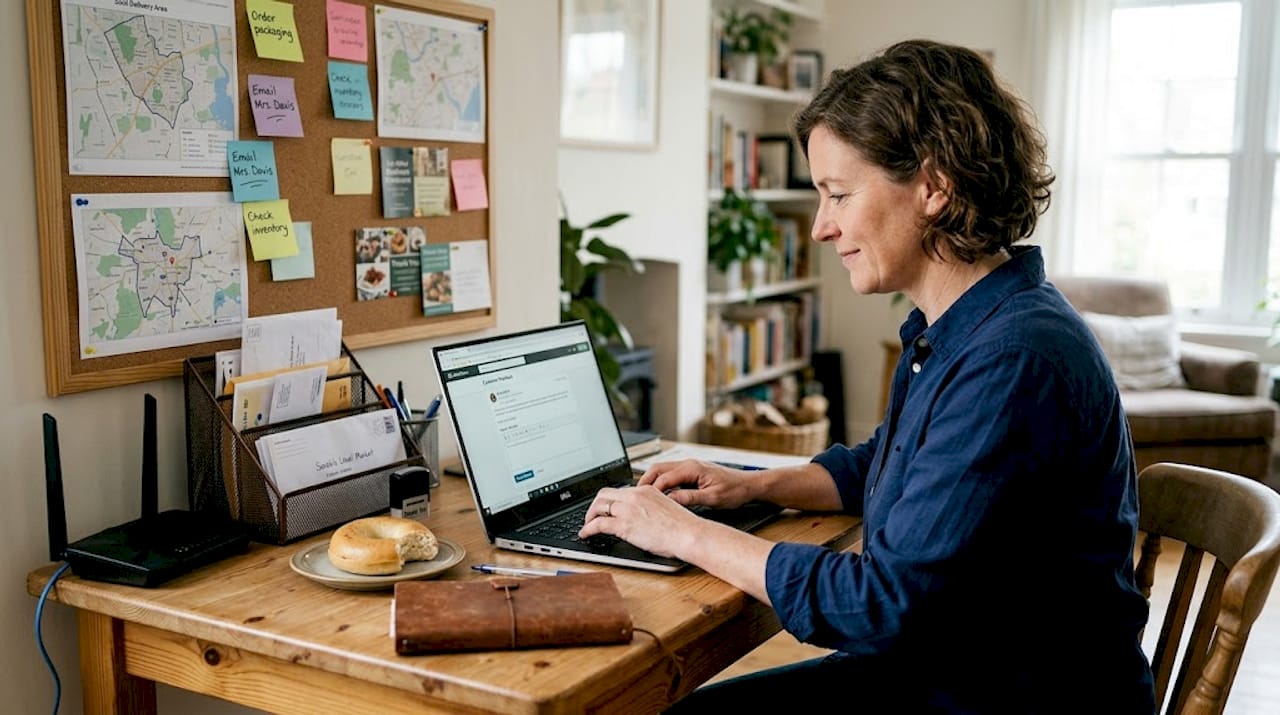
Here is how the main ranking factors compare:
| Factor | What it covers | Impact level |
|---|---|---|
| Google Business Profile | Category, photos, posts, hours | Very high |
| NAP consistency | Matching info across directories | High |
| Reviews | Volume, rating, recency, responses | High |
| Local landing pages | Location-specific content on your site | Medium to high |
| Behavioral signals | Clicks, calls, direction requests | Growing |
To get started on the right foot, work through these steps in order:
- Claim and complete your GBP. Fill out every field, add real photos, and select the most accurate primary category. Our guide on setting up Google Business Profile walks you through the full process.
- Fix your NAP citations. Search for your business name across Google, Yelp, and local directories. Make sure your name, address, and phone number are identical everywhere.
- Build your review foundation. Ask satisfied customers directly. A simple text or email after a service works well.
- Create local landing pages. If you serve multiple neighborhoods or cities, each location deserves its own page with real, original content.
Pro Tip: Add your GBP weekly posts to your calendar like any other marketing task. Businesses that post consistently signal to Google that they are active, and this matters for rankings.
Looking at local SEO strategy examples from similar businesses in your industry can also accelerate your learning significantly.
Avoiding common pitfalls: What NOT to do in local SEO
Knowing what to do is half the battle. Knowing what to avoid can protect months of hard work from being undone overnight.
One of the most common mistakes is creating what Google calls doorway pages. These are thin pages that simply insert a city name and zip code into a national template. Thin doorway pages are classified as spam by Google and can lead to deindexation. Effective localization requires at least 20 to 30% truly unique content on each page. That means real information about the local area, specific service details relevant to that market, or authentic local testimonials.
For service area businesses (SABs), such as plumbers, electricians, or cleaners who visit customers rather than having a storefront, there is an additional risk. SABs can be deranked if their map pin is misplaced or if they have hidden address issues in their GBP settings. Using a residential address as a business address, or leaving your address visible when it should be hidden, can trigger ranking penalties.
Here is a quick checklist of what to avoid:
- Duplicate content across location pages. Google penalizes pages that are nearly identical.
- Keyword stuffing in GBP descriptions. Keep it natural and focused on what you actually offer.
- Ignoring negative reviews. Unanswered complaints signal poor customer service to both Google and potential customers.
- Inconsistent NAP data. Even small differences (“St.” vs. “Street”) can dilute your citation authority.
- Buying fake reviews. This violates Google’s policies and can result in suspension of your GBP listing.
| Risky practice | Potential consequence |
|---|---|
| Doorway pages with city names only | Spam classification, deindexation |
| Misplaced map pin for SABs | Local ranking drop |
| Inconsistent NAP citations | Reduced citation authority |
| Fake or incentivized reviews | GBP suspension |
Pro Tip: Audit your GBP settings every quarter. Check your map pin location, your address visibility setting, and your listed service areas to make sure everything is accurate and up to date.
Reviewing GBP feature examples from businesses in similar industries can show you what a clean, well-optimized profile looks like compared to a problematic one.
Key drivers: Optimizing for reviews, calls, and real-world engagement
Avoiding pitfalls puts you ahead of most competitors. But sustainable local SEO wins come from actively building signals that Google reads as proof of real-world relevance.
Reviews are the clearest example. Businesses with 50 or more reviews are 266% more likely to appear in the Local Pack. Every 10 new reviews boosts GBP conversion by 2.8%. This is compounding math: the more reviews you earn, the more visible you become, and the more visible you become, the more customers you get to ask for reviews.
Building a review system does not need to be complex. Here is a simple process that works:
- Identify the right moment to ask: right after a successful job, delivery, or appointment.
- Send a short, personal text or email with a direct link to your Google review page.
- Respond to every review, both positive and negative, within 48 hours.
- Track your review count monthly and set a target of at least 5 new reviews per month.
Behavioral signals like calls and clicks now play a growing role in local rankings. Pages that generate real engagement, actual direction requests, phone calls, and website visits, signal to Google that the business is genuinely useful. This means your GBP and local pages need to be designed to convert, not just rank.
“The businesses winning in local search are not just optimizing for Google. They are optimizing for real people, and Google rewards that.”
To maximize in-person visits and calls:
- Add your phone number as a click-to-call link on every page.
- Keep your hours accurate and updated for holidays.
- Post photos of your actual location, team, and work regularly.
- Use GBP Q&A to answer common questions before customers even need to ask.
- Monitor emerging AI local SEO trends to stay ahead of how search behavior is evolving.
Structured data markup on your website also helps search engines understand your business entity, your location, your services, and your hours, which supports stronger rankings across both traditional and AI-powered search experiences.
A fresh perspective on local SEO: What most businesses miss
Here is something most local SEO guides will not tell you directly: proximity is overrated. Business owners often assume that being the closest option automatically makes them the winner in local search. It does not.
Authority can override proximity for service area businesses when executed well. A competitor two towns over with 200 genuine reviews, a fully completed GBP, and strong local landing pages will often outrank a nearby business with thin content and no review strategy. Google is trying to surface the most trustworthy and useful result, not just the nearest one.
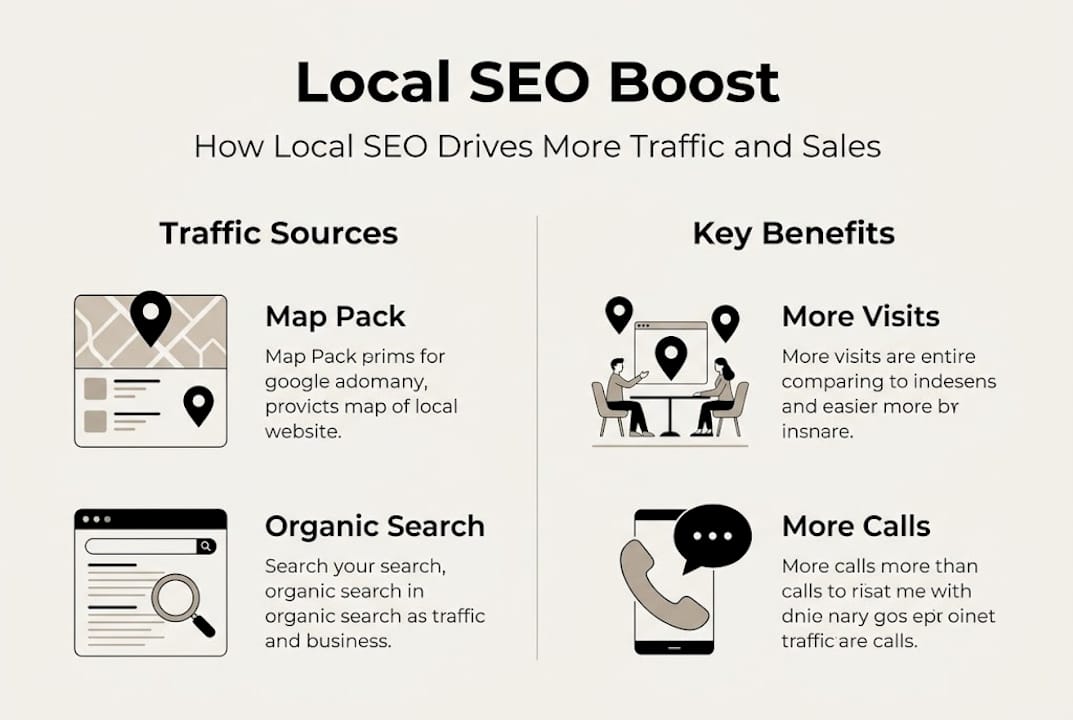
The deeper issue is that many local businesses treat their online presence like a one-time setup task rather than an ongoing investment. They claim their GBP, add a few photos, and then leave it untouched for years. Meanwhile, businesses that treat their in-depth GBP guide as a living marketing channel pull ahead in rankings month by month.
AI-driven search is accelerating this divide. Behavioral signals and entity clarity are becoming more important, not less. Businesses with rich, consistent, and genuinely useful online information will earn visibility in AI-generated results in ways that thin or inconsistent profiles simply cannot.
The takeaway: stop competing on proximity and start competing on authority, engagement, and content quality. That is the sustainable path to owning your local market.
Next steps: Power your local SEO journey
Ready to turn these insights into real results? Even applying two or three of the strategies in this guide can move the needle on your visibility, calls, and foot traffic within weeks.
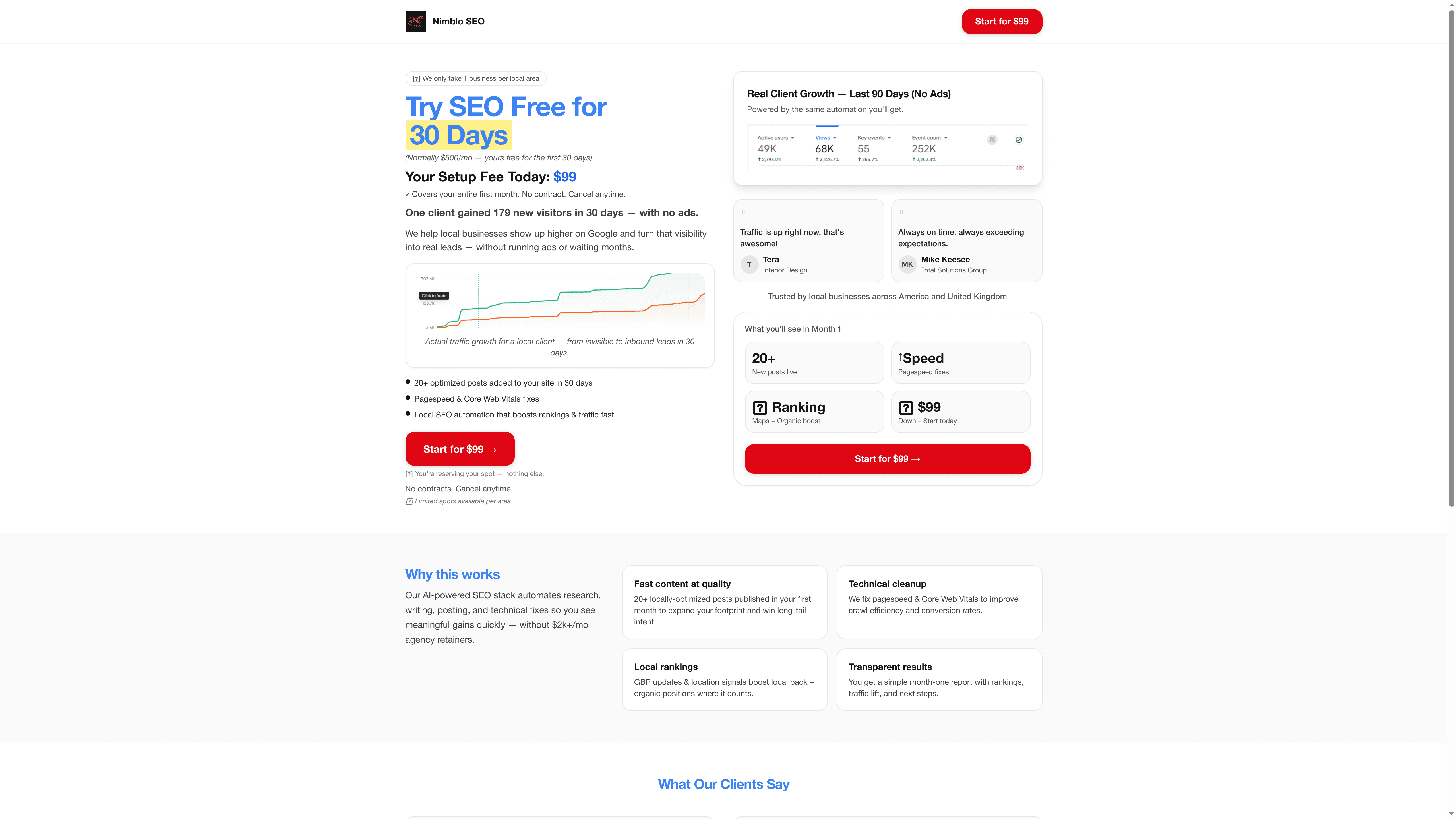
Nimblo.ai works with local businesses and operational teams to implement smart, scalable solutions that include workflow automation and AI-powered tools that support your marketing and visibility goals. Whether you are just getting started with an affordable SEO solution or ready to build a complete local presence from scratch, we have the resources and guidance to help you move fast. Start with the Google Business Profile setup guide and take your first step toward a stronger local presence today.
Frequently asked questions
What are the most important SEO benefits for local businesses?
Local SEO increases your visibility in search results, drives more foot traffic to your location, and generates more calls and direct sales. Businesses in the local map pack earn 126% more traffic and 93% more calls and clicks than lower-ranked listings.
How long does it take to see results from local SEO?
Many businesses see measurable improvements in 30 to 90 days, particularly from GBP optimization and review growth, though competitive markets may take longer. One restaurant chain achieved a 347% revenue boost within just 90 days of focused local SEO work.
Do I need to hire an agency for local SEO?
Many local SEO fundamentals, including GBP setup, NAP fixes, and review requests, can be handled in-house without outside help. Only 30 to 44% of businesses have optimized their local presence, which shows that many owners are already managing this themselves.
Is running Google Ads better than improving local SEO?
Local SEO generally delivers stronger long-term ROI than paid ads because the results persist after your work is done rather than stopping when your budget runs out. 40% of local SEO campaigns achieve 500% or more ROI, making it one of the most cost-effective channels available.
What’s the role of reviews in local SEO?
Reviews directly affect both your ranking position and how likely customers are to choose you over a competitor. Businesses with over 50 reviews are 266% more likely to appear in the Local Pack, making review acquisition one of the highest-leverage activities in local SEO.