
TL;DR:
- Nearly 46% of Google searches have local intent, leading to high conversion rates within 24 hours.
- Optimizing Google Business Profiles and reviews significantly boosts local search rankings and business growth.
- Most SMBs underperform in local SEO due to inconsistent effort and beginners’ common mistakes.
Nearly 46% of all Google searches carry local intent, and 76% of those searchers walk into a business within 24 hours. Yet most small and medium-sized business owners are either ignoring local SEO entirely or doing just enough to feel busy without seeing results. That gap is your opportunity. This guide breaks down what local SEO actually does for your bottom line, which strategies move the needle fastest, what mistakes to stop making immediately, and how to pull ahead of competitors who are still sleeping on one of the highest-ROI marketing channels available to any brick-and-mortar or service-area business today.
Table of Contents
- What is local SEO and why does it matter?
- Proven local SEO benefits for businesses
- Essential strategies to maximize local SEO gains
- Overcoming local SEO obstacles and pitfalls
- A fresh perspective: Why most SMBs leave local SEO money on the table
- Smarter local SEO starts here
- Frequently asked questions
Key Takeaways
| Point | Details |
|---|---|
| Local intent is huge | Nearly half of all Google searches are local, creating massive opportunities for businesses nearby. |
| Real ROI impact | Effective local SEO can drive over 100% more traffic, more calls, and up to 347% revenue growth for businesses. |
| GBP optimization is key | Google Business Profile management influences 32% of Local Pack rankings and is crucial for visibility. |
| Reviews and unique content win | Frequent reviews and genuine, location-specific content drive higher conversions and lower bounce rates. |
| Avoid common pitfalls | Stop using copy-paste location pages and ensure your business info is consistent across all sites. |
What is local SEO and why does it matter?
Local SEO (search engine optimization) is the practice of making your business visible when people search for products or services near them. Think “coffee shop near me,” “HVAC repair Austin,” or “best Italian restaurant downtown.” These are not casual browsers. These are buyers who are ready to act. Your job is to show up when they search.
Google decides which local businesses to display using three core factors. First is relevance, meaning how well your Google Business Profile (GBP) categories, keywords, and content match what someone is searching for. Second is distance, meaning how close your business location is to the person searching. Third is prominence, meaning how well-known and trusted your business appears based on reviews, links, and citations. According to Semrush’s local SEO breakdown, GBP optimization alone accounts for roughly 32% of Local Pack ranking weight, making it the single most important technical lever you can pull.
The “Local Pack” or “Map Pack” is the box of three business listings that appears at the top of Google search results, often before any organic website links. Getting into that box is the goal. Businesses that land there receive 126% more traffic and 93% more calls than businesses ranked in positions four through ten. That is not a marginal improvement. It is a business-changing difference.
Here is what the three-factor algorithm means in practice:
- Relevance: Choose the most specific GBP category for your business. A plumber should not just list “Plumber” if they specialize in commercial pipe repair. Add keywords naturally to your business description and service pages.
- Distance: You cannot move your physical address, but you can make sure your address is correctly listed and that your service area is properly defined in GBP.
- Prominence: Actively collect reviews, build local citations (mentions of your business name, address, and phone number across directories), and earn links from local websites like chambers of commerce or local news outlets.
To understand how to set up and fully optimize your profile, the Google Business Profile guide from Nimblo walks through each step in plain language.
“Local SEO is not a trick. It is a signal-building system. The businesses that win are the ones that make it easy for Google to trust them with a local searcher’s query.”
The businesses that treat local SEO as a one-time setup task consistently underperform. It is an ongoing process, but it pays dividends long after a paid ad stops running.
Proven local SEO benefits for businesses
Numbers tell the real story here. When you look at the difference between ranking in the Local Pack versus ranking just below it, the gap in business outcomes is staggering.
| Metric | Local Pack (Top 3) | Positions 4-10 |
|---|---|---|
| Traffic increase | +126% | Baseline |
| Phone calls received | +93% | Baseline |
| Direction requests | +75% | Baseline |
| Conversion rate | ~28% purchase rate | Much lower |
Those numbers are not theoretical. They reflect the reality of how searchers behave. When someone searches for a service and sees a map with three businesses, they almost always click one of those three. Position four might as well be page two of Google for most local queries.

The financial outcomes are just as striking. One well-documented 347% revenue boost came from a restaurant chain that invested in a focused local SEO campaign. The result was $127,000 in additional revenue within 90 days. Not 90 weeks. 90 days. For a business spending a fraction of that on paid ads with inconsistent returns, that kind of compounding growth from organic local visibility is a game changer.
The key business outcomes you can realistically expect from a well-executed local SEO strategy include:
- More inbound calls from high-intent searchers ready to book or buy
- More direction requests that translate directly into in-store visits
- Higher foot traffic without increasing ad spend
- Stronger trust signals because Map Pack listings feel more credible than ads to most consumers
- Long-term compounding returns as your reviews, citations, and links accumulate over time
According to HubSpot’s local SEO data, 68% of consumers prefer Map Pack results over paid ads when looking for local businesses. That preference is rooted in trust. People know ads are paid placements. A business that earns its position through reviews and relevance feels more legitimate.
Pro Tip: The fastest ROI in local SEO comes from your GBP and reviews. Before spending a dollar on ads, make sure your GBP is fully filled out, your photos are updated, and you have a system for consistently collecting new reviews from happy customers.
You can read more about how SEO impacts local business growth to understand the long-term compounding effect across different business types.
Essential strategies to maximize local SEO gains
Knowing that local SEO works is one thing. Knowing exactly what to do on Monday morning is another. Here is a clear, ordered action plan that prioritizes the steps with the highest impact.
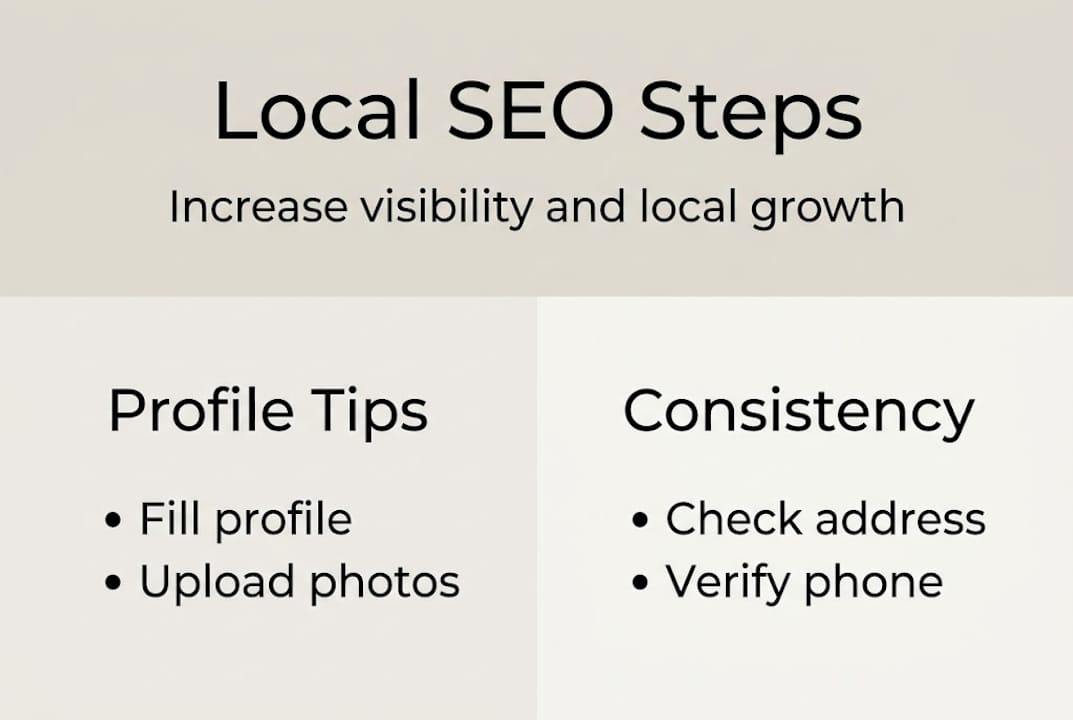
Step 1: Fully optimize your Google Business Profile.
Fill in every field. This means your business name, address, phone number, website, hours (including holiday hours), services, and a keyword-rich description. According to Ahrefs’ SEO guidance, complete profiles with accurate categories and regular posts consistently outperform incomplete ones in local rankings.
Step 2: Lock down NAP consistency.
NAP stands for Name, Address, and Phone number. These three pieces of information must be identical across every directory, website, and citation where your business appears. Even small differences like “St.” versus “Street” can confuse Google’s entity-matching system and reduce your prominence score.
Step 3: Build local citations.
Get listed on platforms like Yelp, Bing Places, Apple Maps, and industry-specific directories. Each accurate citation strengthens your prominence signal. Aim for the top 20 general directories first, then move to niche directories relevant to your industry.
Step 4: Create unique location pages.
If you serve multiple cities or neighborhoods, build a dedicated page for each one. According to Semrush’s local SEO recommendations, each page should include at least two or three unique local details, such as local landmarks, neighborhood-specific customer testimonials, or references to local regulations relevant to your service.
Pro Tip: Never copy-paste the same location page and just swap the city name. That is the exact definition of a “doorway page,” and Google penalizes it. Every location page needs original content that a person in that specific area would find genuinely useful.
Step 5: Build a review generation system.
Top Local Pack businesses average 561 Google reviews at 4.8 stars, and every 10 new reviews boosts GBP conversion by 2.8%. That math adds up fast. Send a follow-up text or email after every transaction asking for a review. Make it easy with a direct link to your GBP review page.
The common mistakes to avoid include:
- Ignoring negative reviews instead of responding professionally
- Using keyword-stuffed business names in GBP (this violates Google’s terms)
- Letting your GBP profile go stale with no new photos or posts
- Skipping schema markup (structured data that helps Google understand your business type and location)
For a detailed walkthrough of what belongs in a high-performing profile, the Google Business Profile checklist covers the seven essentials in order of priority. And if you want to see real examples of how these strategies play out across different business types, the local SEO strategy examples resource shows what good looks like in practice.
Overcoming local SEO obstacles and pitfalls
Most businesses hit a wall with local SEO not because the strategy is wrong, but because execution breaks down in predictable ways. Understanding these pitfalls before you hit them saves months of wasted effort.
The most dangerous mistake is the doorway page trap. A doorway page is a location page that uses a template with only the city name swapped out. It looks like a legitimate local page on the surface, but Google’s quality systems flag these quickly. Research on thin location pages shows they generate 15 to 25% higher bounce rates and carry a real risk of deindexing, which means Google stops showing those pages in search results entirely. In severe cases, it can trigger site-wide trust loss that affects all your pages.
Here is a clear comparison of what effective versus ineffective location page practices look like:
| Practice | Effective | Ineffective |
|---|---|---|
| Content | Unique local testimonials, landmarks, regulations | Copy-pasted text with city name swapped |
| Photos | Local team, local projects, storefront | Generic stock images |
| Reviews | Location-specific GBP with its own reviews | One profile for all locations |
| Schema | LocalBusiness schema with specific address | No structured data |
| NAP | Consistent and unique per location | Shared or mismatched contact info |
For businesses with multiple locations, the challenges multiply. Multi-location SEO research confirms that inconsistent NAP across locations actively hurts your entity matching score, meaning Google struggles to understand which location is which, and your rankings suffer across the board.
Here is an action plan for multi-location businesses:
- Create a separate GBP listing for every physical location
- Write original content for each location page, drawing on real local details
- Collect reviews specifically for each location’s GBP profile
- Use consistent but location-specific NAP on every page and directory listing
- Add LocalBusiness schema markup to every location page
Beyond thin content and NAP issues, another common pitfall is inconsistent review management. Responding to reviews, especially negative ones, is part of your prominence signal. Businesses that ignore reviews or respond defensively lose conversion rate even when their star average looks acceptable. A professional, empathetic response to a one-star review can actually increase trust with prospective customers reading the thread.
For more actionable guidance on structuring your approach, the practical local SEO strategies resource offers real-world examples across multiple business categories.
A fresh perspective: Why most SMBs leave local SEO money on the table
Here is the uncomfortable truth. Most small businesses do not have a knowledge problem. They have a priority problem. Local SEO gets pushed aside because it feels slower and less measurable than running a Facebook ad. But that thinking is exactly backwards.
Paid ads stop generating results the moment you stop paying. Local SEO compounds. Every review you collect, every citation you build, and every piece of genuine local content you publish adds to a growing asset that works around the clock without a budget requirement. The GBP essentials for SMBs are not complicated. What they require is consistency, and most competitors will not bother.
The checklist mindset is the other trap. Business owners treat local SEO like a box to check: “I made a GBP, I’m done.” Real wins come from review velocity (the pace of new reviews over time, not just the total count), from location pages that speak to real community concerns, and from content that treats local searchers like intelligent adults rather than keyword targets.
Over half of SMBs are still under-optimized. That means if you take local SEO seriously right now, you are not chasing a saturated channel. You are walking into a room where most competitors have already left.
Smarter local SEO starts here
Local SEO is one of the clearest examples of where structured execution beats sporadic effort. The businesses winning in local search are not doing anything exotic. They are doing the fundamentals consistently, with the right tools and processes backing them up.
If you are ready to move beyond guesswork and put a real system behind your local visibility, Nimblo.ai can help you get there faster. Our AI-powered automation tools and workflow expertise translate directly into the kind of consistent, scalable execution that local SEO demands. Whether you are managing one location or twenty, the local SEO solutions for your business at Nimblo give you a structured path from setup to measurable results without the trial and error.
Frequently asked questions
How quickly can local SEO show results for small businesses?
Many businesses see increased calls and visits within weeks of optimizing their GBP and collecting new reviews, with the biggest revenue gains often arriving within 90 days, as shown by a restaurant chain case study reporting a 347% revenue boost in that window.
Is local SEO more effective than running paid ads for attracting nearby customers?
Local SEO typically delivers stronger long-term trust and foot traffic, with 68% of consumers preferring Map Pack results over paid ads, though paid ads remain useful when you need immediate short-term visibility.
How important are reviews for local search ranking?
Reviews are one of the most direct ranking and conversion factors in local SEO; top Map Pack businesses average 561 reviews at 4.8 stars, and every 10 new reviews increases GBP conversion by 2.8%.
What’s the biggest mistake SMBs make in local SEO?
The most damaging mistake is using thin templated location pages that simply swap a city name into a generic template, which leads to bounce rates 15 to 25% higher than unique pages and carries a real risk of deindexing.
How can businesses with multiple locations handle local SEO?
Each location needs its own GBP listing, unique location page content, and consistent but location-specific NAP, because inconsistent information across locations directly weakens your entity matching score and suppresses visibility for all your listings.