
TL;DR:
- Many enterprise websites overlook the strategic importance of schema markup for SEO and AI visibility. Proper implementation of JSON-LD schema enhances structured data, improves entity recognition, and boosts rich result performance. Ongoing validation, governance, and integration are essential for scalable, accurate schema deployment at enterprise level.
Most enterprise websites in healthcare, finance, and manufacturing are sitting on untapped SEO potential. Schema markup, when implemented correctly using JSON-LD format, gives search engines and AI systems a structured, machine-readable layer of context that plain HTML simply cannot provide. Yet many large organizations treat it as an afterthought, missing significant gains in click-through rates, AI discoverability, and operational clarity. This guide walks you through everything you need, from foundational concepts to phased enterprise rollout, validation, and governance, so you can move from uncertainty to confident, measurable implementation.
Table of Contents
- Understanding schema markup and enterprise advantages
- What you need: Tools, requirements, and common schema types
- Step-by-step: Implementing schema markup at scale
- Validation, troubleshooting, and avoiding costly mistakes
- Why conventional schema strategy misses the enterprise mark
- Turn schema strategy into business results
- Frequently asked questions
Key Takeaways
| Point | Details |
|---|---|
| Schema powers discoverability | Implementing schema markup boosts enterprise site visibility in search and enables AI-powered benefits. |
| Automation is essential | At scale, CMS integration and automation tools make schema markup maintainable across large organizations. |
| Validation prevents costly errors | Regular use of Google’s Rich Results Test and schema audits ensures accurate, penalty-free markup. |
| Go beyond templates | Lasting value comes from entity relationships and audited schema, not just coverage or out-of-the-box plugins. |
Understanding schema markup and enterprise advantages
Schema markup is structured data code added to your web pages that tells search engines exactly what your content means, not just what it says. Instead of leaving Google to guess whether “Chase” refers to a bank, a name, or a verb, schema markup declares it explicitly using standardized vocabulary from Schema.org. For enterprises, this distinction is operationally significant.
The format most recommended for enterprise use is JSON-LD (JavaScript Object Notation for Linked Data). It sits in the "` of a page as a separate script block, which means your content team can update it without touching the HTML structure. That separation matters enormously when you are managing thousands of pages across multiple business units.
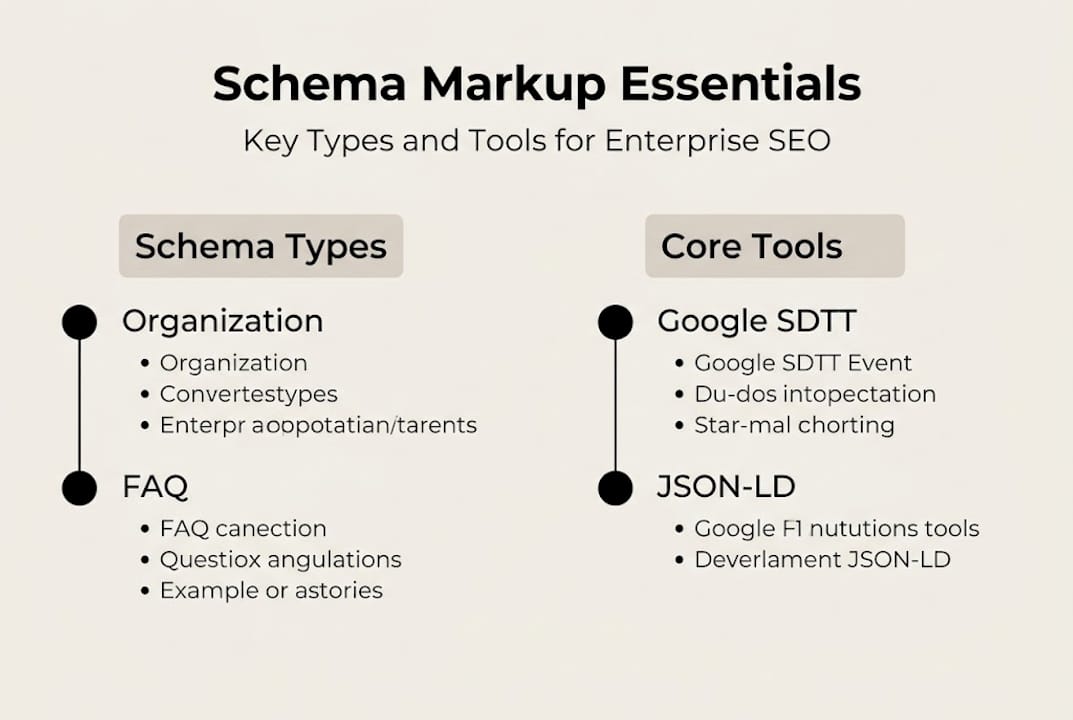
Schema improves operational efficiency via knowledge graphs in sectors like healthcare and finance, where entity clarity directly affects how AI systems and search engines interpret your organization’s services, locations, and expertise. A hospital system, for example, benefits from MedicalClinic and Physician schema to surface accurate information in AI-powered health searches. A financial services firm gains from FinancialProduct and Organization schema to establish authoritative entity presence.
Primary advantages for enterprise organizations:
- Higher click-through rates from rich results (star ratings, FAQs, breadcrumbs)
- Improved entity recognition across Google’s Knowledge Graph
- Better AI readiness as large language models increasingly rely on structured data
- Operational efficiency through consistent, machine-readable content classification
- Reduced manual effort in content categorization when schema is automated
Learn more about schema’s impact on SEO across different page types and business goals.
| Industry | High-value schema types | Key benefit |
|---|---|---|
| Healthcare | MedicalClinic, Physician, FAQPage | Accurate local and AI search results |
| Finance | FinancialProduct, Organization, Review | Trust signals and entity clarity |
| Manufacturing | Product, Organization, BreadcrumbList | Product discoverability and catalog SEO |
Note: Schema markup is not a direct Google ranking factor. Its power lies in enabling rich results and strengthening AI knowledge graph clarity, both of which drive measurable organic performance improvements.
What you need: Tools, requirements, and common schema types
Before you deploy a single line of structured data, you need the right foundation. Skipping this step is how enterprises end up with inconsistent markup across thousands of pages, which creates more problems than it solves.
Technical prerequisites for enterprise schema deployment:
- A CMS with template-level access (WordPress, Sitecore, Adobe Experience Manager, or similar)
- IT and developer permissions to modify
<head>elements or deploy tag manager scripts - Working knowledge of JSON-LD syntax and Schema.org vocabulary
- A content inventory that maps page types to appropriate schema types
- Governance documentation defining who owns schema updates
Google recommends JSON-LD over Microdata or RDFa for ease of maintenance, especially at scale. This is not just a technical preference. It is a practical one. JSON-LD can be injected via Google Tag Manager without touching your CMS templates, which is a significant advantage for organizations with complex publishing workflows.

For a structured walkthrough, the step-by-step schema markup tutorial at SchemaValidator.org covers format specifics clearly.
| Tool type | Example tools | Best for |
|---|---|---|
| Manual coding | VS Code, Notepad++ | Small-scale or one-off pages |
| CMS plugin | Yoast SEO, Rank Math, Schema Pro | Mid-size sites with standard page types |
| Automation platform | Siteimprove, Schema App, Google Tag Manager | Enterprise-scale, multi-template rollout |
Most valuable schema types for enterprise use:
OrganizationandLocalBusinessfor entity establishmentMedicalEntityandPhysicianfor healthcare organizationsFinancialProductandServicefor financial institutionsProductandOfferfor manufacturing and e-commerceBreadcrumbListfor site navigation clarityFAQPagefor capturing featured snippet real estateReviewandAggregateRatingfor trust signals
Consider how schema applies differently across schema for business websites depending on your operational model.
Pro Tip: Start with Tier 1 schemas (Organization, BreadcrumbList, FAQPage) for fast, low-risk wins. Once those are validated and performing, expand using @graph to link multiple schema types on a single page into a connected knowledge structure.
Step-by-step: Implementing schema markup at scale
Enterprise schema implementation is not a one-time project. It is a phased program that requires stakeholder alignment, technical infrastructure, and ongoing governance. Here is a structured approach that works for organizations managing hundreds to tens of thousands of pages.
- Audit your current state. Crawl your site with a tool like Screaming Frog or Siteimprove to identify which pages have schema, which do not, and which have errors. This baseline shapes your entire rollout plan.
- Map page types to schema types. Match each major template (homepage, product page, location page, blog post) to the appropriate schema vocabulary. Document this in a central schema registry.
- Align stakeholders. Get sign-off from IT, legal (especially in healthcare and finance), content, and SEO teams before deployment. Compliance teams in regulated industries need to review schema claims for accuracy.
- Build reusable JSON-LD templates. Create schema templates for each page type. Parameterize dynamic fields (name, URL, description) so they pull from your CMS data layer automatically.
- Deploy via CMS or tag manager. Push templates sitewide using your CMS’s template system or Google Tag Manager. For enterprises, implement schema at scale via CMS integration to maintain consistency across page variants.
- Validate before going live. Run every new schema type through Google’s Rich Results Test and the Schema.org Validator before pushing to production.
- Monitor and iterate. Set up Search Console alerts for structured data errors. Review performance data quarterly and update schema when content changes.
The business case for this investment is concrete. Rich results boost CTR by 15 to 82 percent depending on the schema type and industry. SAP reported a 400 percent increase in clicks after implementing structured data at scale.
Pro Tip: Maintain a central schema template library in a shared repository (GitHub or Confluence work well). When Schema.org updates its vocabulary or Google changes its rich result requirements, you update one template and propagate the change everywhere.
Review schema deployment strategies to understand how rollout decisions affect local and national SEO performance differently.
Validation, troubleshooting, and avoiding costly mistakes
Deploying schema without a validation workflow is like shipping code without testing. At enterprise scale, errors in structured data can affect thousands of pages simultaneously, suppressing rich results and, in worst cases, triggering manual actions from Google.
Three-step validation workflow:
- Test: Use Google’s Rich Results Test to check individual pages for eligibility and errors before deployment.
- Audit: Run site-wide structured data audits using advanced schema validation tools to catch systemic issues across templates.
- Monitor: Use Google Search Console’s “Enhancements” section to track rich result status and receive alerts on new errors.
Validation workflow and common edge cases consistently surface the same categories of mistakes at enterprise organizations. Knowing them in advance saves significant remediation time.
Top 5 schema mistakes enterprises make:
- Using the wrong schema type for the content (marking a blog post as a
Product) - Mismatching schema claims with visible page content
- Omitting required properties (like
nameorurlinOrganizationschema) - Over-marking every page with every possible schema type, which dilutes signal quality
- Incorrect nesting of schema types, especially in
@graphstructures
| Error type | Enterprise impact | Solution |
|---|---|---|
| Wrong schema type | No rich results, wasted crawl budget | Map schema to page type in governance doc |
| Mismatched content | Potential manual penalty | Sync schema fields with CMS data layer |
| Missing required fields | Schema ignored by Google | Use validator before every deployment |
| Over-markup | Confusing signals, reduced trust | Limit to 2-3 schema types per page |
Expert note: Schema must always match what a user can see on the page. Marking up content that is hidden, inaccurate, or misleading violates Google’s guidelines and can result in manual actions that affect your entire domain.
Building schema validation steps into your content publishing workflow, not just your initial deployment, is what separates enterprises that sustain rich result performance from those that see it decay over time.
Why conventional schema strategy misses the enterprise mark
Most enterprise schema strategies stop at coverage. The team deploys templates, checks the validation boxes, and moves on. That approach gets you partial credit but misses the larger opportunity.
The real value of schema at enterprise scale is not just SEO visibility. It is the foundation for a structured knowledge graph that your internal AI systems, chatbots, and search tools can also use. When your schema accurately reflects your organizational entities, services, and relationships, you are not just feeding Google. You are building a machine-readable model of your business.
Expert nuance: Ensure schema matches visible content and regular audits are non-negotiable for enterprises. But beyond accuracy, the strategic gap is entity alignment. Most organizations add schema to pages without thinking about how those entities connect to each other. A hospital system that marks up individual clinic pages without linking them back to the parent Organization entity via @graph is leaving knowledge graph equity on the table.
Schema’s real impact in AI search is growing as generative AI systems increasingly rely on structured data to generate accurate, attributed answers. The enterprises that build entity-focused, regularly audited schema strategies now will have a compounding advantage as AI-driven search continues to expand.
Pro Tip: Use @graph to explicitly link your Organization, WebSite, BreadcrumbList, and content-level schemas on every page. This creates a connected entity map that both Google and internal AI systems can traverse.
Turn schema strategy into business results
Understanding schema is one thing. Deploying it consistently across thousands of enterprise pages, keeping it accurate as content changes, and connecting it to broader AI and operational goals is where most organizations stall.
Nimblo’s embedded automation pods bring together AI engineers, workflow architects, and domain experts who work directly inside your operations. We help healthcare, finance, and manufacturing organizations build scalable, governed schema programs that connect to real business outcomes, not just SEO checklists. From template-driven rollout to automated validation workflows, our 120-day engagement model is designed to deliver measurable results fast. If you are ready to make schema markup a strategic asset rather than a technical task, explore what Nimblo can do for your enterprise.
Frequently asked questions
What is the fastest way to deploy schema markup across an enterprise website?
Use a CMS-integrated automation tool to roll out template-driven JSON-LD markup sitewide, then validate with Google’s Rich Results Test and the Schema.org Validator. Implement schema at scale through CMS or tag manager integration for the most efficient coverage.
Which schema types bring the most value for healthcare and finance enterprises?
Organization, BreadcrumbList, MedicalClinic, FAQPage, and Service schemas provide the fastest SEO and visibility improvements in regulated sectors. Schema types for SEO priority should follow your most trafficked page templates first.
Does schema markup directly improve Google rankings?
Schema markup is not a direct ranking factor but increases rich result presence, which significantly boosts click-through rates and discoverability. Schema impact on rankings is best measured through CTR and impression data in Search Console.
How often should schema markup be audited for enterprise websites?
Enterprises should perform schema audits quarterly and after any major site or content changes to prevent drift and maintain accuracy. Regular schema audits are the single most effective way to protect rich result performance over time.