
Choosing the right marketing and SEO tools can often feel overwhelming with so many options offering different features and promises. Some platforms focus on one aspect like search rankings or review management, while others try to combine everything in a single package. The best match depends on whether you want deep local insights, all-in-one automation, or tools for bigger teams and multiple locations. Looking closer at how these platforms organize your business data, connect with customers, and simplify daily tasks can reveal interesting differences. Are you ready to discover which approach could fit your unique goals?
Table of Contents
Nimblo AI
At a Glance
Nimblo AI is an all-in-one SaaS platform built to consolidate SEO, website, CRM, and marketing automation for small and medium-sized businesses. It combines AI-driven local SEO, reputation management, and lead automation into a single subscription designed to reduce tool sprawl and manual work. For Florida-based SMBs and local service businesses, Nimblo AI targets the everyday needs of getting found, converting leads, and following up—without stitching together multiple vendors.
Core Features
Nimblo AI bundles a broad automation stack: voice calls and scheduling, review management with sentiment analysis, automated content writing and publishing, CRM syncing, invoicing, lead qualification, and email triage. Its SEO and Google Business Profile optimization features focus on local search visibility, while schema markup and conversion-optimized web design help capture more clicks. These integrated capabilities let you run campaigns, manage reputation, and move prospects through a sales pipeline from a single dashboard.
Pros
- Comprehensive subscription: Nimblo AI delivers many marketing and operational tools under one plan, which simplifies vendor management and reduces monthly overhead.
- Automation-first: Repetitive tasks—review responses, follow-ups, email triage—are automated to save time and cut manual errors.
- Local SEO emphasis: Built-in Google Business Profile and schema optimizations increase visibility for nearby customers and service-area searches.
- Ease of integration: CRM syncing and pipeline automation mean your lead data flows where it should without manual imports.
- SMB-focused design: Feature choices reflect the priorities of small businesses—lead generation, reputation, and efficient operations.
- Flexible plans: Monthly and annual subscription options provide predictable pricing and discounts for longer commitments.
Who It’s For
Nimblo AI is ideal for small to medium-sized business owners in Florida and similar local markets who want a single platform to manage SEO, leads, and basic operations. If you run a service-based SMB—restaurants, contractors, clinics, or local agencies—and you’re replacing multiple point tools or an expensive agency, Nimblo AI is tailored to cut complexity and centralize workflows.
Unique Value Proposition
Nimblo AI’s core strength is consolidation: instead of paying for separate SEO tools, a CRM, scheduling, reputation software, and content services, you get a unified stack engineered for local market performance. The platform pairs AI writing and automated publishing with Google Business Profile optimizations and CRM-driven follow-ups—so content drives leads that are automatically qualified and routed. That single-source approach reduces integration friction, shortens time-to-value, and lowers the recurring cost and training burden of managing several vendors. In practice, this means faster setup, cleaner data, and a repeatable system that turns local search visibility into measurable pipeline activity. Competitors may offer one or two of these pieces; Nimblo AI bundles them in a workflow-focused package for SMBs.
Real World Use Case
A local restaurant uses Nimblo AI to optimize its Google Business Profile, publish SEO-friendly menu pages, automate review replies, and manage reservations and customer follow-ups. The combined effect increases search visibility for neighborhood queries, converts transient searchers into reservations, and automates repeat-guest outreach—freeing staff from manual follow-ups and generating measurable revenue lift.
Pricing
Nimblo AI starts at $500/month for the business stack, with customized options and premium services available for specialized needs.
[Website translated to English]: https://nimblo.ai
BrightLocal
At a Glance
BrightLocal is a focused local SEO platform that brings citation building, listings management, rank tracking, review monitoring, and white-label reporting into one dashboard. It’s built for agencies, multi-location brands, and local businesses that need repeatable, trackable local search results. The platform balances DIY tools with done-for-you services, making it practical for teams that want control as well as those that prefer an outsourced option.
Core Features
BrightLocal’s core capabilities center on local search fundamentals: citation and listings management, local rank tracking and auditing, review monitoring, and customizable reporting with white-label options. The product also includes local SEO audits, competitor analysis, citation submission to national data aggregators, and tools to schedule and optimize Google My Business posts. All these features are organized to support multi-location workflows and recurring reporting for clients.
Pros
- Specialized for local SEO: The toolset is built specifically around local search needs, so features target the signals that matter for local visibility.
- Flexible pricing options: Plans and custom arrangements are available to fit small businesses up to larger multi-location brands.
- All-in-one dashboard: You can manage citations, track rankings, monitor reviews, and build reports from a single interface, reducing tool fragmentation.
- Strong industry reputation: BrightLocal has high user satisfaction (reported 4.8/5 across 1,300+ reviews), reflecting reliability and consistent delivery.
- Support and education: The platform pairs customer support with free training and community resources to help users get results faster.
Cons
- Opaque pricing for some users: Detailed pricing often requires contacting sales or arranging a custom plan, which can slow decision-making for budget-conscious buyers.
- Advanced features behind higher tiers: Certain integrations and advanced capabilities may only be available on upper-level plans or add-on services.
- Single-platform dependence: Relying on BrightLocal for every local SEO function can limit flexibility for teams that prefer a best-of-breed, multi-tool stack.
Who It’s For
BrightLocal is best for marketing agencies, local SEO professionals, and SMBs that manage multiple locations or clients and need centralized, repeatable local SEO workflows. If you want a platform that reduces manual citation work, automates ranking audits, and produces white-label reports on a regular cadence, this is aimed at you.
Unique Value Proposition
BrightLocal’s value is its deep specialization in local search combined with both software and service options. That dual model—DIY tools plus done-for-you services—lets teams scale local campaigns quickly while keeping reporting and reputation management consistent across locations.
Real World Use Case
A marketing agency uses BrightLocal to audit dozens of client locations each month, push citation updates to aggregators, track local rankings, and assemble white-label reports for clients. That workflow saves time, keeps visibility metrics consistent, and allows the agency to present measurable local SEO outcomes.
Pricing
Pricing is available on request and through custom plans, with a 14-day free trial that requires no credit card.
[Website]: https://brightlocal.com
SEMrush
At a Glance
SEMrush is a full-featured, data-driven marketing platform that bundles SEO, content, advertising, social, local marketing, and PR tools into one suite. Its strong AI integrations and competitor intelligence make it especially useful when you need clear, actionable data across channels. That breadth is powerful — but it also means there’s a learning curve, and smaller teams should weigh cost versus the features they’ll actually use.
Core Features
SEMrush combines traditional SEO tooling with AI-powered workflows: keyword research with AI insights, backlink and traffic potential analysis, technical site audits, and rank tracking. It extends into local marketing with Google My Business optimization, supports AI-assisted content creation and optimization, and offers social post creation and scheduling. On the paid side, it adds AI visibility tracking, influencer identification, paid-ad planning and optimization, and media monitoring for PR outreach — all designed to give you a single pane of visibility into where and how your brand is discovered.
Pros
- All-in-one coverage: The platform covers SEO, content, paid ads, social scheduling, local listings, and PR monitoring so you can centralize many marketing tasks in one place.
- Strong AI integration: AI-assisted keyword and content tools provide automated insights that speed up research and content optimization workflows.
- Competitive intelligence: Robust competitor analysis and visibility tracking help you identify gaps and opportunities in your niche quickly.
- Trusted by professionals: Widely used by marketers and agencies, the toolset aligns with professional workflows and enterprise needs.
- Industry recognition: The platform’s awards and reputation validate its capabilities for larger teams and complex campaigns.
Cons
- Complex for beginners: The extensive feature set can overwhelm small teams or business owners new to digital marketing, requiring time to learn.
- Potentially costly: Pricing can put pressure on small businesses or solo users who only need a subset of capabilities.
- Learning curve to extract value: Advanced features and integrations may require training or trial-and-error before delivering measurable returns.
Who It’s For
SEMrush is best suited for marketing professionals, SEO specialists, content marketers, digital agencies, and enterprise teams that need deep, cross-channel data and can invest time in mastering the platform. If your goal is to run sophisticated SEO and competitive research alongside paid campaigns and PR monitoring, SEMrush offers a unified solution.
Unique Value Proposition
SEMrush differentiates itself by merging AI-driven insights with established SEO and competitive intelligence tools, allowing teams to move from discovery to execution within one platform. That combination can reduce tool fragmentation when you rely on data to shape content, local listings, and paid strategies.
Real World Use Case
A digital agency uses SEMrush to audit a client’s site, identify high-opportunity keywords, map competitor backlinks, and then run AI-assisted content optimization and targeted ad planning. Over time, the agency measures higher organic traffic and improved ad ROI after iterating on SEMrush-driven recommendations.
Pricing
SEMrush offers a free trial and multiple subscription plans, though specific plan prices are not provided in the product data. Evaluate the trial to confirm if available features align with your team’s needs before committing.
[Website]: https://semrush.com
Moz
At a Glance
Moz is a mature, all-in-one SEO toolkit designed to help businesses and agencies improve search visibility, understand competitors, and fix technical site issues. Powered by Moz AI, it combines keyword research, rank tracking, link analysis, and site audits into a single platform trusted by hundreds of thousands of brands. If you need a consolidated SEO workflow with reliable data and educational support, Moz delivers — though some advanced users may bump into plan limits or a steeper interface learning curve.
Core Features
Moz’s core capabilities include deep keyword research with thousands of suggestions, difficulty scores, and search-volume insights, competitive research to reveal keyword gaps and link opportunities, link research that surfaces authority and backlink profiles, rank tracking across search engines for multiple keywords, and site auditing that pinpoints technical SEO issues with actionable recommendations. These features are presented in a unified dashboard designed to move from discovery to execution without hopping between tools.
Pros
- Comprehensive feature set: Moz provides a wide-ranging suite of SEO tools that reduces the need for multiple point solutions, which simplifies workflow for small teams.
- Moz AI integration: The platform’s AI-driven insights speed up analysis and make recommendations more contextually useful for planning.
- Proven trust and scale: With thousands of brands and agencies using Moz, the product benefits from mature data sets and longstanding industry credibility.
- Flexible plans: A range of pricing tiers helps accommodate startups through enterprises, allowing businesses to pick the scope they need.
- Educational resources: Moz includes extensive guides and support that help users learn SEO best practices while using the tool.
Cons
- Pricing pressure for advanced use: Costs can become high for larger plans or when you need advanced features or more tracks, affecting tight budgets.
- Initial interface complexity: New users may find the dashboard overwhelming at first, which can slow onboarding and early returns.
- Plan-based limits: The number of tracked keywords or active campaigns is restricted by plan level, forcing upgrades for growth.
Who It’s For
Moz fits digital marketing professionals, dedicated SEO specialists, agencies managing multiple client accounts, and business owners who want a centralized SEO stack. If you manage client reporting, run recurring audits, or need credible data to justify strategy shifts, Moz is geared toward your workflow and reporting needs.
Unique Value Proposition
Moz’s strength lies in packaging robust SEO research, link intelligence, rank tracking, and site auditing under one roof while layering Moz AI for faster, more relevant insights. That combination—mature data, integrated workflows, and educational support—makes it a compelling choice for teams seeking a single source of SEO truth.
Real World Use Case
A digital marketing agency uses Moz Pro to monitor client rankings, run keyword and competitive research, and audit technical issues. The agency then translates Moz’s actionable recommendations into prioritized tasks and monthly reports that demonstrate measurable improvements in organic visibility.
Pricing
Plans start at $39 USD/month with annual discounts available and scale up to $239 USD/month for larger plans, reflecting options for differing business sizes and feature needs.
[[Website] translated to English]: https://moz.com
Yext
At a Glance
Yext is a centralized platform designed to make local brands discoverable across search engines, maps, review sites, and social channels. It combines listing management, benchmarking, content distribution, and AI-informed ranking insights to help multi-location businesses increase local visibility and customer engagement. For organizations that prioritize consistent local presence and data-driven optimization, Yext is a capable, enterprise-grade option — though it can feel heavyweight for very small operators.
Core Features
Yext’s core capabilities focus on local discovery and control: you can create and optimize local business listings, distribute and manage content across multiple channels, and gather reviews and social content to build trust. The platform also offers benchmarking tools to compare location performance against competitors and AI and traditional search insights that inform optimization for machine understanding and ranking. In short, it’s built to keep location data accurate, visible, and actionable across the places customers search.
Pros
- Unifies local brand management in one platform: Yext centralizes listings, reviews, and local content so you don’t juggle separate tools for each channel.
- Provides actionable insights and recommendations: The platform offers diagnostics and suggestions that help you prioritize fixes and optimization opportunities.
- Seamless integration with existing marketing solutions: Yext is designed to plug into other systems, making it easier to include local data in broader marketing stacks.
- Proven increase in site search volume and search views: Users can expect measurable gains in discoverability when local listings and structured data are consistently managed.
- Supports hyper-local SEO and social engagement: The toolset includes features aimed at local relevance and community-level engagement, which matters for brick-and-mortar foot traffic.
Cons
- Potential complexity for small or new businesses: The breadth of features and enterprise focus can overwhelm very small teams without dedicated marketing resources.
- Reliance on accurate data inputs: Yext’s effectiveness depends on clean, consistent data — incorrect inputs reduce the platform’s impact.
- Cost may be high for smaller enterprises: Pricing typically skews toward enterprise or custom models, which may be out of reach for tighter budgets.
Who It’s For
Yext is best suited to businesses with multiple physical locations, franchises, or multi-location service providers that need centralized control over listings, reviews, and local content. If you manage several storefronts or a roll-up of local service areas and want a single system to maintain consistency and run localized campaigns, Yext fits that profile.
Unique Value Proposition
Yext’s unique strength is its ability to unify distributed location data and activate it across many search channels while adding benchmarking and AI-informed optimization. That combination helps multi-location brands preserve consistent customer-facing information and make data-driven decisions to improve local search performance.
Real World Use Case
A retail chain uses Yext to synchronize listings across hundreds of locations, monitor competitor presence in each local market, and push localized promotions and content to increase both foot traffic and online inquiries. Centralized reporting flags underperforming locations for targeted action.
Pricing
Pricing is not specified in the available data and is typically offered at enterprise or custom levels, which means quotes are tailored to the scale and needs of the business.
[[Website] translated to English]: https://yext.com
Local Marketing Tools Comparison
This table provides a comprehensive overview of local marketing tools, highlighting their core features, pros, cons, pricing, and ideal user base. It aims to help businesses and agencies make informed decisions based on their specific needs.
| Tool | Core Features | Pros | Cons | Pricing |
|---|---|---|---|---|
| Nimblo AI | SEO, CRM, Marketing Automation | Consolidated features, automation, local SEO | Geared towards SMBs, price point starts at $500/month | $500/month |
| BrightLocal | Local SEO, Citation, Rank Tracking | Specialized SEO, strong reputation | Opaque pricing, advanced features at higher tiers | Custom, trial available |
| SEMrush | SEO, Competitor Analysis, Content Creation | Comprehensive coverage, AI integration | Complex for beginners, potentially costly | Multiple plans, trial available |
| Moz | SEO Toolkit, Rank Tracking, Link Analysis | Comprehensive, AI insights, educational resources | High costs for advanced plans, complex interface | Starts at $39/month |
| Yext | Local Listings, Review Management | Centralized management, actionable insights | Complex for small businesses, relies on accurate inputs | Custom, enterprise-level pricing |
Simplify Your Local SEO Strategy with Nimblo AI
Small and medium businesses often struggle with managing multiple digital marketing tools that complicate local SEO efforts and inflate costs. The article highlights the pain points of juggling separate platforms for SEO, CRM, reputation management, and lead automation — all essential for capturing nearby customers and growing your pipeline efficiently. If you feel overwhelmed by the day-to-day manual work and vendor sprawl affecting your business growth, you are not alone.
Nimblo AI offers a powerful solution tailored to Florida SMBs that reduces complexity and accelerates results. Combining AI-driven local SEO, website optimization, automated follow-ups, and reputation monitoring within one platform, Nimblo AI replaces costly tools and agency fees with a single affordable subscription. This approach lets you focus on what matters most — turning local searches into qualified leads and revenue.
Ready to stop managing scattered tools that slow your growth? Discover the benefits of our all-in-one platform designed for small businesses like yours in Florida. See how fast you can get setup and start growing your leads by exploring Nimblo AI’s streamlined business stack.
Need proof that a smarter SEO toolkit can make the difference?
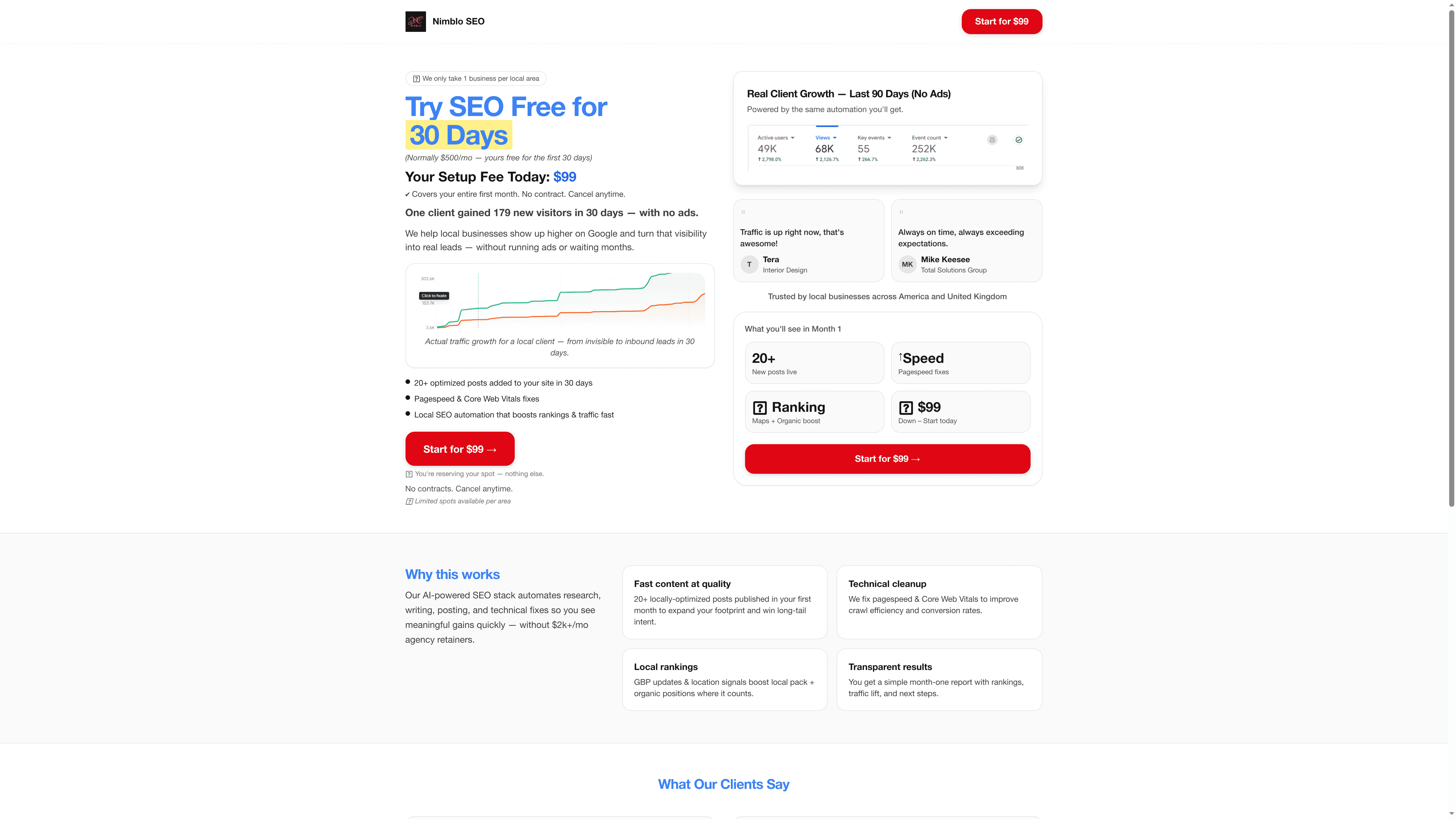
Get ahead of your competition today with Nimblo AI. Visit our all-in-one SaaS platform page to learn more and start your journey toward simplified SEO, website management, and automated lead generation. Don’t wait — your local customers are searching for businesses just like yours right now.
Explore how Nimblo AI helps you win more local business at https://nimblo.ai/99down
Frequently Asked Questions
What are the essential features to look for in small business SEO tools in 2025?
A comprehensive small business SEO tool should include keyword research, site auditing, competitor analysis, and backlink tracking. Focus on tools that provide automated insights and straightforward reporting to streamline your SEO efforts. Prioritize platforms that integrate multiple functions to reduce tool sprawl and improve workflow.
How can I measure the effectiveness of an SEO tool for my small business?
To measure effectiveness, track key metrics such as organic traffic, keyword rankings, and conversion rates before and after implementing the tool. Set specific goals, like increasing site visits by 25% within 90 days, to evaluate whether the tool offers a tangible return on investment.
What steps can I take to optimize my website using the SEO tools mentioned in the comparison?
Begin by conducting a thorough site audit with your chosen SEO tool to identify areas for improvement, such as page speed or mobile friendliness. Then, implement on-page SEO strategies, like optimizing titles and meta descriptions, based on the insights gathered and monitor changes in performance monthly.
How often should I update my SEO strategy with small business SEO tools?
Regularly update your SEO strategy at least every few months, or more frequently based on algorithm changes and market trends. Review your analytics data monthly to adapt your approach to maximize your visibility and lead generation.
Can these SEO tools help with local SEO strategies?
Yes, many small business SEO tools come equipped with features tailored for local SEO, such as Google My Business optimization. Leverage these features to enhance your local search visibility and attract nearby customers effectively.