
Managing a service-based small business in Florida often means juggling customer needs while keeping expenses in check. Staying ahead depends on more than quick fixes or chasing new leads. Building true loyalty starts with understanding customer retention and using the right digital tools to engage clients without driving up costs. Discover how a smart mix of automation and personalized digital marketing can help you create lasting connections, simplify your tech stack, and protect your bottom line.
Table of Contents
- Defining Customer Retention For Small Businesses
- Core Metrics And Measurement Methods Explained
- Key Strategies To Improve Retention Rates
- Common Pitfalls And What To Avoid
- How Automation Boosts Customer Loyalty
Key Takeaways
| Point | Details |
|---|---|
| Customer Retention is Essential | Focusing on customer engagement and building relationships is vital for small businesses seeking sustainable growth. |
| Measure Key Metrics | Regularly track retention, churn, and NPS to gain insights into customer loyalty and identify areas for improvement. |
| Personalize Customer Interactions | Tailor experiences to individual preferences and feedback to foster customer satisfaction and loyalty. |
| Avoid Common Pitfalls | Be cautious of treating all customers the same and neglecting feedback, as this can weaken relationships and engagement. |
Defining Customer Retention for Small Businesses
Customer retention represents the strategic art of keeping existing customers engaged and committed to your business over time. For small businesses in Florida, understanding this concept goes beyond simple repeat purchases – it’s about building lasting relationships that drive sustainable growth.
At its core, customer retention measures how many customers continue doing business with you after their initial purchase. Evaluating customer loyalty and engagement becomes critical because acquiring new customers typically costs five to seven times more than maintaining existing relationships.
Key aspects of customer retention include:
- Tracking consistent customer interactions
- Measuring repeat purchase frequency
- Analyzing customer satisfaction levels
- Monitoring overall engagement metrics
Small businesses benefit immensely from strong retention strategies. Effective approaches focus on creating personalized experiences that make customers feel valued. This means understanding their specific needs, providing exceptional service, and consistently delivering high-quality products or solutions.
Retention isn’t just about preventing customers from leaving – it’s about creating an experience they never want to leave.
Successful retention requires ongoing commitment. Small businesses must continually adapt their strategies, leveraging digital tools and personalized communication to maintain strong connections with their customer base.
Pro tip: Track your customer retention rate monthly and identify specific touchpoints where you can improve customer experience and engagement.
Core Metrics and Measurement Methods Explained
Understanding and tracking customer retention metrics is crucial for small businesses seeking sustainable growth. These metrics provide invaluable insights into customer loyalty, helping businesses identify potential issues and develop targeted strategies to improve engagement.
Customer retention metrics help businesses understand why and when customers might leave, offering a comprehensive view of their relationship with the brand. The most critical metrics small businesses should monitor include:
- Retention Rate: Percentage of customers who continue doing business over a specific period
- Churn Rate: Percentage of customers who stop purchasing within a given timeframe
- Net Promoter Score (NPS): Measures customer likelihood of recommending the business
- Repeat Purchase Rate: Frequency of customers making additional purchases
Calculating these metrics requires systematic tracking and analysis. For instance, retention rate can be determined by dividing the number of customers at the end of a period by the total number of customers at the start, then multiplying by 100. This straightforward calculation provides a clear snapshot of customer loyalty.
To better understand retention metrics, here’s a summary of their measurement and business significance:
| Metric Name | Calculation Method | Business Impact |
|---|---|---|
| Retention Rate | (End customers ÷ Start customers) x 100 | Indicates loyalty and long-term engagement |
| Churn Rate | (Lost customers ÷ Total customers) x 100 | Reveals customer loss trends and concerns |
| Net Promoter Score | Survey response analysis | Measures advocacy and satisfaction levels |
| Repeat Purchase Rate | (Repeat buyers ÷ Total buyers) x 100 | Highlights recurring revenue opportunities |
Effective measurement isn’t just about numbers – it’s about understanding the story behind those numbers.
Small businesses should also consider additional factors that influence retention, such as customer satisfaction, service quality, and overall experience. Comprehensive assessment means looking beyond simple transactional data and diving deeper into customer interactions and emotional connections.
Pro tip: Implement a consistent tracking system that allows you to monitor retention metrics monthly, enabling quick identification and resolution of potential customer experience issues.
Key Strategies to Improve Retention Rates
Improving customer retention requires a strategic and multifaceted approach that goes beyond simple transactions. Small businesses must create comprehensive experiences that make customers feel valued, understood, and consistently satisfied with their interactions.
Increasing customer retention rates can dramatically impact business profitability, with research showing that even a 5% improvement can boost profits by 25% to 95%. To achieve this, businesses should focus on several key strategies:
- Personalize customer interactions
- Develop a robust feedback system
- Create targeted loyalty programs
- Provide exceptional customer service
- Implement proactive communication
Effective personalization means understanding individual customer preferences and tailoring experiences accordingly. This could involve segmenting customers based on purchasing history, developing customized communication strategies, or creating targeted offers that resonate with specific customer groups.
Customer loyalty is not purchased – it’s earned through consistent, meaningful interactions.
Developing a comprehensive feedback mechanism allows businesses to continuously improve their offerings. Regular surveys, follow-up calls, and digital feedback channels help identify potential issues before they lead to customer churn. By demonstrating that you value customer input, you create a sense of partnership and collaboration.

Pro tip: Implement a monthly customer feedback review process that transforms insights into actionable improvements for your products and services.
Common Pitfalls and What to Avoid
Customer retention strategies can quickly become ineffective when businesses fall into predictable traps that undermine their long-term relationship-building efforts. Understanding these common mistakes is crucial for small businesses seeking to maintain a loyal customer base.
Targeting customers based solely on risk can lead to misallocation of valuable resources. Not all high-risk customers are worth pursuing, and businesses must be strategic about where they invest their retention efforts.
Key pitfalls to avoid include:
- Neglecting customer segmentation
- Treating all customers identically
- Focusing exclusively on transactional interactions
- Ignoring customer feedback
- Overrelying on technology solutions
- Failing to personalize communication
One critical mistake is approaching customer retention as a one-size-fits-all strategy. Small businesses must recognize that different customer segments have unique needs, preferences, and value propositions. Blindly applying generic retention techniques can actually drive customers away instead of keeping them engaged.
Not all customers are equally valuable – focus on those who genuinely align with your business model.
Effective retention requires a nuanced, customer-centric approach that goes beyond superficial engagement. This means developing deep understanding of individual customer journeys, continuously adapting strategies, and demonstrating genuine commitment to solving customer problems.
Here’s a comparison of typical retention pitfalls and how strategic approaches overcome them:
| Common Pitfall | Resulting Problem | Strategic Solution |
|---|---|---|
| Treating all customers equally | Missed personalization opportunities | Segment customers by preferences |
| Focusing on transactions only | Weak relationships, low engagement | Build ongoing experience touchpoints |
| Ignoring customer feedback | Reduced satisfaction, unresolved issues | Establish routine feedback reviews |
Pro tip: Conduct quarterly customer segment analysis to understand changing preferences and realign your retention strategies accordingly.
How Automation Boosts Customer Loyalty
In today’s competitive business landscape, marketing automation has become a powerful tool for small businesses seeking to enhance customer loyalty and create more meaningful interactions. Automation transforms traditional customer engagement by enabling personalized, timely, and consistent communication across multiple touchpoints.
Automation improves business growth by handling repetitive tasks and delivering tailored experiences that make customers feel uniquely understood. When implemented strategically, automation can dramatically increase customer satisfaction and retention rates.
Key ways automation drives customer loyalty include:
- Personalized communication at scale
- Consistent and timely follow-ups
- Predictive customer service
- Seamless multi-channel experiences
- Data-driven customer insights
- Reduced response times
Small businesses can leverage automation to create more intelligent customer interactions. By tracking customer behaviors, preferences, and engagement patterns, automated systems can trigger personalized responses that feel genuine and responsive.
Intelligent automation transforms transactional interactions into meaningful relationships.
The most effective automation strategies focus on creating value for customers, not just reducing operational costs. This means using technology to anticipate needs, solve problems proactively, and demonstrate a deep understanding of individual customer journeys.
Pro tip: Start small by automating one key customer touchpoint and gradually expand your automation strategy based on measured results and customer feedback.
Elevate Your Customer Retention Strategy with Nimblo.ai
The article highlights that customer retention is more than just repeat purchases it is about building meaningful relationships through personalized engagement and timely communication. Small businesses often struggle with tracking key retention metrics and delivering consistent experiences that truly resonate. If you want to transform the way you measure and improve customer loyalty while saving time and money you need tools that simplify complex marketing and retention challenges.
Nimblo.ai offers a comprehensive solution tailored for Florida SMBs that integrates SEO customer relationship management and marketing automation into one easy-to-use platform. With features like AI-powered local SEO Google Business Profile management and automated follow-ups you can confidently boost retention metrics such as repeat purchase rate and Net Promoter Score without juggling multiple expensive tools. Imagine delivering personalized experiences and proactive communications that turn occasional buyers into loyal brand advocates.
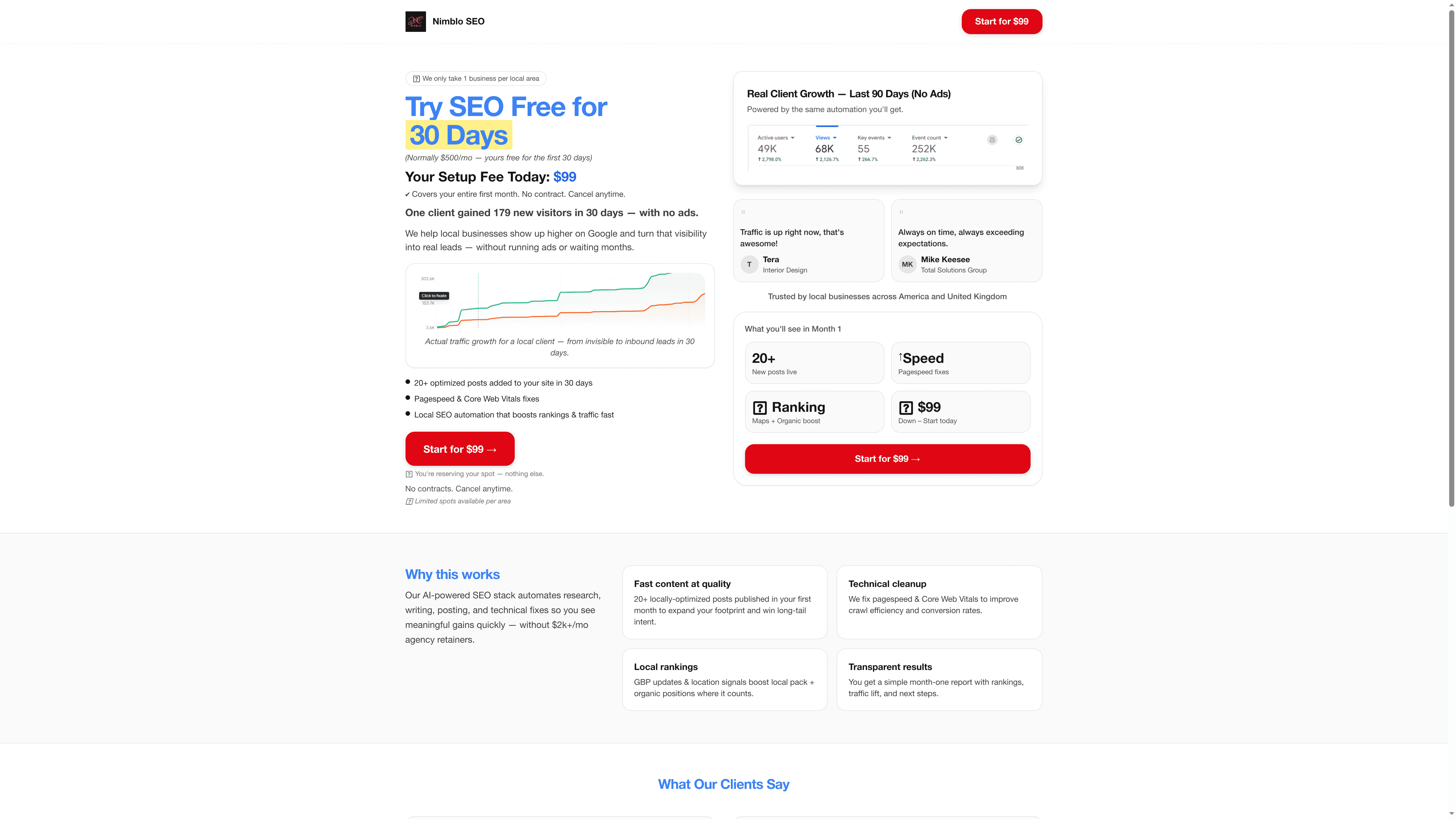
Ready to stop losing customers and start building lasting loyalty? Discover how Nimblo.ai can streamline your customer retention efforts and accelerate your local growth at Nimblo.ai. Learn more about how our platform supports your unique needs with AI-powered local SEO and automated marketing tools. Take control of your customer relationships today and watch your business thrive.
Frequently Asked Questions
What is customer retention?
Customer retention is the strategy of keeping existing customers engaged and committed to your business over time, focusing on building lasting relationships that lead to sustainable growth.
Why is customer retention important for small businesses?
Customer retention is crucial because acquiring new customers can cost significantly more than maintaining existing relationships. Strong retention strategies can drive repeat purchases and enhance overall profitability.
What metrics should small businesses track for customer retention?
Small businesses should monitor key metrics like retention rate, churn rate, net promoter score (NPS), and repeat purchase rate to gain insights into customer loyalty and engagement.
How can automation improve customer retention?
Automation can enhance customer retention by enabling personalized communication, providing timely follow-ups, and delivering predictive customer service, all of which help create more meaningful customer interactions.