
Every Florida business owner knows how much commitment a traditional contract demands, yet many still believe that month-to-month services are less legitimate. The reality is, a no contract agreement delivers all the billing clarity and legal protection you expect while letting your business stay flexible as local market trends shift. In this guide, you’ll discover how these arrangements empower you to adapt your marketing, avoid hidden risks, and maintain control over every dollar spent.
Table of Contents
- Defining No Contract And Common Misconceptions
- Types Of No Contract Arrangements In SaaS
- Key Features And Benefits For SMBs
- Financial And Legal Implications Explained
- Comparing No Contract Vs Long-Term Agreements
Key Takeaways
| Point | Details |
|---|---|
| No Contract Flexibility | No contract agreements allow businesses to cancel services month-to-month without penalties, providing operational agility. |
| Legally Binding | No contract arrangements are still enforceable agreements, with clear obligations for both parties. |
| Variety of Pricing Models | Understanding different no contract pricing structures helps businesses select the best option that matches their usage patterns. |
| Financial Protection | Clarity in service agreements and cancellation terms is essential to protect against unexpected charges or service issues. |
Defining No Contract and Common Misconceptions
A no contract agreement simply means you’re not locked into a long-term commitment with a service provider. You can use the service month-to-month or for a shorter period without penalty if you decide to leave.
When you sign up with most traditional agencies or software vendors, they require you to commit to a year or more. A no contract setup removes that obligation entirely. According to Florida law, a valid contract requires offer, acceptance, and mutual intent, but it doesn’t have to lock you in for years.
Here’s what actually changes when there’s no contract:
- You pay month-to-month without long-term financial obligations
- You can cancel anytime without early termination fees or penalties
- The service provider must earn your business every month by delivering results
- You maintain flexibility to adjust or pivot your marketing strategy quickly
Many Florida SMB owners assume no contract means the agreement isn’t legally binding or legitimate. That’s false. A no contract arrangement is still a real, enforceable agreement. Both parties have obligations: the provider delivers services, and you pay the monthly fee.
Another common misconception is that providers only offer no contract because they’re desperate or low-quality. In reality, confident companies use this model because they know their service quality keeps customers coming back. They don’t need to trap clients contractually.
No contract doesn’t mean no agreement—it means no long-term lock-in. The service must prove its value month after month.
Some business owners worry that without a contract, there’s no legal protection. The opposite is true. Even without a contract, you have clear terms of service, billing policies, and dispute resolution processes. Everything is documented.
The flexibility benefit matters most for growing businesses. Your marketing needs change as you scale. A locked-in contract forces you to stick with outdated strategies. Month-to-month lets you adapt faster than your competitors.
Pro tip: Before signing up with any no contract service, request their service level agreement and cancellation policy in writing—this protects you and clarifies exactly when and how you can leave.
Types of No Contract Arrangements in SaaS
Not all no contract options work the same way. Different SaaS platforms structure their pricing and commitment models differently, and understanding these variations helps you choose what fits your business best.
The most common type is month-to-month subscription. You pay a flat monthly fee and can cancel anytime without penalties. This is straightforward and works well for most Florida SMBs because it matches cash flow predictability with complete flexibility.
Another popular model is pay-as-you-go pricing. You only pay for what you actually use each month. If you send 500 emails one month and 2,000 the next, your bill reflects that difference. This works best for businesses with unpredictable usage patterns.
Here’s how the main types compare:
- Month-to-month flat rate: Fixed price, same bill every month, easiest budgeting
- Usage-based pricing: You pay per action (emails, contacts, API calls), scales with growth
- Tiered subscriptions: Different feature levels at different price points, upgrade or downgrade monthly
- Freemium with paid upgrades: Start free, pay only when you need advanced features
SaaS companies increasingly use flexible subscription models without long-term commitments to compete in a crowded market. This benefits you because providers must constantly prove their value instead of relying on contract lock-in.
One key advantage of these arrangements is transparency. Since there’s no long-term obligation, SaaS platforms emphasize clear service terms and regular updates to keep customers satisfied. You always know exactly what you’re getting and what you’re paying.
The best no contract SaaS model for your business is the one where you only pay for features you actually use.
Many Florida SMBs overlook the tiered subscription approach. You might start with a basic tier at $500 per month, then upgrade to premium features when you need them. Crucially, you can downgrade next month if priorities shift. That flexibility is invaluable for growing businesses.
Usage-based pricing sounds risky until you realize most SaaS platforms cap your monthly spend or notify you before overages. You maintain control and predictability while only paying for growth.
Pro tip: Ask any SaaS provider upfront how their pricing scales with your growth and whether you can switch between plans or pricing models mid-month without penalty.
The following table summarizes how different no contract SaaS models suit various SMB needs:
| SaaS Model | Best For | Budget Predictability |
|---|---|---|
| Month-to-month flat | Stable usage, simple accounting | Very high (fixed rate) |
| Usage-based | Fluctuating business demand | Varies monthly |
| Tiered subscription | Changing feature requirements | High (selectable tiers) |
| Freemium | Testing before investing | Full control |
Key Features and Benefits for SMBs
No contract arrangements unlock several critical advantages that directly impact your bottom line as a Florida SMB owner. The most obvious benefit is financial flexibility. You’re not paying for a year’s worth of service upfront or risking penalties if you need to cancel.
When you adopt services without long-term commitments, SMBs gain the ability to scale operations quickly as demand changes. If your business grows 30% in three months, you can upgrade your plan immediately. If things slow down, you downgrade without guilt or penalties.
Here’s what changes operationally for your business:
- Reduced cash flow strain: Pay month-to-month instead of annual upfront fees
- Lower procurement complexity: Simplified signup processes versus lengthy contract negotiations
- Better budget predictability: Know your exact costs each month without surprise long-term obligations
- Easier vendor switching: Test competitors without financial penalties locking you in
- Risk mitigation: Avoid being trapped with underperforming tools for years
Administrative burden drops significantly with no contract models. Traditional contracts require legal review, approval workflows, and ongoing compliance monitoring. Month-to-month arrangements eliminate that overhead completely.
You also gain rapid adaptation capability. Market conditions in Florida change fast. A hotel in Miami might suddenly need different marketing during peak season versus summer. Flexible arrangements help SMBs respond to changing market demands efficiently without renegotiating terms.
No contract doesn’t mean no reliability—it means your vendor must earn your business every single month.
Many Florida SMBs underestimate the psychological advantage of true flexibility. You’re not stuck. If a tool isn’t delivering results after 90 days, you can switch next month. This mindset forces service providers to actually deliver value rather than just collect fees.
The ability to test new platforms matters more as you grow. You might want to experiment with AI-powered features or local SEO automation tools. With contracts, testing new solutions costs thousands in switch fees. Without them, you experiment freely.
Access to technology improves too. SMBs that previously couldn’t afford enterprise-level tools can now use advanced platforms at reasonable monthly rates without massive upfront investment.
Pro tip: Document your results after each 30-day period to track which tools actually move the needle—this data helps you make confident decisions about whether to keep or cancel subscriptions.
Financial and Legal Implications Explained
No contract agreements sound perfect until you understand the financial and legal nuances. The good news: legitimate no contract services are fully enforceable and protective. The catch: you need to know what you’re signing.
Financially, no contract arrangements actually reduce your risk exposure significantly. You’re not committing to a full year of payments upfront. If the service doesn’t deliver, you stop paying next month. Traditional contracts force you to pay even if results disappoint.

However, clarity matters enormously. Agreements require mutual assent, consideration, and clear terms to be enforceable in the United States. A vague month-to-month arrangement with unclear service obligations creates legal gray areas that hurt both parties.
Here’s what you need to protect yourself:
- Written service agreement: Even for month-to-month services, get terms in writing
- Clear service level expectations: Define response times, uptime guarantees, and support availability
- Defined cancellation terms: Understand notice periods and billing cycles
- Data ownership and security: Clarify who owns your data if you cancel
- Payment terms: Know when invoices come due and what triggers charges
In Florida specifically, contracts can be verbal and enforceable, but no contract arrangements risk unclear obligations and dispute complications. Written agreements protect you far more than handshake deals.
One critical financial protection: request a clear fee schedule before signup. Some platforms charge setup fees, processing fees, or hidden overage costs that surprise you mid-month. Legitimate no contract providers disclose everything upfront.
Always request the complete Terms of Service and Service Level Agreement in writing before committing financially.
Legally, legitimate no contract SaaS platforms remain enforceable and binding. You have clear obligations, they have clear obligations. The difference from traditional contracts is duration, not legitimacy. Month-to-month doesn’t mean unprotected.
Breach remedies matter too. If your vendor fails to deliver promised services, you need recourse beyond just canceling. Will they refund the current month? Offer service credits? Know the answer before you sign.
Liability limitations are standard in SaaS. Most platforms limit what they owe you if something goes wrong. Read these sections carefully. A vendor limiting liability to one month’s fees is reasonable; limiting it to $100 when you pay $500 monthly is not.
Here is a quick reference to core legal protections in no contract SaaS agreements for Florida SMBs:
| Legal Protection Area | Why It Matters | What to Look For |
|---|---|---|
| Service scope definition | Avoids disputes about deliverables | Detailed written descriptions |
| Cancellation terms | Prevents surprise charges | Clear notice periods, cut-off |
| Data ownership & handling | Safeguards your business data | Ownership, deletion, transfer |
| Dispute resolution | Ensures enforceable remedies | Outlines recourse for breach |
| Liability limits | Prevents unfair financial impact | Caps tied to monthly spend |
Pro tip: Before signing any no contract agreement, have a lawyer review the Terms of Service specifically looking for liability caps, data ownership, and breach remedies—this costs $200-400 upfront but prevents thousands in disputes.
Comparing No Contract vs Long-Term Agreements
Choosing between no contract and long-term agreements requires understanding what you gain and lose with each approach. They serve different business needs, and the right choice depends on your situation and risk tolerance.
Long-term agreements lock in pricing and terms for one to three years. You negotiate once, then operate under those same conditions for years. This provides budget certainty and often discounts per-unit costs because vendors invest in your stability.
No contract arrangements keep you flexible month-to-month. Pricing may be higher per month, but you adapt quickly when needs change. Long-term commitments provide pricing stability and negotiated advantages, while no contract options offer adaptability and reduced risk.
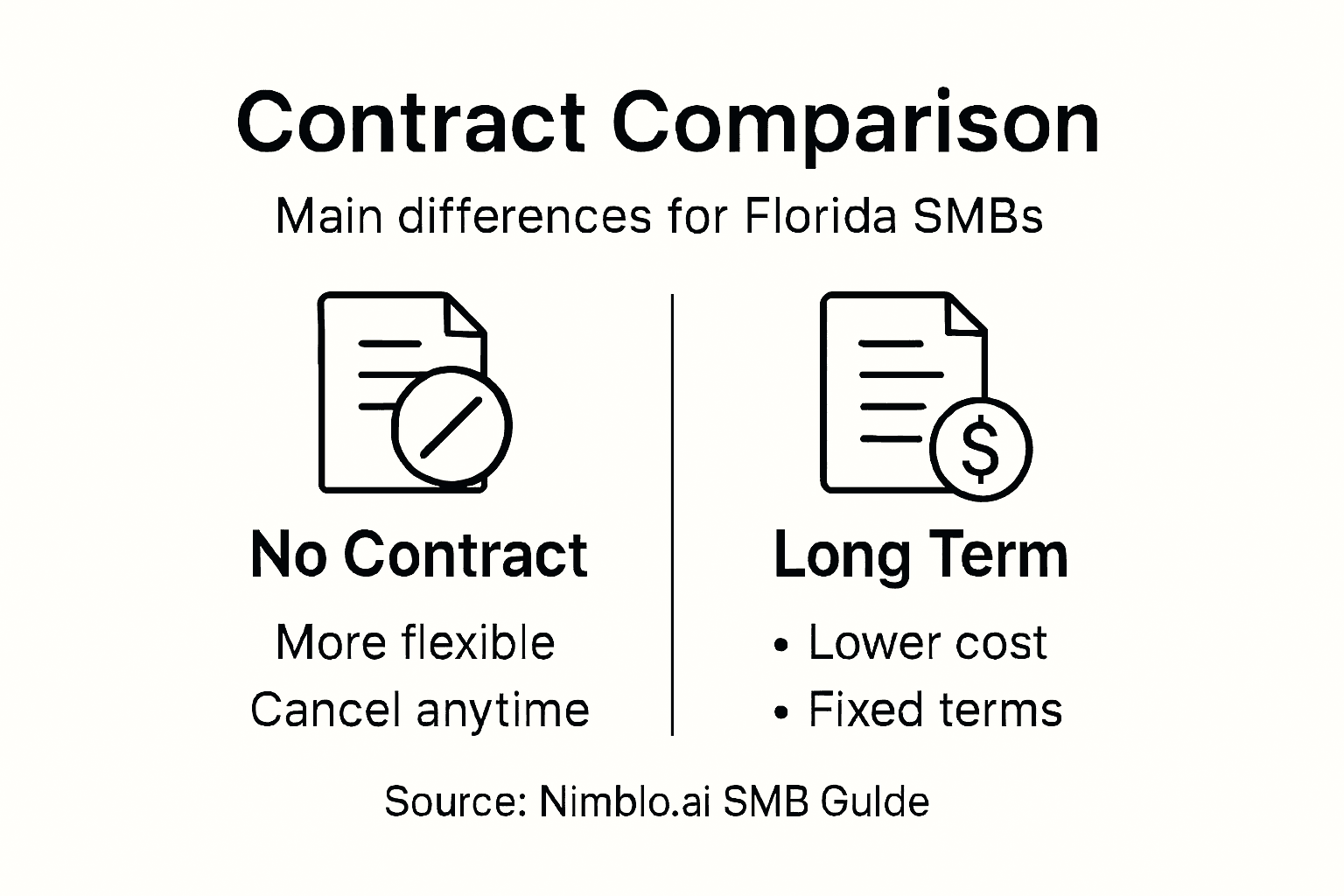
Here’s how they stack up:
| Aspect | Long-Term | No Contract |
|---|---|---|
| Cost per unit | Lower (discounted) | Higher per month |
| Budget predictability | High (fixed for years) | Month-to-month variability |
| Flexibility | Locked in for duration | Change anytime |
| Switching costs | Early termination fees | None |
| Renegotiation | Locked until renewal | Monthly adjustment possible |
| Risk exposure | Years of commitment | One month at a time |
In Florida, long-term agreements often include restrictive covenants that may limit your operational freedom. Florida law supports enforceability of these restrictive terms when properly documented, whereas no contract arrangements avoid these legal entanglements entirely.
When should you choose long-term? If you have stable, predictable needs and the vendor proves themselves over six months, locking in better pricing makes sense. You save money and eliminate vendor switching costs.
Choose no contract when your business is growing rapidly or market conditions are uncertain. Miami service businesses, for example, face seasonal demand swings. Month-to-month flexibility lets you scale up during winter season and down in summer without penalty.
The hidden cost of long-term agreements isn’t just the contract itself—it’s the cost of being locked into outdated strategies for years.
Many Florida SMBs overlook the psychological cost of long-term commitments. If a tool underperforms after one year, you’re still trapped paying for two more years. No contract means you vote with your wallet monthly, keeping vendors accountable.
The growth factor matters most. If you’re scaling rapidly, your software needs change every quarter. Long-term contracts become anchors preventing optimization.
Pro tip: Ask long-term contract vendors for a 30-day trial period or quarterly review checkpoints—many will negotiate this to earn your business, giving you flexibility without full month-to-month pricing.
Experience True Flexibility and Results with No Contract SaaS Solutions
The article highlights the challenge Florida SMBs face when stuck in long-term commitments that limit flexibility and trap budgets. If you want to avoid hefty cancellation fees, outdated tools, and rigid marketing strategies, embracing a no contract model is the key to staying agile and competitive. Your business deserves a platform that earns your trust every month by delivering measurable growth without locking you in.
Nimblo.ai perfectly aligns with this approach by offering an all-in-one SaaS solution tailored for Florida businesses. With a flat rate of $500 per month and no contracts, you gain access to AI-powered local SEO, automated lead generation, high-speed websites, and CRM features—all designed to replace costly fragmented tools and agencies. This means you pay only for what you need, with complete transparency and the freedom to cancel anytime. Discover how you can benefit from rapid setup and localized expertise by exploring Nimblo.ai’s complete service package.
Unlock the power of flexibility and rapid adaptation to changing market demands today and never feel trapped by traditional contracts again.
Harness the advantages of month-to-month SaaS with Nimblo.ai’s no contract pricing and see why local Florida SMBs trust us for digital marketing success.
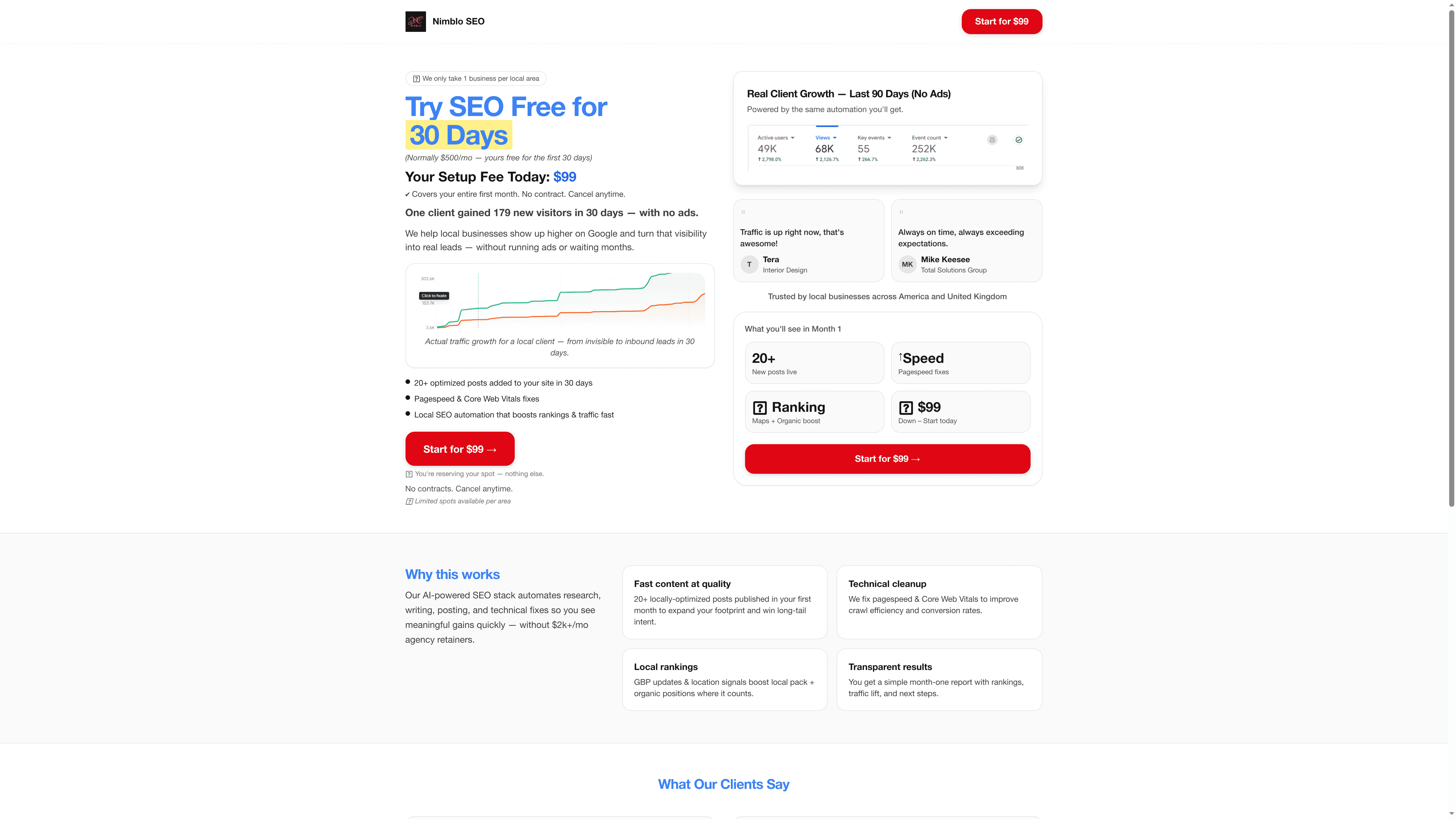
Ready to grow your business without commitment worries Start now by visiting Nimblo.ai and take control of your marketing future with a solution designed for your success.
Frequently Asked Questions
What are the benefits of a no contract agreement for SMBs?
A no contract agreement allows SMBs to pay month-to-month without long-term financial obligations, providing flexibility to cancel anytime without penalties. This structure requires service providers to consistently deliver quality results to retain customers.
How does a no contract service model impact budget predictability for businesses?
No contract arrangements typically have month-to-month fees that can vary, but they eliminate surprise costs typically associated with long-term commitments. This allows for better financial planning as businesses only pay for the services they need at any given time.
What should SMBs consider before signing up for a no contract service?
SMBs should request the service level agreement and cancellation policy in writing. It’s crucial to understand the terms of service, including clear expectations regarding delivered services, data ownership, and defined cancellation procedures to avoid misunderstandings.
Are no contract agreements legally binding?
Yes, no contract agreements are legally binding and enforceable. Even without a long-term commitment, both parties have obligations defined in writing. Clarity in the terms of service is essential for legal protection and compliance.