
Setting up marketing automation as a small business owner can feel overwhelming, especially if you want every dollar and minute to count. You need real steps that actually help you reach the right customers and turn their interest into real business growth. Generic advice is everywhere, but what you need is a direct path from confusion to clarity.
This list breaks down the process into simple, proven actions you can actually apply. You will find out how to define your goals, make your customer data work for you, and build a system designed to put your business in front of the people who matter most. Get ready to discover practical insights that take you from scattered efforts to smart marketing automation you control.
Table of Contents
- 1. Define Your Business Goals And Target Audience
- 2. Integrate Website And CRM For Seamless Data Flow
- 3. Set Up Automated Lead Capture And Follow-Ups
- 4. Optimize Local SEO With AI Tools And Schema Markup
- 5. Manage Google Business Profile For Maximum Visibility
- 6. Track And Analyze Marketing Automation Results
- 7. Review And Refine Automation Processes Regularly
Quick Summary
| Key Message | Explanation |
|---|---|
| 1. Define clear business goals | Establish specific and measurable objectives that align with your target audience’s needs to enhance marketing effectiveness. |
| 2. Integrate website and CRM | Seamless data sharing between your website and Customer Relationship Management system boosts customer tracking and improves marketing efforts. |
| 3. Automate lead capture processes | Implement intelligent web forms and workflows that engage potential customers, ensuring timely follow-ups and increasing conversion rates. |
| 4. Optimize local SEO with AI tools | Utilize AI-powered tools and Schema markup to enhance local search visibility and drive targeted traffic to your business. |
| 5. Regularly review automation processes | Continuous evaluation of your marketing automation systems is crucial for identifying inefficiencies and adapting strategies to remain competitive. |
1. Define Your Business Goals and Target Audience
Successful marketing automation begins with crystal clear business objectives and a deep understanding of your ideal customer. Your marketing strategy cannot be effective without precisely identifying who you want to reach and what you aim to achieve.
Defining your target audience is more than basic demographics. It involves creating a comprehensive profile that includes:
- Geographic location (especially crucial for Florida-based businesses)
- Customer behavior patterns
- Specific consumer motivations
- Economic characteristics
- Purchasing decision triggers
Businesses that invest time in understanding their target market can develop more personalized and impactful marketing campaigns. This detailed approach allows you to allocate resources strategically and create messages that truly resonate.
When you know exactly who your customers are, your marketing becomes a precise instrument instead of a scattershot approach.
To develop actionable business goals, follow these key steps:
- Conduct thorough market research
- Analyze your current customer base
- Create detailed customer personas
- Set SMART goals (Specific, Measurable, Achievable, Relevant, Time-bound)
- Align goals with your target audience’s needs
By developing a detailed marketing plan that considers your target market’s size, demographics, and unique traits, you create a roadmap for strategic success.
Pro tip: Schedule quarterly reviews of your target audience profile to ensure your marketing automation remains relevant and responsive to changing market dynamics.
2. Integrate Website and CRM for Seamless Data Flow
Integrating your website and Customer Relationship Management (CRM) system is a critical step in creating a unified digital ecosystem for your business. This powerful connection transforms how you capture, track and leverage customer interactions across multiple touchpoints.
A well-integrated website and CRM system provides several key advantages:
- Real-time data synchronization
- Comprehensive customer profile tracking
- Automated lead capture and management
- Personalized communication workflows
- Enhanced marketing and sales alignment
Seamless data integration eliminates information silos and creates a holistic view of your customer journey.
Businesses can achieve this integration through several strategic approaches. CRM systems for small businesses enable sophisticated tracking mechanisms that capture every website interaction automatically. This means every form submission, page visit and engagement gets instantly recorded in your central customer database.
To successfully integrate your website and CRM, consider these implementation steps:
- Select a compatible CRM platform
- Install tracking scripts on your website
- Configure data mapping rules
- Set up automated lead scoring
- Test integration thoroughly
Effective data integration allows you to understand customer behaviors more deeply. By connecting website analytics with CRM insights, you create a powerful tool for personalized marketing and strategic decision making.
Pro tip: Conduct monthly audits of your website and CRM integration to ensure data accuracy and identify potential optimization opportunities.
3. Set Up Automated Lead Capture and Follow-Ups
Automated lead capture and follow-up systems transform how small businesses engage potential customers transforming cold contacts into warm opportunities. These strategic workflows ensure no potential customer falls through the cracks.
Successful lead capture systems include several critical components:
- Intelligent web form design
- Automatic contact segmentation
- Personalized communication triggers
- Behavior-based lead scoring
- Timely and relevant follow-up sequences
Effective lead capture is about creating meaningful connections before your competitors even realize a prospect exists.
Businesses can dramatically improve their conversion rates by automating lead generation with sophisticated tracking and engagement tools. Modern marketing automation platforms allow you to create complex workflows that respond to specific customer interactions instantly.
Implementing an automated lead capture system involves these strategic steps:
- Design user-friendly website contact forms
- Configure lead scoring rules
- Create multi-stage follow-up email sequences
- Set up behavioral trigger points
- Integrate CRM for seamless data management
Strategic follow-up communications are the backbone of successful lead nurturing. By understanding and responding to potential customer behaviors quickly and intelligently you transform casual website visitors into committed buyers.
Pro tip: Review and refine your automated lead capture workflows monthly to ensure they remain responsive to changing customer behaviors and market conditions.
4. Optimize Local SEO with AI Tools and Schema Markup
Local search engine optimization has transformed from a complex technical challenge to a strategic opportunity for small businesses to dominate their regional market. AI-powered tools and advanced structured data techniques are now game changers in creating hyper-targeted online visibility.
Modern local SEO strategies leverage several powerful approaches:
- Intelligent keyword research
- Automated content optimization
- Structured data implementation
- Location-specific search targeting
- Competitive performance analysis
Precision in local SEO means turning your digital presence into a laser-focused marketing weapon.
Businesses can dramatically improve their search rankings by leveraging AI in local SEO strategies that automate complex optimization processes. Schema markup provides search engines with crystal-clear signals about your business location content and relevance.
Implementing an effective local SEO optimization strategy requires these key steps:
- Audit current website structured data
- Implement location-specific Schema markup
- Optimize Google Business Profile
- Generate localized content
- Monitor search performance metrics
Strategic Schema implementation transforms how search engines understand and rank your local business content. By providing explicit context about your services location and expertise you create powerful signals that boost search visibility.
Pro tip: Regularly update your Schema markup and local content to reflect current business information ensuring maximum search engine accuracy and relevance.
5. Manage Google Business Profile for Maximum Visibility
Your Google Business Profile is the digital storefront that can make or break your local online presence. It serves as the first point of contact for potential customers searching for services in your area.
A well-managed profile offers multiple strategic advantages:
- Instant local search visibility
- Free marketing platform
- Customer trust building
- Enhanced geographic targeting
- Direct customer communication channel
A perfectly optimized Google Business Profile is like having a 24/7 digital marketing representative for your business.
Businesses can significantly improve their local search performance by implementing comprehensive profile management with strategic and consistent updates. This means regularly refreshing information sharing customer reviews and maintaining accurate contact details.
To maximize your Google Business Profile effectiveness follow these critical steps:
- Verify your business listing
- Complete every profile section thoroughly
- Upload high-quality professional photos
- Respond promptly to all customer reviews
- Post weekly updates and offers
- Use relevant local keywords
- Enable messaging for customer inquiries
Consistent profile management transforms your online presence from passive to powerful. By treating your Google Business Profile as a dynamic marketing tool you create multiple entry points for potential customers to discover your business.
Pro tip: Set a monthly calendar reminder to review and refresh your Google Business Profile ensuring your information remains current and engaging.
6. Track and Analyze Marketing Automation Results
Successful marketing automation is not about implementing tools but understanding their actual performance and impact. Tracking and analyzing your marketing results transforms raw data into actionable strategic insights.
Comprehensive marketing performance measurement involves monitoring multiple critical metrics:
- Conversion rate tracking
- Customer acquisition costs
- Lead generation effectiveness
- Engagement percentage
- Revenue attribution
Data without interpretation is just noise. Smart analysis turns numbers into strategy.
Businesses can dramatically improve their marketing outcomes by tracking key performance indicators with precision and consistency. Understanding which metrics truly matter helps you allocate resources more intelligently.
To effectively analyze marketing automation results implement these strategic steps:
- Define clear performance benchmarks
- Set up comprehensive tracking dashboards
- Analyze customer journey touchpoints
- Compare campaign performance
- Calculate return on marketing investment
- Identify optimization opportunities
- Create actionable improvement plans
Strategic metric analysis reveals the true health of your marketing efforts. By moving beyond surface-level numbers you uncover deeper insights into customer behavior and campaign effectiveness.
Pro tip: Schedule quarterly deep-dive analytics reviews to ensure your marketing automation strategy remains adaptive and aligned with your business goals.
7. Review and Refine Automation Processes Regularly
Marketing automation is not a set-it-and-forget-it strategy. Your automated systems require continuous evaluation and strategic refinement to maintain peak performance and adapt to changing business landscapes.
Regular process review offers multiple critical advantages:
- Identify performance bottlenecks
- Optimize workflow efficiency
- Reduce operational redundancies
- Improve customer experience
- Adapt to emerging market trends
Automation without periodic assessment is like driving with outdated maps.
Businesses can enhance their operational effectiveness by implementing systematic workflow improvements that prioritize continuous learning and adaptation.
To effectively review and refine automation processes follow these strategic steps:
- Establish baseline performance metrics
- Schedule quarterly system audits
- Collect team and customer feedback
- Analyze automation performance data
- Identify potential optimization opportunities
- Implement incremental improvements
- Document and track changes
Strategic process refinement transforms marketing automation from a static tool into a dynamic competitive advantage. By treating your automation system as an evolving ecosystem you ensure sustained operational excellence.
Pro tip: Create a dedicated calendar reminder for systematic automation process reviews to maintain continuous improvement momentum.
Below is a comprehensive table summarizing the strategic insights and actionable steps included in the article about enhancing marketing automation strategies for businesses.
| Topic | Description | Key Actions |
|---|---|---|
| Define Business Goals | Establish clear objectives and understand the target audience | Conduct market research, set SMART goals |
| Integrate Website and CRM | Link your website to CRM for effective data management | Select CRM, ensure data synchronization |
| Set Up Automated Lead Capture | Build workflows for capturing leads strategically | Design forms, automate follow-ups |
| Optimize Local SEO | Improve regional visibility using modern tools | Apply Schema markup, target local keywords |
| Manage Google Business Profile | Enhance your business’s profile for local searches | Update information, engage with reviews |
| Track and Analyze Results | Monitor marketing performance to drive improvements | Establish metrics, analyze data regularly |
| Refine Automation Processes | Continuously evaluate and optimize workflows | Schedule audits, implement incremental changes |
Streamline Your Marketing Automation with Nimblo.ai
The “7 Essential Steps for a Marketing Automation Checklist” article highlights the challenges Florida small businesses face when trying to efficiently manage lead capture, CRM integration, local SEO, and consistent follow-ups. You understand the pain of juggling multiple platforms and the frustration of fragmented data and slow implementation. Concepts like AI-powered local SEO, schema markup, and automated workflows are not just buzzwords—they are critical tools to grow leads, reduce costs, and create meaningful connections with your customers.
Nimblo.ai offers an all-in-one solution designed specifically for Florida-based SMBs who want to automate marketing processes, manage their Google Business Profile, optimize local SEO effortlessly, and unify website and CRM data into one seamless system. With rapid setup, user-friendly automation, and a flat monthly fee, you get the power to act fast and see measurable results without the confusion of multiple costly tools.
Unlock the full potential of your marketing automation by exploring Nimblo.ai’s complete platform today.
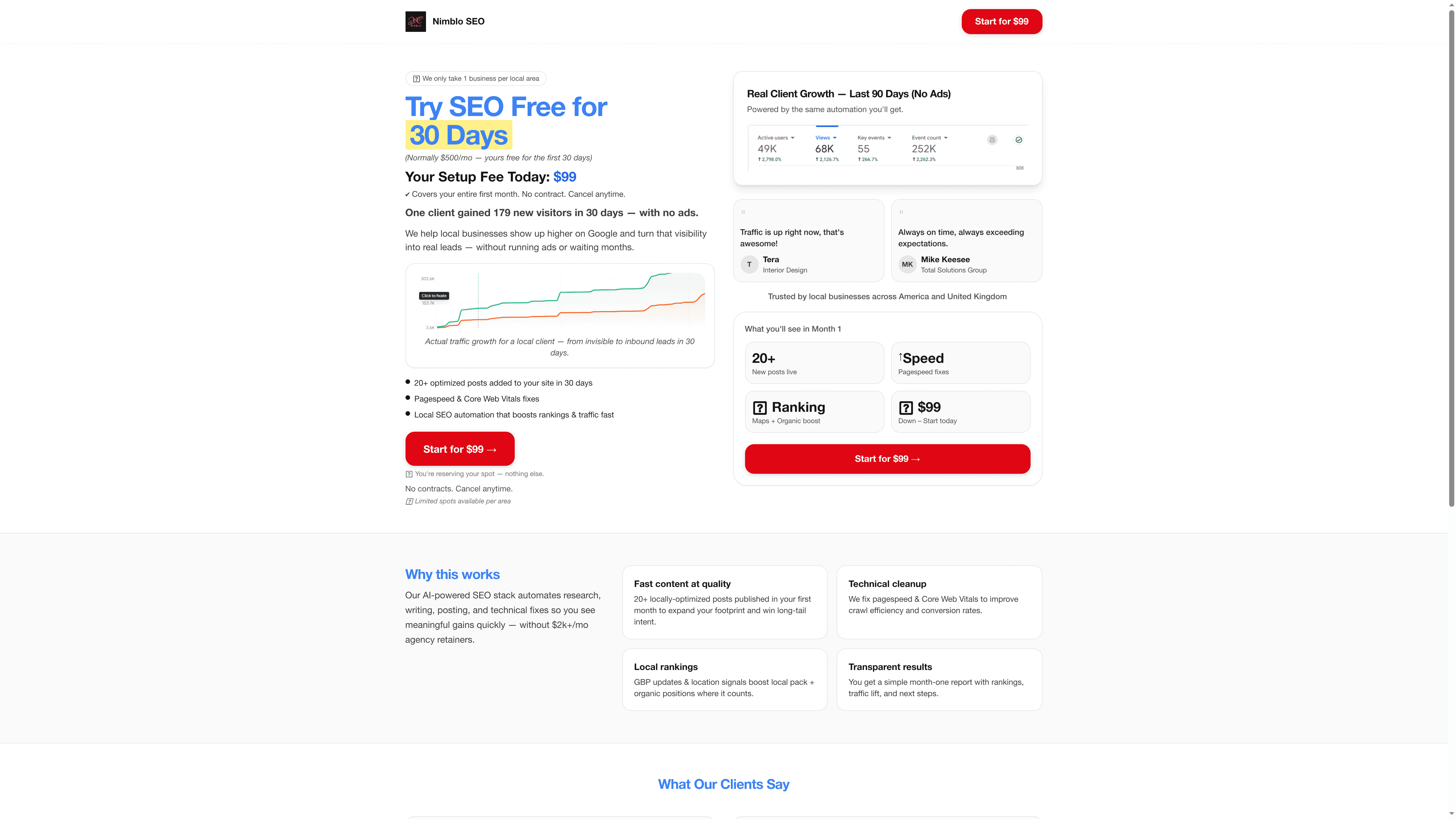
Take control of your marketing automation now with Nimblo. Visit Learn About Marketing Automation Solutions and start turning your strategy into a streamlined, profitable reality. Don’t wait for opportunities to slip away—partner with local experts who understand your unique needs and deliver real impact.
Frequently Asked Questions
What are the key components of a marketing automation checklist?
To create an effective marketing automation checklist, include defining business goals, integrating your website and CRM, setting up automated lead capture and follow-ups, optimizing local SEO, managing your Google Business Profile, tracking performance metrics, and regularly reviewing automation processes. Start by organizing these components into actionable steps and timelines to guide your implementation.
How can I define my target audience for marketing automation?
To define your target audience, conduct market research, analyze your current customer base, and create detailed customer personas. Focus on specific characteristics like geographic location, behavior patterns, and purchasing triggers to develop a clear profile that aligns with your business goals.
What steps should I take to integrate my website and CRM?
Begin by selecting a compatible CRM platform and installing necessary tracking scripts on your website. Next, configure data mapping rules and set up automated lead scoring to ensure efficient data flow and customer profile tracking.
How do I set up automated lead capture and follow-ups?
To set up automated lead capture, design user-friendly web forms and create multi-stage follow-up email sequences based on customer behaviors. Implementing these strategies will streamline your communications and increase conversion rates.
Why is local SEO important in marketing automation?
Local SEO is crucial because it helps your business appear in local search results, enhancing visibility to potential customers in your area. Optimize your website using location-specific keywords and structured data to attract more local traffic.
How often should I review my marketing automation processes?
You should review your marketing automation processes at least quarterly to identify performance bottlenecks and potential optimization opportunities. Regular reviews ensure that your strategies remain effective and responsive to changing customer behaviors.