
TL;DR:
- Effective enterprise AI SEO combines automation with human oversight to ensure quality and strategic alignment.
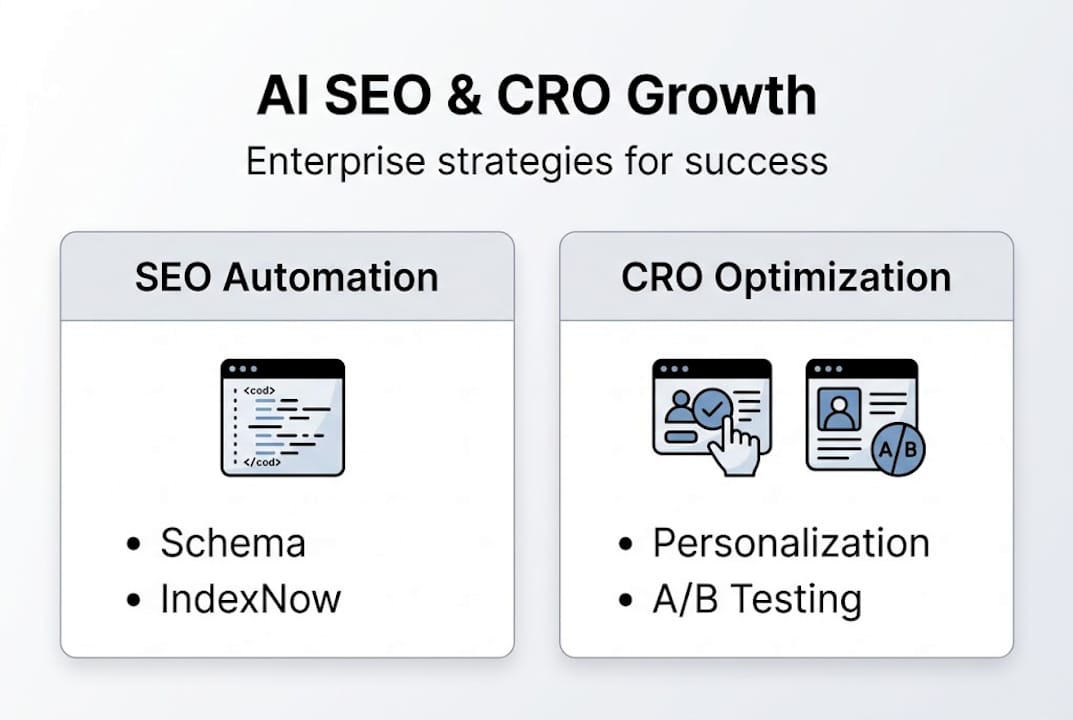
- Building structured content clusters, automating schema deployment, and centralizing entity data are key for AI search visibility.
- AI-driven personalization and real-time testing revolutionize conversion optimization by enabling rapid, targeted user experiences.
Enterprise leaders are pouring resources into AI-powered SEO and conversion optimization (CRO), yet results often fall short of expectations. Here’s a striking reality check: while 72% of SEOs believe AI content matches human quality, only 10% of top-ranking results are actually AI-generated. That gap signals something important. Speed and volume alone won’t win. What separates enterprises that grow from those that stall is a disciplined, strategic approach that fuses AI automation with human judgment. This guide gives you exactly that, walking through proven frameworks to align SEO and CRO under one AI-powered operational system.
Table of Contents
- How AI transforms enterprise SEO: From topical authority to AI search
- automation at scale: Enterprise SEO systems and technical accelerators
- AI-powered conversion optimization: personalization and real-time decision making
- overcoming enterprise hurdles: governance, cross-team silos, and KPIs for the AI era
- The hybrid imperative: Why AI-human collaboration is the enterprise edge
- unlock AI-powered SEO and CRO for your enterprise
- frequently asked questions
Key Takeaways
| Point | Details |
|---|---|
| AI enhances SEO and CRO synergy | Combining AI automation with human oversight strengthens both visibility and conversions for enterprise businesses. |
| Technical automation scales impact | Automated schema, IndexNow, and entity frameworks allow enterprises to deploy SEO and CRO strategies at scale. |
| Human expertise remains essential | Editorial quality, E-E-A-T signals, and strategic oversight by experts are still required to outperform AI-only approaches. |
| New KPIs drive enterprise growth | Tracking AI search citations, brand sentiment, and cross-channel conversions unlocks new optimization opportunities. |
How AI transforms enterprise SEO: From topical authority to AI search
The old playbook of targeting individual keywords is fading fast. Modern enterprise SEO demands that you build topical authority through interconnected content clusters, structured schema markup, and signals that satisfy both Google and large language models (LLMs) like ChatGPT and Google’s AI overviews. LLMs reference content that demonstrates E-E-A-T, which stands for Experience, expertise, authoritativeness, and trustworthiness. If your content architecture doesn’t reflect those qualities, you’re invisible to both traditional and AI-powered search.
AI-driven strategies build topical authority through clusters, schema, and E-E-A-T signals to rank in both Google and AI search engines. That means organizing your content into tightly themed pillars, each supported by satellite pages that reinforce your entity relationships and internal link structure. AI tools can automate cluster gap analysis, map competitor content coverage, and surface internal linking opportunities your editorial team would otherwise miss.
Schema markup is a particularly high-value automation target. When you deploy schema consistently across product pages, articles, FAQs, and event listings, AI search features pull from your structured data directly. This boosts your chance of appearing in AI overviews and rich results. For enterprises with thousands of pages, manual schema management is simply not viable. That’s where enterprise AI SEO strategies become essential, automating deployment through CMS templates and code-level triggers.
Key advantages of an AI-powered SEO foundation:
- Entity and topic cluster mapping at scale without manual auditing
- Schema auto-deployment across CMS templates and product feeds
- E-E-A-T reinforcement through author profiles, source attribution, and citation depth
- LLM-friendly content formatting: short paragraphs, structured headers, concise definitions
- Internal link automation based on semantic relevance scoring
Building a solid AI content strategy requires mapping your entity relationships before you scale content production. Think of it as laying tracks before running trains.
| SEO approach | Traditional method | AI-powered method | Speed gain | Coverage depth |
|—|—|—|—|—|
| Topic cluster mapping | Manual spreadsheet | AI gap analysis | 10x faster | Full coverage |
| Schema deployment | Developer sprint | CMS automation | Always-on | Enterprise-wide |
| E-E-A-T signals | Editorial discretion | AI scoring models | Real-time | Page-level |
| Internal linking | Manual review | NLP semantic match | 5x faster | Site-wide |
Pro tip: Create a centralized schema library and topic map that every team references. This prevents content gaps, conflicting entity signals, and duplicate schema errors that quietly tank your AI search visibility.
automation at scale: Enterprise SEO systems and technical accelerators
Building on a modern SEO foundation, scaling technical operations is the next frontier. For large enterprises, the difference between a good SEO strategy and a great one often comes down to infrastructure. You need systems that run continuously, adapt to site changes, and don’t depend on a single team member catching an error.
Schema deployment, IndexNow, and crawl budget optimization are recognized as key enterprise best practices for AI search visibility. IndexNow, in particular, is an underused tool. It lets you push URL change notifications directly to search engines the moment content goes live, eliminating the lag of waiting for crawlers to discover updates organically. For enterprise sites publishing dozens or hundreds of pages daily, that speed advantage compounds quickly.

Crawl budget is another lever most teams overlook. When crawlers waste time on low-value URLs, staging paths, or duplicate parameter strings, your high-priority pages lose indexing frequency. AI-powered crawl management tools analyze your crawl logs and prioritize pages based on revenue impact, link equity, and update frequency. This is AI search technical requirements work done at the infrastructure level, not the content level.
Centralizing entity data solves a problem that siloed teams create constantly. When your product catalog, author database, and location data live in separate systems, on-page signals become inconsistent. A centralized entity data layer ensures that every page pulling information from those sources stays aligned, accurate, and search-ready. Follow these automated SEO best practices to reduce drift between teams.
Four steps to enterprise SEO automation maturity:
- Map your CMS and release pipeline. Know exactly where schema, metadata, and structured data are generated so automation triggers match your deployment cycle.
- Deploy IndexNow across your publishing stack. Connect it to your CMS so every publish action triggers an instant ping to search engines.
- Build crawl budget rules based on revenue priority. Block low-value URL patterns and allocate crawl depth to transactional and high-authority pages.
- Create a centralized entity data repository. Pull from it for all on-page generation to keep signals consistent and QA automated.
Pro tip: Build your automation triggers to align with QA gates and release cycles. If schema auto-generates before final content review, you risk publishing structured data that contradicts the actual page content, which actively hurts your search credibility.
AI-powered conversion optimization: personalization and real-time decision making
With technical SEO automation in place, let’s focus on conversion optimization’s new AI-driven realities. CRO is no longer about running one A/B test per month and waiting weeks for statistical significance. AI collapses that timeline dramatically.
AI enables personalization, dynamic A/B testing, and real-time behavior analysis to boost engagement and reduce bounce rates at enterprise scale. The mechanism is straightforward: AI models ingest user intent signals, session data, and behavioral patterns, then adjust page elements, offers, and content sequences in real time. Users see a version of your site tailored to their segment before they even scroll.
For context, B2B average conversion rates sit around 2%, but industry variance is extreme. Legal and finance B2B sites can reach 7.4%, while engineering sectors average as low as 1.2%. That spread tells you that generic CRO benchmarks are nearly useless. What matters is your industry baseline and your ability to test against it continuously. AI makes continuous testing economically viable. You can run multivariate tests across hundreds of page variations simultaneously without expanding your team.
Understanding AI and customer journey dynamics shows why personalization at the session level moves metrics faster than static page redesigns.
How AI changes the CRO game for enterprise teams:
- Intent-based segmentation: AI clusters users by behavior, not just demographic buckets
- Real-time hypothesis testing: Deploy and validate CRO changes within hours, not months
- Dynamic content blocks: Product recommendations, CTAs, and messaging shift by user segment automatically
- AI’s role in enterprise SEO and CRO converges here, with organic traffic quality feeding personalization models directly
Pro tip: Don’t obsess over macro-conversions like form submissions alone. AI analytics surface micro-conversion signals, such as scroll depth, video replays, and hover patterns, that reveal new optimization paths your team would never manually discover.
overcoming enterprise hurdles: governance, cross-team silos, and KPIs for the AI era
Even with top technology, operational excellence decides your outcome. The most common reason enterprise AI SEO and CRO programs underperform isn’t the technology. It’s the organizational structure around it.
Cross-team coordination, release cycle misalignment, and high revenue stakes are the defining pain points for enterprise SEO programs. When your development team ships a site update that breaks schema, and your SEO team finds out two weeks later in a rankings report, you’ve lost ground that takes months to recover. The fix isn’t more tools. It’s embedding governance checkpoints into existing workflows.
New KPIs matter as much as new tools. Traditional rankings and organic traffic are still valid, but they don’t tell the full story in 2026. You need to track AI citations, which measure how often your brand appears in LLM-generated responses. You need share of voice in AI search results. And you need to attribute revenue to AI-referred traffic specifically, not just lump it into organic.
“91% monthly organic revenue growth and 2,327% ROI achieved through AI SEO implementation” represent what’s possible when strategy, governance, and automation align at the enterprise level.
Executive action steps to break silos and unify measurement:
- Create a cross-functional AI SEO task force with representatives from SEO, engineering, product, and content
- Define shared KPIs that include AI visibility metrics alongside traditional performance indicators
- Build governance checkpoints into your sprint or release cycles so SEO and CRO tests are protected from accidental deployment conflicts
- Use AI-driven enterprise wins as internal case studies to build buy-in from resistant teams
- Reference AI strategy governance frameworks to formalize accountability without slowing down execution
The hybrid imperative: Why AI-human collaboration is the enterprise edge
Here’s where most enterprise SEO conversations go wrong. Leaders see AI automation as a replacement for editorial judgment, when it’s actually a force multiplier for it. We’ve seen organizations automate their entire content operation, only to watch rankings erode within two quarters because the content lacked the depth and credibility that human subject matter experts provide.
AI-human hybrid workflows, where AI handles speed and scale while humans ensure E-E-A-T and quality, consistently produce the strongest long-term performance. The AI drafts, clusters, and optimizes. The human validates, enriches, and signs off. That division of labor is where AI impact on digital marketing becomes sustainable rather than a short-term spike.
The enterprises winning in 2026 are not the ones with the most AI tools. They’re the ones with the clearest ownership at each workflow stage. AI flags the opportunity, a human makes the strategic call, and the system executes at scale. That’s not a limitation of AI. It’s the architecture that makes AI reliable.
Pro tip: Define who owns every stage of your AI-assisted workflow before you launch. Without that, content and CRO decisions drift into a gray zone where neither AI output nor human judgment gets the attention it deserves.
unlock AI-powered SEO and CRO for your enterprise
Ready to put these strategies to work? The gap between knowing what to do and actually operationalizing it at enterprise scale is where most programs stall. At enterprise AI automation solutions, we embed dedicated automation pods directly into your operations, combining AI engineers, workflow architects, and domain experts who work within your existing systems and release cycles.
Our 120-day structured engagement gets your SEO and CRO automation running with measurable results, not promises. From schema automation to real-time CRO personalization, we build the infrastructure so your team can focus on strategy. If you’re ready to stop experimenting and start executing, connect with us to launch a pilot program built around your specific enterprise environment.
frequently asked questions
What is the most effective way to combine SEO and conversion optimization with AI in enterprises?
Integrate AI-driven automation for technical SEO and real-time CRO insights, then layer in human expertise for content quality and governance. AI for automation, humans for E-E-A-T and oversight is the framework that sustains long-term gains.
Which technical SEO automations provide the best ROI for large enterprises?
Schema, IndexNow, entity centralization are the fastest and most scalable automations for enterprise SEO, delivering immediate indexing speed and consistent on-page signal quality across large site architectures.
How does AI improve conversion optimization compared to traditional methods?
AI enables hyper-personalized user flows, real-time A/B test scaling, and rapid behavioral analytics. AI-driven personalization and testing allows teams to identify and act on conversion opportunities within hours rather than weeks.
What new KPIs matter most in the era of AI-powered enterprise SEO?
Track AI-citation frequency, share of voice in LLM responses, and revenue from AI-referred traffic alongside classic rankings. AI share of voice and referral conversions are the metrics that reveal whether your brand is winning in AI-powered search environments.