
TL;DR:
- Scaling AI content alone yields lower search rankings compared to hybrid human-AI workflows.
- Human oversight, governance, and structured prompts are crucial for high-quality, trustworthy enterprise content.
- Optimizing for both traditional SEO and AI overview systems improves overall search visibility and authority.
Most enterprise operations managers assume that scaling AI-written content is the fastest path to search visibility. That assumption is costing real traffic. Recent performance data shows pure AI content achieves a 13% page-1 ranking rate compared to 70% for human-authored content, while hybrid workflows consistently outperform both extremes. For managers in healthcare, finance, and manufacturing, where content must meet regulatory standards and convert specialized audiences, the stakes are too high to leave SEO strategy to automation alone. This guide walks through exactly what works at scale: from hybrid content architecture to dual-ecosystem optimization and enterprise workflow governance.
Table of Contents
- Why AI matters for enterprise SEO content creation
- Hybrid content creation: Balancing AI efficiency with human expertise
- Building SEO content for both humans and AI systems
- Enterprise workflow optimization: From content clusters to crawl budgets
- Our perspective: What most enterprise teams miss about AI-driven SEO content creation
- Take the next step: Transform your SEO content creation with Nimblo AI
- Frequently asked questions
Key Takeaways
| Point | Details |
|---|---|
| Hybrid beats pure AI | Mixed workflows outperform pure AI by dramatically improving rankings and engagement. |
| Schema unlocks visibility | Structured data and schema markup help content stand out in both human and AI-driven search. |
| Workflow governance is essential | Templates, prompt audits, and entity consistency provide sustainable SEO results at enterprise scale. |
| AI is best used strategically | Automation should support, not replace, expert input and careful process management. |
Why AI matters for enterprise SEO content creation
AI is not optional at enterprise scale. The volume of content required to compete across hundreds of product lines, service pages, and local markets simply cannot be produced manually without massive team expansion. Operations managers know this equation well: more output, same headcount, higher expectations.
The ROI case is concrete. In healthcare, AI-driven SEO produced a staggering 1,637% increase in organic traffic for one practice, along with measurable growth in bookings and patient inquiries. That is not a minor efficiency gain. That is a business transformation driven by search visibility.
Enterprise sectors are investing in AI-assisted content for three core reasons:
- Workflow acceleration: AI drafts, outlines, and researches content in minutes rather than days, freeing human editors to focus on accuracy and differentiation.
- Precision at scale: Large language models can be prompted to follow brand voice guidelines, target specific keywords, and structure content for featured snippets without manual reformatting.
- Competitive intelligence: AI tools can analyze competitor content gaps faster than any manual audit, giving SEO teams a real-time advantage.
For finance teams managing regulatory disclosures or manufacturing operations documenting technical specifications, AI offers a way to produce consistent, structured content that aligns with compliance requirements. The key is not whether to use AI. It is how to integrate it without sacrificing the expertise that makes enterprise content credible.
Organizations exploring enterprise AI wins in content marketing are seeing that the highest-performing teams treat AI as a force multiplier for their domain experts, not a replacement for them. The shift from manual to AI-assisted workflows is where real competitive advantage begins.
Hybrid content creation: Balancing AI efficiency with human expertise
Pure AI content has a performance ceiling. And in practice, that ceiling is surprisingly low.
The 13% page-1 rate for AI-only content versus 70% for human-written content is not just a vanity metric. It reflects how search engines evaluate expertise, authoritativeness, and trustworthiness, the principles at the core of Google’s quality rater guidelines. AI-only content tends to be fluent but generic. It passes a surface read but fails on depth.

| Content type | Page-1 ranking rate | Key risk |
|---|---|---|
| Pure AI | 13% | Hallucinations, low engagement |
| Human-only | 70% | Slow, costly at scale |
| Hybrid | Highest | Requires governance |
The risks of unreviewed AI content are real for enterprise teams:
- Hallucinations: AI models generate plausible-sounding but factually wrong statements. In healthcare or financial content, a single error can trigger regulatory consequences.
- Low engagement signals: Generic AI prose often fails to hold reader attention, raising bounce rates and lowering dwell time, both signals that hurt rankings.
- Brand inconsistency: Without defined templates and review protocols, AI output drifts from established brand voice across large content libraries.
The hybrid model fixes these problems by injecting human expertise at two key stages: before the AI generates content (through detailed prompts, data inputs, and structured briefs) and after (through expert review, factual verification, and editorial refinement). Review the top AI SEO tools that support this workflow to identify which platforms allow prompt customization and review integrations.
Understanding content’s SEO role helps clarify why human oversight is not just a quality check. It is a ranking factor by proxy. Expertise-injected content earns backlinks, longer visits, and higher click-through rates, all of which compound over time.
Pro Tip: Build a content brief template that forces contributors to add three proprietary data points, one expert quote, and one differentiating claim before handing off to AI. This single practice dramatically lifts the quality ceiling of AI-assisted output.
Building SEO content for both humans and AI systems
Search in 2026 is not one ecosystem. It is two running in parallel, and enterprise teams that optimize only for traditional search engine results pages (SERPs) are leaving significant visibility on the table.
AI Overviews (Google’s AI-generated answer summaries) and generative engine optimization (GEO) represent a separate ranking pathway. Content that gets extracted and featured in these systems follows different rules than traditional SEO. The dual-ecosystem strategy requires teams to optimize for both traditional SERPs and AI overview systems simultaneously, using governance frameworks like templates and entity consistency to ensure content is machine-readable and factually reliable.
For operations managers, this translates into concrete technical requirements:
| Optimization target | Key tactic | Enterprise benefit |
|---|---|---|
| Traditional SERPs | Keyword targeting, internal links | Organic traffic growth |
| AI Overviews | Structured data, declarative answers | Featured extraction |
| GEO systems | Entity consistency, schema markup | Brand authority signals |
Structured data and schema markup for SEO are no longer optional for enterprise teams. Schema tells both human-facing search engines and AI extraction systems exactly what your content is about: the author, the organization, the topic, and the factual claims. Without it, AI systems struggle to confidently extract and credit your content in generated answers.
Governance templates matter here too. When dozens of writers and AI tools are contributing to a large content library, entity consistency (using the same names, spellings, and categorizations for products, services, and people) ensures that AI systems build a coherent understanding of your brand. Understanding schema’s local impact shows how this precision pays off even at the location level for multi-site enterprise operations.
Pro Tip: Run a quarterly prompt audit where your team submits your brand’s core topics into major AI search tools and documents which competitor content gets cited. This tells you exactly where your structured data and entity consistency gaps are.
“Content designed for AI extractability is not simpler content. It is more precisely organized content, with clear claims, defined entities, and schema that signals confidence to automated systems.”
Enterprise workflow optimization: From content clusters to crawl budgets
At enterprise scale, individual pieces of content are not the unit of SEO strategy. Topic clusters are.
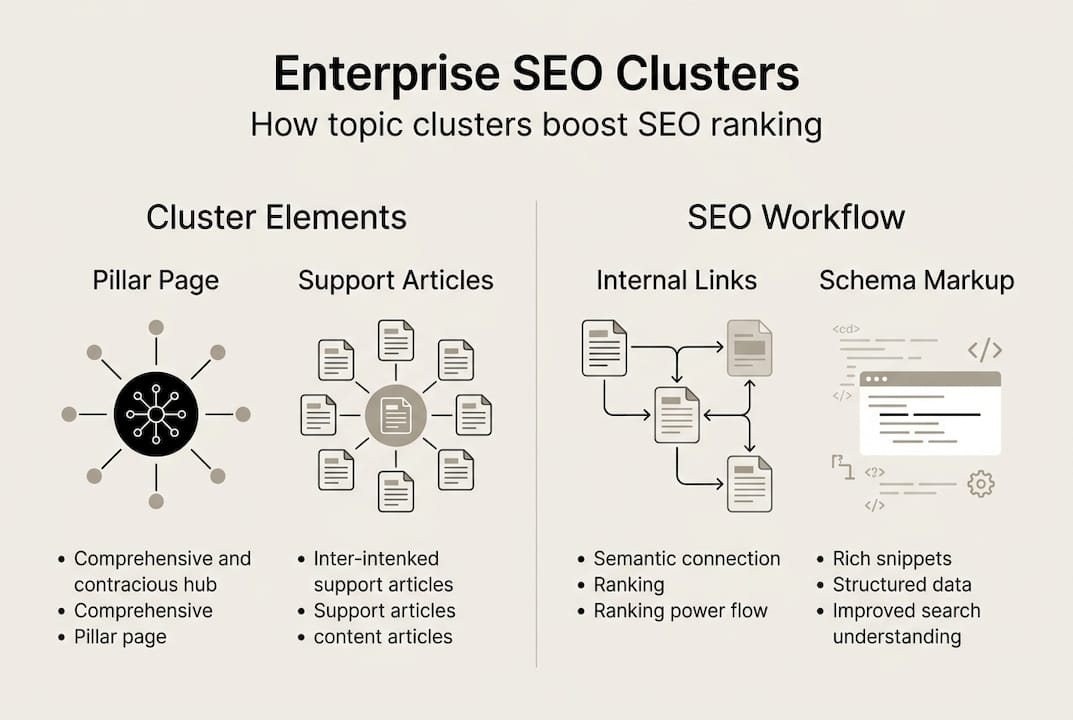
A topic cluster is a network of content built around a central pillar page, supported by dozens of related articles that link back to it. This architecture signals deep topical authority to search engines. For a manufacturing company, that might mean a pillar page on supply chain optimization supported by cluster content on procurement automation, vendor management, and inventory tracking.
Beyond content architecture, crawl budget management is a critical workflow consideration for enterprise teams. Crawl budget refers to how many pages a search engine will crawl and index within a given timeframe. Large enterprise sites with thousands of URLs often have low-quality or duplicate pages consuming crawl budget that should go to high-value content.
Key workflow tactics for enterprise SEO at scale:
- Audit and prune: Regularly identify thin, duplicate, or outdated content and either consolidate or remove it to free up crawl budget for priority pages.
- Build FAQ-structured content: Declarative, question-and-answer formatted content is more likely to be extracted by AI overview systems and featured in voice search results.
- Use topical clusters: Organize all content production around pillar topics with clear internal linking structures, not isolated one-off articles.
- Standardize prompt governance: Use shared AI prompt libraries that enforce keyword targeting, schema fields, and entity naming conventions across all content teams.
For operations managers with geographically distributed teams, enterprise local search strategies layer on top of this framework, ensuring that location-specific content also benefits from cluster architecture and schema consistency.
Pro Tip: Map your internal links before publishing new cluster content. Every new article should link to at least two existing articles and receive at least one link from a high-authority page. This pre-publication habit compresses the time it takes for new content to rank.
Our perspective: What most enterprise teams miss about AI-driven SEO content creation
Here is what we see consistently across enterprise operations: teams invest heavily in automation tooling and almost nothing in governance.
The assumption is that better AI tools produce better content. That is partially true. But the teams generating sustainable SEO results are not the ones with the most sophisticated AI stack. They are the ones with the clearest content governance frameworks: defined prompt libraries, entity glossaries, schema templates, and editorial review checkpoints.
Automation obsession creates a different kind of problem. When teams chase output volume without governance, they produce hundreds of pages that drift in voice, contradict each other on facts, and fail to build coherent topical authority. Search engines penalize this over time, and AI extraction systems ignore it entirely.
The hard-won insight is this: entity consistency and template discipline beat raw content volume for long-term SEO performance. One well-governed cluster of 30 articles will outperform 200 ungoverned AI-generated pages.
Teams that study enterprise AI case studies consistently find that governance, not automation, is the differentiating factor between those who see compounding SEO growth and those who plateau after an initial traffic bump.
Take the next step: Transform your SEO content creation with Nimblo AI
The strategies in this guide require more than a new tool. They require a coordinated workflow where AI, domain experts, and governance frameworks operate together. That is exactly the model Nimblo AI was built to support.
Nimblo embeds cross-functional automation pods directly into your operations, bringing together AI engineers, workflow architects, and domain experts to redesign how your enterprise produces and manages SEO content. From prompt library development to schema implementation and crawl budget governance, our 120-day engagement model delivers measurable results without disrupting your existing teams. If your organization is ready to move from isolated AI experiments to a scalable, governed content operation, explore Nimblo AI workflow solutions to see how we structure this for enterprise teams.
Frequently asked questions
What is the main advantage of using AI in enterprise SEO content creation?
AI scales content production efficiently across large topic libraries, but peak ranking performance comes when human expertise is injected into AI workflows for accuracy and audience relevance.
How can enterprise managers reduce AI hallucinations in content?
Structured briefs with proprietary data, expert review checkpoints, and governance templates significantly reduce hallucination risk. Human data injection at the prompt stage is the most effective single control.
Why is schema markup important for AI-powered search results?
Schema markup signals precise entity and factual relationships to both traditional and AI search systems. Content with proper schema for extractability is significantly more likely to appear in AI Overviews and generative answers.
What workflow tactics deliver the best SEO content results at scale?
Topical clusters, crawl budget audits, and standardized prompt governance are the highest-leverage tactics. Crawl budget management combined with FAQ-structured content ensures both indexing efficiency and AI extractability across large enterprise sites.