
TL;DR:
- Audience segmentation is a dynamic system that personalizes marketing to improve ROI.
- High-maturity segmentation integrates multiple data sources and aligns teams for better performance.
- Advanced tactics include hybrid, real-time, and dynamic segmentation, but execution and data quality are critical.
Most enterprise organizations collect more customer data than they know what to do with. Yet a surprising number of marketing leaders still treat audience segmentation as a basic demographic exercise, splitting customers by age bracket or zip code and calling it strategy. That gap between data collection and meaningful segmentation is exactly where ROI gets left on the table. This guide covers what audience segmentation actually means in 2026, the five core methods, a repeatable framework for operationalizing it, critical B2B vs. B2C distinctions, and the insights most segmentation guides never mention.
Table of Contents
- What is audience segmentation and why does it matter?
- Types and methods of audience segmentation
- How audience segmentation works: Step-by-step framework
- Enterprise segmentation: B2B vs. B2C, advanced tactics, and pitfalls
- Our take: What most segmentation advice overlooks
- Bring smarter segmentation to your enterprise
- Frequently asked questions
Key Takeaways
| Point | Details |
|---|---|
| Audience segmentation defined | Dividing your market into subgroups unlocks personalization and better ROI. |
| Segmentation methods vary | Choosing the right mix of demographic, behavioral, and firmographic data is key. |
| Operationalize and validate | Successful enterprises integrate, test, and update segments continuously. |
| Advanced tactics drive results | Hybrid, intent-based, and dynamic segmentation outperform static lists. |
What is audience segmentation and why does it matter?
Let’s cut through the confusion and start with what audience segmentation really means and the business results it drives.
Audience segmentation is formally defined as “the process of dividing a broad target audience into smaller, homogeneous subgroups based on shared characteristics to enable personalized marketing, improve relevance, engagement, and ROI.” That definition sounds clean on paper, but the operational reality is far more nuanced for enterprise teams.
Segmentation is not a one-time project. It is a living system that connects your data infrastructure to every customer-facing decision your marketing team makes.
Why does this matter so much at the enterprise level? Because the difference between a well-segmented campaign and a generic one is measurable in dollars. When you personalize messaging to a specific subgroup, you reduce wasted spend, increase conversion rates, and extend customer lifetime value. These are not soft benefits. They show up directly in marketing ROI calculations.
Here is what separates high-maturity segmentation from low-maturity segmentation in practice:
- High maturity: Segments are built from multiple data sources, updated dynamically, tied to CRM and campaign execution, and measured at the segment level for LTV and ROAS
- Low maturity: Segments are static demographic buckets created once per quarter, rarely validated, and disconnected from actual campaign targeting logic
The most common challenge enterprises face is not a lack of data. It is fragmented data sitting in disconnected systems that never gets unified into actionable segments. Sales data lives in one platform, behavioral data in another, and customer support signals somewhere else entirely. Without integration, even the best segmentation strategy stalls at the planning stage.
Another underappreciated challenge is organizational alignment. Segmentation only delivers value when marketing, sales, and product teams agree on what each segment means and how to act on it. When definitions drift across teams, campaigns target the wrong people and attribution becomes unreliable. Getting that alignment locked in early is what separates enterprises that scale segmentation from those that perpetually restart the process.
Types and methods of audience segmentation
Understanding its role and impact sets the stage for a closer look at the actual segmentation methods you can deploy.
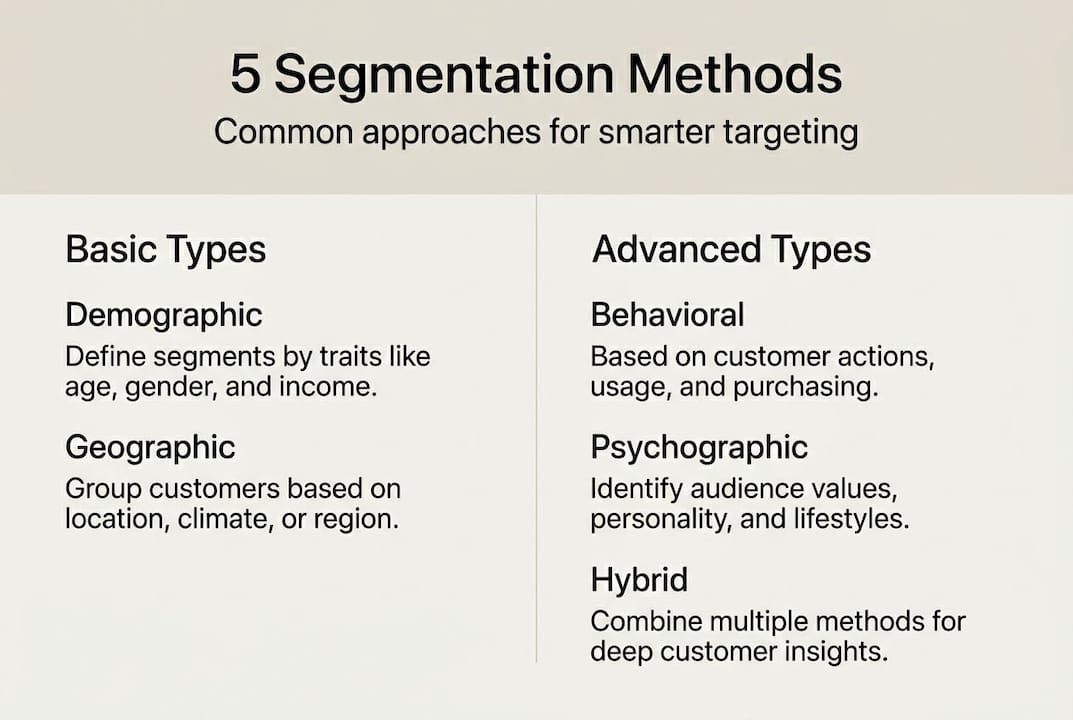
Primary segmentation types include demographic, geographic, psychographic, behavioral, and firmographic, and hybrid multi-dimensional approaches yield 20 to 30 percent better performance than single-method models. That performance gap is why enterprise teams are moving toward layered segmentation strategies rather than relying on any one method alone.
Here is a quick breakdown of each type with practical enterprise examples:
- Demographic: Age, income, job title, company size. Useful for broad targeting but limited in predictive power on its own.
- Geographic: Region, country, metro area, climate zone. Critical for localized campaigns or field sales territory planning.
- Psychographic: Values, lifestyle, attitudes, motivations. Powerful for brand positioning and content strategy.
- Behavioral: Purchase history, product usage, engagement patterns, churn signals. The most actionable type for conversion and retention campaigns.
- Firmographic: Industry, revenue, employee count, tech stack. The backbone of B2B account-based marketing programs.
| Segmentation type | Best use case | Key limitation |
|---|---|---|
| Demographic | Mass market targeting | Low predictive accuracy |
| Geographic | Regional campaigns | Misses intent signals |
| Psychographic | Brand and content strategy | Hard to scale with data |
| Behavioral | Conversion and retention | Requires robust tracking |
| Firmographic | B2B account targeting | Limited for B2C contexts |
Hybrid models combine two or more of these types to create richer, more predictive segments. A B2B enterprise might layer firmographic data with behavioral signals to identify high-intent accounts within a target industry. A B2C brand might combine demographic and psychographic data to find the right message for a specific lifestyle segment.

Leveraging marketing automation advantages is what makes hybrid segmentation scalable. Without automation, maintaining and activating multi-dimensional segments across channels becomes a manual burden that most teams cannot sustain.
Pro Tip: Always validate segment relevance through actual performance data before scaling spend. A segment that looks logical in a spreadsheet may not behave the way you expect once campaigns go live. Run a small test, measure response rates, and adjust criteria before committing budget.
How audience segmentation works: Step-by-step framework
Knowing your options is a start, but putting them into practice requires a clear framework.
The core segmentation mechanics follow a five-step process: define objectives, collect and integrate data, select criteria, create and validate segments, then test, activate, and iterate. That sequence sounds straightforward, but each step has enterprise-specific complexity worth addressing.
- Define objectives: Start with a specific business outcome. Are you trying to reduce churn, increase upsell revenue, or improve lead-to-close rates? Vague objectives produce vague segments.
- Collect and integrate data: Pull from CRM, marketing automation, web analytics, transactional systems, and third-party enrichment sources. Data quality at this stage determines everything downstream.
- Select criteria: Choose segmentation variables that are directly relevant to your objective. Resist the urge to include every available data point.
- Create and validate segments: Build the segments, then test them against historical data to confirm they behave differently from each other. Segments that look similar in response patterns are not useful segments.
- Test, activate, and iterate: Launch campaigns to each segment, measure results at the segment level, and update criteria based on what you learn.
Integrating segmentation with automation tools and CRM systems is what makes this framework repeatable rather than a one-time project. When segment logic lives inside your GTM stack, updates propagate automatically and campaigns stay aligned with current customer behavior.
| Campaign type | Primary data source | Key segment variable | Success metric |
|---|---|---|---|
| B2B pipeline acceleration | CRM plus intent data | Buying stage plus firmographic | Pipeline velocity |
| B2C retention | Behavioral plus transactional | Purchase recency plus frequency | Churn reduction |
Pro Tip: Pilot new segments on a small audience slice before full activation. This protects budget, surfaces data quality issues early, and gives you a clean baseline for measuring segment-level performance.
Enterprise segmentation: B2B vs. B2C, advanced tactics, and pitfalls
With the basics in place, enterprises face another layer of complexity when segmenting in different business models or at scale.
B2B segmentation emphasizes firmographic, account-based, and buying-group approaches, while B2C focuses on behavioral and demographic signals for faster purchase cycles. Intent-based segmentation enhances performance in both models by identifying audiences who are actively researching or showing purchase signals right now.
The most expensive segmentation mistake is treating a B2B buying committee the same way you would treat an individual consumer. The decision dynamics, the content needs, and the timeline are fundamentally different.
Here is where enterprises most often go wrong:
- Over-reliance on a single data type: Using only demographic data for a B2B campaign ignores buying intent entirely. Using only behavioral data for a B2C brand misses the psychographic drivers behind purchase decisions.
- Static segments: Dynamic segmentation that self-updates based on new behavior outperforms static models, but requires a data infrastructure investment that many teams delay.
- Ignoring data quality: Dirty, incomplete, or outdated data produces segments that look valid but perform poorly. A segment built on stale email addresses or misclassified company sizes will waste budget at scale.
Advanced tactics that high-performing enterprise teams are using in 2026 include:
- Hybrid segmentation: Combining firmographic with behavioral intent signals for B2B account prioritization
- Dynamic segment updates: Automating segment membership changes based on real-time behavioral triggers
- Real-time personalization triggers: Firing personalized content or offers the moment a user crosses a behavioral threshold
- Lookalike modeling: Using your best-performing segments as seeds to find similar audiences in new markets
- Segment-level LTV tracking: Measuring lifetime value by segment to identify which groups deserve the most acquisition investment
The marketing automation for agencies playbook applies here too. Enterprises that automate segment maintenance free up their analysts to focus on strategy rather than data hygiene.
Our take: What most segmentation advice overlooks
Most segmentation guides stop at the methodology. They tell you the five types, give you a framework, and leave you to figure out the hard part on your own. The hard part is execution at scale inside a real enterprise with legacy systems, competing priorities, and inconsistent data.
Here is what we have seen consistently: segmentation that is not directly connected to GTM and CRM execution will underperform, regardless of how sophisticated the underlying model is. A beautifully designed segment that lives in a spreadsheet and never gets activated inside your marketing stack is just an expensive analysis exercise.
The other truth most guides skip is that measuring analyzing segmented ROI at the segment level matters far more than optimizing for your largest audience group. Your biggest segment is rarely your most valuable one. The segments with the highest LTV and ROAS are often mid-sized, highly specific groups that most teams overlook because they look small on a dashboard.
Start small. Pick one objective, build two or three tight segments, activate them inside your existing stack, and measure relentlessly. That discipline compounds faster than any tool or tactic.
Bring smarter segmentation to your enterprise
If you are advancing your segmentation approach, the right support and tools accelerate results further.
Nimblo works with enterprise marketing and operations teams to operationalize segmentation strategies that connect directly to CRM execution, campaign automation, and measurable ROI. Our embedded automation pods bring together AI engineers, workflow architects, and domain experts to build the data infrastructure and activation logic that makes segmentation actually work at scale.
Explore our enterprise marketing solutions to see how we structure segmentation and automation engagements, or read more about enterprise automation strategies to understand what a fully operationalized approach looks like in practice. If you are ready to move from theory to execution, we would like to talk.
Frequently asked questions
What is the first step in audience segmentation?
Define clear marketing objectives, such as improving conversion or reducing churn, before collecting or segmenting any data. Starting without a specific outcome in mind produces segments that are technically valid but strategically useless.
What types of data are most important for segmentation?
Behavioral and firmographic data are the most powerful for enterprise use cases, particularly when combined in hybrid models that yield 20 to 30 percent better performance than single-method approaches.
How often should audience segments be updated?
Dynamic segment updates that respond to real-time behavioral changes outperform static quarterly reviews. Segments should be validated frequently to reflect current customer behavior and market conditions.
What is the main benefit of audience segmentation for ROI?
Segmentation enables personalized marketing campaigns that improve relevance and engagement, which directly reduces wasted spend and increases return on investment across every channel you activate.