
TL;DR:
- Small businesses can achieve high ROI and traffic via local SEO and Google Business Profiles.
- Consistent updates, reviews, and content optimization are crucial for long-term search visibility.
- Focused, specific strategies outperform broad tactics in AI-driven search environments.
SEO isn’t reserved for Fortune 500 companies with massive marketing budgets. Small businesses that invest in the right strategies are seeing 53% of website traffic come from organic search alone, with a 14.6% close rate compared to just 1.7% for outbound methods like cold calls or direct mail. That gap is enormous. Most small business owners assume SEO is too technical, too slow, or too expensive to bother with. This guide challenges that assumption directly. You’ll find research-backed, actionable steps that drive real visibility and bring in new customers, without needing a massive team or a six-figure budget.
Table of Contents
- Why SEO matters for small businesses
- Building your local SEO foundation
- Content, keywords, and AI: What works in 2026
- Tracking, troubleshooting, and growing: Measuring what matters
- Our perspective: Why small businesses still win with focused SEO, even in the age of AI
- Ready to supercharge your SEO results?
- Frequently asked questions
Key Takeaways
| Point | Details |
|---|---|
| Local SEO wins customers | Optimizing your Google Business Profile and local content turns searches into sales faster than any other channel. |
| Focus on AI-readiness | Structured data and conversational answers help you stay visible in evolving AI-powered search results. |
| Consistent tracking matters | Measuring organic conversions and fixing gaps keeps your SEO investment profitable as algorithms shift. |
| Start with the basics | Master reviews, accurate citations, and focused keywords before chasing advanced tactics or new trends. |
Why SEO matters for small businesses
If you’re still treating SEO as optional, consider this: 97% of consumers search for local businesses online before making a purchase decision. That’s not a trend. That’s your customer base, actively looking for what you sell, every single day.
“SEO isn’t a luxury for small businesses anymore. It’s the primary channel through which customers find, evaluate, and choose local providers.”
The importance of local SEO goes beyond just showing up in search results. It’s about being present at the exact moment a buyer is ready to act. Local searches convert fast. Nearly 28% of local searches result in a purchase within 24 hours. That’s a buying signal you can’t afford to ignore.
Here’s what makes SEO especially powerful compared to traditional marketing channels:
- Longevity: A well-optimized page keeps generating traffic for years, unlike a paid ad that stops the moment your budget runs out.
- Compounding returns: SEO results build on themselves. Traffic and authority grow over time, not in a straight line but in an accelerating curve.
- Intent-based reach: People searching for “emergency plumber near me” or “best accountant in Austin” are already in buying mode. You’re not interrupting them. You’re answering them.
- Cost efficiency: SEO delivers up to 1200% ROI over three years for small businesses, outperforming most traditional marketing by a factor of 8 to 12 times.
The ROI comparison is stark:
| Marketing Channel | Average 3-Year ROI | Lead Close Rate |
|---|---|---|
| SEO (organic) | Up to 1200% | 14.6% |
| Outbound (cold calls, mail) | 100-200% | 1.7% |
| Paid social ads | 200-400% | 3-5% |
Those numbers aren’t theoretical. They reflect what small businesses across industries are actually achieving when they commit to consistent SEO effort. The question isn’t whether SEO works. It’s whether you’re using it.
Building your local SEO foundation
Understanding the value of SEO is one thing. Knowing where to start is another. The good news: the highest-ROI actions are also the most accessible ones, and they don’t require a technical background.
Your Google Business Profile (GBP) is the single most important asset in local search. GBP completeness, reviews, and citations account for up to 56% of local pack rankings, meaning they directly determine whether you appear in the top three results when someone searches for your service nearby.
Here’s a step-by-step approach to set up Google Business Profile and build your local foundation:
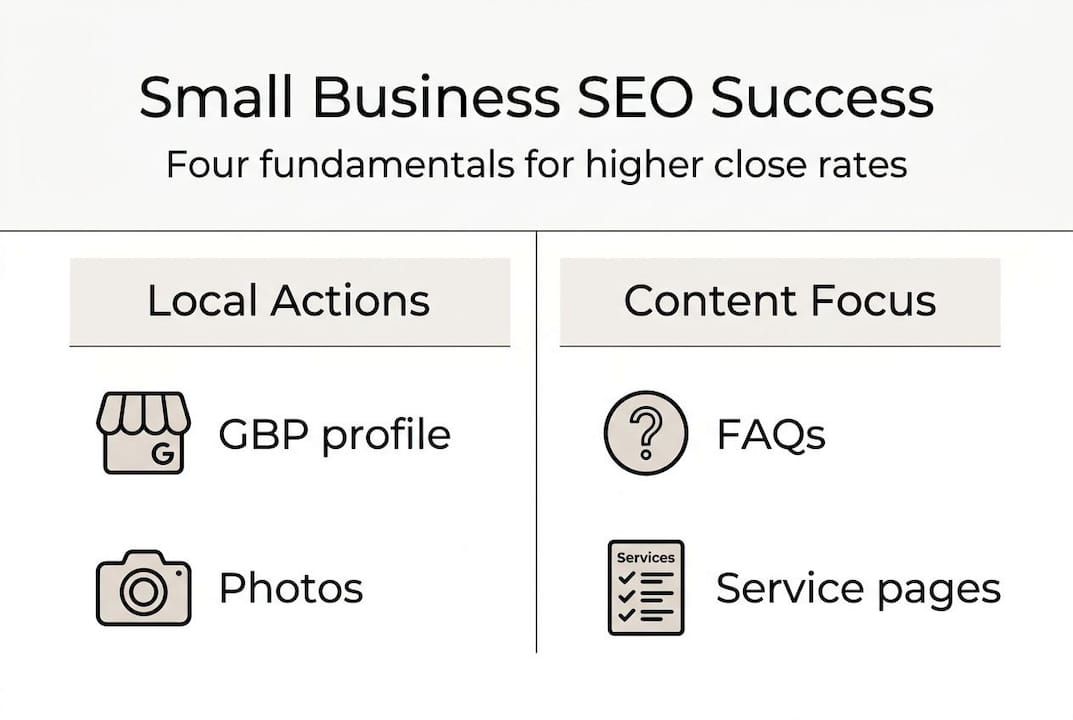
- Claim and verify your GBP listing: Make sure every field is filled out completely, including business hours, service areas, categories, and a detailed description.
- Add photos consistently: Businesses with 50+ photos get 520% more map directions than those with fewer. Upload real photos of your team, location, and work.
- Collect reviews actively: Ask satisfied customers directly and respond to every review, positive or negative. Review volume and recency both affect rankings.
- Build local citations: Get your business listed accurately on directories like Yelp, Bing Places, and industry-specific platforms. Consistency in name, address, and phone number matters.
Local SEO foundation checklist:
| Action | Priority | Impact |
|---|---|---|
| Complete GBP profile | High | Very High |
| Add 50+ photos | High | High |
| Generate 10+ reviews | High | Very High |
| Build 20+ citations | Medium | High |
| Add posts to GBP weekly | Medium | Medium |
For inspiration on what’s working right now, explore examples of local SEO strategies that other small businesses are using effectively. You can also review specific Google Business Profile features that are often underused but deliver strong results.

Pro Tip: Don’t just fill out your GBP once and forget it. Treat it like a social media profile. Post updates, add seasonal offers, and respond to questions. Active profiles rank higher and convert better.
Content, keywords, and AI: What works in 2026
With your local foundation in place, the next lever is content. And in 2026, content strategy has shifted in ways that favor small businesses willing to be specific and consistent.
Long-tail keywords are where small businesses win. Instead of targeting “plumber,” target “emergency water heater repair in Denver.” These phrases have lower competition, higher buyer intent, and convert at a much better rate. They’re also easier to rank for, which means faster results with less effort.
Here’s how to approach keyword and content strategy in 2026:
- Research buyer-intent keywords: Use tools like Google’s free Keyword Planner or Ubersuggest to find phrases your customers actually type when they’re ready to buy.
- Write content that answers real questions: Structure your pages with clear headings, short paragraphs, and direct answers. This format performs well in both traditional search and AI-generated overviews.
- Add structured data markup: Schema markup helps search engines and AI systems understand your content. It increases your chances of being cited in AI Overviews, which now appear in 25.8% of all searches.
- Update existing content regularly: 72.9% of top-10 pages are over three years old, but they’re updated consistently. A 1,750-word page refreshed yearly outperforms a new page written once and abandoned.
Content format comparison:
| Content Type | Best For | AI Visibility |
|---|---|---|
| FAQ pages | Featured snippets | High |
| Service location pages | Local rankings | Medium |
| How-to guides | Educational queries | High |
| Case studies | Trust building | Low |
Following current SEO best practices means treating your website like a living document, not a one-time project. The businesses ranking at the top aren’t necessarily the ones who wrote the most content. They’re the ones who kept improving it.
Pro Tip: Pick three to five core service pages and commit to updating them every six months. Add new customer questions, refresh statistics, and improve the structure. That alone can lift rankings significantly.
Tracking, troubleshooting, and growing: Measuring what matters
Creating great content and optimizing your GBP is only valuable if you’re measuring what’s actually working. Without tracking, you’re flying blind, and small businesses can’t afford to waste time or money on tactics that aren’t delivering.
Focus on these core metrics:
- Organic conversions: How many leads or sales came from organic search? This is your north star.
- Customer acquisition cost (CAC): Compare your SEO-driven CAC to paid channels. SEO leads close at 14.6% versus 1.7% for outbound, which means your cost per acquired customer through SEO is dramatically lower.
- Organic traffic growth: Track month-over-month trends in Google Search Console. Look for pages gaining or losing clicks.
- Keyword position changes: Monitor your target keywords weekly. A sudden drop signals either a technical issue or an algorithm update.
“The businesses that win long-term with SEO are the ones that treat it like a system, not a one-time project. They measure, adjust, and stay consistent.”
Algorithm and AI changes are real risks. 40% of small businesses lost meaningful traffic from Google or AI-driven search shifts in recent years. The fix isn’t panic. It’s a structured audit.
When traffic drops, check these in order:
- Thin or duplicate content: Pages with less than 500 words or copied text get deprioritized.
- Mobile usability: Google ranks mobile-first. A site that’s hard to use on a phone will lose rankings.
- Page speed: Slow load times hurt both rankings and conversions.
- Backlink profile: Lost or toxic backlinks can drag down your entire domain.
Learning how to increase local website traffic through consistent monitoring and smart troubleshooting separates businesses that grow from those that stall.
Pro Tip: Set a monthly SEO review calendar. Spend 30 minutes checking Search Console, reviewing your top five pages, and confirming your GBP is active. Consistency beats intensity every time.
Our perspective: Why small businesses still win with focused SEO, even in the age of AI
Here’s something most SEO guides won’t tell you: the rise of AI in search is actually good news for small businesses. Not because it’s easy, but because it rewards exactly what large competitors often fail to do, which is being specific, local, and genuinely useful.
Big brands optimize for broad keywords and massive scale. You can optimize for your neighborhood, your niche, and your customer’s exact problem. That specificity is your competitive edge, and AI-powered search amplifies it.
The mistake we see most often is small business owners chasing every new tactic. One week it’s AI content tools, the next it’s short-form video SEO. The businesses that actually grow are the ones that master the basics and execute them consistently. As 2026 SEO guidance confirms, integrating AI-readiness through structured data and conversational content works best when it’s layered on top of a solid foundation, not used as a replacement for it.
The Google Business Profile tips that worked two years ago still work today. The fundamentals haven’t changed. What’s changed is how much more they matter when your competitors aren’t doing them.
Focus on your market. Own your niche. Measure what moves revenue. That’s the formula.
Ready to supercharge your SEO results?
You now have a clear picture of what drives SEO results for small businesses in 2026. From building a strong Google Business Profile to creating content that ranks in AI-powered search, every tactic here is proven and actionable.
But knowing the strategy and executing it consistently are two different things. If you’re ready to turn these insights into real traffic and customer growth, explore our SEO solutions for small businesses designed specifically for owners who want results without the guesswork. We make it straightforward to get expert support, track real ROI, and build the kind of online presence that keeps generating leads month after month.
Frequently asked questions
What is the most effective SEO strategy for small businesses in 2026?
Combining a fully optimized Google Business Profile with local content and structured data for AI visibility delivers the highest ROI. Local SEO and reviews remain the top ranking factors for small businesses.
How long does SEO take to work for small businesses?
Most businesses see measurable results in 3 to 6 months, with traffic and leads compounding significantly over 12 to 24 months. Top-ranking content is often several years old but consistently updated.
How much budget should a small business allocate for SEO?
Most small businesses invest $1,500 to $5,000 per month or commit 5 to 8 hours of focused DIY work weekly. The suggested budget range depends on your market competition and growth goals.
What should I do if my SEO traffic suddenly drops?
Audit for algorithm or AI-driven changes first, then refresh thin content and fix any mobile or technical issues. 40% of small businesses have experienced traffic loss from search shifts, so prompt action matters.
Is it better to manage SEO in-house or hire an agency?
DIY works well for foundational tactics, but agencies add value when you need advanced tracking, link building, or fast adaptation to algorithm changes. 50% of small businesses handle SEO in-house and use agencies for specialized needs.