
TL;DR:
- Effective enterprise content marketing relies on clear success metrics, strategic alignment, and AI integration.
- Cross-functional ContentOps and structured workflows are crucial for sustainable content performance.
- Prioritizing social and video channels enhances engagement and aligns with modern buyer preferences.
Enterprise marketing leaders are under increasing pressure to prove that their content operations deliver real, measurable results. 68% of enterprise marketers rate their marketing as highly or somewhat effective, outpacing broader B2B peers at 59%. But that gap does not close by accident. It closes when executives make deliberate choices about strategy, tooling, and organizational alignment. This article walks through the core criteria for evaluating content marketing strategies, then covers three evidence-backed approaches that consistently separate high-performing enterprise teams from those stuck in a cycle of high output and low impact.
Table of Contents
- Define success: Key criteria for enterprise content marketing strategies
- Strategy #1: AI-powered content creation and automation
- Strategy #2: Cross-functional alignment and ContentOps
- Strategy #3: Channel mix optimization—social, video, and blogs
- Our take: Quality, alignment, and innovation outpace volume and automation
- Take the next step: Enhance your content marketing ROI with AI-driven solutions
- Frequently asked questions
Key Takeaways
| Point | Details |
|---|---|
| Operational efficiency wins | Enterprise marketers rate high effectiveness because they prioritize streamlined processes, not just output. |
| AI automation leads transformation | 95% of enterprises rely on AI-powered tools to improve content creation and personalization. |
| ContentOps drives sustained results | Teams with structured workflows and cross-functional alignment outperform those focusing on volume alone. |
| Channel mix matters | Social and video generate more engagement than blogs—optimizing your mix is key to ROI. |
| Quality and alignment outpace quantity | Top-performing teams refine strategy, embrace innovation, and avoid chasing content quantity. |
Define success: Key criteria for enterprise content marketing strategies
Before comparing strategies, you need a shared definition of what winning looks like. For enterprise teams, that means moving past vanity metrics like page views or social followers and anchoring evaluation to criteria that actually reflect business value.
Here are the benchmarks that matter most:
- Operational efficiency: How much time and budget does the strategy consume relative to the output it delivers? Efficient strategies reduce manual effort and improve throughput without proportional cost increases.
- Cross-functional alignment: Does the strategy connect marketing, sales, product, and operations around shared goals? Content that lives inside a silo rarely compounds in value.
- Measurable ROI: Can you trace content activity to pipeline, revenue, or retention outcomes? If attribution is impossible, the strategy is likely not worth scaling.
- Quality over quantity: Does the approach prioritize depth and relevance, or just output volume? Enterprise buyers respond to specificity.
- AI integration with human oversight: Does the strategy use AI to amplify human decision-making, or does it run on automation alone without strategic input?
The AI efficiency and ROI conversation is central here. AI can unlock enormous leverage, but only when deployed inside a strategy that has clear goals and governance. Without that, automation speeds up the wrong activities.
Statistic to remember: Enterprise marketers outperform their B2B peers in self-rated effectiveness (68% vs. 59%), and the strategies outlined below explain a significant share of that gap.
Pro Tip: Build your evaluation scorecard before piloting any new content strategy. Rate each option across efficiency, alignment, ROI traceability, and AI readiness. This prevents post-launch rationalization and keeps executive stakeholders aligned on what success actually means.
Strategy #1: AI-powered content creation and automation
AI is no longer a future-state ambition for enterprise marketing. It is the operating baseline. 95% of enterprise marketers now use AI-powered marketing applications, with content creation being the dominant use case at 86%. That level of adoption signals a shift: the question is no longer whether to use AI, but how to use it well.
The results are meaningful. AI improves content quality for 53% of enterprise marketers and content performance for 38%. Those are real gains, and they compound when AI is embedded into repeatable workflows rather than used on a one-off basis.
Practical AI applications that enterprise teams are deploying today include:
- Automated content scheduling across channels, reducing manual coordination between marketing ops and creative teams
- Dynamic content personalization that adapts messaging based on buyer segment, industry, or stage in the funnel
- AI-assisted drafting and editing that accelerates first-draft production without replacing editorial judgment
- Performance-triggered content updates that flag underperforming assets for refresh based on engagement data
If you are evaluating AI SEO tool comparison options for your content stack, the key is to look for tools that integrate with your existing CRM and CMS rather than requiring a separate workflow.
There is an important caveat, though. While enterprise marketing automation platforms are powerful, only 3% of enterprise marketers currently use AI agents as a core strategic layer. The rest use AI tactically. That gap matters because tactical AI use tends to plateau. You get faster content, but not smarter content strategy.
“AI excels at execution. It does not replace the strategic thinking that determines whether you are creating the right content for the right audience at the right time.”
Pro Tip: Audit your current AI tools by use case. If every tool is focused on creation speed and none are focused on strategic insight, like audience gap analysis or competitive positioning, you are leaving the highest-value AI applications unused.
Strategy #2: Cross-functional alignment and ContentOps
AI handles the execution layer. ContentOps handles the organizational layer. And without both working together, enterprise content programs tend to drift: teams publish more, but results flatten.

ContentOps prioritizes cross-functional alignment over sheer volume. Enterprises succeed through structured processes, not output alone. That insight is backed by data: 61% of enterprise marketers improved their content strategy in the last 12 months, and strategy refinement was the top driver at 73%. Technology upgrades ranked lower. That is a critical finding for executives who default to buying new tools when results stagnate.
Here is how to build effective ContentOps in practice:
- Map your content supply chain. Identify every step from brief to publish, including approval gates, legal review, and distribution. You cannot optimize what you have not documented.
- Assign clear ownership across functions. Every content asset should have one accountable owner, not a committee. Shared ownership is often no ownership.
- Standardize your editorial calendar across teams. Campaigns, product launches, and thought leadership need to live in one shared planning view.
- Establish feedback loops between content and sales. Content that does not inform sales conversations is content that likely does not reflect buyer reality.
- Run quarterly strategy reviews. Not just performance reviews. Actual strategy reviews that ask whether you are targeting the right topics, channels, and audiences.
Here is a direct comparison of output-focused versus process-focused approaches:
| Dimension | Output-focused approach | Process-focused ContentOps |
|---|---|---|
| Primary metric | Volume of content published | Quality and alignment of content |
| Team coordination | Ad hoc, by project | Structured, by workflow |
| ROI visibility | Low, difficult to attribute | High, traceable to outcomes |
| Scalability | Hits ceiling quickly | Scales with process maturity |
| AI integration | Bolted on for speed | Embedded in workflow design |
Connecting agentic AI for leaders to your ContentOps model is where the real leverage lives. When AI agents operate inside structured workflows rather than around them, the efficiency gains are sustainable. And when ContentOps is aligned with customer engagement strategies, content naturally reflects what buyers actually need at each stage.
Pro Tip: Invest in strategy refinement before you invest in another platform. A well-structured ContentOps model will extract more value from your existing tools than a new tool will extract from a broken process.
Strategy #3: Channel mix optimization—social, video, and blogs
Once your content creation engine and operational structure are solid, channel mix becomes your strategic lever for multiplying results. And the data here is clear: not all channels are created equal for enterprise teams.
Social content drives 32% top impact for B2B marketers, compared to just 11% for blogs. That does not mean blogs are dead. Median B2B SaaS companies publish 11 to 20 blog posts per quarter, and search-optimized content still plays a critical role in long-term pipeline. But the center of gravity has shifted toward social and video.
Here is how to think about channel allocation:
| Channel | Primary strength | Enterprise use case |
|---|---|---|
| Social (LinkedIn, X) | Reach, engagement, thought leadership | Executive visibility, demand generation |
| Video (YouTube, webinars) | Trust building, complex topic explanation | Product education, customer stories |
| Blog and SEO | Long-term discovery, authority building | Organic pipeline, category capture |
| Nurture, retention, conversion | ABM campaigns, customer lifecycle |
- Social and video content generates faster engagement signals, giving your team real-time data to optimize against
- Blog content compounds over time but requires consistent investment to build domain authority
- Video content is particularly effective for enterprise deals with complex buying committees who need to build confidence before engaging sales
“AI boosts ROI for 68% of marketers, but effectiveness plateaus without alignment. Quality and channel fit matter more than volume across every format.”
Social media marketing and AI in local SEO are both channels where AI tools can dramatically accelerate the feedback loop between publishing and optimization. The key is to let performance data guide your channel weighting over time rather than defaulting to historical assumptions about where your audience lives.
Our take: Quality, alignment, and innovation outpace volume and automation
Here is the uncomfortable truth most enterprise marketing teams do not want to hear: more automation without better alignment makes your problems faster, not smaller. We have seen teams triple their content output with AI tools and watch engagement rates drop because the content was faster but not smarter.
The teams that consistently outperform are not the ones with the largest content budgets or the most sophisticated AI stacks. They are the ones with rigorous strategy reviews, genuine cross-functional alignment, and a willingness to cut channels that no longer deliver. They treat ContentOps as infrastructure, not overhead.
Social and video are not trends. They are the new primary channels for enterprise buyers who want insight before they engage. If your enterprise automation advantages are concentrated in blog production, you are optimizing the wrong asset class. The teams winning in 2026 are the ones who reallocated early, invested in alignment, and used AI to enhance judgment rather than replace it.
Take the next step: Enhance your content marketing ROI with AI-driven solutions
The strategies covered here share one common requirement: they work best when AI, people, and process operate as an integrated system rather than independent parts. That is exactly the model Nimblo AI is built around.
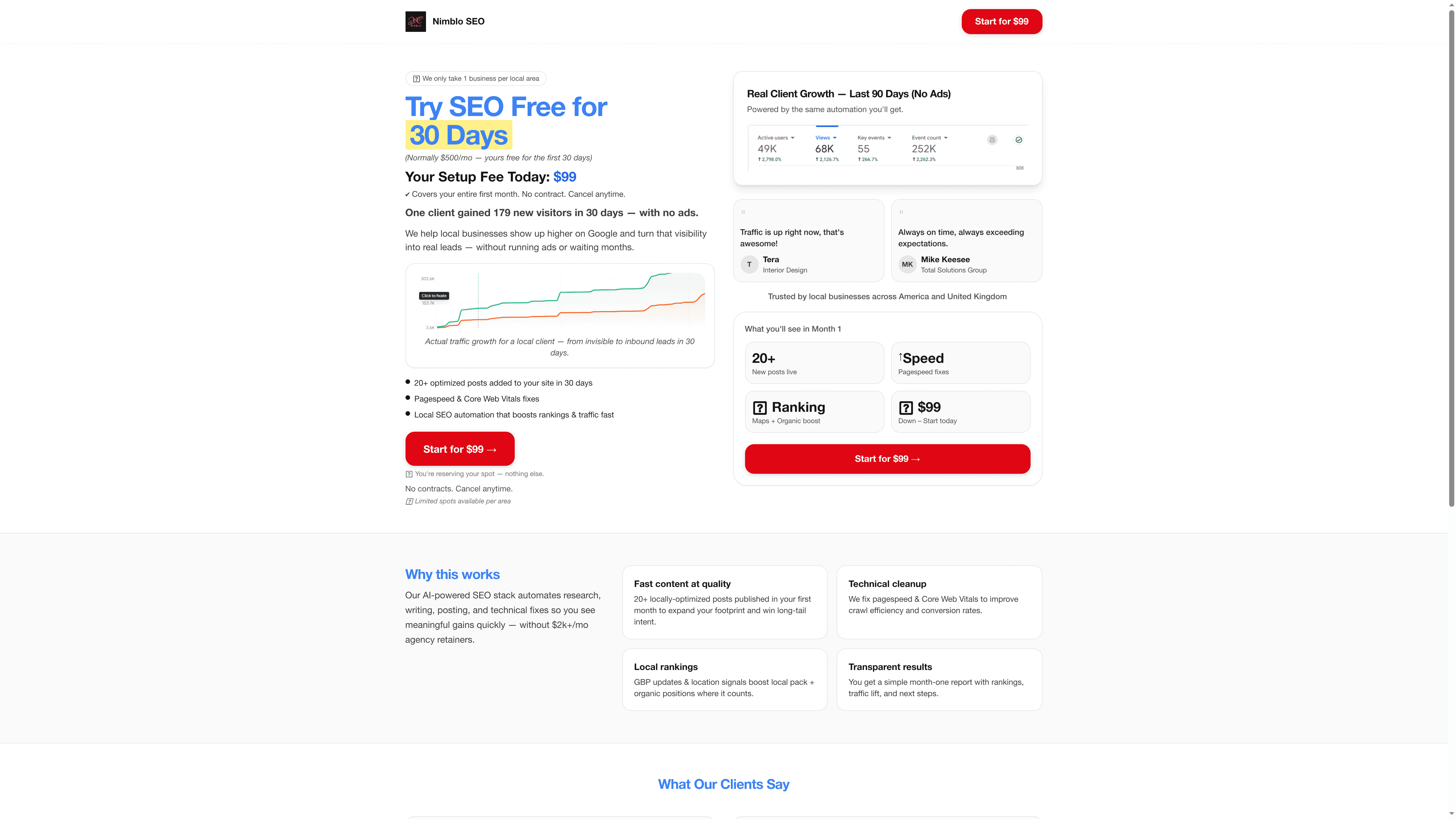
Nimblo embeds cross-functional automation pods directly into your marketing and operations teams, combining AI engineers, workflow architects, and domain experts in a structured 120-day engagement. If your content marketing operations need better alignment, faster execution, and traceable ROI, explore AI-driven marketing solutions built for enterprise scale. The next step toward measurable, sustainable content marketing performance starts with the right operational foundation.
Frequently asked questions
How does AI-driven automation improve enterprise content marketing?
AI-driven automation accelerates content creation and personalization, improving quality for 53% and performance for 38% of enterprise marketers. The real gain comes when automation is embedded inside structured workflows rather than used as a standalone speed tool.
What is ContentOps and why is it important?
ContentOps is the structured organization of workflows and teams for content creation and distribution. Enterprises succeed through structured processes and cross-functional alignment, not raw output volume, making ContentOps a core competitive advantage rather than an operational detail.
Which channels drive the most impact for enterprise content marketing?
Social content leads with 32% top impact for B2B marketers, well ahead of blogs at 11%. Video is rapidly gaining ground, particularly for complex enterprise buying cycles where trust must be built before sales conversations begin.
How should executives balance AI automation with human oversight?
AI handles execution well, but human oversight remains essential for strategy, channel decisions, and quality control. Only 3% use AI agents as core strategy, meaning most enterprise teams still rely on human judgment for the decisions that matter most.
What are the top content marketing priorities for enterprises in 2026?
Strategy refinement leads at 73%, followed by cross-team alignment, channel optimization, and AI tool investment. 61% of enterprise marketers improved their content strategy in the last 12 months by focusing on process quality rather than technology alone.