
TL;DR:
- Local search is a high-ROI revenue tool for enterprise-scale organizations.
- Consistent management of profiles, reviews, and content is key to success.
- AI-driven search increases importance of structured data, unique location content, and trust signals.
Enterprise leaders often assume local search optimization is a tactic reserved for neighborhood shops and single-location businesses. That assumption is costing large organizations real money. A multi-location brand recently generated $127K in revenue from a $9.6K investment in just 90 days, a 347% ROI that no CFO would dismiss. At enterprise scale, local search compounds across dozens or hundreds of locations, creating a revenue engine that national campaigns simply cannot replicate. This guide covers the most effective, evidence-based strategies your organization can deploy in 2026 to drive visibility, customer engagement, and measurable growth through local search.
Table of Contents
- Why local search optimization matters for enterprises
- Core methodologies for scalable local search optimization
- Navigating AI-driven search: Making your website the ‘source of truth’
- Enterprise challenges and advanced solutions in local search
- Why most enterprises miss local search optimization’s real opportunity
- Ready to transform your enterprise’s local search results?
- Frequently asked questions
Key Takeaways
| Point | Details |
|---|---|
| ROI is substantial | Enterprises have demonstrated over 300% ROI from local search optimization investments in just 90 days. |
| GBP completeness and reviews are critical | Fully optimized profiles and sustained review acquisition consistently outperform higher totals with low engagement. |
| AI search raises the bar | Websites must have structured schema, FAQs, and unique local content to win in increasingly selective AI-driven results. |
| Unique local content beats templates | Multi-location brands must use unique hyperlocal content to prevent penalties and maximize visibility. |
| Track beyond rankings | Success is best measured by pack visibility, directions, and conversions, not only by search rankings. |
Why local search optimization matters for enterprises
Local search is not a small-business tactic. It is one of the highest-intent marketing channels available, and at enterprise scale, its impact multiplies fast. When someone searches for your service near a specific location, they are ready to act. Capturing that moment across hundreds of locations is where enterprise organizations win or lose significant revenue.
The business case is hard to argue with. Beyond the 347% ROI benchmark mentioned above, brands have seen 300% organic traffic increases through targeted on-page fixes, and franchise networks have reported 49% more leads after implementing structured local search programs. These are not outlier results. They reflect what happens when a disciplined, scalable approach replaces ad hoc local efforts.
For enterprises specifically, the compounding effect is the real story. A single-location business improving its local search performance sees one stream of new customers. An organization with 200 locations sees 200 streams. Each location that climbs into the Map Pack or earns a featured AI recommendation generates incremental revenue that adds up to material business impact at the portfolio level.
The challenges, though, are real. Enterprise organizations face three specific pressures that smaller competitors do not:
- Scale: Managing consistent, accurate information across hundreds of Google Business Profiles (GBP) is operationally complex.
- Consistency: Brand standards, hours, services, and contact details must stay synchronized across every location and every platform.
- Local relevance: National messaging rarely resonates at the neighborhood level. Each location needs content that speaks to its specific community.
Understanding local SEO foundations is the starting point, but enterprise execution requires a layer of operational discipline that most organizations underestimate. The brands that crack this combination are the ones generating outsized returns. The ones that treat local search as a set-it-and-forget-it task are leaving substantial revenue on the table. For teams focused on increasing enterprise website traffic, local search is often the fastest lever available.
“Local search is not a visibility tactic. It is a revenue infrastructure decision.”
Core methodologies for scalable local search optimization
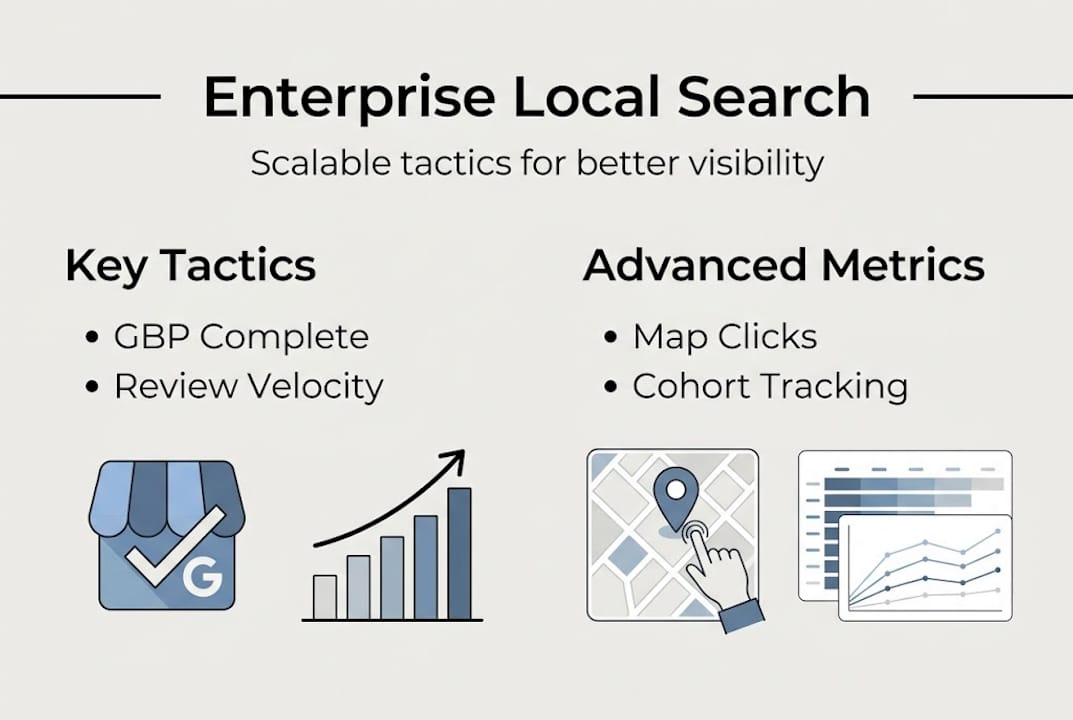
With the business case established, the next question is execution. What actually moves the needle for enterprise organizations? The answer comes down to five core methodologies, each of which scales across locations when implemented with the right systems.
1. Google Business Profile completeness
GBP profiles with 95% or more field completion consistently outperform incomplete profiles. That means every location needs accurate hours, service categories, photos, descriptions, and attributes filled in. Incomplete profiles signal unreliability to both search algorithms and customers. Review the GBP setup best practices to ensure your team is not leaving easy wins uncaptured.
2. Review velocity over review volume
This surprises most teams. Earning 10 or more new reviews per month matters more than having a large total count. Algorithms and customers both interpret recent reviews as a signal of active, trustworthy operations. A location with 500 old reviews and no new ones looks stagnant. Use the Google Business Profile checklist to build a systematic review request process into your operations.
3. Consistent NAP citations
NAP stands for Name, Address, and Phone number. Inconsistent NAP data across directories, social profiles, and your own website confuses search engines and undermines trust. Consistent citations now serve a dual purpose: they support traditional Map Pack rankings and help AI systems ground their local recommendations in verified data.
4. Hyperlocal content and location pages
Each location needs a dedicated page with unique content, not a template with the city name swapped in. Thin, duplicate location pages are treated as spam by search engines. Genuine hyperlocal content, covering neighborhood context, local staff, and community involvement, signals authenticity.
5. Schema markup and structured data
LocalBusiness schema tells search engines and AI systems exactly what your business is, where it operates, and what it offers. Without it, you are relying on algorithms to guess.
| Methodology | Primary benefit | Enterprise priority |
|---|---|---|
| GBP completeness | Map Pack visibility | High |
| Review velocity | Trust and ranking signals | High |
| NAP consistency | Citation authority | Medium |
| Hyperlocal content | Organic and AI visibility | High |
| Schema markup | AI and structured search | Critical |
Pro Tip: Audit your top 20 locations first. Fix completeness and review gaps there before scaling the program. Early wins build internal momentum and prove ROI to leadership.
The key local SEO methodologies above are well-established, but most enterprises implement them inconsistently. Systematic execution across all locations is the differentiator.

Navigating AI-driven search: Making your website the ‘source of truth’
AI is reshaping how local search results are delivered, and the implications for enterprise organizations are significant. Traditional search returned ten blue links. AI assistants return one or two answers. If your website is not structured to be selected as a trusted source, you are invisible to a growing share of high-intent searchers.
The numbers are stark. AI search is 30x more selective, with only 1.2% of results surfaced by ChatGPT. That selectivity means the bar for inclusion is dramatically higher than it was in traditional search. Structured content, schema markup, and clear evidence of local expertise are now table stakes, not optional enhancements.
| Signal | Traditional search impact | AI search impact |
|---|---|---|
| LocalBusiness schema | Moderate | Critical |
| FAQ content | Low | High |
| Review recency | High | High |
| NAP consistency | High | Medium |
| Unique location content | Medium | Critical |
Zero-click searches, where users get their answer directly from the results page without visiting a site, are also increasing. This makes it even more important that your structured data is accurate and complete. If AI pulls the wrong address or outdated hours, the damage to customer experience is immediate.
For enterprises, the practical steps are clear. Every location page needs LocalBusiness schema implemented correctly. Each page should include a robust FAQ section that answers the questions your customers actually ask. And the content must demonstrate local E-E-A-T, meaning Experience, Expertise, Authoritativeness, and Trustworthiness, through specific local references, staff credentials, and community context.
“45% of retail leaders are missing critical AI recommendations because their websites lack the structure AI systems need to select them as a trusted source.”
Pro Tip: Test your location pages with Google’s Rich Results Test tool. If your schema is not validating cleanly, AI systems are likely skipping your pages entirely.
For teams working to maximize your local SEO ROI, the website is now the foundation, not just a supporting asset. AI search optimization requires treating each location page as a standalone authority document.
Enterprise challenges and advanced solutions in local search
Operating local search at enterprise scale introduces challenges that go well beyond what a typical marketing team handles. The organizations that perform best are the ones that build systems, not just campaigns.
The most common pitfall is thin location pages. Many enterprises build location pages using templates that swap in city names and addresses but share identical body content. Search engines classify these as doorway pages, which are low-value pages designed to rank rather than inform, and they suppress them in results. Each location page must have genuinely unique content that reflects the specific community, team, and services at that site.
Here is what high-performing enterprise local search programs have in common:
- API data syndication: Rather than manually updating hundreds of profiles, leading brands use API connections to push accurate data from a single source of truth to GBP, Yelp, Apple Maps, and other platforms simultaneously.
- Cohort-based management: Instead of trying to manage 300 locations as one undifferentiated group, smart teams segment locations into cohorts by performance tier, region, or service type. This allows targeted interventions where they matter most.
- Ongoing maintenance cycles: Local search is not a one-time project. Hours change, services evolve, and new competitors emerge. Monthly audits and quarterly content refreshes outperform annual overhauls.
- Performance tracking by the right metrics: Pack visibility, map directions clicks, and conversion rates tell you far more than static keyword rankings. Rankings shift constantly; customer actions are what drive revenue.
Multi-location brands that implement API syndication and cohort-based tracking consistently outperform those relying on manual updates and rank-only reporting.
Pro Tip: Build a performance dashboard that tracks map directions clicks and call conversions by location. These metrics correlate directly with foot traffic and revenue in ways that keyword rankings do not.
For organizations focused on improving local website performance, the investment in systems and ongoing management pays back faster than any single campaign. The advanced local SEO tactics that separate good programs from great ones are almost always operational, not creative.
Why most enterprises miss local search optimization’s real opportunity
Here is the uncomfortable truth: most enterprise local search programs are optimized for the wrong goal. Teams chase a universal number-one ranking, as if a single position could represent performance across hundreds of locations in dozens of markets. It cannot. Search results are hyperlocal and personalized, meaning no universal rank exists to chase.
The brands outperforming their peers are not obsessing over rank. They are tracking review velocity, operational completeness, and AI visibility. They treat each location as a distinct market with its own competitive dynamics. They measure success through pack visibility, engagement, and conversions, not through a screenshot of a keyword position.
What we see consistently is that the gap between good and great local search performance is almost never a content creativity problem. It is an operational discipline problem. The brands winning in local search have built systems that keep data accurate, reviews flowing, and location pages current. Everything else is secondary.
For enterprise teams serious about enterprise traffic optimization, the shift from rank-focused thinking to conversion-focused thinking is the single biggest unlock available in 2026.
Ready to transform your enterprise’s local search results?
If the strategies above feel like the right direction but the execution feels overwhelming at scale, that is a common and solvable problem. Building the systems, workflows, and content processes to run local search optimization across hundreds of locations requires more than a checklist.
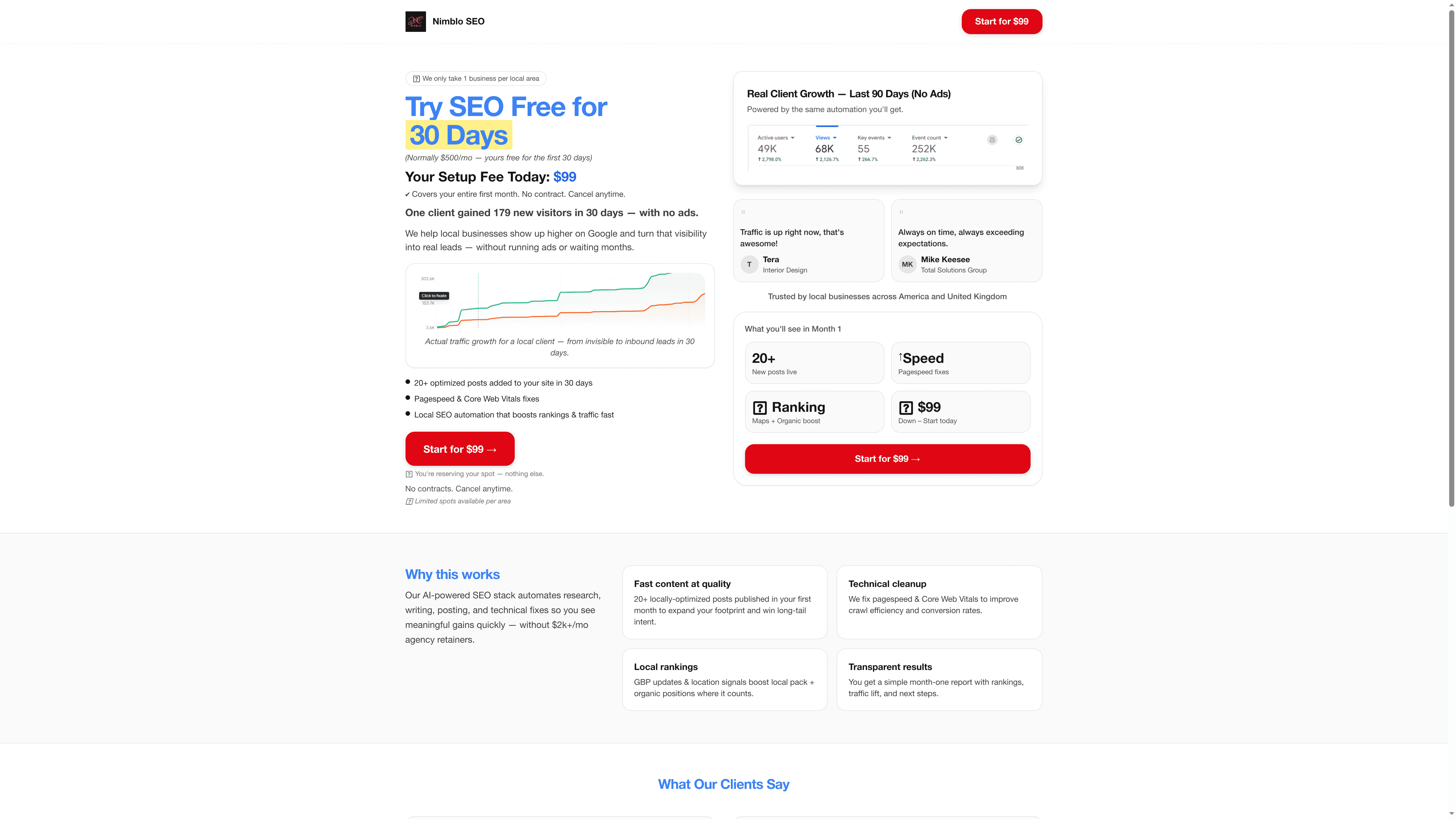
Nimblo’s embedded automation teams work directly inside enterprise operations to build the workflows, data pipelines, and content systems that make scalable local search execution possible. From API syndication to automated review management and location page optimization, our 120-day engagement model delivers measurable results without adding headcount. If you are ready to turn local search into a real revenue driver, explore the enterprise local search optimization solution and see what structured execution looks like in practice.
Frequently asked questions
What is the most important factor for local search optimization in 2026?
For enterprises, GBP completeness and review velocity are the most impactful signals, followed by structured website content built for AI visibility. Both require ongoing operational discipline, not one-time setup.
How does AI change local search results?
AI search is 30x more selective than traditional search, surfacing only 1.2% of results through platforms like ChatGPT. Enterprises need robust schema, FAQs, and authoritative location pages to be selected as a trusted source.
Is it still important to build local citations?
Yes. Citations are resurging as AI systems use them to verify business data, even as their direct impact on Map Pack rankings has shifted. Consistent NAP data across platforms remains a foundational requirement.
How do you measure ROI from local search optimization?
Track pack visibility, directions, and conversions rather than keyword rankings alone. These metrics connect directly to foot traffic and revenue, giving leadership a clear picture of what local search is actually generating.
What’s the biggest mistake enterprises make with local SEO?
Relying on thin, templated location pages and inconsistent review management. Search engines suppress duplicate content, and AI systems skip pages that lack unique local authority signals.