
TL;DR:
- Most enterprises lack clear measurement frameworks, causing misallocated resources and stalled AI projects.
- Effective ROI tracking requires establishing baselines, choosing suitable metrics, and continuous benchmarking.
- Simplified, direct impact metrics and quarterly reviews boost trust and long-term AI ROI success.
Only 20% of organizations qualify as AI ROI Leaders, meaning most enterprises are pouring budget into automation without a clear picture of what they’re getting back. That’s not a technology problem. It’s a measurement problem. When ROI tracking is vague or missing, the consequences are real: misdirected resources, stalled projects, and leadership that loses confidence in AI initiatives entirely. This guide gives you a practical, step-by-step framework to set baselines, choose the right metrics, track progress in real time, and continuously refine your approach so your AI automation investments consistently deliver.
Table of Contents
- Why tracking ROI in enterprise AI automation is different
- Step 1: Establish concrete baselines and objectives
- Step 2: Select and apply the right ROI metrics
- Step 3: Track progress and avoid common pitfalls
- Step 4: Benchmark and refine for lasting ROI
- Why most enterprise ROI tracking falls short—and how to get it right
- Accelerate your ROI tracking with enterprise-ready solutions
- Frequently asked questions
Key Takeaways
| Point | Details |
|---|---|
| Set clear baselines | Establishing quantifiable pre-AI metrics is essential for meaningful ROI tracking. |
| Use tailored ROI formulas | Apply standard, NPV, or IRR formulas aligned with your enterprise automation goals. |
| Account for hidden costs | Include ongoing maintenance, oversight, and the J-curve effect in your ROI models. |
| Benchmark and refine | Regularly compare your results to internal baselines and industry benchmarks for continuous improvement. |
| Iterate with speed and rigor | Balance rapid experimentation with disciplined measurement for sustainable, enterprise-wide excellence. |
Why tracking ROI in enterprise AI automation is different
Most financial ROI models were built for predictable capital investments: buy a machine, measure output, calculate savings. AI automation doesn’t work that way. The cost structure is layered, the timeline is longer, and the benefits spread across functions in ways that don’t always show up cleanly on a balance sheet.
Enterprise AI projects often follow what’s known as the J-curve in AI investments: you spend heavily upfront on implementation, training, and integration, and visible returns take months to surface. Leaders who expect immediate gains often pull the plug too early, right before the curve turns upward.
True enterprise ROI also goes beyond direct cost savings. You need to account for:
- Risk reduction: Fewer errors, lower compliance exposure, stronger audit trails
- Operational resilience: Systems that scale without proportional headcount increases
- Innovation capacity: Time freed up for higher-value work your teams couldn’t previously prioritize
- Strategic positioning: Faster response to market shifts enabled by better data and automation
As Deloitte’s research puts it, AI ROI Leaders treat AI as an enterprise transformation and measure success beyond immediate financial outcomes. That mindset shift is the foundation everything else builds on.
You also need multiple comparison points. Benchmarking only against your pre-AI baseline gives you an incomplete picture. The stronger approach triangulates across your own historical data, industry peers, and the opportunity cost of alternative investments. Connecting results to AI-driven performance indicators across business units gives leadership the full view they need to make confident decisions.
“The enterprises winning at AI ROI aren’t measuring less. They’re measuring smarter, with broader definitions of value and tighter feedback loops.”
Step 1: Establish concrete baselines and objectives
You cannot measure improvement without knowing where you started. This sounds obvious, but many enterprises launch AI automation projects without documenting their current state in enough detail to support meaningful comparison later.
Start by capturing baseline metrics for ROI across four core dimensions before any implementation begins:
- Throughput: How many units, transactions, or tasks are processed per hour, day, or week?
- Quality: What is your current error rate, rework frequency, or defect rate?
- Cost: What does it cost in labor, tools, and overhead to execute this process today?
- Cycle time: How long does it take to complete each process from start to finish?
Once you have those numbers documented, align your automation objectives to specific, measurable targets. Vague goals like “improve efficiency” create measurement gaps. Specific goals like “reduce invoice processing time from 4 days to 1 day” give you a clear before-and-after.
| Metric | Pre-AI baseline | Post-AI target | Actual result |
|---|---|---|---|
| Invoice processing time | 4 days | 1 day | 1.2 days |
| Error rate | 6% | Under 2% | 1.4% |
| Labor cost per transaction | $18 | $7 | $8.50 |
| Monthly throughput | 2,400 units | 6,000 units | 5,800 units |
Cross-functional input is critical here. Finance, operations, IT, and frontline managers all see different costs and value levers. Missing any of them means missing ROI sources that won’t show up in your final numbers. Value measurement frameworks that incorporate multiple stakeholder perspectives consistently produce more accurate and defensible ROI models.

Research shows that organizations should establish baselines before implementation and use automated tracking rather than self-reported data, which is often inconsistent and hard to audit.
Pro Tip: Set up your tracking infrastructure before go-live, not after. Retroactively reconstructing baseline data wastes time and introduces inaccuracies that undermine your entire ROI case.
Step 2: Select and apply the right ROI metrics
Not all ROI formulas are equally useful for every AI use case. Picking the wrong method leads to numbers that either overstate value or fail to capture it accurately enough for executive decision-making.
The standard ROI formula for AI investments is: (Value created – Total costs) ÷ Total costs × 100. That gives you a percentage return. But it’s rarely sufficient on its own. Here’s how the major frameworks compare:
| Framework | Best used for | Key limitation |
|---|---|---|
| Standard ROI | Quick comparisons, pilot evaluation | Ignores time value of money |
| Net Present Value (NPV) | Long-horizon AI programs | Requires reliable future projections |
| Internal Rate of Return (IRR) | Comparing competing investments | Complex to calculate and explain |
| Payback period | Risk-sensitive use cases | Ignores returns after breakeven |
For measuring AI-driven ROI in customer support automation, payback period and standard ROI tend to work well because the savings are direct and measurable within months. For large-scale agentic AI deployments with multi-year buildouts, NPV gives a more accurate picture of long-term value.
To avoid automation ROI pitfalls, separate your value categories before you calculate:
- Direct cost savings: Labor reduction, error correction, rework elimination
- Revenue gains: Faster billing cycles, improved customer retention, higher throughput
- Risk reduction value: Compliance savings, audit cost avoidance, reduced liability exposure
Gartner’s AI value metrics recommend matching your measurement approach to the specific type of AI deployment. Generative AI use cases, like document summarization or drafting, often show value through time savings. Agentic AI, where autonomous systems complete multi-step workflows, shows value through process throughput and error reduction.
Pro Tip: Run your ROI model with conservative, base-case, and optimistic assumptions. Presenting a single number to the board creates fragility. A range with clear assumptions builds credibility.
Step 3: Track progress and avoid common pitfalls
Setting baselines and selecting metrics gets you ready to measure. But ongoing tracking is where most enterprises fall apart. Real-time dashboards connected to your source systems are the minimum standard for any serious AI automation program.
Your tracking setup should capture both activity metrics (tasks completed, documents processed, API calls made) and outcome metrics (cost per transaction, cycle time, error rate). Activity without outcomes is noise. Many teams celebrate high usage numbers without checking whether those activities are actually moving the needle.
Hidden costs are the biggest threat to accurate ROI. Hidden costs like oversight and maintenance add 40 to 60% to total project costs, yet most ROI models omit them. These include:
- Model drift correction (AI accuracy degrades over time without maintenance)
- Human oversight labor required to review edge cases
- Infrastructure scaling costs as usage grows
- Retraining and fine-tuning as business requirements change
For automation cost oversight at scale, build a fully-loaded cost model from the start and update it quarterly.
“Tracking ROI without accounting for maintenance costs is like measuring fuel efficiency while ignoring the cost of oil changes.”
Research on median ROI benchmarks from real-world B2B deployments shows that organizations with structured tracking protocols consistently outperform those relying on periodic manual reporting.
Small pilots are your best diagnostic tool. Launch a contained automation in one process, measure it rigorously, and iterate before scaling. This approach catches measurement gaps and cost surprises before they compound across the enterprise.
Step 4: Benchmark and refine for lasting ROI
Measuring your own results in isolation only tells you part of the story. Sustainable ROI improvement requires knowing how you compare to similar organizations and consistently raising your own standards based on what the best performers are doing.
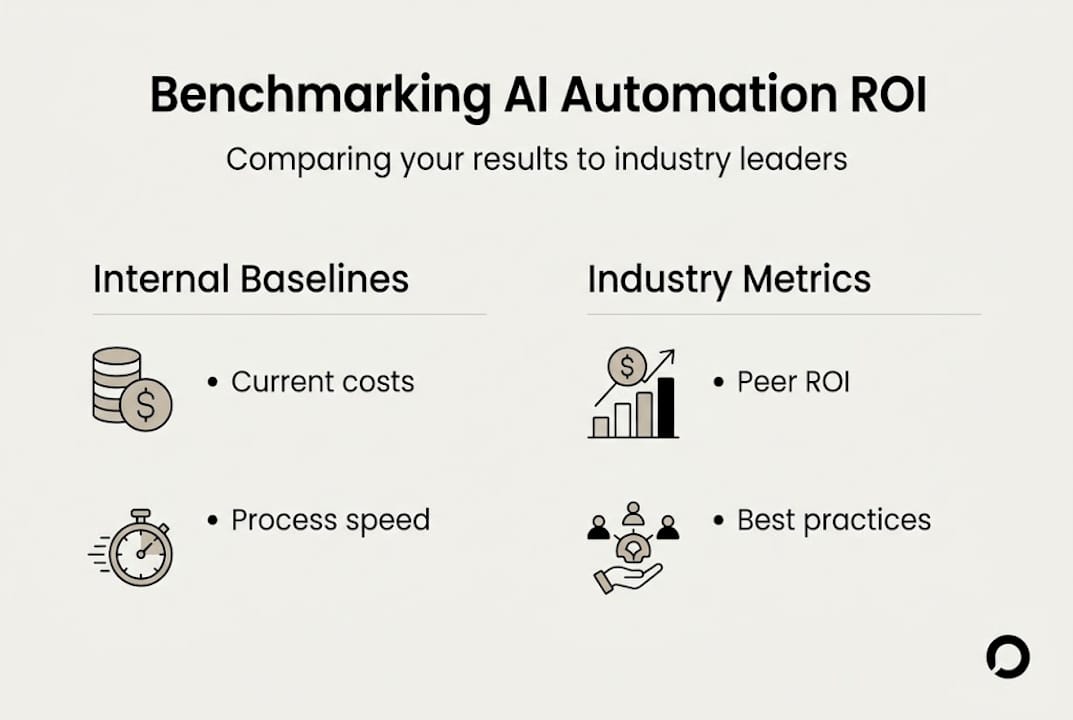
Strong enterprise benchmarking methods involve three reference points working together. First, your own pre-AI baseline as the starting marker. Second, industry peer benchmarks to gauge relative performance. Third, published research on returns across similar AI deployments. According to a broader framing of AI benchmarking, triangulating across all three gives you a 360-degree view that single-point comparisons simply cannot match.
Key benchmarking steps every enterprise should follow:
- Quarterly ROI reviews: Compare actual vs. projected returns and surface gaps early
- Post-implementation analysis at 30, 90, and 180 days: Catch the J-curve dip before it becomes a leadership concern
- Cross-functional value audits: Pull input from finance, operations, and compliance every cycle
- Scenario stress-testing: Challenge your assumptions with pessimistic inputs to identify fragile ROI claims
- Use case expansion reviews: Assess which automation wins can be replicated in adjacent processes
Cost reduction from AI tends to compound when enterprises build systematic review processes into their operating rhythm rather than treating benchmarking as a one-time exercise.
AI ROI leader insights from Deloitte consistently show that the organizations with the strongest long-term returns treat ROI refinement as an ongoing discipline, not a project deliverable. They assign ownership, set review cadences, and update their models as new AI capabilities and business priorities emerge.
Why most enterprise ROI tracking falls short—and how to get it right
Here’s the uncomfortable pattern we see repeatedly: enterprises invest in elaborate ROI frameworks with dozens of metrics, complex attribution models, and multi-layer reporting hierarchies, and then produce numbers that nobody fully trusts.
The problem isn’t lack of rigor. It’s the wrong kind of rigor. Overengineered measurement systems create friction, slow down decision-making, and often obscure the clearest signals. The enterprises that actually sustain strong returns tend to track fewer metrics with higher confidence, not more metrics with ambiguous connections to business outcomes.
The contrarian insight here is that simpler direct P&L impact tracking often outperforms complex frameworks in real-world enterprise settings. When you can show that a specific automation reduced a specific cost by a specific amount, leadership acts on it. When you show a weighted composite score of twelve variables, you get a committee review.
Successful organizations balance speed with rigor. They ship fast, measure the direct impact, iterate, and then layer in more sophisticated tracking as the program matures. Scaling automation wisdom consistently points back to this principle: start tight, expand deliberately.
Pro Tip: Run a quarterly human-in-the-loop review of your ROI assumptions. Assign a skeptic to stress-test your numbers before they go to the board. This catches optimistic bias before it erodes credibility.
Accelerate your ROI tracking with enterprise-ready solutions
Putting this framework into practice requires more than spreadsheets and good intentions. Enterprise-scale AI automation demands tools and expertise designed specifically for the complexity you’re managing.
Nimblo’s enterprise automation solutions embed cross-functional automation teams directly into your operations, bringing AI engineers, workflow architects, and domain experts together in a structured 120-day engagement. From baseline setting and metric selection to real-time dashboards and quarterly benchmarking reviews, Nimblo’s pods handle the execution so your leadership team can focus on decisions, not data wrangling. If you’re ready to move from uncertain ROI to measurable, defensible returns, this is the practical starting point.
Frequently asked questions
What is the standard formula for calculating ROI in AI automation projects?
The standard ROI formula is (Value created – Total costs) ÷ Total costs × 100, with payback period, NPV, and IRR commonly used alongside it for a fuller picture.
Why do enterprise AI automation projects often have a slower ROI than expected?
Enterprises often underestimate hidden costs and the J-curve effect in AI projects, where value dips before rising, leading to longer payback periods and delayed visible returns.
How can I benchmark my organization’s AI ROI performance?
Benchmark against your pre-AI baseline, industry peers, and published research. The empirical median ROI for B2B AI deployments is 159.8% over 24 months, which gives a useful reference point. Cross-reference with peer benchmarks to evaluate your position accurately.
What are the most common pitfalls in tracking AI automation ROI?
The top pitfalls include overestimating cost savings, ignoring hidden maintenance and oversight costs, failing to set clear baselines before launch, and tracking activity instead of real business outcomes.
How often should we review and update our AI ROI measurement framework?
Review your framework quarterly. Ongoing post-implementation analysis is essential for uncovering hidden value, catching model drift, and reallocating resources as your AI program evolves.