
TL;DR:
- Consistent NAP data across citation sources enhances local search trust and rankings.
- Enterprise citation management requires structured workflows, accountability, and automation tools.
- Ongoing audits and updates are crucial to maintain accuracy amid evolving search and AI landscape.
Even the most resource-rich enterprises bleed local search visibility through something as simple as an inconsistent phone number or a street address written two different ways. NAP inconsistencies — meaning mismatches in your business Name, Address, and Phone number — can actively damage your standing in local search results across every location you operate. For operations managers overseeing dozens or hundreds of sites, this isn’t a minor marketing problem. It’s a compounding operational risk. This guide maps out a proven, step-by-step citation strategy that large organizations can implement, automate, and sustain for measurable local search gains.
Table of Contents
- Understanding local citations: What they are and why they matter
- The enterprise citation strategy: Methodology and workflow
- Tools, automation, and operational efficiency at scale
- Nuances, pitfalls, and evolving trends in local citation strategy
- A new era: Why local citation strategy demands operational discipline
- Take your local citation management to the next level
- Frequently asked questions
Key Takeaways
| Point | Details |
|---|---|
| Consistency is critical | Accurate and uniform business information across citations drives local search authority. |
| Quality over quantity | A handful of authoritative, up-to-date citations outperforms scattered, low-quality listings. |
| Leverage automation | Enterprise tools streamline updates and reduce costly manual errors in maintaining citations. |
| Monitor emerging trends | Stay alert to AI-driven search and unstructured citations for ongoing local SEO success. |
Understanding local citations: What they are and why they matter
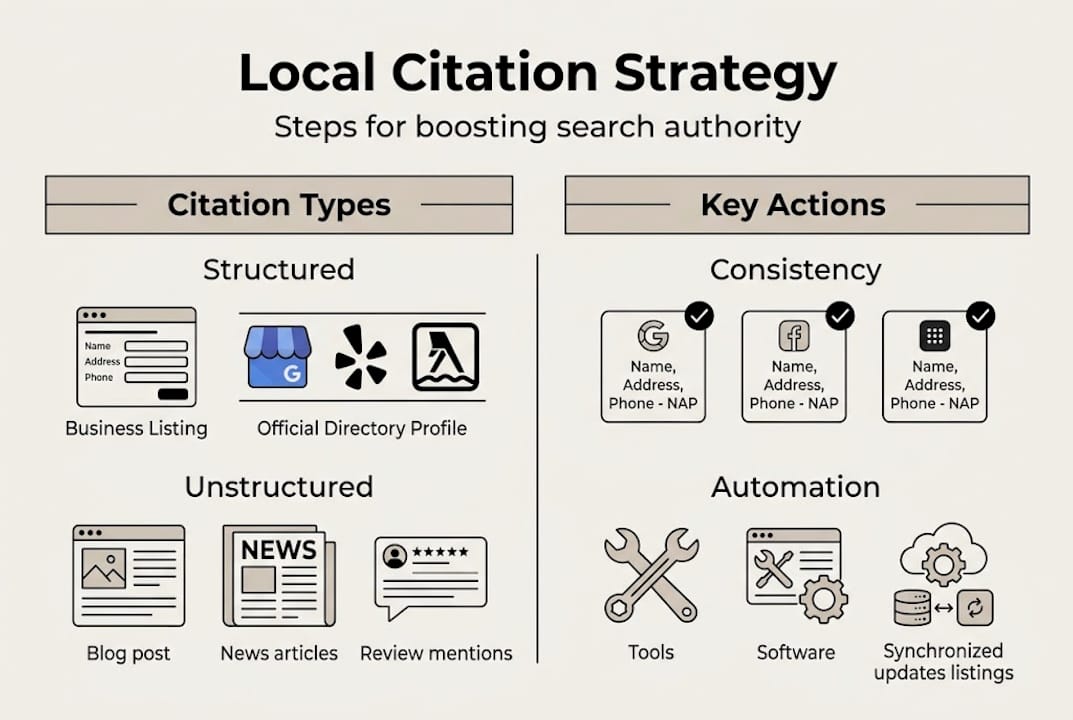
A local citation is any place online where your business’s core contact information appears. According to the local citation guide, citations are split into two types: structured and unstructured. Structured citations appear in formatted directories like Google Business Profile, Yelp, or Yellow Pages, where your NAP sits inside defined data fields. Unstructured citations are more informal, showing up in news articles, blog posts, event listings, or social mentions.
For enterprises managing multiple locations, the distinction matters operationally. Structured citations are easier to monitor and update in bulk. Unstructured citations are harder to control but carry significant authenticity signals. Both types contribute to how search engines evaluate your authority and geographic relevance.
The business case is straightforward. Citations account for roughly 7 to 13% of local pack and organic ranking factors, which is a meaningful share in competitive local markets. When you understand local SEO fundamentals, it becomes clear that citations act as independent verification signals. Search engines cross-reference your listing data across dozens of sources. Agreement builds trust. Disagreement creates doubt.
Top citation platforms for enterprises:
- Google Business Profile (non-negotiable first priority)
- Apple Maps and Bing Places
- Yelp, Facebook, and Foursquare
- Data aggregators: Data Axle, Neustar Localeze, Foursquare
- Industry-specific directories (healthcare, legal, hospitality, etc.)
- Local chamber of commerce and regional directories
| Platform type | Examples | Primary value |
|---|---|---|
| Core directories | Google, Yelp, Facebook | Direct ranking signals |
| Data aggregators | Data Axle, Localeze | Wide data distribution |
| Industry directories | Healthgrades, Avvo, TripAdvisor | Niche authority signals |
| Unstructured sources | News sites, blogs, events | Natural profile diversity |
“Consistent NAP data across all citation sources sends a unified trust signal to search engines, reinforcing your location authority across every market you serve.”
Understanding the importance of citation building puts you ahead of competitors who treat citations as a one-time task rather than an ongoing operational discipline.
The enterprise citation strategy: Methodology and workflow
Scaling citation management across dozens or hundreds of locations without a defined process creates expensive chaos. The right approach follows a structured methodology: audit, standardize, submit, and maintain. Each phase has specific outputs and owners.
A proven local citation management framework starts with creating a canonical NAP master. This is your single source of truth — a document or database field that defines the exact, approved version of every location’s name, address, phone number, hours, and website URL. Every submission draws from this master. No exceptions, no improvisation by individual teams.
The core methodology includes auditing citation consistency, establishing the canonical NAP master, and prioritizing platforms by tier. It also emphasizes quality over volume. A citation on a relevant, authoritative directory does more than 20 low-authority submissions. Quality citations on authoritative platforms consistently outperform high-volume, low-quality submissions in ranking impact.
Step-by-step enterprise citation workflow:
- Run a full citation audit across all locations using tools like BrightLocal or Semrush
- Document every existing citation, flag inconsistencies, and identify duplicate listings
- Build or update your canonical NAP master with approved data for all locations
- Submit to Tier 1 core directories first (Google, Yelp, Facebook, Apple Maps)
- Push data through the three major aggregators to propagate broadly
- Target 10 to 20 relevant industry or local directories per location
- Set a quarterly maintenance calendar with assigned owners per region
| Tier | Platforms | Action priority |
|---|---|---|
| Tier 1: Core | Google, Apple, Bing, Yelp | Immediate, non-negotiable |
| Tier 2: Aggregators | Data Axle, Localeze, Foursquare | Month 1 priority |
| Tier 3: Niche/Local | Industry + regional directories | Ongoing, quarterly |
Pro Tip: Assign a named operations owner for citation governance at the regional or brand level. Without accountability, even well-designed processes decay over time as locations change phone numbers, move, or rebrand without notifying the central team.
Reviewing local citation building steps gives your team a repeatable checklist that reduces both error rates and onboarding time for new locations. Reinforcing this with local SEO best practices ensures each submission aligns with broader search strategy goals.
Tools, automation, and operational efficiency at scale
Managing citations manually across more than a handful of locations is not just inefficient. It’s a liability. A single team member updating 200 listings by hand introduces inconsistency at every step: different formatting, outdated phone numbers, missed platforms, duplicated entries. The error rate grows with scale.

Centralized enterprise tools like Yext and BrightLocal are built specifically for multi-location bulk management and automation, which makes them essential for accuracy at scale. These platforms let you push NAP updates across hundreds of listings simultaneously, audit for inconsistencies in real time, and receive alerts when third-party sites alter your data.
What to look for in enterprise citation tools:
- Bulk location import and update capabilities
- Real-time monitoring and discrepancy alerts
- Publisher network reach (how many directories they sync with)
- Review management integration
- Reporting dashboards by location, region, or brand
- API access for integration with your existing CRM or operations stack
Automation doesn’t just save time. It creates operational consistency that manual workflows cannot sustain. When a location changes its address, a centralized tool propagates that update across every connected directory simultaneously. Without automation, that same update might take weeks and still miss a dozen platforms.
Pro Tip: Before investing in any citation platform, audit your current publisher network reach. Some tools syndicate to 100+ directories; others cover only the top 20. For enterprises in specialized industries, niche directory coverage matters as much as mainstream reach.
Performance measurement is equally important. Use your citation tools’ analytics to track accuracy scores by location, identify which directories drive the most traffic, and monitor listing completeness. This data supports quarterly reviews and helps you prioritize where to invest further effort.
Learn how smart citation management strategies connect to broader goals around how to increase local website traffic across all your markets. Reviewing local SEO strategy examples from comparable organizations can also surface tactics your team hasn’t considered yet.
Nuances, pitfalls, and evolving trends in local citation strategy
Even well-run programs hit friction points. The most common enterprise citation failures aren’t dramatic. They’re quiet and cumulative.
Small formatting differences — writing “Street” in one directory and “St” in another — create consistency score damage that compounds across hundreds of locations. Quarterly audits and a mixed structured and unstructured citation strategy prevent the kind of unnatural profiles that can trigger algorithmic skepticism. Sudden bursts of citation activity also raise flags. Build at a consistent, deliberate pace rather than submitting 200 listings in a week.
Common pitfalls that derail enterprise citation programs:
- Ignoring unstructured citations (press coverage, blog mentions, event listings)
- Letting old, inaccurate listings persist alongside new correct ones
- Failing to update citations when a location moves, rebrands, or changes hours
- Treating citation building as a one-time project rather than an ongoing program
- Missing industry-specific directories in favor of only generic platforms
The search landscape is also shifting. Citation signals are declining in local pack influence but rising in importance for AI-driven search results. This is a critical distinction for enterprise operations managers. As AI-powered search engines evaluate entity signals — meaning, how consistently and credibly your business is described across the web — citation accuracy becomes a foundational data quality issue, not just an SEO tactic.
“Entity verification in AI-driven search means your NAP data is no longer just a ranking input — it’s part of how search systems decide whether your business is real and trustworthy.”
The role of AI in local SEO is accelerating this shift. Staying current on the broader enterprise SEO guide ensures your citation strategy evolves alongside these platform changes. Understanding NAP consistency as a data integrity issue, not just a marketing concern, is what separates operationally mature programs from those that plateau.
A new era: Why local citation strategy demands operational discipline
Most enterprises approach local citations as a marketing function. That framing is limiting and increasingly outdated. The real driver of citation success at scale is operational rigor: clear data governance, defined process ownership, and systems that enforce consistency without relying on individual judgment.
We’ve seen this repeatedly. Organizations with modest budgets but tight operational controls outperform well-funded competitors whose citation data is fragmented across departments, agencies, and regional teams with no single source of truth. Strategy matters. Execution discipline matters more.
The rise of AI-driven search reinforces this. When search engines use entity signals to validate business legitimacy, your citation data becomes part of your operational data quality infrastructure. It connects directly to how citation tutorial best practices translate into real-world authority. Operations managers are now the right owners for this program, not just marketing coordinators. The organizations that recognize this shift earliest will hold a durable competitive advantage in local search through 2026 and beyond.
Take your local citation management to the next level
Building a citation strategy that holds up across dozens of locations requires more than a checklist. It requires systems, accountability, and automation working together. That’s exactly where Nimblo.ai’s embedded automation teams deliver results fast.
Nimblo deploys dedicated automation pods directly into your operations, combining AI engineers, workflow architects, and domain experts in a structured 120-day engagement. We’ve helped enterprise teams eliminate manual citation errors, centralize data governance, and build workflows that scale without adding headcount. If you’re ready to turn citation management into a competitive operational advantage, explore centralized citation management solutions built for organizations like yours.
Frequently asked questions
What is a local citation in SEO?
A local citation is any online mention of a business’s Name, Address, and Phone number, helping search engines verify location and trust. They appear in both structured directories and unstructured sources like blogs or news articles.
How often should enterprises audit and update their local citations?
A quarterly audit and maintenance schedule is the recommended standard for enterprise organizations. Quarterly audits ensure that location changes, rebrands, and data drift are caught and corrected before they compound.
Which tools are best for managing multi-location citation data?
Centralized platforms like Yext and BrightLocal allow bulk updates, detect inconsistencies across hundreds of listings, and automate management at the scale enterprises actually need.
Do unstructured citations still matter for enterprises?
Yes. Combining structured and unstructured citations creates a natural, diverse local profile. Unstructured mentions in press, event listings, and industry blogs signal real-world activity that structured directories alone cannot provide.
What’s the ideal number of platforms for enterprise citation submission?
Focus on quality over volume. Prioritize Tier 1 core sites (5 to 10), three major data aggregators, and 10 to 20 relevant industry or local directories per location for the strongest results.