
TL;DR:
- Proximity remains the dominant factor, often outside a business’s control in Google Maps rankings.
- Review signals, GBP completeness, and behavioral engagement strongly influence rankings.
- Enterprise success requires consistent, localized strategy and automated workflows for multiple locations.
Even large enterprise chains with powerful websites and serious marketing budgets can struggle to crack the Google Maps top 3 for their locations. It feels like the system is working against you. Proximity accounts for 35-55% of ranking weight, and empirical studies show that 96% of top-3 variance is explained within just 5km of a search. That one fact alone reshapes how you should approach Maps optimization across dozens or hundreds of locations. This guide lays out the exact playbook top-performing franchises use to consistently win in the local map pack.
Table of Contents
- Google Maps ranking factors: What matters most in 2026
- Preparation: Enterprise checklist for Google Maps success
- Step-by-step process to optimize your Google Maps ranking
- Troubleshooting and monitoring: Overcoming common pitfalls
- Expert perspective: Why local beats global for Google Maps wins
- Unlock Google Maps growth at scale
- Frequently asked questions
Key Takeaways
| Point | Details |
|---|---|
| Proximity is king | Google Maps ranks businesses most highly for users located nearby, so service area accuracy is key. |
| Reviews drive results | Consistent, high-volume, and fast-responded reviews strongly impact map pack rankings. |
| Unique location content wins | Every location needs its own page with fresh content and clear NAP to avoid duplicate penalties. |
| GBP trumps web SEO | Optimizing your Google Business Profile matters far more than classic web domain strength for Maps. |
| Monitor and adapt weekly | Ongoing reviews and updates to assets and processes are essential for staying on top in 2026. |
Google Maps ranking factors: What matters most in 2026
Before you invest another dollar in local SEO, you need to understand which signals Google actually weighs for Maps rankings. The 2026 picture looks different from what many enterprise teams still believe.
Proximity is the dominant factor, and it is largely outside your control. As noted above, proximity drives top-3 variance across the board. You cannot move your location, but you can strategically define your service areas in Google Business Profile (GBP) to extend your effective coverage radius. This matters enormously for service-area businesses and mobile franchises.
Here is how the major ranking signals stack up:
| Ranking factor | Relative weight | Controllable? |
|---|---|---|
| Proximity to searcher | 35-55% | No (optimize service areas) |
| Review signals (volume, recency, response rate) | 15-25% | Yes |
| GBP completeness and relevance | 10-20% | Yes |
| Behavioral signals (clicks, calls, directions) | 10-15% | Yes |
| Local website relevance and citations | 5-15% | Partially |
| Domain authority | Inverse effect | Avoid over-prioritizing |
One of the most counterintuitive findings from recent research: high domain authority hurts local pack rankings. Google interprets very high DA sites as nationally focused, reducing their hyperlocal relevance score. This is a direct contradiction of traditional SEO instincts and one reason enterprise brands often underperform nimbler local competitors.
Review signals carry serious weight. Volume, recency, rating consistency, and your response rate all factor in. 2026 local search updates confirm that AI-driven behavioral signals and structured data are now influencing pack rankings more than ever. GBP data freshness, Q&A sections, and user-generated photos feed directly into these AI models.
Beyond the table:
- Keep your GBP category selections tight and accurate
- Post updates weekly, not monthly
- Respond to every review, including negative ones, within 24 hours
- Use attributes (e.g., “women-led,” “wheelchair accessible”) to match search intent filters
“The brands winning in Maps are not always the strongest websites. They are the ones treating GBP as a living product, not a static listing.”
For a deeper breakdown of execution steps, the Google Maps optimization steps resource covers what most brands still miss.
Preparation: Enterprise checklist for Google Maps success
Now that you know what factors matter, check off these preparation tasks before starting implementation. Skipping this phase is the single most common reason enterprise rollouts stall or produce inconsistent results across locations.
Start with your data foundation. NAP (Name, Address, Phone) consistency is non-negotiable. Every listing, directory, website page, and GBP entry must display identical business information. Even minor variations (“St.” vs. “Street” or a missing suite number) can suppress rankings.

Here is a comparison of enterprise teams that prepare versus those that skip this phase:
| Prepared teams | Unprepared teams |
|—|—|—|
| Centralized location data sheet | Scattered, siloed location data |
| Unique content per location | Templated, duplicate descriptions |
| Unified review request workflow | Ad-hoc, inconsistent review asks |
| Verified GBP access for all locations | Missing or unverified listings |
| Schema markup on all location pages | No structured data |
Build dedicated location pages on single-domain subdirectories (for example, /locations/city) with unique content, NAP data, an embedded map, and schema markup. Templated pages trigger duplicate content filters and actively suppress rankings. Each page needs neighborhood-specific language, local testimonials, and unique staff or service descriptions.
Key preparation steps:
- Audit all existing GBP listings and claim any unclaimed locations
- Create a master spreadsheet with every location’s verified NAP data
- Assign one team member per location (or region) as GBP account manager
- Prepare location-specific photo assets, staff bios, and service descriptions
- Build a centralized review request and response template library
Pro Tip: Use a Google Business Profile guide tailored to your industry to confirm you are selecting the right primary categories before you scale. A wrong category costs you far more than the time spent fixing it.
Enterprises looking to increase local website traffic across multiple markets will find that this preparation phase directly accelerates results in weeks rather than months.
Step-by-step process to optimize your Google Maps ranking
With foundational assets in place, execute this step-by-step process to systematically boost each location’s Maps ranking.
-
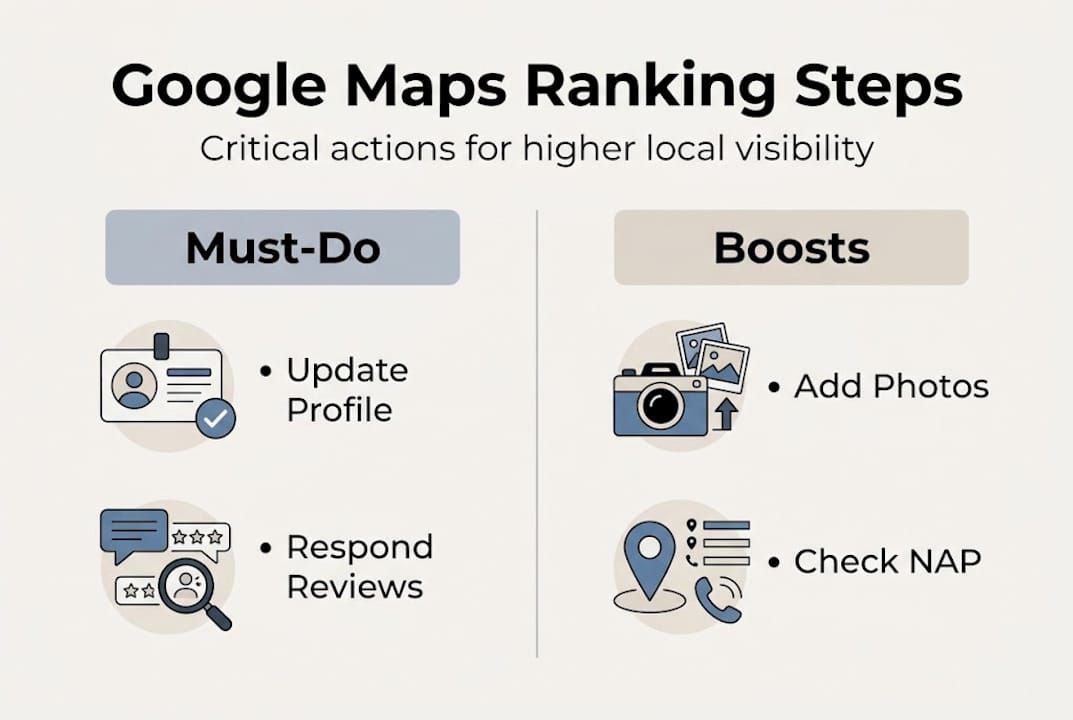
Claim and fully verify every location in GBP. Unverified listings cannot rank competitively. Use bulk verification if you manage 10 or more locations. Complete every field including business description, services, products, and attributes.
-
Build or audit your location pages. Each page needs unique written content (not AI-spun templates), embedded Google Maps, schema markup (LocalBusiness type), and exact NAP match to GBP.
-
Launch a structured review solicitation program. Industry top-3 benchmarks show locations need between 100 and 800-plus reviews with ratings above 4.5 and a 100% response rate to compete. That is not a suggestion. It is the competitive floor. Send review requests via SMS or email within hours of service delivery, not days later.
-
Respond to every review within 24 hours. This is both a ranking signal and a trust signal. Use personalized responses that naturally include location names and service keywords. Avoid copy-paste templates.
-
Post weekly updates to GBP. Weekly behavioral cadence outperforms sporadic bursts. Share promotions, events, and operational updates consistently. Weekly activity signals to Google that the listing is active and relevant.
-
Optimize Q&A sections with structured answers. Seed your own questions and answer them with keyword-rich, genuinely helpful responses. This feeds AI-driven summarization tools that Google is increasingly using to populate Maps results.
-
Keep hours, photos, and attributes current. Stale data is a quiet ranking killer. Verify holiday hours proactively. Upload new photos at least twice per month. Use the “open now” attribute accurately since this filter is now a significant behavioral trigger.
Pro Tip: Use the Google Business Profile setup guide to run a completeness audit before scoring your locations. Aim for 100% field completion on every single listing.
For inspiration on what top-performing locations look like in practice, reviewing GBP feature examples gives your team a concrete visual benchmark to work from.
Statistic to bookmark: Locations responding to 100% of reviews and maintaining a rating above 4.5 consistently appear in top-3 results, even against competitors with larger review counts.
Troubleshooting and monitoring: Overcoming common pitfalls
After initial steps, ongoing troubleshooting and tracking are essential for maintaining and scaling Maps visibility. Many enterprise teams do the hard work upfront and then let rankings quietly erode due to neglect.
The most common issues to scan for:
- Duplicate listings: Google sometimes auto-generates listings for locations. Audit monthly and merge or suppress duplicates via GBP support.
- NAP drift: Vendors update directories without your knowledge. Use a citation monitoring tool to catch inconsistencies fast.
- Templated content flags: If multiple location pages share more than 30% of their text, you risk a duplicate content filter. Rewrite from scratch.
- Review velocity drops: A sudden slowdown in new reviews signals Google that engagement is declining. Refresh your review solicitation process.
- Low behavioral signals: If calls, direction requests, and website clicks from GBP are low, your profile may be visible but unconvincing. Improve photos, offers, and listing descriptions.
“Rankings are not a destination. They are a daily operational output. Teams that build weekly review and audit routines consistently outrank those that treat Maps as a set-it-and-forget-it channel.”
Weekly cadence beats one-off campaigns for both behavioral and AI-driven ranking factors. Build a standing weekly workflow that covers: new review responses, GBP post publishing, photo uploads, and a quick check of ranking positions using rank-tracking tools (BrightLocal or Local Falcon work well at enterprise scale).
Use the Google Business Profile checklist to standardize your audit process across every location manager on your team.
Track these key metrics weekly:
- Maps ranking position by keyword and location
- GBP action rates: calls, direction clicks, website visits
- New review volume and average rating per location
- Response rate and average response time
- Photo view counts as a proxy for profile engagement
Expert perspective: Why local beats global for Google Maps wins
Here is the uncomfortable reality most enterprise marketing leaders do not want to hear: your brand’s national SEO strength is actively working against you in Maps. High domain authority correlates inversely with local pack rankings. Google interprets signals meant to show national breadth as noise when evaluating hyperlocal relevance.
We have seen enterprise clients with DA scores above 70 lose map pack positions to local competitors with DA scores under 30 but with robust GBP profiles and strong review velocity. The mechanism is simple. Google’s local algorithm is optimizing for proximity and perceived local authority, not global web influence.
The teams that win think small to win big. They treat every GBP listing as its own micro-brand, with dedicated content, a localized voice, and its own review pipeline. They do not depend on the parent domain to carry local rankings.
This is a strategic shift that requires operational discipline, not just marketing budget. Local SEO examples from smaller competitors often show exactly the playbook enterprise brands should adopt: tight GBP focus, hyperlocal content, and consistent behavioral engagement rather than broad authority signals.
Unlock Google Maps growth at scale
Managing Google Maps optimization across 10, 50, or 500 locations requires more than good intentions. It demands repeatable workflows, automated review monitoring, and consistent execution across every location manager.
Nimblo’s embedded automation teams work directly inside your operations to build and run those workflows for you. From enterprise local SEO solutions that systematize GBP management at scale, to structured review pipelines and location page automation, Nimblo turns ranking strategy into operational reality. If you want to move faster and stop managing Maps optimization manually, explore our full GBP guide or talk to our team about a 120-day engagement built around your locations.
Frequently asked questions
How long does it take to see results from Google Maps ranking optimizations?
Most businesses see measurable ranking improvements in 2 to 8 weeks when changes are applied consistently and review rates increase. Weekly behavioral cadence produces faster results than one-time optimization pushes.
What review benchmark should an enterprise location aim for in 2026?
Industry top-3 medians range from 277 to 830 reviews depending on category, with ratings above 4.5 and near-perfect response rates being the consistent standard across sectors.
Can a business influence proximity for Maps rankings?
Proximity itself is fixed by your physical address, but you can configure service areas in GBP to extend coverage. 96% of top-3 variance is still driven by distance within 5km, so service area strategy matters most for mobile and service-area businesses.
Why would a high domain authority hurt Google Maps rankings?
Domain authority hurts local pack performance because Google interprets high-DA signals as nationally oriented, which lowers hyperlocal relevance scores. GBP optimization and localized content are far more effective ranking levers for Maps than building general web authority.