
Most Florida small business owners claim their Google Business Profile and never touch it again. That’s a costly mistake. Research shows 70% of SMBs neglect ongoing profile optimization, losing potential customers to competitors who actively manage their Google Maps presence. This guide reveals practical strategies to capture more local searches and grow your customer base through effective Google Maps optimization.
Table of Contents
- Understanding Google Maps Optimization
- How Google Maps Ranking Works
- Key Components of Google Maps Optimization
- Common Misconceptions and Pitfalls
- Practical Steps and Tools for SMBs
- Measuring Success and Next Steps
- Optimize Your Florida SMB’s Google Maps Presence With Nimblo.ai
- FAQ
Key Takeaways
| Point | Details |
|---|---|
| Maps optimization drives local customer acquisition | Active profile management increases visibility in local search results and foot traffic |
| Three core factors determine rankings | Proximity, relevance, and prominence influence where your business appears on Google Maps |
| Consistent updates maintain competitive edge | Regular profile refinements and review engagement keep your business ranking high |
| Automation tools reduce costs and errors | Integrated platforms streamline Google Business Profile management and save valuable time |
Understanding Google Maps Optimization
Google Maps optimization is the process of managing your online business presence specifically on Google Maps to improve search rankings and attract local customers. For Florida SMBs competing in saturated markets like Miami, Tampa, and Orlando, this optimization directly impacts visibility when potential customers search for services nearby.
The platform serves as a primary discovery tool for local businesses. When someone searches “plumber near me” or “Tampa coffee shop,” Google Maps displays relevant businesses based on sophisticated algorithms. Your optimization efforts determine whether you appear in those results.
Key benefits include:
- Cost effective marketing channel requiring minimal advertising spend
- Increased local credibility through reviews and accurate business information
- Direct customer actions like calls, directions, and website visits
- Enhanced visibility in Google’s local pack results on search pages
- Higher conversion rates from geographically targeted traffic
Local SEO and Schema Markup research demonstrates that Google Maps optimization significantly increases local search visibility and customer engagement for SMBs. The impact extends beyond digital metrics. Improved Maps rankings translate to more phone calls, store visits, and revenue growth. For a comprehensive approach, review our Google Business Profile guide for SMBs covering foundational setup through advanced tactics.
How Google Maps Ranking Works
Google evaluates three primary signals when determining which businesses appear in Maps results: proximity, relevance, and prominence. Understanding these factors helps you prioritize optimization efforts effectively.
Proximity measures the physical distance between your business location and the searcher. You can’t change your address, but accurate location data ensures Google correctly calculates this distance. Relevance assesses how well your business matches the search query based on your selected categories, keywords in your profile description, and services listed.
Prominence evaluates your business’s overall reputation both online and offline. This includes:
- Number and quality of customer reviews on your Google Business Profile
- Consistency of your business information across the web
- Links from reputable websites pointing to your business
- Social media presence and engagement levels
- Physical visibility factors like signage and local recognition
“Proximity, relevance, and prominence are the core ranking factors in Google Maps, and neglecting these elements costs businesses valuable local search visibility.”
Accurate and consistent NAP (Name, Address, Phone) data across all online platforms reinforces Google’s confidence in your business information. Discrepancies confuse the algorithm and hurt rankings. Real customer engagement, particularly quality reviews with detailed feedback, signals prominence and trustworthiness to Google.

The statistic bears repeating: 70% of SMBs fail to regularly update their profiles after initial claiming. This neglect directly damages their Maps rankings as competitors who actively optimize gain algorithmic advantages. Our guide on local SEO ranking factors for Florida SMBs dives deeper into these mechanisms.
Key Components of Google Maps Optimization
Successful optimization requires managing several interconnected elements. Each component influences how Google evaluates and ranks your business in Maps results.
Your Google Business Profile serves as the foundation. Complete every section: select precise business categories, write keyword rich descriptions that accurately represent your services, upload high quality photos of your location and offerings, and list specific services with descriptions. Incomplete profiles signal low engagement to Google.
NAP consistency across citations and directories reinforces your legitimacy. Ensure your business name, address, and phone number match exactly on platforms like Yelp, Facebook, industry directories, and your website. Even minor variations like “St.” versus “Street” create confusion.
Active review management drives prominence. Solicit reviews from satisfied customers through follow up emails or text messages after service completion. Respond professionally to all reviews, both positive and negative, within 48 hours. This engagement demonstrates active business management.
Technical SEO implementation, specifically local business schema markup, helps Google understand and display your business information accurately. Research confirms that implementing local business schema markup enhances Google Maps visibility, improving click through rates by up to 15%.
| Approach | Time Investment | Cost | Technical Skills Required | Results Timeline |
|---|---|---|---|---|
| Manual Optimization | 10+ hours/month | Free but labor intensive | Moderate learning curve | 3 to 6 months |
| Agency Services | Minimal oversight | $1,500 to $5,000/month | None but limited control | 2 to 4 months |
| Integrated SaaS Platform | 2 to 3 hours/month | $500/month | Minimal, user friendly | 1 to 3 months |
Pro Tip: Combining profile management and review automation in one platform eliminates the need to juggle multiple tools and logins. This consolidation reduces errors, saves hours each week, and ensures consistent optimization efforts. Check our Google Business Profile checklist and writing Google Business posts tips for detailed implementation guidance.
Common Misconceptions and Pitfalls
Many Florida business owners operate under false assumptions that undermine their Google Maps performance. Recognizing these myths helps you avoid costly mistakes.
The biggest misconception: claiming your profile once provides sufficient optimization. Google favors actively managed profiles with regular updates. Businesses that post weekly updates, add new photos monthly, and consistently engage with reviews outrank static profiles.
Another myth suggests that accumulating massive review volumes automatically improves rankings. Quality and recency matter more than quantity. Ten detailed, recent reviews from verified customers carry more weight than fifty brief, old reviews. Google’s algorithm detects authentic engagement patterns.
Data shows 70% of SMBs neglect to regularly update or optimize their profiles, resulting in suboptimal local search performance. This statistic represents opportunity. Consistent optimization efforts create competitive advantages in crowded Florida markets.
Common pitfalls to avoid:
- Inconsistent NAP data across your website, social profiles, and directories
- Ignoring negative reviews or responding defensively instead of professionally
- Selecting irrelevant business categories to appear in more searches
- Failing to add new photos and posts regularly to signal activity
- Using keyword stuffing in descriptions rather than natural, helpful language
- Neglecting to verify and update business hours, especially during holidays
Pro Tip: Schedule monthly profile audits using a checklist and set up alerts for new reviews through your Google Business Profile dashboard or management platform. This proactive approach prevents information drift and ensures timely review responses. Our Google Business Profile common mistakes guide provides a detailed audit framework.
Practical Steps and Tools for SMBs
Implementing effective Google Maps optimization requires consistent effort across specific tasks. This systematic approach ensures comprehensive coverage without overwhelming your schedule.
Follow these prioritized steps:
- Claim and verify your Google Business Profile if you haven’t already through the verification process
- Complete every profile section with accurate information, focusing on categories, descriptions, attributes, and services
- Upload at least 10 high quality photos showcasing your location, products, services, and team
- Audit your NAP consistency across major directories and correct any discrepancies
- Implement local business schema markup on your website or have your developer add it
- Create a review solicitation system through post purchase emails or text messages
- Respond to every review within 48 hours with personalized, professional messages
- Post weekly Google Business updates about offers, events, or helpful tips
- Monitor your Google Business Profile Insights monthly to track performance trends
- Adjust your strategy based on which posts, photos, and keywords drive the most engagement
Manually executing these tasks consumes 10+ hours monthly. Integrated SaaS platforms like Nimblo.ai automate profile management, review monitoring, schema implementation, and reporting workflows. This automation eliminates repetitive tasks while ensuring consistency.
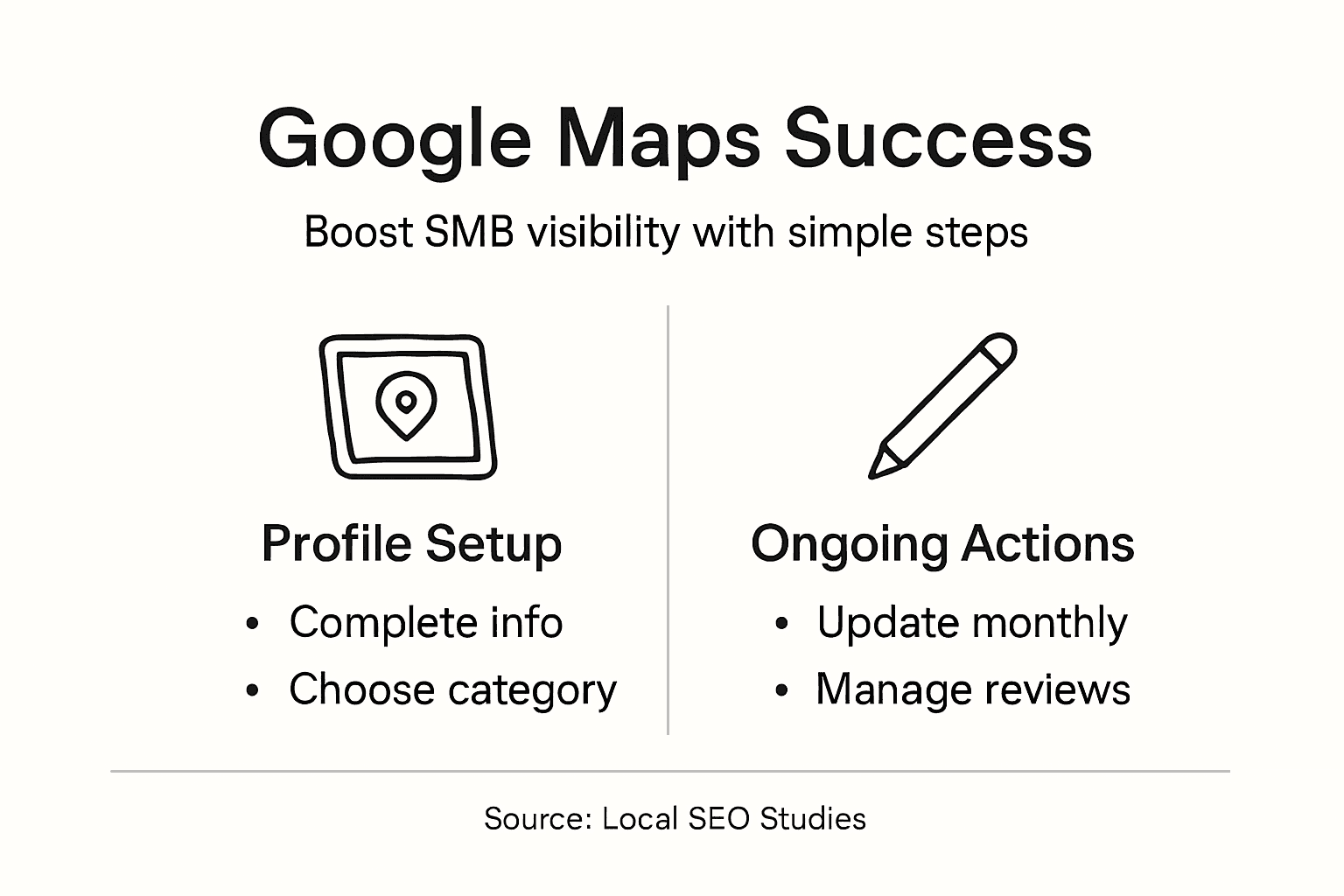
The cost comparison favors automation. Traditional agencies charge $1,500 to $5,000 monthly with long contracts. Fragmented tool stacks require subscriptions to separate review management, schema generators, and analytics platforms. Unified platforms consolidate these functions at a fraction of the cost while maintaining full control.
Pro Tip: Configure platform alerts to notify you immediately when new reviews arrive or when competitors change their strategies. Real time monitoring enables faster responses and strategic adjustments without constant manual checking. Explore our marketing automation tips for SMBs and business operations automation for SMBs for broader efficiency gains.
Measuring Success and Next Steps
Tracking the right metrics reveals whether your optimization efforts generate tangible business results. Focus on indicators that directly correlate with customer acquisition and revenue.
Key performance metrics include:
- Local pack ranking position for your primary keyword searches
- Total profile views and search queries triggering your listing
- Customer actions like calls, direction requests, and website clicks
- Review quantity, average rating, and sentiment trends over time
- Photo views and engagement rates on posted content
- NAP citation consistency score across major directories
Google Business Profile Insights provides native analytics for views, actions, and search queries. Third party tools offer competitive benchmarking and deeper trend analysis. Review these metrics monthly to identify patterns and opportunities.
Adjust your strategy based on data insights. If certain photo types generate more engagement, upload similar images. When specific keywords drive profile views, incorporate them more naturally into your description. If competitors outrank you for particular searches, analyze their profiles for optimization gaps.
Consider advanced support when:
- Your business operates in highly competitive Florida markets requiring sophisticated tactics
- You lack time for consistent manual optimization despite understanding best practices
- Competitive analysis reveals significant gaps in your current approach
- You want to scale optimization across multiple locations efficiently
The iterative improvement cycle:
- Measure current performance across key metrics
- Analyze data to identify strengths, weaknesses, and opportunities
- Optimize specific profile elements based on insights
- Repeat monthly to maintain and improve rankings
Our local SEO optimization workflow provides a detailed framework for implementing this cycle systematically.
Optimize Your Florida SMB’s Google Maps Presence with Nimblo.ai
Managing Google Maps optimization manually drains time you should spend growing your business. Nimblo.ai consolidates profile management, review automation, schema implementation, and local SEO workflows into one intuitive platform designed specifically for Florida SMBs.
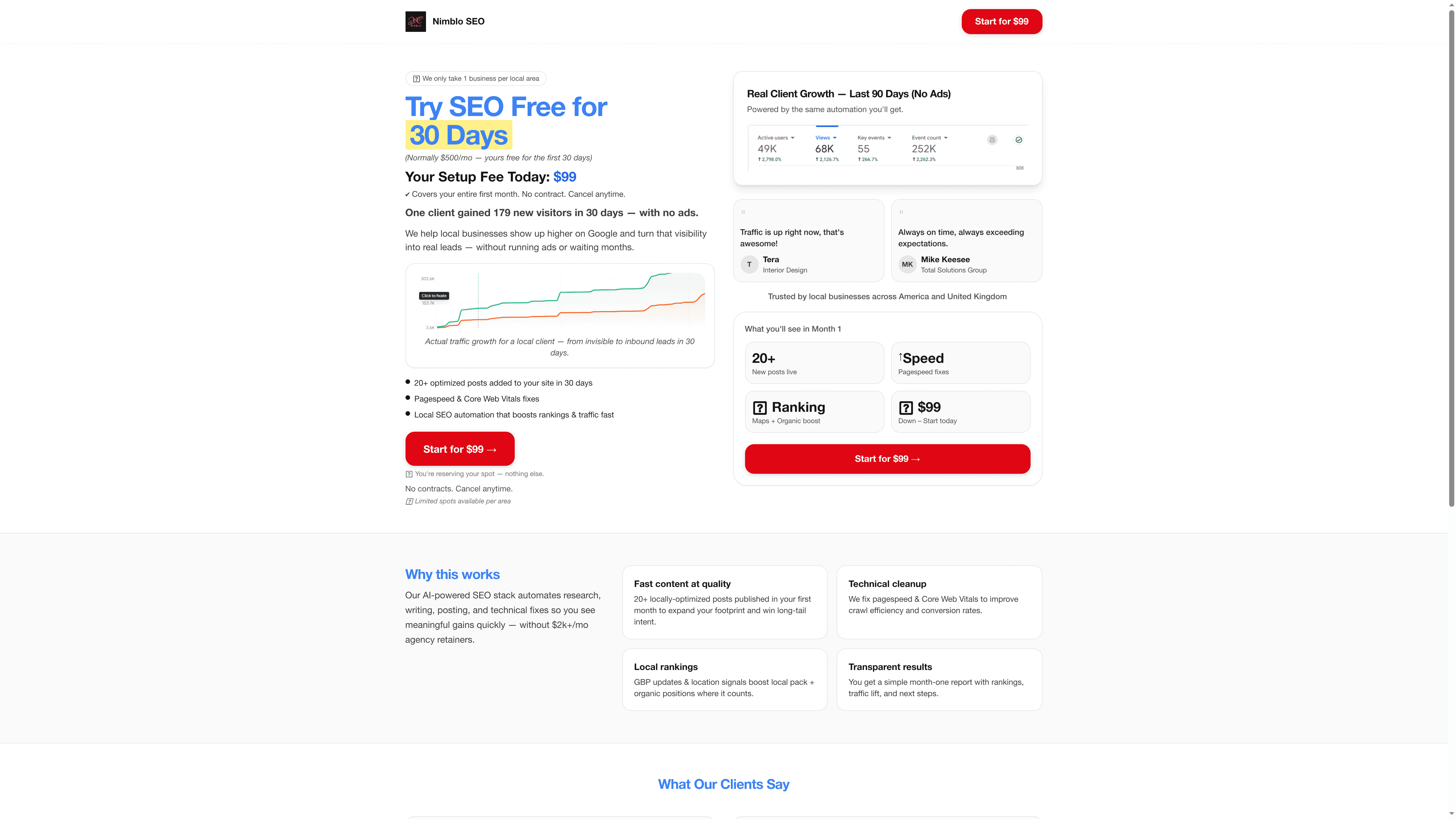
The platform replaces multiple expensive tools and eliminates agency dependency while maintaining full control over your online presence. Automated review solicitation and response templates save hours weekly. Built in schema markup ensures technical SEO compliance without developer costs.
Florida businesses using integrated platforms report faster ranking improvements and higher customer acquisition rates compared to manual methods. The $500 monthly flat rate with no contracts costs less than a single agency retainer while delivering comprehensive functionality.
Explore our cost effective marketing automation tips and local SEO optimization workflow to understand how automation amplifies your efforts. Ready to dominate local search results? Visit our Florida SEO + Business Stack for SMBs to see how Nimblo.ai transforms Google Maps optimization from a time consuming chore into an automated growth engine.
FAQ
What is Google Maps Optimization?
Google Maps optimization means actively managing your business profile and location data so your business appears prominently in Google Maps local search results. It improves local visibility and drives more customers to your Florida SMB.
How often should I update my Google Business Profile?
You should review and update your Google Business Profile at least monthly, and respond promptly to new reviews to maintain rankings. Regular updates signal to Google that your business is active and reliable, giving you algorithmic advantages over static profiles.
Can automation tools really improve my local SEO?
Yes, automation tools save time, reduce manual errors, and ensure consistent updates to your Google Business Profile and review management. They enable SMBs to stay competitive without needing extensive technical skills or dedicating hours weekly to manual optimization tasks. Check our marketing automation tips for SMBs for specific implementation strategies.
What common mistakes should Florida SMBs avoid with Google Maps optimization?
Avoid claiming your profile without ongoing updates, inconsistent NAP across listings, and ignoring customer reviews. Regularly monitor and engage with your profile to improve local ranking. Many businesses also select irrelevant categories or stuff keywords unnaturally, which Google penalizes. Our Google Business Profile mistakes guide covers these pitfalls in detail.