
Many Florida SMBs juggle five or more marketing tools, believing more platforms equal better results. That’s a costly misconception. Consolidating to a single all-in-one website optimization platform can slash software costs by 50% while boosting lead generation speed by 30%. This checklist walks you through selecting the right platform, optimizing your website for local SEO, and integrating CRM and automation to turn your site into a lead-generating machine tailored for the Florida market.
Table of Contents
- How to Choose a Website Optimization Platform: Key Selection Criteria
- Local SEO Optimization Checklist for SMB Websites
- Marketing Automation and CRM Integration for Lead Generation
- Platform Feature Highlights: What to Expect from an All-in-One Solution
- Cost and Efficiency Considerations: Consolidate or Fragment?
- Summary Comparison Table of Leading Website Optimization Platforms for Florida SMBs
- Choosing the Right Platform: Situational Recommendations for Florida SMBs
- Explore Nimblo.ai for Your Florida SMB Website Optimization
- Frequently Asked Questions
Key Takeaways
| Point | Details |
|---|---|
| Google Business Profile and schema markup | These are the top local SEO factors driving visibility for Florida SMBs. |
| CRM and marketing automation integration | Automated follow-ups increase lead conversions by up to 30%. |
| Consolidating platforms cuts costs | Switching to an all-in-one solution reduces software spend by around 50%. |
| Rapid setup accelerates market entry | Platforms offering under 7-day setup get you competing faster in local markets. |
| Platform comparison guides decisions | Evaluating pricing, features, and support helps pick the best fit for your business. |
How to Choose a Website Optimization Platform: Key Selection Criteria
Picking the right all-in-one platform can feel overwhelming when every vendor promises results. Focus on five critical criteria that directly impact your local SEO and lead generation outcomes.
First, prioritize platforms with Google Business Profile integration and schema markup support. According to the BrightLocal Local SEO Survey 2023, Google Business Profile is the most influential local ranking factor, cited by 25% of SEO experts as the top priority for SMBs. Schema markup adds structured data to your site, making it easier for search engines to understand your business details and display rich snippets in results.
Second, look for seamless CRM and marketing automation integration. Your website should capture leads and immediately trigger follow-up sequences without manual effort. Platforms that connect lead forms directly to automated email campaigns and sales pipelines improve response times and conversion rates. This integration eliminates the data silos that plague businesses using separate tools for website, email, and customer management.
Third, evaluate speed of setup and ease of use. If a platform takes months to deploy, you’re losing revenue every day. Look for solutions promising website launch in under two weeks, ideally with pre-built templates optimized for conversion. User-friendly dashboards reduce the learning curve for your team, cutting down on training time and technical support needs.
Fourth, check pricing transparency and contract flexibility. Hidden fees and long-term contracts trap many SMBs in expensive commitments. Favor platforms with flat-rate monthly pricing and no contracts, giving you the freedom to scale or switch as your business evolves. This approach protects your budget and reduces financial risk.
Finally, ensure the platform supports website performance and conversion optimization. Page speed under two seconds, mobile responsiveness, and conversion-focused design are non-negotiable. A beautiful website that loads slowly or confuses visitors won’t generate leads. Confirm the platform includes hosting, speed optimization, and A/B testing tools to continuously improve results.
Key criteria checklist:
- Google Business Profile and schema markup support
- Integrated CRM and marketing automation
- Setup time under 7 days
- Transparent pricing with no long-term contracts
- High-speed hosting and mobile-optimized design
- Centralized dashboard for all marketing functions
Pro Tip: Before committing, request a demo focused on your specific Florida market. Ask the vendor to show you exactly how they optimize for local search in your city and how quickly they can get your site live. Generic demos don’t reveal whether a platform truly understands local SEO optimization workflow nuances.
Local SEO Optimization Checklist for SMB Websites
After choosing your platform, implement this step-by-step local SEO checklist to maximize visibility in Florida search results. Each action directly impacts how easily potential customers find your business online.
-
Set up and optimize your Google Business Profile listing. Claim your profile, fill out every field completely, and add high-quality photos of your business, team, and products. Update your hours, services, and contact information regularly. Encourage satisfied customers to leave reviews and respond to all reviews promptly. This single step influences more local rankings than any other factor.
-
Implement schema markup to enhance local business data visibility. Add LocalBusiness schema to your homepage and service pages. Include your business name, address, phone number, hours, and service area in structured data format. According to schema markup benefits, schema markup implemented on local business websites boosts their organic search click-through rates by up to 20%. Search engines display this data as rich snippets, making your listing stand out.
-
Optimize your website speed to load under 2 seconds. Compress images, enable browser caching, and use a content delivery network. Test your site speed with Google PageSpeed Insights and aim for scores above 90. Speed affects both user experience and search rankings. Visitors abandon slow sites, and Google penalizes them in results. Learn more about why website speed matters for SEO performance.
-
Use localized keywords and content tailored to Florida market. Research what terms your customers search when looking for your services in your city. Include city names, neighborhood references, and Florida-specific phrases in your page titles, headings, and content. Create dedicated service pages for each location you serve. Write blog posts addressing local trends, events, and customer questions. This signals relevance to both search engines and visitors.
-
Ensure mobile-friendly and responsive website design. Over 60% of local searches happen on mobile devices. Your site must display perfectly on all screen sizes, with easy-to-tap buttons and readable text. Test on multiple devices and browsers. A poor mobile experience kills conversions even if you rank well. Responsive design is now a ranking factor, not just a nice-to-have.
Pro Tip: Tackle these tasks in order. Google Business Profile and schema markup deliver the fastest visibility gains, often within days. Speed and mobile optimization follow closely. Content creation is ongoing, so build a boost local search effectively calendar to publish locally relevant posts monthly. For comprehensive guidance, review SEO best practices for Florida SMBs.
Marketing Automation and CRM Integration for Lead Generation
Optimizing your website for search is only half the battle. Integrating marketing automation and CRM completes your lead generation strategy by ensuring no opportunity slips through the cracks.
Automated follow-ups can boost lead conversions by up to 30%. According to Marketing Automation: Transforming Florida Small Businesses, automated follow-up sequences increase lead conversion by up to 30%. When a prospect fills out a contact form, automation immediately sends a welcome email, schedules a follow-up call, and adds them to a nurture campaign. This speed of response dramatically improves conversion rates compared to manual follow-ups that might take hours or days.
Personalized email marketing raises engagement by 40%. Generic blasts get ignored. Segmenting your audience by service interest, location, or behavior lets you send targeted messages that resonate. Automation platforms track opens, clicks, and conversions, showing exactly which campaigns drive results. You refine your messaging based on data, not guesswork.
CRM integration eliminates data silos and aligns sales and marketing. When your website, email platform, and sales pipeline share a single database, everyone sees the same customer information. Marketing knows which leads sales contacted. Sales sees which emails prospects opened. This visibility prevents duplicate outreach, ensures timely follow-ups, and provides a complete view of the customer journey.
Key CRM features help track, segment, and nurture leads systematically. Look for:
- Lead scoring to prioritize high-intent prospects
- Automated task assignment to sales reps
- Pipeline tracking to monitor deal progress
- Reporting dashboards showing conversion rates and ROI
- Integration with email, SMS, and social media channels
Many Florida SMBs waste money on leads they never follow up properly. A CRM for small businesses captures every inquiry, tracks interactions, and reminds you to reach out at the right time. Combined with automation, it turns your website into a 24/7 sales machine that nurtures prospects even while you sleep. Explore a detailed marketing automation workflow to see how these pieces fit together.
Platform Feature Highlights: What to Expect from an All-in-One Solution
With CRM and automation benefits clear, here’s what you gain from major all-in-one platforms designed for SMBs. Understanding these features helps you evaluate whether a platform truly meets your needs or just checks marketing boxes.
AI-powered local SEO tools focused on schema and Google Business Profile set leading platforms apart. These systems automatically generate and update schema markup as you add services or change business information. They sync with your Google Business Profile to publish posts, respond to reviews, and track insights without you logging into multiple dashboards. This automation saves hours weekly and ensures consistency across all your online listings.
Rapid website setup in under 7 days accelerates time to market. Traditional web development takes months. All-in-one platforms use pre-built templates optimized for your industry and local market. You provide content and branding, and the platform handles technical implementation, hosting, and optimization. This speed matters when competing in fast-moving Florida markets where delays mean lost opportunities.
Flat-rate pricing with no contracts simplifies budgeting. You pay the same amount monthly regardless of traffic spikes or feature usage. No surprise bills for exceeding email limits or storage quotas. No penalties for canceling if your business priorities shift. This predictability helps small businesses manage cash flow and reduce financial risk.
High-speed hosting and conversion-optimized page design come included. You don’t need separate hosting vendors or designers. The platform provides CDN-backed hosting ensuring load times under two seconds globally. Templates follow proven conversion principles with clear calls to action, trust signals, and mobile-first layouts. Regular updates keep your site secure and performant without your involvement.
Centralized dashboard consolidates marketing and operational insights. Track website traffic, lead sources, email campaign performance, and sales pipeline status from one screen. This unified view reveals which marketing channels drive the most valuable leads, helping you allocate budget wisely. You spend less time wrestling with multiple logins and more time making strategic decisions.
| Feature | Benefit | Typical Cost Standalone |
|---|---|---|
| AI-powered local SEO | Automated schema and GMB management | $200/month |
| High-speed hosting | Sub-2-second load times | $50/month |
| CRM integration | Unified lead management | $100/month |
| Marketing automation | Automated follow-ups and nurture | $150/month |
| Conversion-optimized design | Professionally designed templates | $2000+ upfront |
Key benefits:
- Reduce tool complexity by 40%
- Cut marketing software costs up to 50%
- Launch websites 5x faster than traditional development
- Improve lead response time from hours to minutes
- Gain actionable insights from unified analytics
For deeper understanding of implementation, review SEO best practices and the website speed optimization guide.
Cost and Efficiency Considerations: Consolidate or Fragment?
Having seen feature sets, now weigh cost and efficiency benefits between consolidation and multiple tools. This analysis helps justify platform investments to stakeholders and clarifies the true cost of fragmented systems.
Consolidating platforms can reduce marketing software costs by up to 50%. When you add up individual subscriptions for website hosting, email marketing, CRM, analytics, and SEO tools, monthly costs easily exceed $500 to $1000. All-in-one platforms bundle these functions at flat rates starting around $300 to $700 monthly, eliminating redundant expenses. You also avoid the hidden costs of integrating disparate systems that don’t communicate well.

Technical complexity decreases by around 40% with an all-in-one solution. Fewer platforms mean fewer logins, interfaces to learn, and technical issues to troubleshoot. Your team spends less time managing software and more time executing strategy. Training new employees becomes simpler when they need to master one system instead of five. This efficiency compounds over time as your business scales.
Faster troubleshooting and consistent updates improve reliability. With multiple vendors, identifying the source of a problem becomes a blame game. Is the email integration broken, or is the CRM API down? Consolidated platforms provide single-source support, resolving issues faster. Updates roll out uniformly across all features, preventing version conflicts that plague fragmented stacks.
Typical pricing ranges from $300 to $700 per month depending on features. Entry-level platforms around $300 monthly cover basic websites, email marketing, and simple CRM. Mid-tier options at $500 monthly add advanced automation, local SEO tools, and premium support. Enterprise solutions above $700 monthly include white-label capabilities and custom integrations. Evaluate what features you’ll actually use before overpaying for unnecessary complexity.
Balanced evaluation of contract flexibility and risk of vendor lock-in matters. While consolidation simplifies operations, depending entirely on one vendor creates risk. If they raise prices dramatically or discontinue features you rely on, migration becomes painful. Favor platforms with data export capabilities and no long-term contracts. This flexibility lets you switch if needed without losing years of customer data or marketing history.
| Approach | Monthly Cost | Tools Managed | Setup Time | Technical Complexity |
|---|---|---|---|---|
| Fragmented (5+ tools) | $800-$1200 | 5-8 platforms | 2-3 months | High |
| All-in-One Platform | $300-$700 | 1 platform | 1-2 weeks | Low |
| Hybrid (2-3 specialized) | $500-$900 | 2-3 platforms | 1 month | Medium |
Consolidation advantages:
- Single monthly bill simplifies accounting
- Unified data improves decision-making
- Faster onboarding for new team members
- Reduced vendor management overhead
- Consistent user experience across functions
Understand how website speed impact and search engine rankings impact tie to platform performance when evaluating options.
Summary Comparison Table of Leading Website Optimization Platforms for Florida SMBs
This table distills the features and costs from earlier sections into an easy-to-compare format. Use it to evaluate which platform aligns best with your budget, technical capabilities, and business goals.
| Platform | Monthly Price | Contract | Local SEO | Marketing Automation | CRM Included | Setup Time | Support |
|---|---|---|---|---|---|---|---|
| Nimblo.ai | $500 | None | Full GMB + schema | Advanced | Yes | Under 7 days | Dedicated onboarding |
| Competitor A | $400 | 12 months | Basic GMB | Limited | Partial | 2-3 weeks | Email only |
| Competitor B | $300 | None | Manual setup | None | No | 1-2 weeks | Community forum |
| Competitor C | $700 | 6 months | Full GMB + schema | Advanced | Yes | 3-4 weeks | Phone + email |
Nimblo.ai stands out with flat $500/month pricing and no contracts, removing financial risk for Florida SMBs testing all-in-one solutions. Full Google Business Profile and schema markup support come standard, addressing the top local SEO ranking factors identified earlier. Integrated marketing automation and CRM eliminate the need for separate lead management tools, streamlining operations significantly.
Setup time under 7 days gives Nimblo.ai a speed advantage. Competitor A requires 2 to 3 weeks, while Competitor C takes 3 to 4 weeks. This matters when entering competitive markets quickly or replacing underperforming legacy systems. Faster deployment means faster ROI and earlier lead generation.
Support quality varies widely. Nimblo.ai provides dedicated onboarding with local Florida expertise, walking you through setup and optimization. Competitor A offers only email support, slowing problem resolution. Competitor B relies on community forums, forcing you to troubleshoot independently. Competitor C provides phone and email support but lacks the specialized local market knowledge Florida SMBs need.
Marketing automation and CRM integration separate leading platforms from budget options. Competitor B omits these entirely, requiring you to purchase and integrate third-party tools. Competitor A includes partial CRM functionality but limited automation. Only Nimblo.ai and Competitor C deliver comprehensive automation and CRM, though Competitor C charges $200 more monthly and requires a six-month contract.
This comparison clarifies the cost versus feature trade-offs. Budget-conscious SMBs might consider Competitor B, accepting manual processes to save $200 monthly. Businesses prioritizing speed and comprehensive features should focus on Nimblo.ai or Competitor C, weighing contract flexibility and local support quality.
Choosing the Right Platform: Situational Recommendations for Florida SMBs
After comparing platforms, these situational picks clarify the best fit for different SMB scenarios. Match your business circumstances to the recommendations below.
Nimblo.ai works best for rapid local SEO deployment and comprehensive lead automation. If you need a fully optimized website live within a week and lack in-house technical staff, Nimblo.ai delivers turnkey solutions. The platform excels for service businesses like contractors, medical practices, and professional services where local visibility and fast lead follow-up drive revenue. Florida market expertise means schema markup and Google Business Profile optimization reflect local search behavior nuances.
Competitor B suits very tight budgets prioritizing cost over features. Startups with technical founders who can handle manual setup and integration save $200 monthly. You’ll invest more time configuring and managing systems, but the cost savings matter when cash flow is tight. This approach works if you have six months to a year before needing advanced automation.
Nimblo.ai is recommended for SMBs with limited technical staff due to ease of onboarding. Non-technical owners appreciate the guided setup process and centralized dashboard. You avoid hiring specialized developers or agencies to launch and maintain your online presence. The role of SEO for local businesses becomes accessible without deep technical knowledge.
Prioritize platform speed of setup if entering competitive Florida local markets quickly. Real estate agents, new restaurant locations, and seasonal businesses can’t wait months for websites. Nimblo.ai’s under-7-day deployment gets you visible and generating leads while competitors are still building. Time to market directly impacts revenue in fast-moving sectors.
Cost-effectiveness tips:
- Calculate total cost of ownership including setup fees, monthly subscriptions, and staff time managing tools
- Request trial periods to test platforms before committing, focusing on ease of use and support quality
- Prioritize features you’ll use daily over impressive but rarely used capabilities
- Factor in switching costs and data migration complexity if you might outgrow a platform
- Evaluate vendor stability and track record to avoid platforms that might discontinue service
Your choice ultimately depends on balancing budget constraints, technical capabilities, time urgency, and feature requirements. Most Florida SMBs find mid-tier platforms like Nimblo.ai hit the sweet spot, offering comprehensive features without enterprise complexity or costs.
Explore Nimblo.ai for Your Florida SMB Website Optimization
Ready to implement the checklist and stop juggling multiple marketing tools? Nimblo.ai consolidates website optimization, local SEO, CRM, and marketing automation into one platform designed specifically for Florida SMBs.
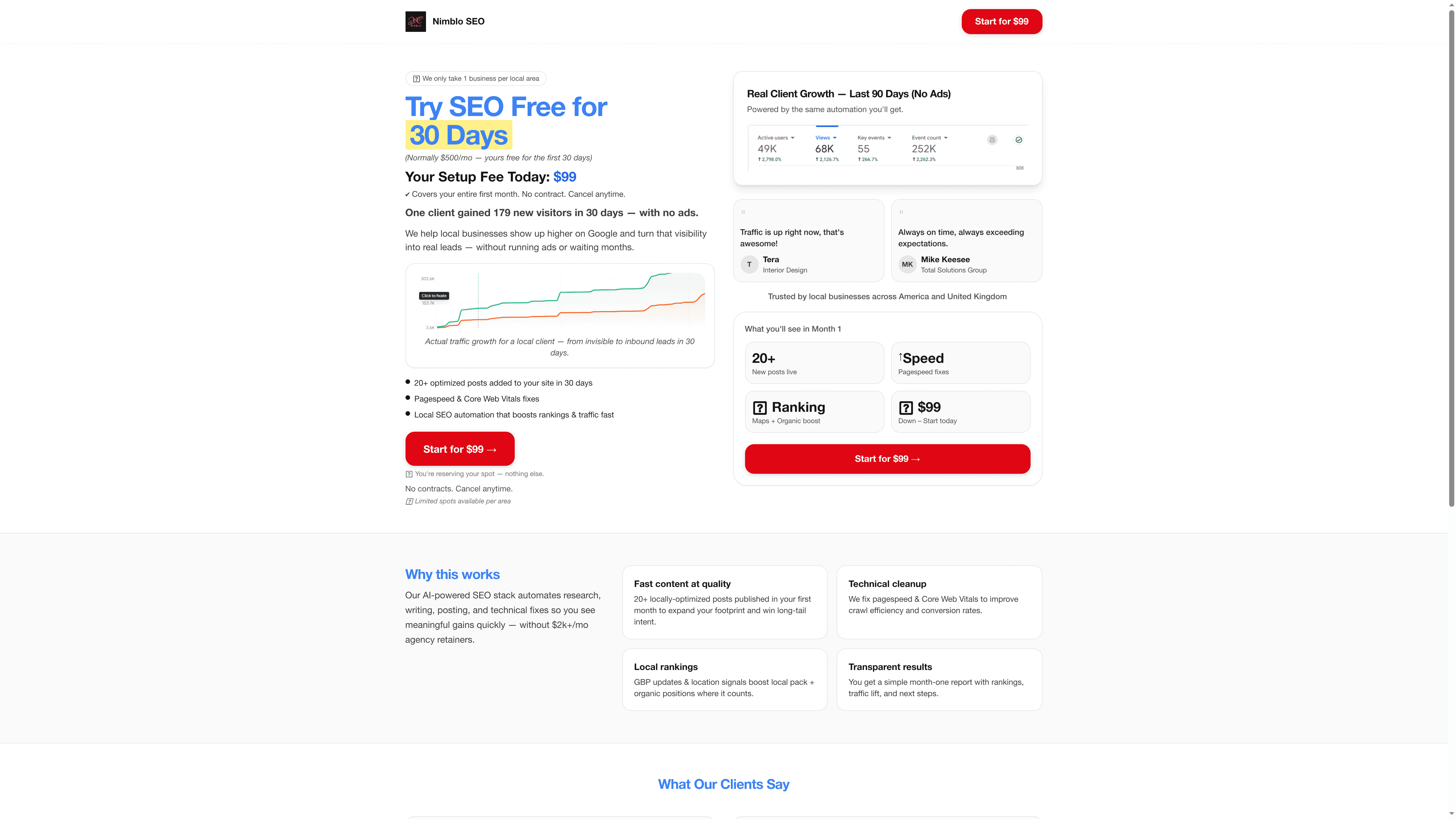
Nimblo.ai delivers fast setup under 7 days with AI-powered local SEO tools that automatically manage schema markup and Google Business Profile optimization. You launch with a conversion-optimized website, high-speed hosting, and automated lead nurture sequences active from day one. Flat-rate pricing at $500 monthly with no contracts gives you flexibility to scale or pause as business conditions change. Dedicated onboarding ensures you understand how to maximize every feature, from local SEO strategies examples to implementing the complete 7-step lead generation checklist. Learn more about how marketing automation for SMBs transforms your lead management and stops revenue leaks from slow follow-up.
Frequently Asked Questions
What is the most important local SEO factor for Florida SMB websites?
Google Business Profile drives local rankings more than any other factor. The BrightLocal 2023 survey found that Google Business Profile is the most influential local ranking factor, with 25% of SEO experts citing it as their top priority. Maintaining a complete, optimized listing with regular posts, photos, and review responses signals authority to Google and makes your business visible in local map packs and search results.
How does schema markup improve my website’s local search performance?
Schema markup adds structured data that helps search engines understand your business details like services, location, hours, and customer reviews. According to Google Developers schema guide, schema markup boosts organic search click-through rates by up to 20% by enabling rich snippets that display star ratings, pricing, and availability directly in search results. This enhanced visibility makes your listing stand out, driving more qualified traffic to your website.
Why should I integrate CRM and marketing automation with my website platform?
Integration speeds lead follow-up and dramatically improves conversion rates. Research from Marketing Automation: Transforming Florida Small Businesses shows automated follow-ups increase lead conversion by up to 30% by eliminating delays between inquiry and response. CRM integration creates a single source of truth for customer data, preventing leads from falling through cracks and enabling personalized nurture campaigns that move prospects through your sales funnel systematically.
How much can I realistically save by switching to an all-in-one platform?
Most Florida SMBs reduce marketing software costs by 40% to 50% when consolidating from five or more tools to a single platform. Typical fragmented setups cost $800 to $1200 monthly across website hosting, email marketing, CRM, analytics, and SEO tools. All-in-one platforms range from $300 to $700 monthly, bundling these functions and eliminating integration costs. You also save staff time previously spent managing multiple vendor relationships and troubleshooting compatibility issues between systems.
What website load speed should I target for optimal local SEO?
Aim for page load times under 2 seconds on mobile and desktop. Google confirmed page speed as a ranking factor, and user experience data shows visitors abandon sites loading slower than 3 seconds. Fast-loading sites also convert better because users stay engaged. Use Google PageSpeed Insights to test your site and target scores above 90. High-speed hosting, image compression, and CDN delivery help achieve these targets without sacrificing design quality or functionality.