
TL;DR:
- Inbound marketing generates more leads at lower cost by attracting prospects actively seeking solutions.
- It emphasizes permission-based engagement, persona-specific content, and data-driven personalization.
- Successful inbound requires a long-term, disciplined approach integrating channels, automation, and strategic mindset.
Most enterprise marketing leaders know inbound marketing exists. Far fewer actually understand what it is. There’s a persistent myth that inbound just means publishing blog posts and waiting for traffic to arrive. In reality, inbound generates 54% more leads at 62% lower cost than outbound. That’s not a content strategy talking point. That’s a structural advantage that reshapes how you build pipeline, allocate budget, and measure marketing’s contribution to revenue. This article breaks down the definition, core tactics, ROI comparisons, and advanced strategies you need to make inbound a competitive weapon.
Table of Contents
- Defining inbound marketing: Principles and methodology
- Core inbound marketing tactics and channels
- Inbound marketing vs. outbound marketing: Costs, ROI, and lead quality
- Advanced strategies: Personalization, ABM integration, and AI
- A fresh perspective: Inbound as discipline, not just a tactic
- Elevate your inbound strategy with expert-led solutions
- Frequently asked questions
Key Takeaways
| Point | Details |
|---|---|
| Inbound attracts, outbound interrupts | Inbound marketing earns attention with valuable content, while outbound interrupts audiences through forced messaging. |
| Lower cost, higher ROI | Inbound typically delivers more leads at a much lower cost per lead than outbound methods. |
| Multi-channel tactics matter | Successful inbound campaigns use SEO, content, email, and automation working together. |
| Personalization and ABM drive results | Adopting advanced techniques like persona segmentation and Account-Based Marketing increases enterprise impact. |
| Inbound is a discipline | Consistent execution, leadership support, and cross-team collaboration are key to inbound success. |
Defining inbound marketing: Principles and methodology
With myths aside, let’s clarify exactly what inbound marketing means and how it’s distinct from traditional methods.
Inbound marketing is a methodology that attracts customers through valuable, relevant content and experiences tailored to their needs, contrasting with outbound marketing’s interruptive tactics. That’s the textbook version. The practical version is this: inbound is about earning attention, not buying it.
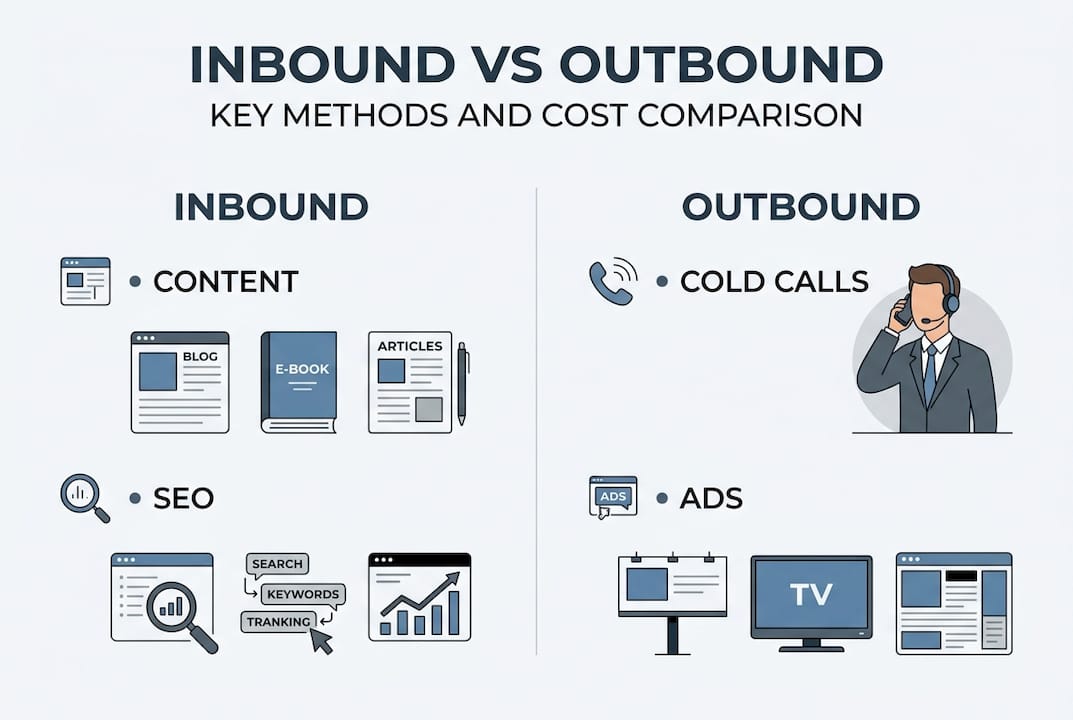
Outbound marketing interrupts. Cold calls, display ads, trade show booths, unsolicited email blasts. These methods push a message at people whether they want it or not. Inbound pulls. It creates content, experiences, and resources that prospects actively seek out because those things solve a real problem.
Here’s what separates inbound as an operating framework from inbound as a tactic:
| Dimension | Inbound marketing | Outbound marketing |
|---|---|---|
| Audience targeting | Persona-centric, intent-driven | Broad, demographic-based |
| Engagement model | Permission-based, opt-in | Interruptive, push-based |
| Cost structure | Lower CPL over time | Higher CPL, ongoing spend |
| Lead quality | Higher intent, self-qualified | Variable, often lower intent |
| Measurement | Attribution, pipeline influence | Impressions, reach, response rate |
| Scalability | Compounds over time | Scales with budget only |
The distinction matters because it changes how you resource the function. Outbound is a faucet: turn off the budget and leads stop. Inbound is an asset: the content, authority, and trust you build keep generating returns long after the initial investment.
“Inbound marketing isn’t a campaign you run. It’s a system you build. The organizations that treat it as a campaign will always underperform the ones that treat it as infrastructure.”
Three principles define mature inbound execution. First, persona-centric content: every asset maps to a specific buyer role, stage, and question. Second, permission-based engagement: prospects choose to receive communications, which means they arrive with higher intent. Third, data-driven personalization: behavioral signals inform what content surfaces next, creating a self-reinforcing loop that improves conversion over time.
For enterprise teams building lead generation strategies, this framework is the foundation. Without it, you’re producing content without a system, and that’s where most programs stall.
Core inbound marketing tactics and channels
Having defined the framework, it’s crucial to examine which channels and tactics power successful inbound strategies.
Key inbound tactics include SEO, content marketing (blogs, ebooks, videos), social media, email nurturing, personalization, and marketing automation. Each plays a distinct role in the buyer journey, and the most effective enterprise programs integrate all of them into a coordinated system.
Let’s look at how these channels perform in practice:
| Channel | Average ROI per $1 spent | Notes |
|---|---|---|
| SEO | $22 ROI | Compounds over time, high intent traffic |
| Email nurturing | $36 to $42 ROI | Highest direct ROI of any digital channel |
| Content marketing | 3x more leads than paid | Lower CPL, longer ramp time |
| Social media | Variable | Best for awareness and retargeting |
The role of SEO in inbound is often underestimated at the enterprise level. Teams focus on branded search and ignore the vast opportunity in informational and commercial intent queries. That’s where your buyers are doing research before they ever talk to a sales rep.
Here’s what an integrated inbound channel mix looks like for a complex B2B buyer journey:
- Awareness: SEO-optimized blog posts, YouTube explainers, LinkedIn thought leadership
- Consideration: Gated ebooks, comparison guides, webinars, case studies
- Decision: Free trials, demos, ROI calculators, customer testimonials
- Post-conversion: Onboarding email sequences, product education, loyalty content
Personalization and automation are what separate good inbound programs from great ones. Without automation, you can’t deliver the right content to the right person at the right time at scale. Marketing automation strategies allow you to trigger content based on behavior, score leads based on engagement, and route high-intent prospects to sales without manual intervention.
One area that consistently gets overlooked: effective website copy. Your website is the hub of every inbound channel. If the copy doesn’t convert visitors into leads, the traffic you’re generating is wasted.
Pro Tip: Don’t neglect post-conversion nurturing. Most teams focus all their energy on acquiring new leads and ignore the buyers who already converted. A structured onboarding and expansion sequence can increase customer lifetime value by 20 to 30% with minimal additional spend.
Inbound marketing vs. outbound marketing: Costs, ROI, and lead quality
While inbound is highly effective, understanding its practical advantages requires a side-by-side look at performance over outbound marketing.
The cost-per-lead (CPL) comparison is where inbound’s advantage becomes undeniable. SEO-generated leads average a CPL of $31. Email nurturing runs around $53. Compare that to paid search at $110 or trade shows and events, which can exceed $800 per qualified lead. The math is straightforward.

But CPL alone doesn’t tell the full story. Lead quality matters more than volume. Inbound leads are self-qualified. They found you because they were searching for a solution to a problem you solve. That intent signal changes everything downstream.
Here’s a breakdown of inbound vs. outbound performance across key metrics:
- Lead volume: 54% more leads generated by inbound at 62% lower cost
- Conversion rate: B2B inbound leads convert at 2 to 3% on average; elite performers reach 7 to 11%
- Pipeline velocity: Inbound leads close faster because they arrive with context and intent
- Customer lifetime value: Higher for inbound because the relationship starts with trust, not interruption
- Compounding returns: Inbound assets appreciate over time; outbound costs reset every cycle
Stat callout: Inbound generates 54% more leads at 62% lower cost than outbound. For a $1M marketing budget, that’s not a marginal improvement. That’s a structural reallocation of resources.
The conversion rate gap between average performers (2 to 3%) and elite performers (7 to 11%) is worth examining. That gap isn’t explained by budget. It’s explained by program maturity, content quality, and how well the team maps content to buyer intent at each stage.
For enterprise teams reviewing lead generation case studies, the pattern is consistent: the organizations outperforming on inbound conversion aren’t spending more. They’re executing more precisely.
Pipeline velocity is the metric most teams ignore. A lead that converts in 30 days is worth more than one that converts in 90 days, even at the same deal value. Inbound’s intent-driven leads consistently show faster time-to-close because the buyer has already done significant research before engaging sales.
Advanced strategies: Personalization, ABM integration, and AI
To achieve maximum ROI, enterprises must evolve beyond basic inbound and adopt advanced strategies.
Success requires buyer personas, topical authority content, dark funnel tracking, and AI for personalization. Let’s break down what each of these looks like in practice.
Buyer personas and role mapping go deeper than demographics. At the enterprise level, you’re often selling to a buying committee of 6 to 10 people. Each role has different questions, different objections, and different content preferences. Mapping content to each role in the committee dramatically increases engagement and deal velocity.
Here’s a framework for advancing your inbound program:
- Build role-specific content libraries: Map every asset to a specific buyer role and funnel stage
- Integrate ABM for tier-one accounts: Use ABM for high-value accounts alongside inbound to create personalized account experiences
- Implement dark funnel tracking: Monitor intent signals from review sites, communities, and third-party sources
- Deploy AI for hyper-personalization: Use machine learning to dynamically serve content based on behavioral patterns
- Build attribution models that reflect reality: Multi-touch attribution shows inbound’s true pipeline influence
AI is changing inbound execution in three specific ways. First, content personalization at scale: AI can serve different versions of a landing page or email based on firmographic and behavioral data. Second, predictive lead scoring: models that identify which leads are most likely to convert before they self-identify. Third, attribution: AI-powered attribution tools can connect dark funnel activity to pipeline, giving you a clearer picture of what’s actually driving revenue.
Using a marketing automation workflow that integrates these signals creates a feedback loop: better data leads to better personalization, which leads to higher engagement, which generates better data.
Pro Tip: Measure pipeline influence, not just MQL counts. MQLs are a leading indicator, but pipeline influence tells you whether your inbound program is actually contributing to closed revenue. If your CMO is reporting MQLs to the board and not pipeline, that’s a red flag.
The biggest pitfalls at this stage: over-indexing on vanity metrics (traffic, social shares, open rates), producing generic content that doesn’t establish topical authority, and ignoring dark funnel data entirely.
A fresh perspective: Inbound as discipline, not just a tactic
After exploring advanced strategies, it’s worth considering why many organizations still underperform with inbound and what mindset shift is needed.
Only 23% of organizations are highly successful with inbound, despite 74% reporting adoption. That gap is not a technology problem. It’s a discipline problem.
Most enterprise teams treat inbound as a campaign. They launch a content program, run it for two quarters, don’t see immediate pipeline impact, and pivot to something else. That’s the wrong mental model entirely. Inbound compounds. The first six months rarely show dramatic results. Months 12 to 24 are where the returns accelerate.
The organizations that win with inbound share three traits: cross-functional adoption (sales, marketing, and product aligned on content and messaging), leadership buy-in that extends beyond the marketing team, and a willingness to measure what actually matters.
There’s also a false choice that holds many teams back: inbound versus outbound. The best programs integrate both. Use affordable SEO lead generation to build long-term pipeline while outbound accelerates speed-to-revenue for priority accounts. The two are not competitors. They’re complements.
Chasing engagement metrics instead of pipeline influence is the single most common failure mode we see. Likes, shares, and page views feel good. Closed revenue is the only metric that matters.
Elevate your inbound strategy with expert-led solutions
Now that you understand inbound’s true power and pitfalls, discover how partnering with specialists can drive predictable, scalable results.
Building a high-performing inbound program requires more than publishing content. It demands precise execution across SEO, automation, personalization, and attribution, all connected to a clear revenue outcome. Most enterprise teams have the intent but not the infrastructure.
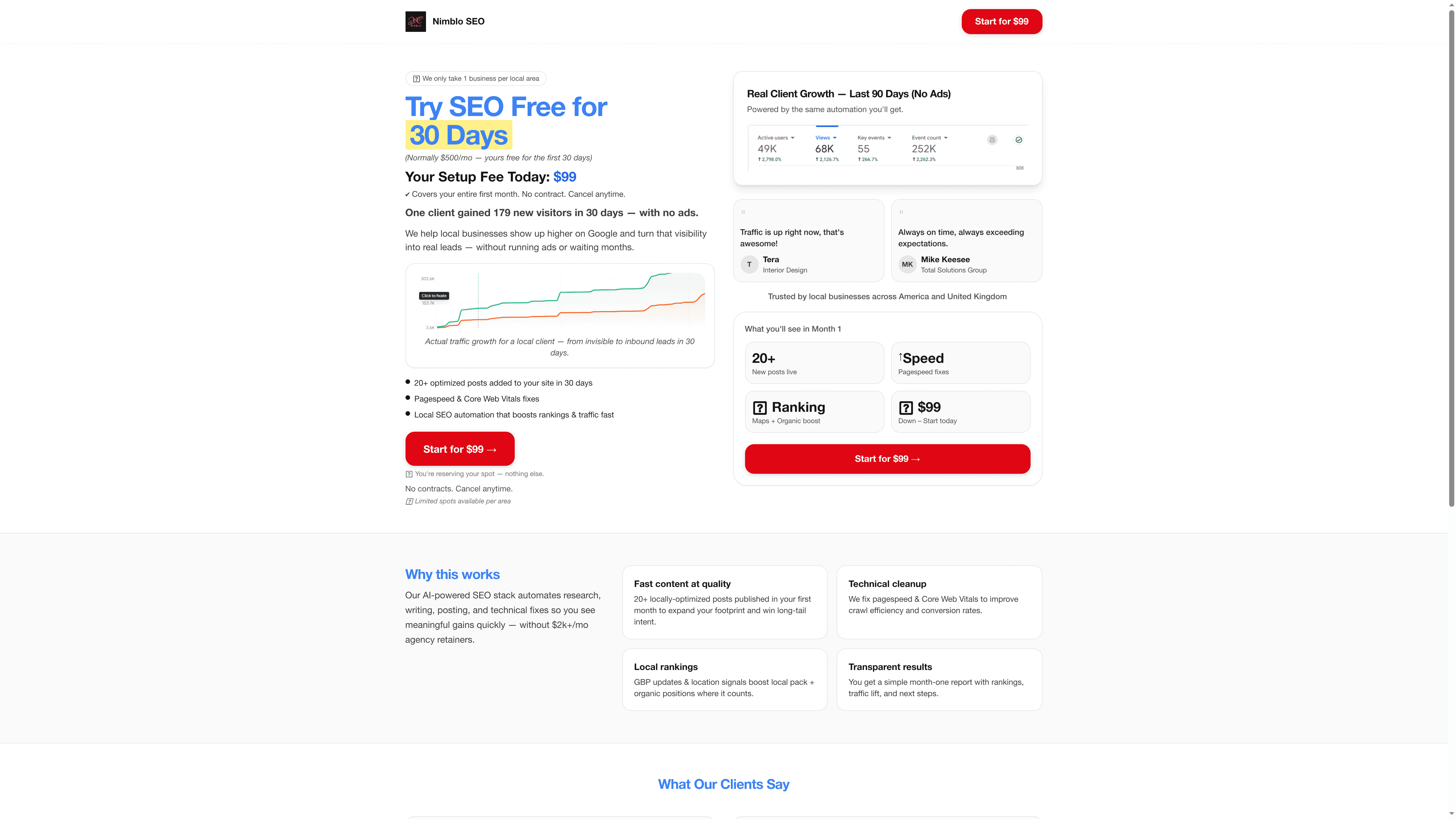
At Nimblo.ai, our embedded automation pods work directly inside your operations to build and optimize the workflows that make inbound scale. From AI-powered lead scoring to automated nurture sequences and attribution modeling, we help you turn inbound from a cost center into a revenue engine. If you’re ready to move from theory to measurable results, explore our enterprise inbound solutions and see what a structured 120-day engagement can deliver for your pipeline.
Frequently asked questions
What is the difference between inbound and outbound marketing?
Inbound marketing attracts prospects through valuable content tailored to their needs, while outbound interrupts with ads and cold outreach. The core difference is permission: inbound earns attention, outbound buys it.
Which inbound marketing channel delivers the highest ROI?
Email and SEO consistently offer the highest return on investment among inbound channels. Email delivers $36 to $42 per $1 spent, making it the top-performing direct channel.
Why do some inbound marketing programs underperform?
Only 23% of organizations report high inbound success because most treat it as a campaign rather than a long-term discipline. Misaligned teams and vanity metric obsession are the most common execution gaps.
How does ABM fit into inbound marketing for enterprises?
Account-Based Marketing complements inbound by targeting high-value accounts with personalized content and coordinated campaigns. Together, they cover both broad pipeline generation and precision account engagement.
Is inbound alone enough for complex B2B sales?
Pure inbound can move too slowly for complex sales cycles with long decision timelines. Hybridizing with outbound accelerates pipeline velocity for high-priority accounts while inbound builds long-term authority.