
Running a Florida small business means juggling daily operations while trying to stay visible online. With limited time and countless marketing tools promising results, you need a clear checklist to evaluate platforms and prioritize actions that actually drive local leads. This guide walks you through essential criteria for selecting marketing solutions, compares top all-in-one platforms tailored for Florida SMBs, and delivers actionable steps to simplify your local marketing strategy. You’ll discover how to cut through complexity and focus on what moves the needle for your business.
Table of Contents
- Key takeaways
- How to evaluate local marketing solutions for Florida SMBs
- Top all-in-one digital marketing platforms to simplify your checklist
- Comparing platforms: which fits your Florida business best?
- Making the decision: local marketing checklist essentials and final tips
- Streamline your local marketing with Nimblo’s all-in-one solution
- Frequently asked questions
Key Takeaways
| Point | Details |
|---|---|
| Time efficient evaluation | Prioritize platforms that save time by unifying listings, reviews, automation, and reporting in one dashboard. |
| Automation and integration | Prioritize platforms that connect paid ads with organic SEO, CRM, and automated follow ups in a single workflow. |
| Localization focus | In Florida markets like Miami, Tampa, and Orlando, choose bilingual SEO and geo targeting to tailor messaging by ZIP code or neighborhood. |
| Mobile app importance | Test each platform’s mobile app before committing to ensure you manage reviews, leads, and analytics on the go. |
How to evaluate local marketing solutions for Florida SMBs
Florida business owners typically have less than one hour daily for marketing tasks. That constraint makes unified platforms far more valuable than piecing together separate tools for listings, reviews, email, and social media. Marketing automation saves time for 67% of SMBs who implement it, while 73% remain unsure if their current strategy works at all.

Your evaluation checklist should prioritize time efficiency above all else. Look for platforms that unify Google Business Profile management, review monitoring, automated follow-ups, and reporting in one dashboard. Florida’s diverse population means bilingual SEO capabilities matter, especially in Miami, Tampa, and Orlando markets where Spanish-speaking customers represent significant opportunity. Check whether platforms offer geo-targeting features that let you adjust messaging by ZIP code or neighborhood.
Integration between paid advertising and organic SEO tools ranks high on any serious checklist. You want seamless workflows where lead capture forms feed your CRM, which triggers automated email sequences, all visible in unified analytics. Platforms offering these connections eliminate data silos and reduce the manual copying between systems that wastes your limited daily marketing time.
Setup complexity creates a tradeoff you must evaluate honestly. More powerful platforms often require steeper learning curves or professional configuration. If you lack technical skills or dedicated marketing staff, prioritize solutions emphasizing quick deployment and intuitive interfaces over feature-rich complexity you’ll never fully utilize.
Pro Tip: Test each platform’s mobile app before committing. You’ll manage reviews, respond to leads, and check analytics from your phone more often than from a desktop, so mobile functionality directly impacts your daily workflow efficiency.
Understanding why digital marketing matters for Florida SMBs helps frame your checklist priorities around measurable business outcomes rather than feature lists.
Top all-in-one digital marketing platforms to simplify your checklist
Several platforms have emerged as favorites among Florida SMBs seeking consolidated marketing tools. Each addresses different points on your evaluation checklist with varying strengths.
Hibu One provides unified dashboard access for listings management, review monitoring, and marketing automation. It excels at keeping your business information consistent across 60+ directories, which matters for local SEO rankings. The platform handles reputation management by aggregating reviews from Google, Facebook, and industry-specific sites into one feed.
GoHighLevel replaces 5-6 separate tools by integrating CRM, sales funnels, SMS marketing, email campaigns, and Google Business Profile management. At $97 monthly for the starter plan, it delivers significant value for businesses ready to invest time in initial setup. The platform shines for service businesses needing appointment scheduling, automated reminders, and pipeline management.
Zoho One offers 50+ applications covering marketing, sales, support, finance, and HR for $37 per user monthly. This breadth makes it ideal for growing SMBs wanting room to expand beyond pure marketing tools. You get email marketing, social media management, CRM, survey tools, and website analytics in one subscription.
Marketing 360 combines website hosting, design tools, CRM, and advertising management with dedicated account support. It targets businesses preferring managed services over pure self-service software. The platform handles both organic SEO and paid ad campaigns across Google, Facebook, and display networks.
Pro Tip: Calculate your current monthly spend across all existing marketing tools, agency fees, and staff time before comparing platform costs. Most Florida SMBs discover they’re already spending $400-800 monthly on fragmented solutions that an all-in-one platform consolidates for less.
Each platform aligns differently with the digital marketing priorities Florida businesses face in competitive local markets.
Comparing platforms: which fits your Florida business best?
Side-by-side comparison reveals how platform strengths match specific Florida SMB needs and budgets.
| Platform | Monthly cost | Best for | Key strength | Setup complexity |
|---|---|---|---|---|
| Hibu One | Custom pricing | Multi-location businesses | Listings consistency | Low |
| GoHighLevel | $97+ | Service businesses | Complete automation | Medium-high |
| Zoho One | $37/user | Growing companies | Application breadth | Medium |
| Marketing 360 | Custom pricing | Hands-off owners | Managed service | Low |
The ease of use versus power tradeoff becomes clear when examining GoHighLevel’s documented results. HVAC companies achieve $12.90 cost per lead through the platform’s integrated campaigns, but reaching those numbers requires mastering funnel builders, automation workflows, and multi-channel sequences. You save significant time once configured, but initial setup demands either technical skill or hiring a certified agency partner.
Florida’s tourism-heavy economy creates unique platform requirements. Restaurants, hotels, and attractions need robust review management since visitors research heavily before choosing where to spend. Platforms emphasizing reputation monitoring and automated review requests deliver more value in these industries than those focused purely on lead generation funnels.
Integration with local SEO tools matters enormously. Your platform should simplify creating location-specific landing pages, managing Google Business Profile posts, and tracking local pack rankings. Service area businesses like plumbers, electricians, and landscapers benefit most from platforms offering service area SEO capabilities rather than simple storefront optimization.
Time savings calculations help justify platform investments. If you currently spend eight hours monthly managing listings across directories, responding to reviews on multiple sites, manually sending follow-up emails, and compiling reports from separate analytics tools, a unified platform reclaims that time for revenue-generating activities. At a $50 hourly value for your time, eight saved hours monthly equals $400 in recovered opportunity cost.
Pro Tip: Request demo accounts from your top two platform choices and run them in parallel for 30 days. Track actual time spent in each system completing your weekly marketing tasks to identify which interface truly fits your workflow.
Making the decision: local marketing checklist essentials and final tips
Implementing effective local marketing requires following proven fundamentals while adapting to Florida’s unique market conditions. This checklist ensures you cover essential bases regardless of which platform you choose.
- Claim and optimize your Google Business Profile with accurate hours, services, photos, and regular posts. This free tool drives more local visibility than any paid platform.
- Build consistent NAP (name, address, phone) citations across major directories. Inconsistencies confuse search engines and hurt rankings.
- Implement review generation workflows that request feedback from satisfied customers within 24-48 hours of service completion. Avoid review gating, which violates Google policies by selectively asking only happy customers.
- Create location-specific content addressing neighborhood concerns, local events, and community topics. Generic content performs poorly in local search.
- Set up automated follow-up sequences for leads who don’t convert immediately. Most sales require 5-7 touchpoints, but manual follow-up rarely persists beyond two attempts.
- Combine organic local SEO with targeted paid ads for faster results. SEO builds sustainable traffic over months, while ads deliver immediate visibility during that ramp-up period.
- Monitor voice search optimization since 75% of local queries in Florida now come through voice assistants. Focus on conversational keywords and question-based content.
- Address bilingual SEO if serving diverse markets. Miami, Tampa, and Orlando have substantial Spanish-speaking populations requiring localized content in both languages.
Florida’s seasonal patterns demand tactical content adjustments. Hurricane preparedness content resonates May through November. Tourism businesses should amplify marketing during peak visitor seasons while scaling back in slower months. Snowbird-dependent businesses need campaigns timed for October arrivals and April departures.
Future-proofing your marketing means embracing AI-powered tools now becoming standard. Chatbots handle initial customer inquiries 24/7. Predictive analytics identify which leads deserve immediate follow-up. Automated content suggestions keep your blog and social media active without constant manual effort. Platforms integrating these AI capabilities position your business to compete as technology evolves.
Pro Tip: Document your current marketing process in detail before switching platforms. Knowing exactly which tasks consume your time helps you configure new tools to address actual pain points rather than getting distracted by flashy features you don’t need.
Mastering local SEO best practices for Florida SMBs creates the foundation on which platform tools amplify your results.
Streamline your local marketing with Nimblo’s all-in-one solution
Managing separate tools for SEO, website hosting, CRM, and marketing automation drains time you’d rather spend serving customers. Nimblo consolidates everything Florida SMBs need into one platform designed specifically for local market challenges.
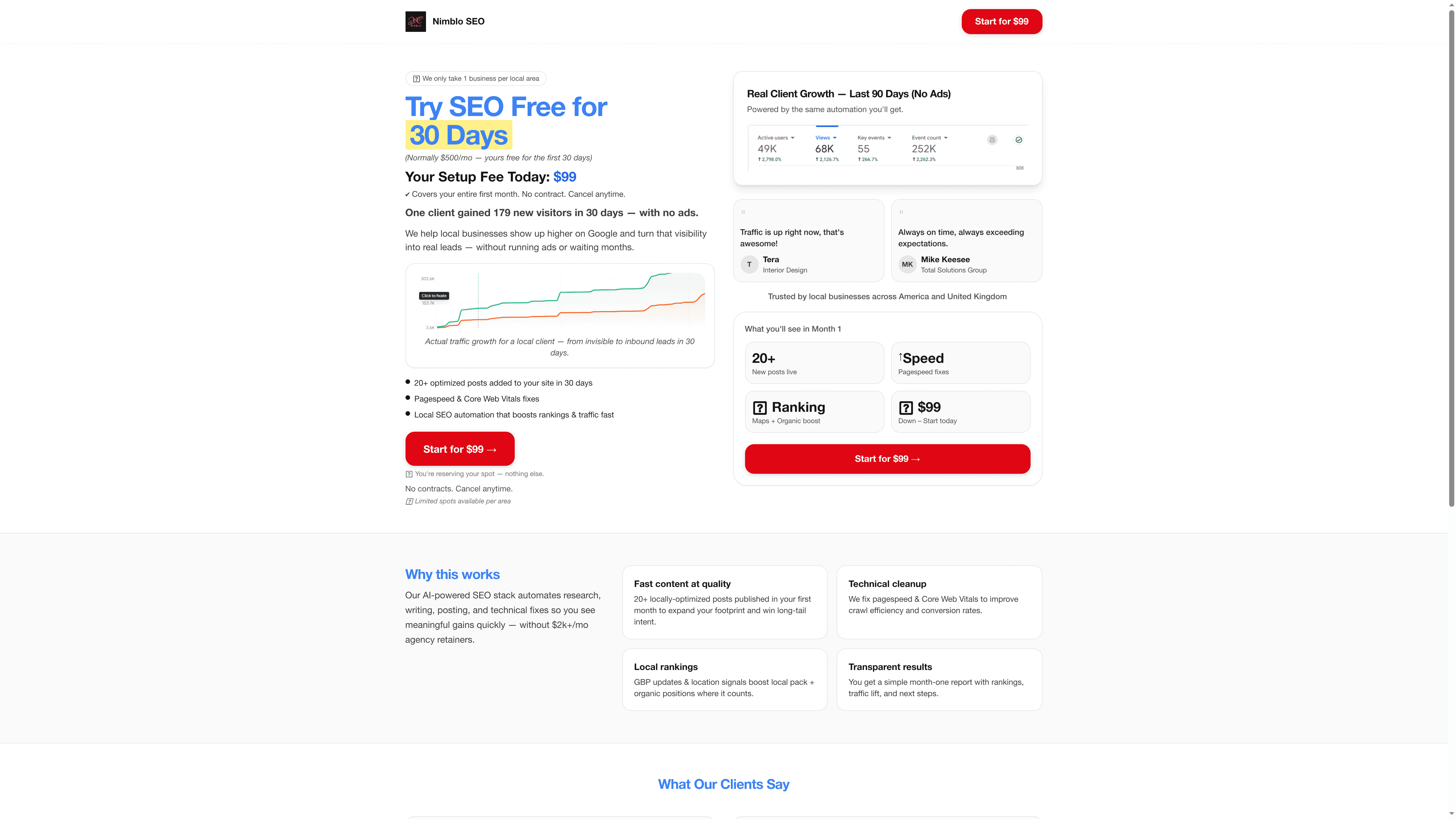
Our unified dashboard handles Google Business Profile optimization, automated review requests, local SEO with schema markup, lead capture forms, and follow-up sequences. You get conversion-optimized web design, marketing automation, and detailed analytics showing exactly which efforts drive revenue. Florida businesses using Nimblo report significant time savings and measurable lead growth within the first 90 days.
The platform eliminates the technical complexity plaguing other solutions. Setup takes hours, not weeks. You’ll have local support from a team understanding Florida’s competitive landscape, seasonal patterns, and diverse customer demographics. No contracts lock you in, and transparent pricing at $500 monthly replaces the $1,200+ most SMBs currently spend across fragmented tools and agency fees.
Discover how Nimblo’s all-in-one marketing platform simplifies your local marketing while delivering the visibility and leads your Florida business deserves.
Frequently asked questions
What is a local marketing checklist and why is it important?
A local marketing checklist is a strategic framework ensuring you complete all essential tasks for maximizing visibility in your geographic market. It prevents missed opportunities like unclaimed directory listings, unanswered reviews, or inconsistent business information that hurt search rankings. Following a structured checklist helps Florida SMBs with limited marketing time focus on high-impact activities rather than random tactics that waste budget.
How do all-in-one marketing platforms benefit Florida SMBs?
Unified platforms eliminate the time drain of logging into separate systems for listings, reviews, email, social media, and analytics. Integration means lead data flows automatically from capture forms into your CRM, triggering follow-up sequences without manual intervention. Florida businesses save 5-10 hours weekly compared to managing disconnected tools, while gaining better visibility into which marketing efforts actually generate revenue.
What local SEO tactics work best for Florida SMBs in 2026?
Focus on hyper-local content targeting specific neighborhoods and ZIP codes rather than generic citywide pages. Bilingual SEO matters enormously in diverse markets like Miami, Tampa, and Orlando where Spanish-speaking customers represent major opportunity. Prioritize Google Business Profile optimization and consistent review generation since these fundamentals still dominate local pack rankings. Combine voice search optimization with traditional keyword targeting since 75% of Florida local queries now come through voice assistants.
Should I handle marketing myself or hire an agency?
Your decision depends on available time, technical skill, and budget. All-in-one platforms empower capable owners to manage marketing independently, saving thousands monthly in agency fees. However, complex platforms like GoHighLevel deliver best results when configured by experts. Consider hybrid approaches where you use intuitive platforms for daily tasks like review responses and social posts while hiring specialists for initial setup, advanced automation, or paid ad management requiring ongoing optimization expertise.