
Running a service-based business in Florida often means juggling high-priced marketing tools that drain your budget faster than they deliver results. Staying visible and trusted in your local community can be tough when national competitors seem to dominate every channel. Switching to affordable, all-in-one local marketing solutions lets you build meaningful connections, enhance lead generation, and become the preferred choice for customers searching nearby. Discover practical ways to simplify your marketing and grow your business where it matters most.
Table of Contents
- What Local Marketing Means For SMBs
- Key Types Of Local Marketing Channels
- Modern Local Marketing Tactics In 2026
- Cost, ROI, And Common Pitfalls
- Comparing All-In-One Platforms To Agency Services
Key Takeaways
| Point | Details |
|---|---|
| Importance of Local Marketing | Local marketing helps Florida SMBs connect with their community, leading to increased customer loyalty and direct competition with larger businesses. |
| Choose the Right Channels | Utilize a mix of digital and traditional marketing channels tailored to your audience for maximum reach and effectiveness. |
| Leverage Technology | Incorporate AI and video optimization to personalize customer interactions and stay relevant in local searches. |
| Measure Marketing Effectiveness | Track the ROI of each marketing channel to understand what works best, allowing for better budget allocation and strategic adjustments. |
What Local Marketing Means For SMBs
Local marketing is about connecting your Florida business directly with your community. It’s not trying to reach everyone everywhere—it’s about becoming the go-to choice for people right in your backyard.
For service-based SMBs in Florida, local marketing means customers can find you, trust you, and choose you over big national competitors. This matters because local customers are often more loyal and require less convincing to book your services.
Why Local Marketing Differs From General Marketing
General marketing casts a wide net. Local marketing targets people actively searching for your specific services near your location.
Consider the difference:
- General marketing: “Buy cleaning services” (vague, national reach)
- Local marketing: “Fast cleaning services in Tampa” (specific, neighborhood-focused)
Local marketing works because people searching for services usually want results quickly. They don’t want to wait for someone from across the state. Buying local connects communities and strengthens the relationships that drive repeat business and referrals.
How Local Marketing Works for SMBs
Local marketing relies on several key components working together.
Building community connections through meaningful engagement helps your business stand out. Here’s what this looks like in practice:
- Online presence: Claim your Google Business Profile, update your hours, respond to reviews
- Local SEO: Optimize your website so people searching “plumber near me” find you, not competitors
- Community involvement: Sponsor local events, partner with other businesses, join networking groups
- Customer trust: Gather reviews, share local testimonials, highlight your community involvement
Each element works together. Your Google Business Profile gets found by local searchers. Your website converts them. Community involvement builds trust and referrals.

The Real Business Impact
Local marketing isn’t theoretical. It produces measurable results for Florida SMBs.
When customers search for your service type in your area, they’re already interested. They’re ready to book or call. Your job is being visible and trustworthy when they search.
Local marketing transforms how small businesses compete—you don’t need the biggest budget, just the right strategy for your community.
Flexibility matters too. You can test what works in your specific market, adjust quickly, and scale tactics that drive results. A cleaning company in Jacksonville might find success with Google Business optimization, while a contractor in Miami might benefit more from community partnerships.
Pro tip: Start by asking your best customers how they found you—their answers reveal which local marketing tactics already work for your business.
Key Types Of Local Marketing Channels
Local marketing channels are the pathways connecting your Florida SMB to nearby customers. Each channel has strengths, and the best results come from using multiple channels together.
You have two basic approaches: reach customers directly or use intermediaries to help you connect. Direct and indirect marketing channels both work for local businesses, depending on your service type and customer preferences.
Digital Channels
Digital channels are where most local customers find you first.
- Google Business Profile: Your free listing that appears in local search results and maps
- Local SEO: Optimizing your website so “services near me” searches find you
- Social media: Facebook, Instagram, and LinkedIn for engaging your community
- Email marketing: Staying connected with past customers and leads
These channels work because customers are already searching online. Your job is being visible when they do.
Traditional Local Channels
Don’t dismiss older marketing methods—they still work in Florida communities.
Local newspapers, radio ads, and print directories reach people who prefer traditional media. Community bulletin boards, local event sponsorships, and partnerships with neighboring businesses build trust and visibility face-to-face.
Traditional channels work especially well for reaching older demographics and building personal relationships in tight-knit communities.
Hybrid Approaches
The most effective strategy combines channels. A plumber might use Google Business to capture search traffic, sponsor a local youth soccer team for visibility, and email past customers with seasonal reminders.
Local marketing strategies that blend digital and traditional channels maximize your reach across different customer groups.
Your specific mix depends on:
- Where your customers actually spend time (online, community events, local media)
- Your budget and available time
- What competitors in your area are doing
- Your service type and audience age range
The best local marketing channel is the one your ideal customer actually uses—not the one you think is trendy.
Flexibility matters. Test a few channels, measure results, and double down on what drives actual customers to your door.
Here’s a quick comparison of key local marketing channels and their most effective uses for Florida SMBs:
| Channel Type | Best For | Typical Audience | Business Impact |
|---|---|---|---|
| Digital Channels | Rapid customer acquisition | Tech-savvy, younger consumers | Boosts visibility, enables quick updates |
| Traditional Channels | Building long-term trust | Older, local residents | Strengthens personal connections |
| Hybrid Strategies | Maximizing reach and consistency | Mixed age and interest groups | Allows flexible targeting, higher ROI |
Pro tip: Track which channel brings in each new customer, then allocate your marketing budget toward the channels actually generating leads for your business.
Modern Local Marketing Tactics In 2026
Local marketing in 2026 looks different from previous years. Technology has evolved, customer expectations have shifted, and Florida SMBs need tactics that actually work right now.
The biggest change? Personalization and speed. Customers expect businesses to understand their specific needs and respond immediately. Generic, one-size-fits-all marketing no longer cuts it.
AI-Powered Personalization
AI-driven analytics now let you understand what individual customers want before they even ask. This isn’t science fiction—it’s practical, actionable insight.
You can now:
- Send tailored messages based on customer behavior and preferences
- Predict which services customers need and when
- Automate follow-ups that feel personal, not robotic
- Adjust your marketing in real-time based on what’s working
For Florida SMBs, this means you can compete with larger companies by being smarter, not bigger. A contractor can target homeowners who recently bought properties in their area with relevant service offers.
Video and Voice Search Optimization
Short-form video content dominates how people discover local businesses. Instagram Reels, TikTok, and YouTube Shorts aren’t optional anymore—they’re where your customers spend time.
Voice search is also changing how people find you. When someone asks “Alexa, find a plumber near me,” you need to be findable. Local SEO best practices for 2025 include optimizing for natural language and voice queries.
Simple tactics:
- Create quick videos showing before-and-after results
- Answer common customer questions in video format
- Optimize your Google Business Profile for voice searches
- Use conversational language on your website
Community-First Approach
Authentic local engagement strategies still matter most. Sponsor local events, collaborate with neighboring businesses, and build real relationships in your community.
The difference in 2026 is speed and consistency. You need to respond to customer messages within hours, not days. Your brand message needs to be identical across all platforms.
Authentic interaction mixed with technology—that’s the winning formula for local marketing in 2026.
Customers want to work with businesses that actually care about their community, not just profit. Show genuine involvement and make it easy for people to do business with you.
Pro tip: Start with one video platform and one AI tool—master those before adding more. Most Florida SMBs fail because they try everything at once instead of excelling at one tactic.
Cost, ROI, And Common Pitfalls
Local marketing costs money, but throwing budget at random tactics wastes it. Florida SMBs need to understand what they’re spending, what they’re getting back, and where most businesses go wrong.
The good news? You don’t need massive budgets to win locally. You need strategy and accountability.
Understanding Your Marketing Costs
Local marketing costs vary wildly depending on your approach. Digital tools might run $500 to $2,000 monthly. Traditional advertising (radio, print, events) can range from $300 to $5,000 per month.
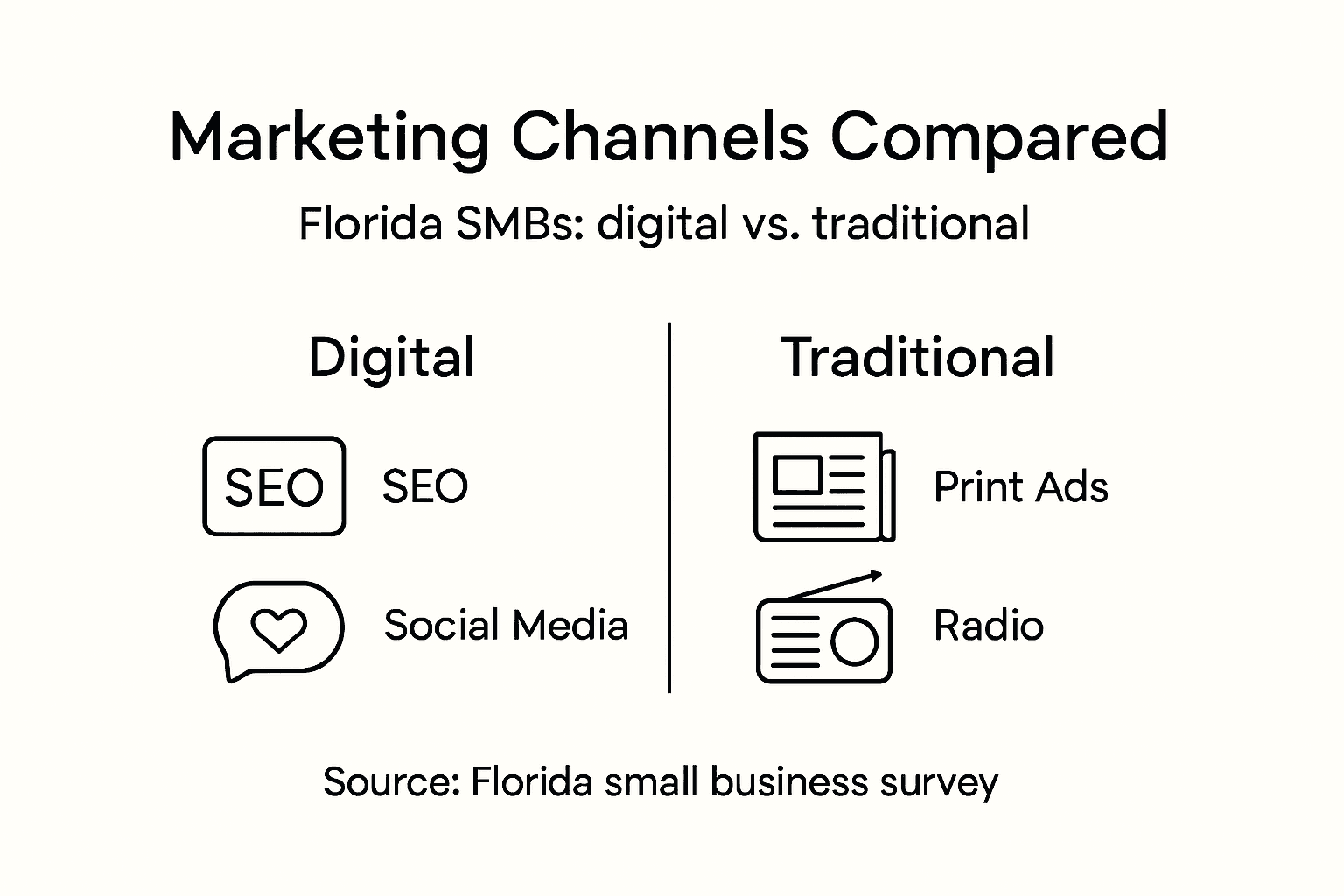
The real question isn’t the cost—it’s whether you’re spending on channels that actually bring customers in.
Common cost categories:
- Google Business Profile optimization (free to $200/month for professional management)
- Social media advertising ($200–$1,500/month depending on reach)
- Local SEO services ($300–$2,000/month)
- Event sponsorships ($500–$5,000 per event)
- Email marketing platforms ($20–$300/month)
Calculating ROI Properly
Understanding marketing ROI helps you allocate budgets toward tactics that actually generate revenue. Many Florida SMBs skip this step and wonder why they’re not seeing results.
Realistically, you should track:
- Where each customer came from (which channel)
- How much you spent on that channel
- How much that customer paid you
- Whether they returned or referred others
If you spent $500 on Google Business optimization and gained five customers worth $200 each, your ROI is 100 percent. That works. If you spent $500 and gained zero customers, it doesn’t.
Common Pitfalls That Drain Budgets
Most Florida SMBs fail at local marketing because of these mistakes:
- No clear goal: Spending without knowing if you’re chasing leads, awareness, or sales
- Poor tracking: Not knowing which channel brought which customer
- Inconsistent messaging: Your Facebook says one thing, your website says another
- Trying everything: Spreading thin across ten channels instead of mastering two
- Underinvestment: Spending $100/month and expecting $10,000 in results
Tracking data accurately prevents wasted marketing spend that most small businesses lose monthly. You need systems in place before spending anything.
One focused strategy with consistent execution beats scattered efforts every time.
Set specific, measurable goals. Track results religiously. Cut tactics that don’t perform. Double down on what works.
Pro tip: Pick two marketing channels, commit for 90 days with full tracking, then measure ROI before deciding to expand or shift budget.
Comparing All-In-One Platforms To Agency Services
Flora SMBs face a choice: hire an agency or use an all-in-one platform. Both have real advantages and real limitations. The right answer depends on your budget, timeline, and business goals.
Here’s what you actually need to know about each approach.
All-In-One Platforms: Speed And Affordability
All-in-one platforms give you SEO, social media, email, analytics, and CRM in one dashboard. Setup takes days, not months. Cost is predictable—usually $300 to $1,000 monthly.
Real advantages:
- Quick launch: Go live with marketing campaigns in a week
- Lower cost: $500/month beats $3,000 to $10,000 agency retainers
- Self-control: Make changes whenever you want without waiting
- Automation: Set tasks to run without manual effort
- Built-in tools: No juggling multiple software subscriptions
Integrated marketing platforms streamline execution by consolidating tasks. You handle execution yourself or train a staff member.
Agency Services: Strategy And Expertise
Agencies bring human expertise, creative thinking, and strategic planning that platforms alone can’t provide. They study your market, understand competitors, and craft custom strategies.
What agencies excel at:
- Custom strategy: Tailored plans based on your specific business
- Creative development: Professional copy, design, and campaigns
- Market knowledge: Understanding local Florida dynamics
- Relationship building: A dedicated team focused on your success
- Problem-solving: Adapting tactics when something isn’t working
The tradeoff? Agencies cost $3,000 to $15,000 monthly, require longer contracts, and may move slower.
The Hybrid Approach
The smartest Florida SMBs actually use both. Using platforms for execution while agencies guide strategy gives you efficiency and expertise without overspending.
Example: A contractor uses an all-in-one platform to manage Google Business, email campaigns, and social posting daily. Once quarterly, they consult with a marketing strategist to review results and adjust direction.
Cost? $500/month for platform plus $1,500/quarter for strategy. Total: $875/month. Better than either alone.
Platforms are the engine; agencies are the navigation. You need both to get somewhere.
Choose based on your situation. Starting out with limited budget? Platform first. Ready to scale aggressively? Combine both. Overwhelmed and confused? Agency plus platform reduces your workload.
To help you decide between all-in-one platforms and agency services, here’s a direct features comparison:
| Aspect | All-In-One Platform | Agency Services | Hybrid Approach |
|---|---|---|---|
| Cost | $300–$1,000 monthly | $3,000–$15,000 monthly | $875 monthly average |
| Setup Time | Days | Weeks to months | Days (platform), Strategy review quarterly |
| Customization | Limited, templated | Highly tailored | Flexible, expert-guided |
| Skill Requirement | Basic, DIY-friendly | Minimal, team-managed | Balanced, learn and adapt |
| Best Use Case | Early-stage or budget SMBs | Growth-focused SMBs | Efficient scaling, data-driven choices |
Pro tip: Start with a platform for 90 days to collect real data about your customers, then use that data to guide whether you hire an agency or continue optimizing yourself.
Unlock Powerful Local Marketing for Your Florida SMB Today
Local marketing can feel overwhelming with so many channels and tactics to juggle. This article highlights the crucial pain points Florida SMBs face: gaining local visibility, managing Google Business listings, optimizing for voice search, and balancing digital with community engagement. You want a cost-effective, all-in-one solution that empowers you to personalize outreach, automate lead follow-ups, and stand out without the confusion or expense of juggling multiple tools or agencies.
At Nimblo.ai, we understand these challenges deeply. Our platform offers everything from AI-powered local SEO to Google Business Profile management and conversion-focused websites fully streamlined in one affordable package. Experience rapid setup and local support designed specifically for Florida businesses. Say goodbye to wasted budget and scattered efforts by letting us help you focus on what really matters: growing your local customer base and increasing referrals.
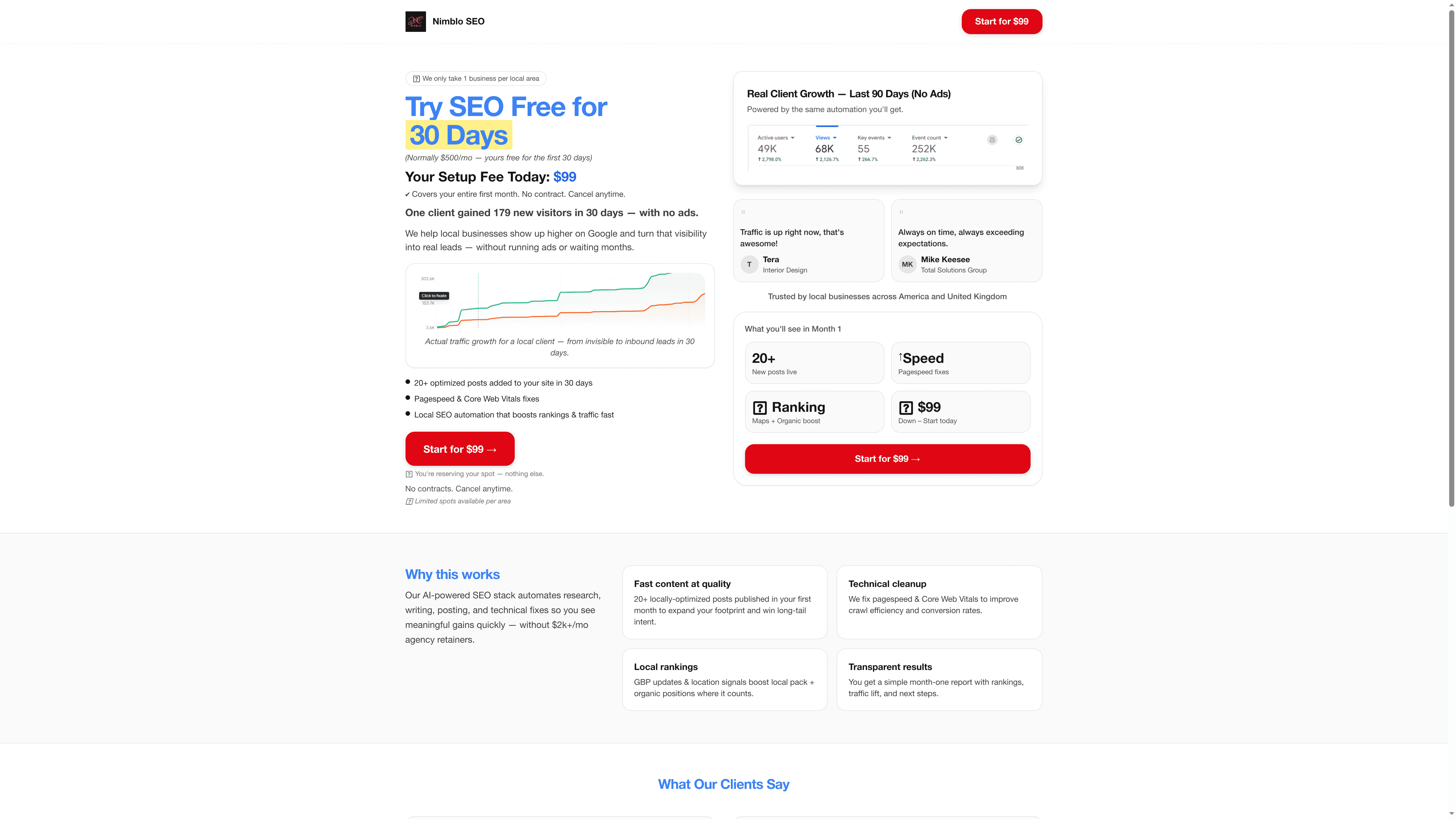
Ready to take control of your local marketing and see measurable results? Discover how Nimblo.ai unifies SEO, CRM, and automation so you can outpace competitors in cities across Florida. Start your journey with our flat-rate, no-contract plan at Nimblo.ai Quick Start and make local marketing simple today. Learn more about our AI-powered marketing tools tailored for your business needs and begin transforming how you connect with your community now.
Frequently Asked Questions
What is local marketing and how does it differ from general marketing?
Local marketing focuses on connecting a business directly with its community, while general marketing casts a wide net. For example, local marketing targets searches like “fast cleaning services in Tampa,” whereas general marketing might use a vague term like “buy cleaning services.”
How can I effectively use online channels for local marketing?
To effectively use online channels, claim and optimize your Google Business Profile, implement local SEO on your website, engage customers on social media, and use email marketing to stay connected with past customers and leads.
What are some common pitfalls to avoid in local marketing?
Common pitfalls include not having clear goals, poor tracking of marketing performance, inconsistent messaging across various channels, trying to use too many marketing channels at once, and underinvesting in marketing efforts.
How do I calculate the return on investment (ROI) for my local marketing efforts?
To calculate ROI, track where each customer came from, how much you spent on that channel, the total revenue generated by those customers, and whether they returned or referred others. For example, if you spent $500 and gained five customers who each paid $200, your ROI would be 100 percent.