
Slow website speed is a silent killer for Florida SMBs trying to bring in new customers online. Every second your site takes to load directly affects whether visitors stay or leave, and lost leads mean lost revenue. Website speed not only shapes customer engagement and satisfaction, it also determines how visible your business is on Google. Discover how optimizing speed builds a strong digital foundation for growth and keeps you ahead of competing Florida businesses.
Table of Contents
- Defining Website Speed And Its Role In Business
- How Website Speed Impacts SEO And Rankings
- Speed’s Effect On User Experience And Conversions
- Common Causes Of Slow Websites In Florida SMBs
- Reducing Costs And Outperforming Agencies With Speed
Key Takeaways
| Point | Details |
|---|---|
| Website Speed is Crucial | Slow loading times lead to higher bounce rates and lost revenue for small businesses, particularly in Florida. |
| Impact on SEO | Website speed directly influences search engine rankings; a faster site ranks higher, driving more organic traffic. |
| Conversion Rates | Faster websites result in increased conversions as users are more likely to complete actions like forms and purchases. |
| Cost Efficiency | Optimizing website speed can reduce operational costs, making it a more sustainable investment compared to traditional digital marketing agencies. |
Defining Website Speed and Its Role in Business
Website speed is more than just a technical metric—it’s the foundation of how your customers experience your business online. Website speed refers to the time it takes for your website to load and become fully interactive for visitors.
For Florida SMB owners, this matters because every second of delay directly impacts your bottom line. When a page takes too long to load, visitors leave. When they leave, you lose potential customers, sales, and leads.
What Website Speed Actually Means
Speed isn’t one single measurement. It’s a combination of several factors working together:
- Page load time: How long before the first content appears
- Time to interactive: When visitors can actually click buttons or fill forms
- Mobile performance: Speed on phones and tablets, not just desktops
- Server response time: How quickly your hosting responds to requests
Each of these contributes to your overall user experience. A slow website fails at all of them.
Why Speed Impacts Your Business
Website speed affects user engagement, satisfaction, and ultimately determines your digital success. When visitors land on your site, they form an impression within milliseconds. A fast site keeps them engaged. A slow site drives them away to competitors.
The business impact is concrete and measurable:
- Higher bounce rates: Slow pages cause visitors to leave immediately
- Lost revenue: Every second of delay costs you potential customers
- Lower conversions: Frustrated visitors don’t fill out forms or make purchases
- Damaged reputation: Users associate slow sites with poor quality
Fast websites aren’t a luxury for Florida SMBs—they’re a requirement for staying competitive in your local market.
Speed’s Role in Search Engine Rankings
Website speed optimization supports both user experience and search engine rankings, making it a dual advantage for your business. Google prioritizes fast websites in search results. When your site loads quickly, you rank higher for local searches. When you rank higher, more customers find you.
This is especially important for local service businesses competing in Florida cities. Your potential customers search for “plumber near me” or “HVAC services in Miami.” If your website is slow, you won’t appear at the top of those results.
The Real-World Cost of Slow Speed
Imagine a plumber’s website taking 5 seconds to load instead of 2 seconds. That 3-second difference means losing 40% of visitors before they even see your phone number. A dental practice with slow pages gets fewer appointment requests. A contractor’s slow website costs them jobs to faster competitors.

These aren’t hypothetical numbers—they’re the reality of how customer behavior works online.
Pro tip: Test your website speed right now using Google PageSpeed Insights to see where you stand, then prioritize improvements that impact user behavior most—fast load times directly drive more leads and lower customer acquisition costs.
How Website Speed Impacts SEO and Rankings
Google doesn’t just care that your website works—it cares how fast it works. Website speed is now a direct ranking factor that determines whether your site appears at the top of search results or gets buried on page three.
For Florida SMBs competing locally, this matters enormously. When someone searches for your service, Google shows faster websites first. Your slow competitor gets the clicks. You get nothing.
Speed as a Google Ranking Signal
Page speed is a critical technical SEO factor that Google uses to determine which sites deserve top positions in search results. Google doesn’t rank websites just on content quality anymore—it ranks them on the entire user experience, which starts with how fast they load.
This isn’t a hidden algorithm detail. Google openly says: fast websites rank higher.
The Direct Connection Between Speed and Rankings
Faster websites rank higher in search results because they provide better user experience. When your site loads quickly, Google sees:
- Lower bounce rates: Users stay on your site instead of leaving
- Longer time on page: Visitors read your content and explore
- More conversions: People complete desired actions like filling forms
- Better mobile experience: Your site works well on phones
Each of these signals tells Google your site is valuable and worthy of a higher ranking.
Slow websites lose ranking positions to faster competitors. Every day your site stays slow, you’re losing ground in local search.
Speed Directly Drives Organic Traffic
When your website climbs higher in Google rankings, more people find you. A Florida electrician who improves speed from 4 seconds to 2 seconds might jump from position 5 to position 2 for “electrician near me.” That’s not just better ranking—that’s more calls.
The connection is direct. Better ranking equals more visibility. More visibility equals more leads. Slow speed prevents all of this from happening.
What Kills Your Rankings
Slow websites trigger negative signals that tank your SEO:
- High bounce rates: People leave without reading anything
- Low engagement: Visitors don’t interact with your content
- Poor mobile performance: Mobile searchers (most of your customers) get frustrated
- Reduced crawlability: Google’s bots can’t efficiently crawl your site
These problems compound. A slow site gets worse rankings, fewer visitors, and lower conversions.
Speed Optimization Improves Rankings
Improving your speed directly improves your SEO. Common techniques include:
- Optimizing images to reduce file sizes
- Leveraging browser caching to speed repeat visits
- Minimizing code to reduce processing time
- Using content delivery networks (CDNs) for faster global delivery
- Reducing server response times
Each improvement pushes your rankings higher and drives more organic traffic.
Pro tip: Monitor your Core Web Vitals monthly using Google Search Console to track speed improvements—this free tool shows exactly which speed metrics are hurting your rankings, letting you fix the biggest problems first.
Speed’s Effect on User Experience and Conversions
Speed doesn’t just affect rankings—it directly impacts whether visitors become customers. When someone lands on your website, their first impression happens in milliseconds. If your site is slow, they form a negative opinion before reading a single word.
For Florida SMBs, this means the difference between winning and losing sales.
The Psychology of Fast vs. Slow
A seamless and fast digital interaction creates positive emotional responses that drive brand loyalty. When your site loads instantly, visitors feel confident and respected. When it crawls, they feel frustrated and undervalued.
This isn’t just a feeling—it’s neuroscience. Fast websites trigger positive emotional responses. Slow websites trigger irritation and abandonment.
Speed Directly Reduces Bounce Rates
Your bounce rate is the percentage of visitors who leave without taking any action. A slow website has a disaster bounce rate. Fast sites reduce user abandonment and enhance engagement by allowing users to access information quickly.
Consider this: A dental practice’s website takes 5 seconds to load. Half the visitors leave before seeing appointment booking options. A competitor’s site loads in 2 seconds. Those visitors stay and book appointments.
Speed Drives Conversions Up
Conversion is when a visitor completes a desired action—filling a form, calling your business, requesting a quote, or making a purchase. Speed directly increases conversion rates.
A faster site means:
- More form submissions: Visitors complete contact forms instead of leaving
- More phone calls: Prospects dial your number instead of shopping competitors
- More purchases: Customers complete transactions instead of abandoning carts
- More inquiries: Service seekers request estimates instead of moving on
Each second of delay costs you conversions and revenue.
Speed is a conversion tool. Every improvement you make directly increases the number of leads and sales your website generates.
The Real-World Conversion Impact
A plumbing company in Miami improves their website speed from 4 seconds to 2 seconds. Their form submissions increase by 23%. That’s not a coincidence—it’s how speed works.
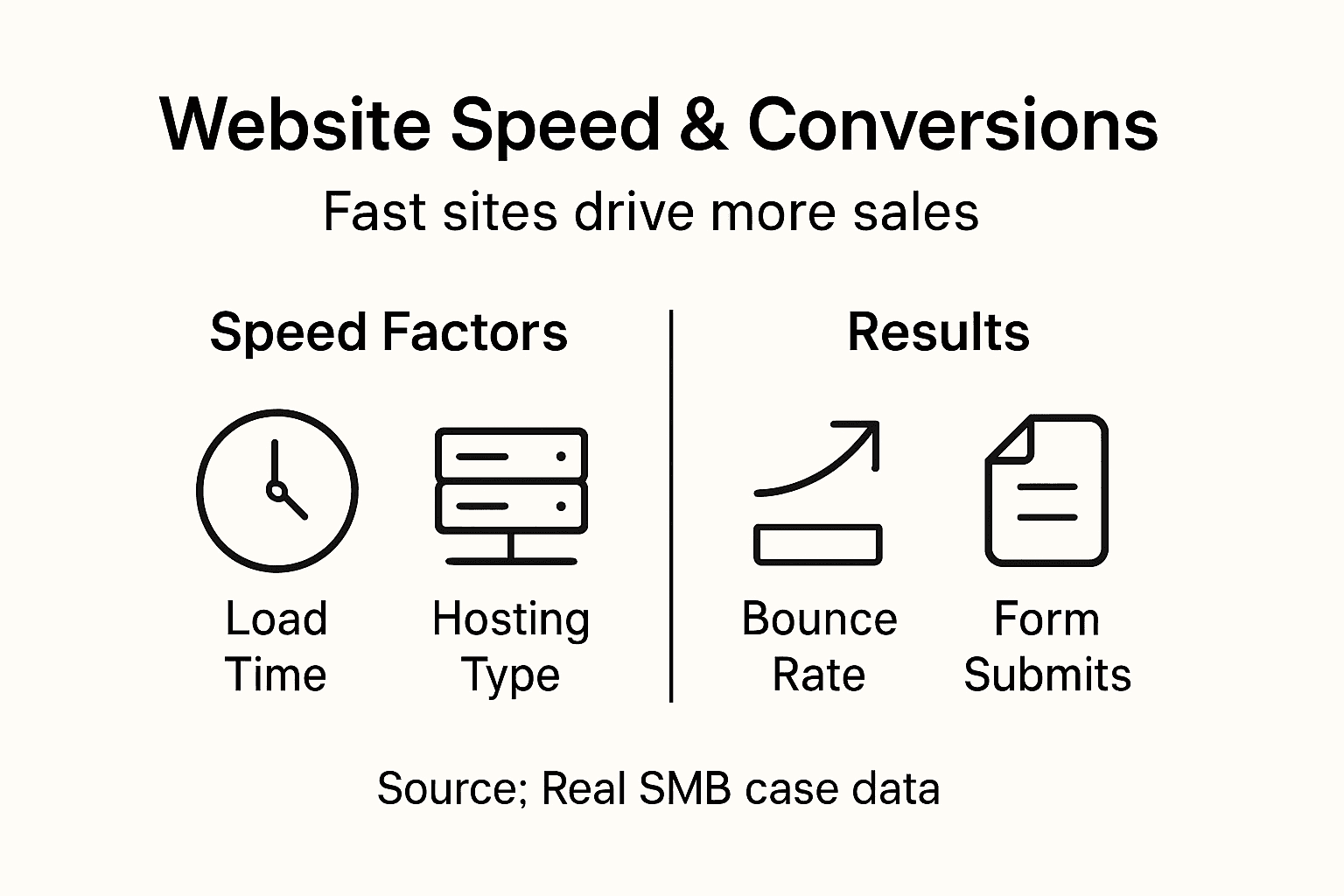
An HVAC contractor reduces page load time by 1.5 seconds. Phone calls to their business jump by 18% within a month. Faster speed equals more leads equals more business.
Speed Improves Customer Satisfaction
When visitors can navigate your site smoothly without frustration, they remember your business positively. They’re more likely to return, recommend you, and become loyal customers.
Slow sites create the opposite experience. Visitors remember the frustration, not your service.
Measuring the Conversion Impact
Track these metrics to see how speed affects your conversions:
- Bounce rate: Percentage of single-page visits
- Time on site: How long visitors stay
- Pages per session: Number of pages viewed per visit
- Conversion rate: Percentage of visitors taking desired actions
- Lead quality: Quality of contacts generated
When you improve speed, all these metrics improve together.
Pro tip: Test your conversion rate before and after a speed improvement by tracking form submissions or phone calls for two weeks—this data proves the connection between speed and your actual revenue, making the case for further optimization investments.
Common Causes of Slow Websites in Florida SMBs
Most Florida SMBs don’t wake up wanting a slow website. Slow websites happen by accident, usually because of budget constraints and limited technical knowledge. Understanding what causes slowness is the first step to fixing it.
You can’t solve a problem you don’t understand.
Poor Hosting Is the Silent Killer
Your hosting is where your website lives online. Cheap shared hosting might cost $5 per month, but it’s shared with hundreds of other websites. When one website gets traffic spikes, all the others suffer.
A Florida contractor on cheap hosting sees their website crawl to a halt during lunch hour when people search for services. A competitor on better hosting loads instantly.
Unoptimized Images Destroy Speed
Images are often the biggest culprit. A photographer’s portfolio with massive, uncompressed images can be 50 megabytes. That’s like trying to download a movie every time someone visits.
Lack of optimized images is one of the primary causes of slow websites in SMBs. Properly optimized images load 10 times faster without sacrificing quality.
Bloated Code and Inefficient Plugins
Every plugin, widget, and script on your website adds to load time. A WordPress site with 30 unnecessary plugins is carrying dead weight.
Common speed killers include:
- Outdated WordPress versions
- Too many plugins running simultaneously
- Unoptimized JavaScript and CSS
- Tracking pixels from multiple analytics tools
- Auto-playing videos and music
- Poorly coded custom themes
Each one slows everything down.
Outdated Technology and Infrastructure
Outdated technology and inefficient vendor relationships often lead to slow site loading times. Many Florida SMBs are stuck with websites built 5 years ago on technology that was already old then.
An old content management system can’t handle modern optimization techniques. Legacy code is slow code.
No Caching Strategy
Caching is like keeping a fresh pot of coffee ready instead of brewing a new pot for every cup. Without caching, your server works overtime rebuilding the same pages repeatedly.
Most Florida SMBs never set up browser caching or server-side caching, forcing every visitor to download everything from scratch.
Slow websites usually aren’t caused by one big problem—they’re caused by a dozen small problems stacking up. Fix the biggest issues first.
Limited Budgets Force Bad Decisions
Budget limitations often force SMBs to prioritize basic website needs over optimization strategies. A plumbing business owner chooses between “get a website up” and “get a fast website.” They pick the cheaper option.
Then they wonder why their website doesn’t generate leads.
No Performance Monitoring
Many Florida SMBs don’t track their website speed at all. You can’t fix what you don’t measure. Without knowing your baseline, you can’t tell if improvements actually worked.
Here’s how common website speed problems compare for Florida SMBs:
| Cause | Typical Symptom | Business Risk | Ease of Fix |
|---|---|---|---|
| Cheap hosting | Slowdowns at peak times | Lost leads during high-traffic hours | Moderate |
| Large, unoptimized images | Long image load times | Frustrated mobile visitors | Easy |
| Bloated plugins and scripts | Frequent site slowdowns | Security and performance issues | Moderate |
| Outdated tech and servers | Poor compatibility | Inability to implement new features | Hard |
| No caching strategy | Always full page reloads | Higher server costs | Easy |
| No speed monitoring | Issues go unnoticed | Missed opportunities for fixes | Easy |
Pro tip: Run your website through Google PageSpeed Insights and Lighthouse today to identify your top three speed problems—then fix those first, as they typically account for 70 percent of your slowness and deliver the fastest return on your optimization effort.
Reducing Costs and Outperforming Agencies with Speed
Traditional digital marketing agencies charge $3,000 to $10,000 monthly. They build campaigns slowly, report monthly, and take months to show results. A fast website with proper optimization outperforms these expensive services in a fraction of the time.
Speed is your competitive advantage against bloated agencies.
Speed Cuts Your Operating Costs
Optimizing website speed reduces operational costs by requiring less bandwidth and lower server load. A faster website uses fewer resources, which means lower hosting bills and reduced infrastructure expenses.
Consider the math: A slow website on premium hosting costs $200 monthly. The same website optimized for speed runs on standard hosting at $50 monthly. That’s $1,800 saved annually on hosting alone.
You Don’t Need an Expensive Agency
Market agencies sell you complexity. They sell ongoing retainers. They sell dependency. A fast website doesn’t require constant tweaking and management.
Your website should work for you, not keep you paying monthly forever.
The Speed Advantage Over Agencies
Agencies focus on paid advertising because it’s profitable for them. You pay them, they spend your budget on ads, they keep a commission. It’s their business model.
Speed optimization works differently:
- Organic traffic grows for free: No per-click costs, no ad spend required
- Results compound over time: Better rankings keep improving without ongoing fees
- Higher conversion rates: Faster sites convert more visitors without paid ads
- Lower customer acquisition cost: You acquire leads without paying agencies
- Sustainable growth: Speed improvements keep working indefinitely
Agencies charge you to acquire customers. Speed lets you acquire customers cheaper.
Faster Payback Than Paid Campaigns
Paid advertising (Google Ads, Facebook Ads) requires constant spending. Stop spending and your traffic stops. Speed optimization is different—improvements keep delivering results.
A Florida HVAC contractor spends $2,000 monthly on Google Ads. After six months, they’ve spent $12,000 with no lasting benefit. A competitor invested $3,000 in speed optimization one time. Six months later, their organic traffic is doubling, costing them nothing.
Outperforming Agencies Through Efficiency
Superior website performance enables SMBs to compete with larger agencies by leveraging digital efficiencies. A fast website does the work that agencies charge thousands for.
You’re not replacing an agency with nothing—you’re replacing expensive outsourcing with efficient automation.
Speed optimization is the only marketing investment that reduces costs while increasing results. Every other marketing tactic costs money to work.
The Real Cost Comparison
Compare your options clearly:
Compare ongoing costs and benefits of digital marketing agencies vs. speed optimization:
| Aspect | Digital Agency | Speed Optimization |
|---|---|---|
| Upfront Cost | $3,000–$10,000/month | $1,000–$3,000 one-time |
| Ongoing Fees | Mandatory monthly retainer | None, after implementation |
| Long-Term Benefit | Stops if you stop paying | Results last indefinitely |
| Lead Acquisition Cost | High, tied to ad spend | Low, improves over time |
| Competitive Edge | Short-lived with ads | Durable through performance |
- Digital agency retainer: $3,000–$10,000 monthly, 6-month commitment, questionable results
- Paid advertising: Continuous spending required, no assets built, stops working when you stop paying
- Speed optimization: One-time investment, builds lasting competitive advantage, improves ROI indefinitely
Speed wins on cost, time, and sustainability.
Pro tip: Calculate your actual customer acquisition cost with paid ads, then compare it to what you’d spend optimizing speed—the difference typically reveals that speed pays for itself in one month while eliminating future marketing costs.
Unlock Fast Website Performance and Grow Your Florida SMB Today
The challenge you face in “Why Optimize Website Speed for Local SMBs” is clear slow website speed costs leads, damages SEO rankings, and frustrates potential customers. You need more than just fast load times. Your site must deliver high-speed performance combined with local SEO optimization and automation that converts visitors into loyal customers. The pain points of lost revenue, high bounce rates, and expensive agency fees are real barriers holding your business back from growth.
Nimblo.ai offers you a powerful solution that directly addresses these struggles. With our all-in-one platform, your Florida SMB gets rapid website setup, AI-powered local SEO, and conversion-optimized web design all designed to maximize speed and user experience. Say goodbye to juggling multiple expensive tools or relying on agencies that do not deliver lasting results. Nimblo automates your leads, manages your Google Business Profile, and ensures your website outperforms competitors in local search ranking.
Don’t let slow website speed and costly marketing hold your business hostage. Explore how you can take control of your digital presence and dominate your local market now.
Experience fast-loading websites and local SEO mastery with Nimblo.ai
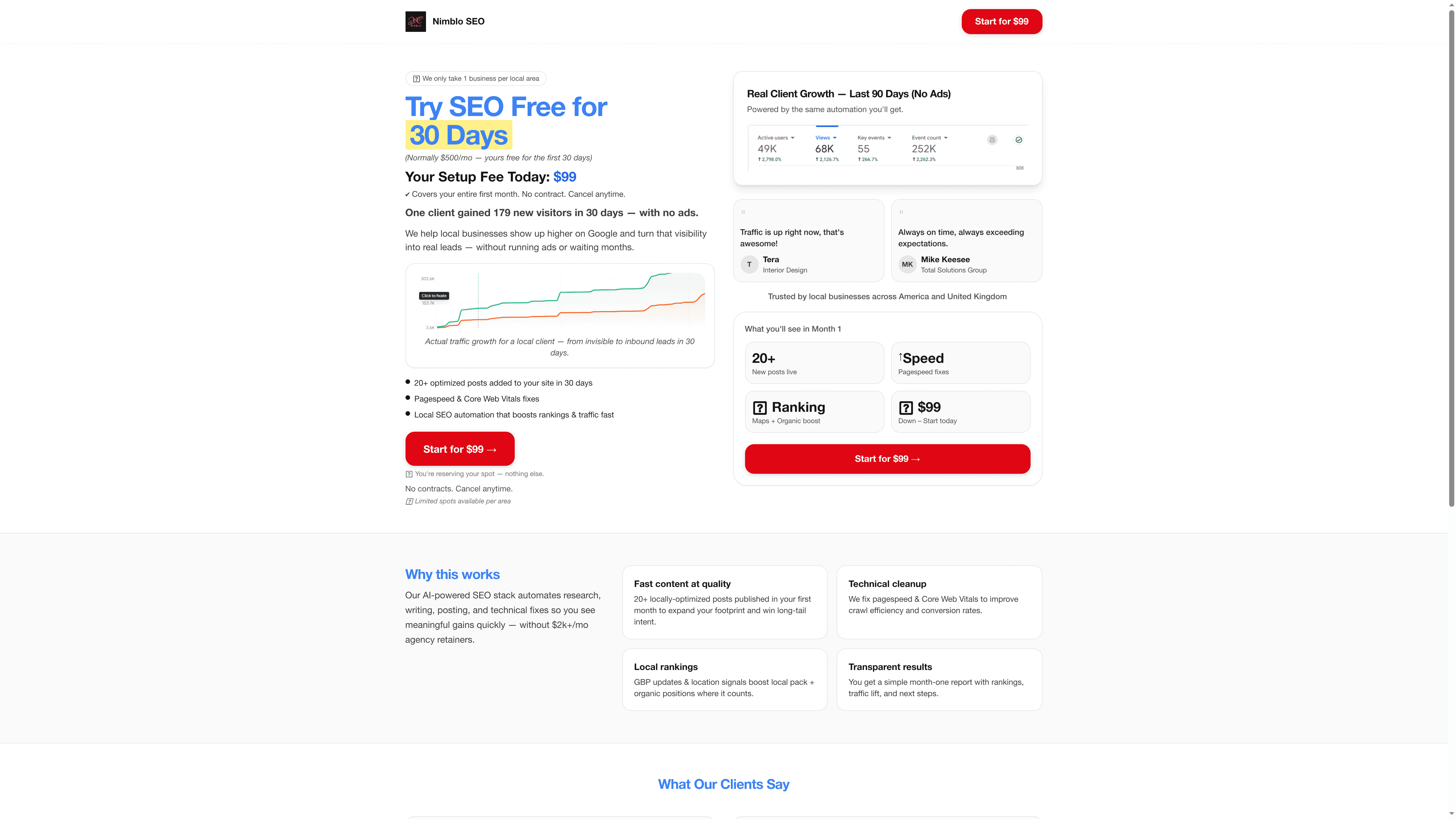
Ready to reduce customer acquisition costs and boost your Florida SMB’s online visibility? Visit https://nimblo.ai/99down to get started with a platform built to deliver speed, savings, and sustainable lead growth. Take the first step toward a faster website and stronger business today.
Frequently Asked Questions
What is website speed and why is it important for small businesses?
Website speed refers to the time it takes for a website to load and become fully interactive for visitors. It’s crucial for small businesses because every second of delay can lead to higher bounce rates, lost revenue, and lower customer satisfaction.
How does website speed affect SEO rankings?
Website speed is a direct ranking factor for Google. Faster websites provide a better user experience, leading to lower bounce rates and higher engagement. As a result, they rank higher in search results, making it essential for local businesses to optimize their site speed.
What common issues cause slow website performance?
Common issues that can slow down a website include poor hosting services, large unoptimized images, bloated code and plugins, outdated technology, a lack of caching strategies, and limited performance monitoring.
How can improving website speed increase conversion rates?
Improving website speed directly increases conversion rates by reducing bounce rates, leading to more form submissions, phone calls, and purchases. Faster websites enhance user experience, encouraging visitors to engage rather than leave for competitors.