
Running a Florida small business means juggling social media, email, search ads, and more, often without knowing which efforts truly pay off. With customer journeys crossing multiple digital and offline touchpoints, tracking what leads to sales can feel confusing. By embracing marketing attribution and understanding how each interaction contributes to your pipeline, you’ll gain the insights needed to consolidate your efforts and sharpen your lead generation. Marketing attribution empowers you to optimize budget and focus on what delivers results.
Table of Contents
- What Is Marketing Attribution And Why It Matters
- Common Attribution Models Explained
- How Attribution Works For SMB Marketing
- Benefits And Practical Use Cases For Florida Businesses
- Costs, Challenges, And Key Mistakes To Avoid
Key Takeaways
| Point | Details |
|---|---|
| Understanding Marketing Attribution | Marketing attribution helps small businesses in Florida track how various channels contribute to revenue, optimizing marketing efforts for better ROI. |
| Choosing the Right Model | Small businesses should experiment with different attribution models to find the most effective approach for their specific customer acquisition process. |
| Leveraging Data Insights | Data-driven attribution enables Florida SMBs to maximize marketing resources by understanding customer behavior across multiple touchpoints. |
| Avoiding Common Pitfalls | Businesses must be cautious of data fragmentation and oversimplified models to effectively implement marketing attribution and align with their business goals. |
What Is Marketing Attribution and Why It Matters
Marketing attribution is a critical strategy for Florida small businesses seeking to understand how their marketing efforts translate into actual revenue. At its core, marketing attribution involves measuring and crediting specific channels that contribute to a company’s sales pipeline and overall business performance.
Understanding marketing attribution helps business owners track the complex journey customers take before making a purchase. Unlike traditional marketing approaches that relied on basic metrics, modern attribution provides granular insights into which touchpoints genuinely influence consumer decisions. Marketing channels might include:
- Social media interactions
- Email marketing campaigns
- Google search ads
- Organic website traffic
- Referral sources
- Direct website visits
The primary goal of marketing attribution is to reveal which marketing strategies deliver the most significant return on investment. Multi-touch attribution helps identify the precise combination of marketing events) that ultimately drive conversions, allowing businesses to optimize their marketing spend strategically.
For Florida small businesses operating in competitive markets, understanding these nuanced customer interaction pathways can mean the difference between wasted marketing budgets and targeted, high-conversion campaigns. By tracking how different marketing efforts contribute to the final sale, entrepreneurs can make data-driven decisions that maximize their limited marketing resources.
Pro tip: Start by implementing basic attribution tracking using free tools like Google Analytics to understand your initial customer journey patterns.
Common Attribution Models Explained
Marketing attribution models provide structured approaches to understanding how different marketing touchpoints contribute to customer conversions. Marketing attribution models range from simple to complex methods of tracking and crediting marketing interactions throughout the customer journey.
The most common attribution models can be categorized into two primary types: single-touch and multi-touch attribution models. Each model offers unique insights into customer interactions:
Single-Touch Models:
- First-Touch Attribution: Credits 100% of the conversion to the initial marketing interaction
- Last-Touch Attribution: Assigns full credit to the final touchpoint before conversion
Multi-Touch Models:
- Linear Attribution: Distributes conversion credit equally across all touchpoints
- Time Decay Attribution: Gives more credit to interactions closer to the conversion
- Position-Based Attribution: Allocates higher credit percentages to specific touchpoints
Multi-touch attribution helps evaluate touchpoint importance across the entire customer journey. This approach allows marketers to understand the nuanced interactions that ultimately drive conversions, moving beyond simplistic single-channel tracking.
Here’s a side-by-side comparison of common marketing attribution models and how they impact business insights:
| Attribution Model | Credit Distribution Method | Data Interpretation Impact |
|---|---|---|
| First-Touch Attribution | All credit to first interaction | Identifies initial driver of interest |
| Last-Touch Attribution | Full credit to last touchpoint | Highlights decisive conversion channel |
| Linear Attribution | Equal credit to every touchpoint | Shows overall customer journey importance |
| Time Decay Attribution | More credit to recent interactions | Values latest influencing actions |
| Position-Based | Highest credit to first and last points | Balances entry and conversion significance |
Choosing the right attribution model depends on specific business goals, marketing strategies, and the complexity of the customer acquisition process. Florida small businesses should experiment with different models to find the approach that most accurately reflects their unique marketing ecosystem.
Pro tip: Start by implementing a linear attribution model to get a baseline understanding of your marketing touchpoints before exploring more advanced tracking methods.
How Attribution Works for SMB Marketing
Marketing attribution for small businesses tracks customer interactions across multiple digital and offline channels, providing crucial insights into how marketing efforts generate leads and drive conversions. By understanding these complex interactions, Florida small businesses can make more informed decisions about their marketing strategies.
The attribution process involves several key steps that help SMBs analyze their marketing performance:
- Data Collection: Gathering interaction data from various marketing channels
- Touchpoint Tracking: Identifying and mapping customer interactions
- Credit Assignment: Allocating conversion value to specific marketing efforts
- Performance Analysis: Evaluating the effectiveness of different marketing channels
Data-driven attribution models enable small businesses to maximize their limited marketing resources. Machine learning methods help SMBs analyze user-path data and understand which interactions most significantly contribute to conversions.
For Florida small businesses, marketing attribution is not just about tracking numbers—it’s about understanding customer behavior. By analyzing how potential customers interact with different marketing touchpoints, entrepreneurs can refine their strategies, optimize marketing spend, and create more targeted campaigns that resonate with their local audience.

Pro tip: Start with free analytics tools to begin tracking your marketing interactions, and gradually develop more sophisticated attribution strategies as you gather more data.
Benefits and Practical Use Cases for Florida Businesses
Marketing attribution provides Florida SMBs strategic insights into their customer acquisition processes, enabling more precise and targeted marketing strategies. By understanding how different marketing channels contribute to business growth, small businesses can make data-driven decisions that maximize their limited marketing budgets.
Practical benefits for Florida businesses include:
- Budget Optimization: Identifying the most cost-effective marketing channels
- Seasonal Strategy Adjustment: Adapting marketing efforts to tourism and local economic cycles
- Customer Journey Mapping: Understanding complex interaction paths
- Performance Tracking: Measuring true marketing impact beyond surface-level metrics
Marketing attribution helps businesses target local customer segments more effectively, particularly in Florida’s diverse and dynamic market. For instance, a local restaurant in Miami could track how social media ads, Google search results, and local directory listings contribute to customer reservations, allowing for more strategic marketing investments.
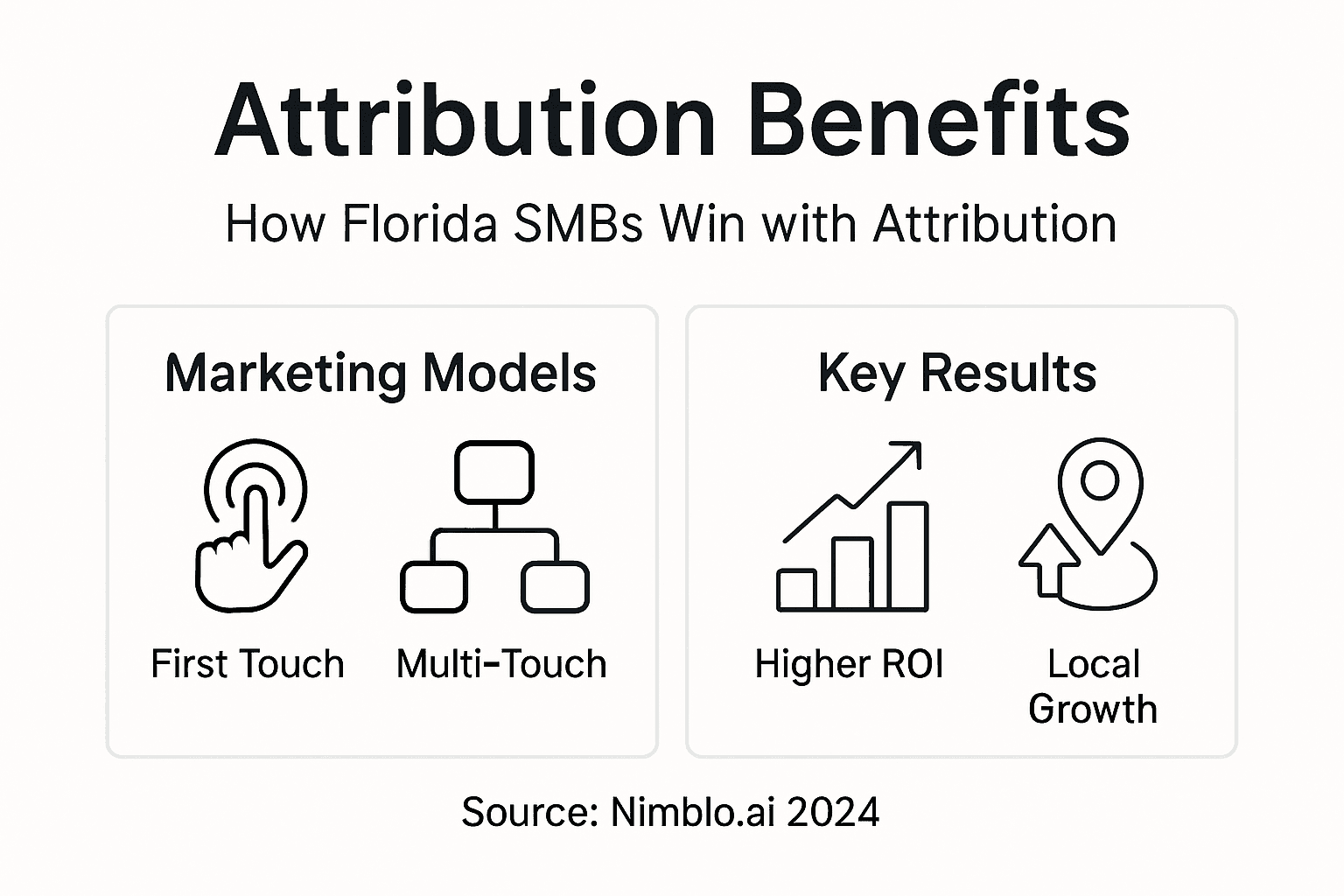
The real power of marketing attribution lies in its ability to transform guesswork into strategic planning. Florida small businesses can use these insights to create more personalized marketing approaches, understand their unique customer behaviors, and allocate resources more intelligently across digital and traditional marketing channels.
This quick reference table highlights key business benefits and practical use cases of marketing attribution for Florida SMBs:
| Benefit Category | Example Impact | Industry Application |
|---|---|---|
| Budget Efficiency | Redirect spend to best channels | Retail, Restaurants |
| Seasonal Adjustments | Adapt campaigns for tourist influxes | Hospitality, Entertainment |
| Customer Insights | Refine local targeting strategies | Services, Real Estate |
| Performance Analysis | Measure ROI beyond clicks | E-commerce, Health Providers |
Pro tip: Start tracking your marketing interactions with free analytics tools, focusing on understanding which channels drive the most valuable customer interactions for your specific business.
Costs, Challenges, and Key Mistakes to Avoid
Marketing attribution implementation involves significant strategic considerations for Florida small businesses looking to optimize their marketing efforts. The journey toward effective attribution is complex, requiring careful planning and understanding of potential pitfalls.
Key challenges and potential mistakes include:
- Data Fragmentation: Struggling with disconnected marketing data sources
- Oversimplification: Relying on single-touch attribution models
- Misaligned Incentives: Failing to connect marketing metrics with business goals
- Resource Constraints: Limited budget for advanced analytics tools
Attribution modeling requires careful model selection and ongoing maintenance. Florida small businesses must invest time in understanding their unique customer journey, recognizing that no single attribution model works perfectly for every business.
The most common and costly mistakes often stem from a lack of comprehensive data integration and an incomplete understanding of customer interaction complexity. Small businesses should approach marketing attribution as an evolving process, continually refining their approach based on real-world performance data and changing market dynamics.
Pro tip: Start with a simple multi-touch attribution model and gradually increase complexity as you gain more insights about your specific customer acquisition processes.
Unlock the Power of Marketing Attribution with Nimblo.ai
Florida small businesses often struggle with scattered marketing data, unclear customer journeys, and wasted budgets on ineffective channels. This article highlights the importance of multi-touch attribution models and data-driven insights to optimize your marketing spend and truly understand which efforts drive conversions. If you want to move beyond guesswork and start maximizing your marketing return on investment with local SEO and automated lead generation, Nimblo.ai offers a compact solution designed specifically for Florida SMBs.
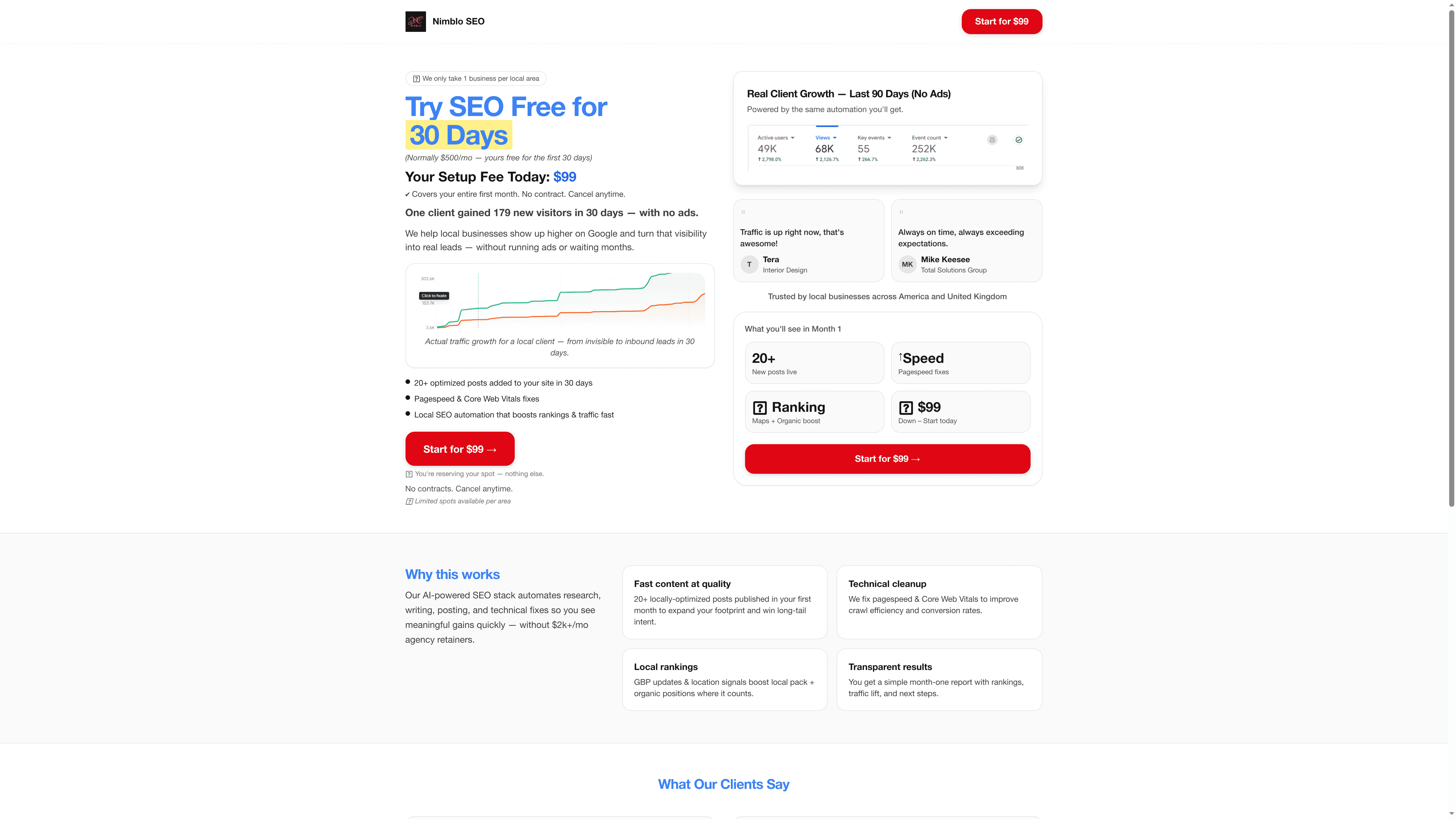
Experience the simplicity of a unified platform that combines AI-powered local SEO, CRM, marketing automation, and high-speed website performance into one affordable package. Nimblo.ai helps you track and attribute marketing efforts accurately so you can confidently allocate your budget to the most effective channels. Start saving money while boosting your leads and conversions with a quick setup and local expertise. Take the first step now by visiting Nimblo.ai and discover how to turn your marketing attribution insights into real business growth.
Frequently Asked Questions
What is marketing attribution and why is it important for small businesses?
Marketing attribution measures and credits specific marketing channels that contribute to sales and overall performance. It is crucial for small businesses as it helps track customer journeys, optimize marketing spend, and understand which strategies provide the highest return on investment.
What are the common marketing attribution models?
Common models include first-touch, last-touch, linear, time decay, and position-based attribution. Each model provides different insights into customer interactions, helping businesses evaluate the effectiveness of their marketing strategies.
How can small businesses implement marketing attribution effectively?
Small businesses can start by using basic attribution tracking methods with free tools like Google Analytics to gather data on customer interactions. They should analyze this data to understand touchpoint contributions, enabling more informed marketing decisions.
What are the key challenges in marketing attribution for small businesses?
Key challenges include data fragmentation from disconnected marketing sources, oversimplifying with single-touch models, misalignment of marketing metrics with business goals, and resource constraints limiting access to advanced analytics tools.