
Juggling client requests, administrative work, and local competition can drain precious hours from any Florida business owner. Managing these demands often means too many manual steps that slow growth and cost money. By embracing workflow automation tools, service businesses across Florida can simplify routine tasks, improve accuracy, and gain more time for high-impact marketing. This guide reveals practical digital solutions that make local SEO and daily operations run smoother while keeping costs in check.
Table of Contents
- Defining Workflow Automation For SMBs
- Types Of Workflow Automation Solutions
- How Workflow Automation Powers SMB Operations
- Key Benefits And Common Pitfalls
- Comparing Automation To Traditional Methods
Key Takeaways
| Point | Details |
|---|---|
| Workflow Automation Enhances Efficiency | Implementing workflow automation helps SMBs minimize manual tasks and streamline operations. This leads to improved overall productivity and resource management. |
| Integration is Key to Success | Selecting the right automation tools that offer seamless integration with existing systems is crucial. This enhances data flow and reduces operational bottlenecks. |
| AI in Automation Drives Growth | Incorporating AI capabilities into automation solutions can provide predictive analytics and intelligent decision-making. This contributes to long-term strategic growth for SMBs. |
| Change Management is Essential | Effective change management, including training and gradual implementation, is necessary to mitigate resistance and ensure successful adoption of automation tools. |
Defining Workflow Automation for SMBs
Workflow automation represents a powerful digital strategy for small and medium-sized businesses (SMBs) seeking to transform their operational efficiency. At its core, workflow automation uses technology to streamline and simplify routine business processes, eliminating manual tasks that traditionally consume valuable employee time and resources.
The fundamental goal of workflow automation is to reduce repetitive manual tasks through strategic software implementation. These intelligent systems can handle a wide range of business functions, including:
- Data entry and processing
- Customer communication tracking
- Invoice and billing management
- Document approval workflows
- Lead generation and tracking
- Scheduling and task assignment
By leveraging technologies like robotic process automation (RPA), SMBs can create rule-based systems that mimic human interactions while dramatically improving speed and accuracy. These automated workflows enable businesses to optimize limited resources, scale operations more effectively, and redirect human talent toward more strategic, creative tasks that drive growth.
Workflow automation goes beyond simple task delegation. It represents a comprehensive approach to digital transformation that allows SMBs to compete more effectively in increasingly technology-driven markets. Small businesses can now access enterprise-level efficiency tools previously available only to large corporations.
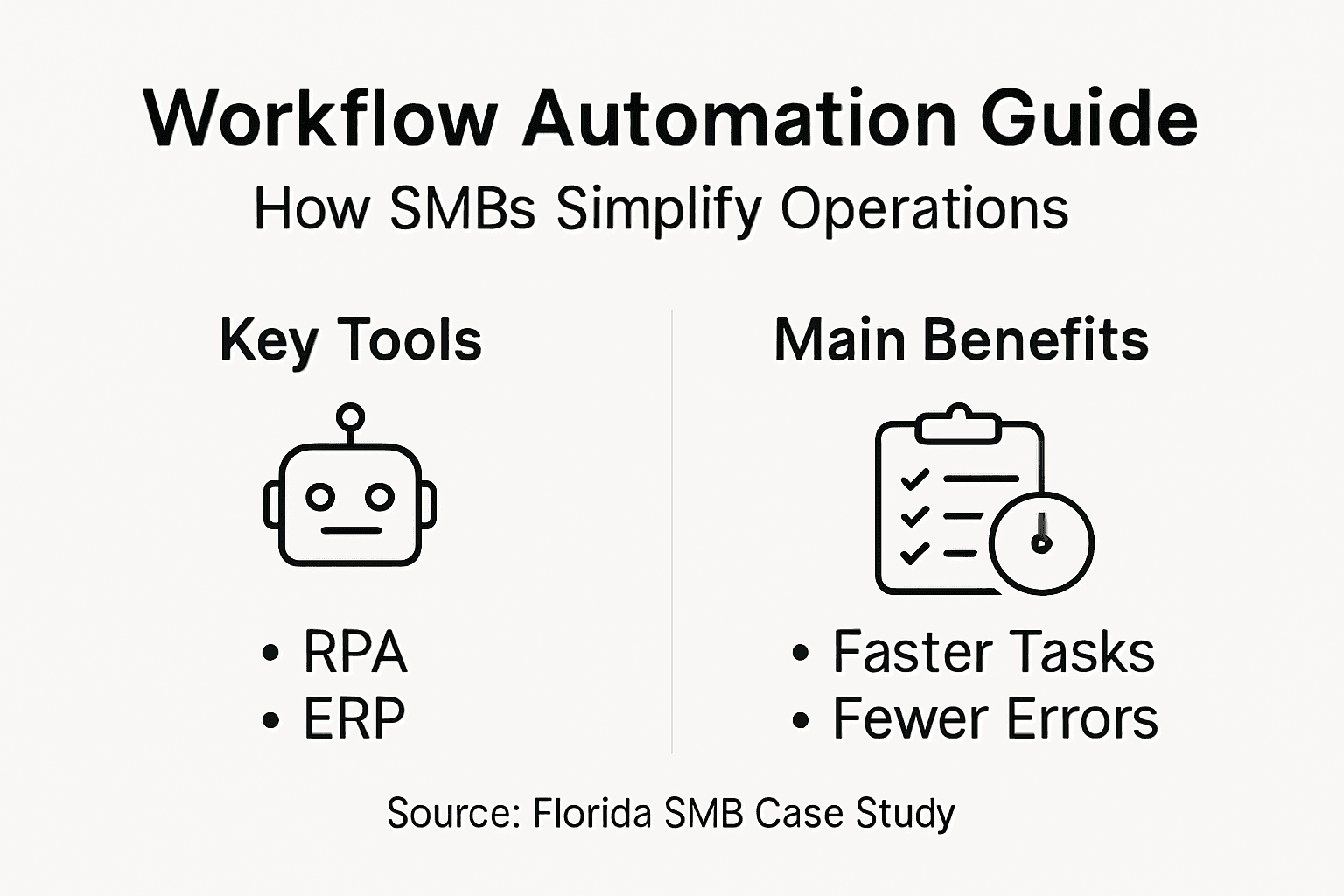
Pro tip: Start by mapping your most repetitive business processes and identifying 2-3 workflows that consume the most employee time for initial automation efforts.
Types of Workflow Automation Solutions
Workflow automation solutions for small and medium-sized businesses (SMBs) encompass a diverse range of technologies designed to streamline operational processes. Project management and integration platforms represent the core categories of workflow automation tools that help businesses reduce manual tasks and improve efficiency.
These solutions typically fall into several key categories:
-
Process Automation Tools
- Automate repetitive administrative tasks
- Handle document routing and approvals
- Standardize routine business workflows
-
Integration Platforms
- Connect disparate business systems
- Enable seamless data transfer between applications
- Eliminate manual data entry and synchronization
-
Marketing Automation Platforms
- Manage customer engagement campaigns
- Track lead generation and nurturing
- Automate email marketing and communication sequences
-
Rule-Based Workflow Engines
- Implement complex business logic
- Enforce compliance and standardized processes
- Create intelligent decision-making frameworks
Advanced workflow automation solutions now incorporate artificial intelligence capabilities, allowing businesses to create more sophisticated, adaptive systems that can learn and optimize processes over time. These intelligent platforms go beyond simple task delegation, offering predictive analytics and automated decision-making that can significantly enhance operational efficiency.
Workflow automation transforms manual processes into streamlined, intelligent systems that enable SMBs to compete more effectively in technology-driven markets.
Enterprise Resource Planning (ERP) systems represent another critical category of workflow automation, integrating multiple business functions into a comprehensive, interconnected platform. By connecting finance, human resources, inventory management, and other core business areas, these solutions provide holistic operational optimization.

Here’s a summary of how key workflow automation categories deliver value for SMBs:
| Solution Type | Main Purpose | Example Use Case | Benefit to SMBs |
|---|---|---|---|
| Process Automation Tools | Streamline routine admin tasks | Automated document approval | Frees staff for higher-value work |
| Integration Platforms | Connect and sync business apps | Real-time syncing CRM and invoicing | Cuts double data entry |
| Marketing Automation | Optimize customer outreach | Auto-segment and nurture leads | Boosts campaign efficiency |
| Rule-Based Workflow Engines | Enforce rules and compliance | Automated expense approval with limits | Reduces compliance risk |
| ERP Systems | Unify business operations | Finance, HR, and inventory integration | Improves data visibility |
Pro tip: Evaluate your current business processes and prioritize automation for workflows that consume the most time and resources, focusing on solutions that offer seamless integration and scalability.
How Workflow Automation Powers SMB Operations
Workflow automation has become a critical strategy for small and medium-sized businesses (SMBs) seeking to optimize their operational efficiency. Repetitive tasks are systematically transformed into streamlined digital processes, enabling businesses to redirect human talent toward more strategic and creative endeavors.
The core operational areas that benefit most from workflow automation include:
-
Customer Support
- Automated ticket routing
- AI-powered chatbot interactions
- Standardized response protocols
-
Financial Management
- Automated invoicing processes
- Expense tracking and reporting
- Seamless accounting integrations
-
Sales and Marketing
- Lead generation tracking
- Automated email marketing campaigns
- Customer segmentation and targeting
-
Human Resources
- Streamlined employee onboarding
- Performance tracking systems
- Automated recruitment workflows
By implementing intelligent automation solutions, SMBs can dramatically reduce manual intervention, minimize human error, and accelerate project completion times. These technologies enable businesses to operate with the efficiency of larger enterprises while maintaining the agility of a smaller organization.
Workflow automation transforms manual, time-consuming processes into intelligent, efficient systems that drive competitive advantage.
No-code platforms have democratized workflow automation, allowing businesses with limited technical resources to create sophisticated digital workflows. These tools enable teams to build complex automation sequences without extensive programming knowledge, making advanced operational optimization accessible to businesses of all sizes.
Pro tip: Start with mapping your most time-consuming business processes and identify 2-3 workflows that can provide immediate efficiency gains through automation.
Key Benefits and Common Pitfalls
Workflow automation presents a transformative opportunity for small and medium-sized businesses (SMBs), offering significant operational advantages while simultaneously presenting potential challenges. Strategic implementation can dramatically improve organizational efficiency, but requires careful planning and execution.
The key benefits of workflow automation include:
-
Enhanced Operational Efficiency
- Reduced manual task processing time
- Consistent and standardized workflow execution
- Elimination of repetitive administrative work
-
Error Reduction
- Minimized human error in routine tasks
- Improved data accuracy and consistency
- Automated quality control mechanisms
-
Cost Optimization
- Lower operational overhead
- Reduced labor costs for repetitive tasks
- More efficient resource allocation
-
Team Collaboration
- Centralized task management
- Real-time workflow tracking
- Improved communication and transparency
However, SMBs must navigate several potential pitfalls when implementing workflow automation. Common challenges include selecting inappropriate automation tools, failing to properly map existing processes, and resistance to technological change within the organization. Successful implementation requires a comprehensive understanding of current workflows, clear communication with team members, and a phased approach to digital transformation.
Workflow automation is not about replacing human workers, but empowering them to focus on high-value, strategic activities that drive business growth.
Careful change management is crucial. Businesses should invest time in training, gather team feedback, and gradually introduce automation to ensure smooth adoption. This approach helps mitigate employee concerns and builds a culture of technological adaptation.
Pro tip: Conduct a thorough audit of your existing processes before automation, identifying bottlenecks and selecting workflows with the highest potential for efficiency gains.
Comparing Automation to Traditional Methods
Traditional business methods often rely on manual processes that are inherently time-consuming and error-prone. Digital workflows dramatically transform operational efficiency, replacing slow, labor-intensive approaches with intelligent, streamlined systems.
Key differences between traditional and automated methods include:
-
Processing Speed
- Traditional: Hours or days for manual tasks
- Automated: Minutes or seconds for same tasks
- Instant execution and real-time tracking
-
Error Rates
- Traditional: High potential for human mistakes
- Automated: Consistent, predictable outcomes
- Built-in quality control mechanisms
-
Resource Allocation
- Traditional: Heavy human labor investment
- Automated: Strategic employee focus
- Reduced operational overhead
-
Scalability
- Traditional: Linear growth requires more personnel
- Automated: Exponential growth with minimal staffing
- Flexible capacity expansion
Manual spreadsheets and paper-based systems represent significant bottlenecks for modern businesses. Automated workflows eliminate these constraints by creating interconnected, intelligent systems that adapt and respond faster than traditional methods.
This comparison shows how workflow automation outperforms traditional methods in core business metrics:
| Metric | Traditional Methods | Automated Workflows |
|---|---|---|
| Task Completion | Hours to days | Minutes or less |
| Error Frequency | Frequent manual mistakes | Consistent, automated accuracy |
| Staff Utilization | Routine labor required | Greater focus on strategic work |
| Scalability | Limited by manpower | Grows easily with business needs |
Automation transforms businesses from reactive operators to proactive innovators, enabling unprecedented operational agility.
The shift from traditional to automated methods represents more than technological upgrades. It fundamentally reimagines how businesses approach task management, communication, and strategic planning. By replacing repetitive manual processes with smart, rule-based systems, SMBs can achieve levels of efficiency previously available only to large enterprises.
Pro tip: Conduct a comprehensive workflow audit to identify repetitive tasks with the highest potential for automation and measurable efficiency gains.
Unlock Workflow Automation Success for Your Florida SMB with Nimblo.ai
Small and medium-sized businesses in Florida face the challenge of managing repetitive manual tasks while striving to grow in competitive markets. This article highlights how workflow automation can remove bottlenecks by streamlining operations like lead generation, customer follow-ups, and local SEO management. If you are seeking a smarter way to consolidate your marketing, CRM, and automation tools into one affordable platform, embracing intelligent workflow solutions is key to preserving your team’s time and boosting accuracy.
Nimblo.ai offers precisely this with a comprehensive all-in-one platform designed specifically for Florida SMBs. Benefit from AI-powered local SEO, automated lead generation, and conversion-optimized website design that replaces multiple costly tools and agencies. With rapid setup, local support, and a flat monthly rate, Nimblo lets you cut overhead while achieving impressive results fast.
Take control of your business operations now with Nimblo.ai’s workflow automation platform.
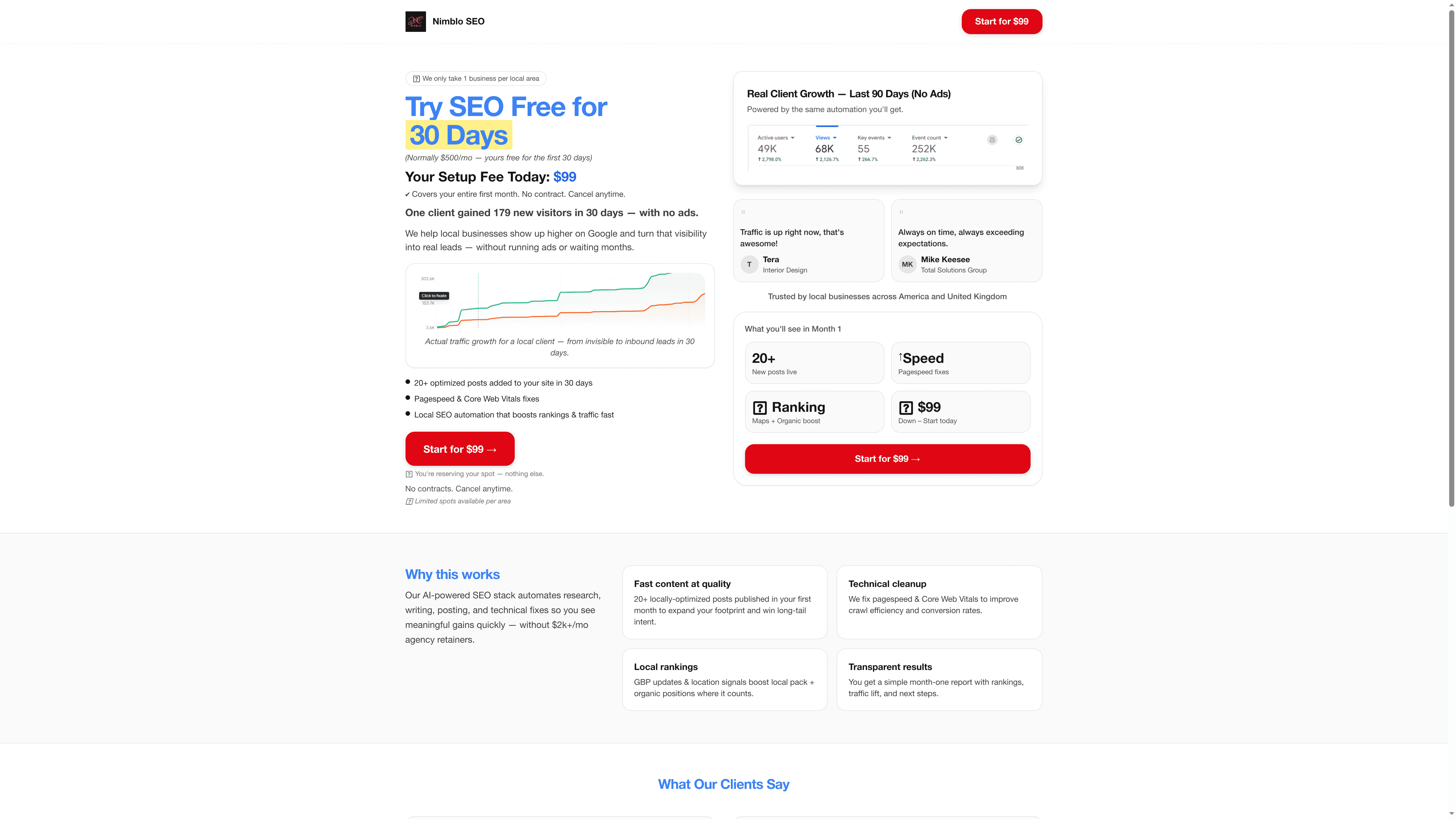
Ready to streamline your SMB’s success across Florida? Discover how easy digital transformation can be with Nimblo.ai’s all-in-one SEO and automation solution. Get started today and experience rapid lead growth and operational efficiency without the hassle of multiple tools or agencies.
Frequently Asked Questions
What is workflow automation for SMBs?
Workflow automation refers to the use of technology to streamline and simplify routine business processes for small and medium-sized businesses. It aims to reduce repetitive manual tasks, improving operational efficiency and allowing employees to focus on strategic tasks.
How can SMBs benefit from implementing workflow automation?
By adopting workflow automation, SMBs can enhance operational efficiency, minimize human error, lower operational costs, and improve team collaboration. These benefits allow businesses to operate more like larger enterprises while maintaining their agility.
What types of tasks can be automated in an SMB?
Common tasks that can be automated include data entry, customer communication tracking, invoicing and billing management, document approval workflows, lead generation, and employee onboarding processes. Automating these tasks saves time and improves accuracy.
What are some common pitfalls SMBs should avoid when implementing workflow automation?
Some pitfalls include selecting inappropriate tools, failing to map existing processes, and experiencing resistance to change from employees. To succeed, businesses should conduct a thorough audit of their processes and involve team members in the transition to automation.