
Running a small business in Florida means every marketing dollar counts. With limited budgets and fierce competition, service industry owners need to know which efforts actually grow revenue and which just drain resources. Defining and tracking marketing ROI helps you make smarter decisions about where to invest, cut costs, and build real value. This guide shows practical ways to measure ROI, clarifies digital versus traditional results, and reveals how an all-in-one platform can simplify your entire process.
Table of Contents
- Defining Marketing ROI for Small Businesses
- How to Calculate Marketing ROI Accurately
- Types of Marketing ROI: Digital vs. Traditional
- Benefits of Measuring ROI in Local Marketing
- Common Mistakes When Tracking ROI
- Maximizing ROI With All-in-One Platforms
Key Takeaways
| Point | Details |
|---|---|
| Understanding Marketing ROI | Small businesses must focus on calculating the net profit generated from marketing to make informed spending decisions. |
| Digital vs. Traditional Marketing ROI | Combining digital and traditional marketing strategies maximizes ROI by leveraging the strengths of both approaches. |
| Common Mistakes in ROI Tracking | To avoid misguided strategies, businesses should develop comprehensive tracking systems that include both financial and qualitative metrics. |
| Leveraging All-in-One Platforms | Using integrated marketing platforms streamlines data collection and analysis, enhancing operational efficiency and decision-making. |
Defining Marketing ROI for Small Businesses
Marketing Return on Investment (ROI) represents the critical financial metric that measures the effectiveness and profitability of marketing efforts for small businesses. Unlike large corporations with extensive marketing budgets, small businesses must be laser-focused on understanding exactly how each marketing dollar generates revenue and contributes to business growth.
At its core, marketing ROI calculates the net profit generated from marketing investments compared to the total costs. This calculation helps Florida small business owners make informed decisions about where to allocate limited marketing resources. Small business marketing effectiveness requires a nuanced approach that goes beyond simple revenue tracking.
The typical marketing ROI calculation follows this fundamental formula:
- Subtract marketing expenses from revenue generated by marketing
- Divide the net profit by total marketing investment
- Multiply the result by 100 to get a percentage
For small businesses, understanding marketing ROI involves more than just raw numbers. Marketing performance measurement requires considering factors like:
- Customer acquisition costs
- Long-term brand value
- Incremental revenue from specific campaigns
- Lifetime customer value
- Local market positioning
Successful Florida small businesses recognize that marketing ROI isn’t a one-time calculation but an ongoing process of refinement and strategic adjustment. By continuously tracking and analyzing marketing performance, entrepreneurs can optimize their spending, target the right audiences, and maximize their return.
Pro tip: Create a standardized tracking system that captures both immediate and long-term marketing outcomes to get a comprehensive view of your marketing investments.
How to Calculate Marketing ROI Accurately
Calculating marketing ROI requires a systematic approach that goes beyond simple number crunching. Small businesses need a precise method to track and evaluate their marketing investments, ensuring every dollar spent contributes meaningfully to business growth. Marketing return on investment analysis involves several critical steps to deliver accurate insights.
The fundamental formula for marketing ROI is straightforward but requires careful consideration of all financial variables. Marketing ROI is calculated by subtracting marketing expenses from the revenue generated, then dividing by the total marketing investment and multiplying by 100 to get a percentage. Accurate marketing investment measurement demands breaking down this calculation into specific components:
- Identify total marketing spend
- Calculate incremental revenue directly attributable to marketing efforts
- Determine contribution margin percentage
- Apply the comprehensive ROI formula
Key components to track when calculating marketing ROI include:
- Direct revenue generated from marketing campaigns
- Customer acquisition costs
- Lifetime value of acquired customers
- Indirect brand value and market positioning
- Cost of marketing tools and platforms
Small businesses should develop a consistent tracking methodology that captures both immediate and long-term marketing outcomes. This approach helps Florida entrepreneurs understand the true impact of their marketing investments and make data-driven decisions about future spending strategies.
Precision in marketing ROI calculation requires tracking multiple financial metrics beyond simple revenue numbers.
Additional considerations for accurate ROI calculation involve:
- Establishing clear baseline measurements
- Using consistent tracking periods
- Accounting for seasonal variations
- Incorporating both quantitative and qualitative marketing impacts
Pro tip: Implement a standardized monthly ROI tracking spreadsheet that captures comprehensive marketing performance metrics across all channels.
Types of Marketing ROI: Digital vs. Traditional
Understanding the nuanced differences between digital and traditional marketing ROI is crucial for small businesses seeking to optimize their marketing investments. Marketing channel effectiveness varies significantly between digital and traditional approaches, each offering unique advantages and measurement challenges for Florida entrepreneurs.
Digital marketing typically provides more precise ROI tracking capabilities compared to traditional methods. Online channels like social media, email marketing, and search engine optimization allow businesses to capture granular data about campaign performance, audience engagement, and direct conversions. By contrast, traditional marketing channels such as print advertisements, radio spots, and billboards present more complex ROI measurement challenges.
Digital Marketing ROI Characteristics:
- Immediate performance tracking
- Precise audience targeting
- Lower cost per acquisition
- Real-time campaign adjustments
- Detailed analytics and metrics
Traditional Marketing ROI Characteristics:
- Broader audience reach
- Higher brand credibility
- Long-term brand recognition
- Less precise tracking mechanisms
- Higher production costs
Comparative marketing research suggests that the most effective approach for small businesses often involves a hybrid strategy. This means strategically combining digital and traditional marketing channels to maximize overall return on investment and reach diverse audience segments.
Successful marketing ROI demands a balanced approach that leverages the strengths of both digital and traditional marketing channels.
For Florida small businesses, the key is understanding which marketing channels deliver the most value for their specific industry and target audience. Digital platforms offer superior tracking and immediate insights, while traditional media can provide broader brand exposure and credibility among certain demographic groups.
Here’s a practical comparison of digital and traditional marketing ROI factors:
| Factor | Digital Marketing ROI | Traditional Marketing ROI |
|---|---|---|
| Data Tracking | Real-time, detailed analytics | Delayed, limited reporting |
| Audience Targeting | Highly specific demographics | Broad, often less defined |
| Cost Efficiency | Lower entry costs per campaign | Higher upfront expenses |
| Adaptability | Quick adjustments possible | Changes require time and budget |
| Performance Transparency | Direct link to conversions | Indirect impact on sales |
Pro tip: Create a mixed marketing strategy that allocates budget across both digital and traditional channels, with clear tracking mechanisms for each campaign.
Benefits of Measuring ROI in Local Marketing
Marketing ROI measurement provides Florida small businesses with a critical strategic advantage in understanding and optimizing their marketing investments. By systematically tracking performance, local entrepreneurs can transform raw data into actionable insights that drive sustainable business growth.

The key benefits of measuring marketing ROI extend far beyond simple financial tracking. Local businesses gain profound strategic advantages that directly impact their bottom line and long-term market positioning. Understanding precise marketing performance allows entrepreneurs to make data-driven decisions that allocate resources more effectively and minimize wasted spending.
Specific benefits of robust ROI measurement include:
- Precise budget allocation
- Identification of most effective marketing channels
- Ability to justify marketing expenditures
- Enhanced competitive intelligence
- Improved strategic planning
- Real-time campaign performance insights
Social media marketing ROI assessment provides particularly valuable insights for local businesses. Digital platforms offer granular tracking capabilities that enable entrepreneurs to understand exactly how each marketing dollar translates into potential customer engagement and revenue generation.
Effective marketing ROI measurement transforms guesswork into strategic precision for small businesses.
For Florida small businesses, marketing ROI measurement is not just about numbers—it’s about building a sustainable, data-driven approach to growth. By developing consistent tracking mechanisms, entrepreneurs can continuously refine their marketing strategies, identify emerging opportunities, and make informed decisions that drive long-term success.
Pro tip: Create a monthly ROI dashboard that tracks key performance indicators across all marketing channels, allowing for rapid strategic adjustments.
Common Mistakes When Tracking ROI
ROI measurement errors can significantly undermine a small business’s strategic decision-making process. Florida entrepreneurs often fall into predictable traps when attempting to calculate and interpret their marketing return on investment, which can lead to misguided strategies and wasted resources.
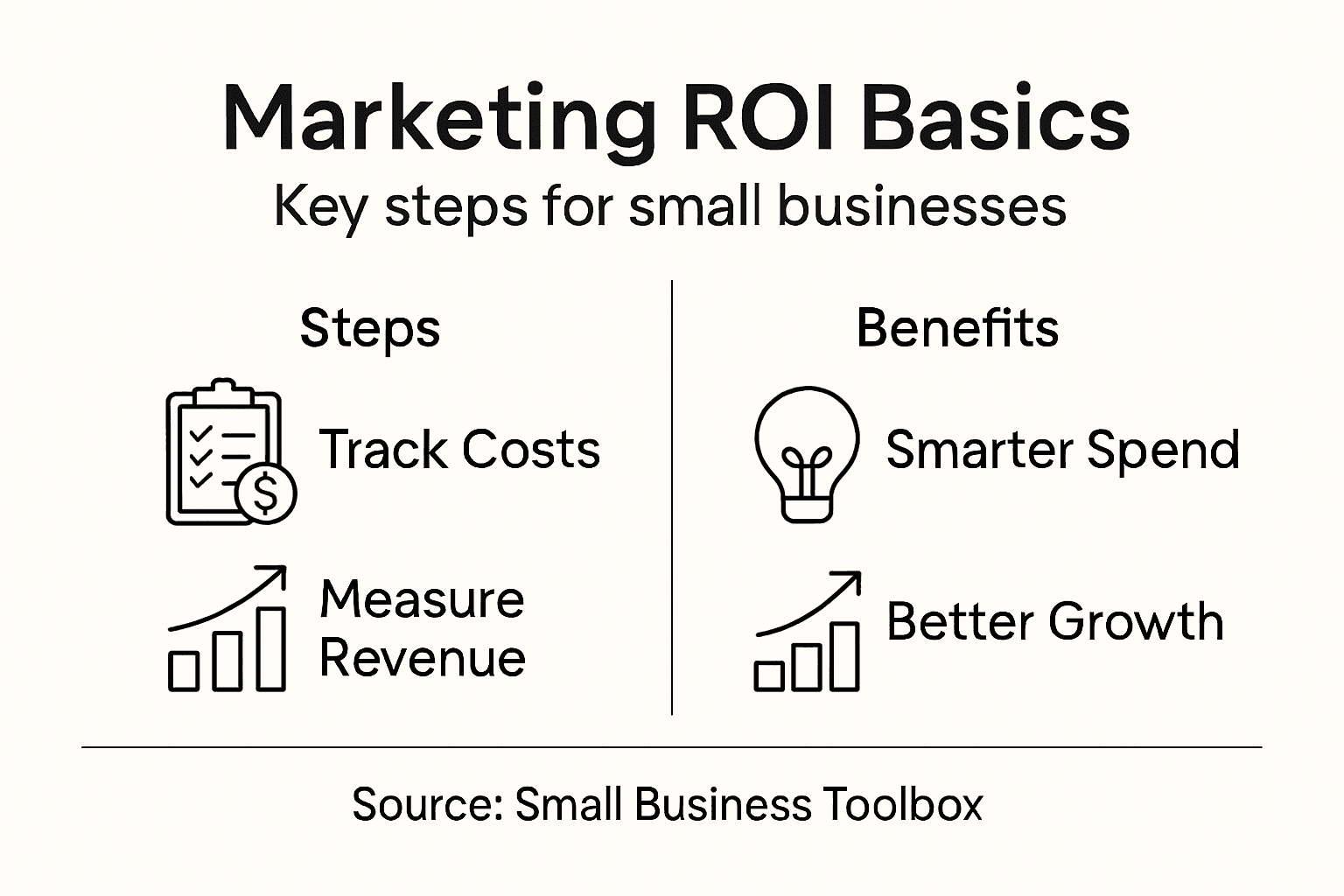
The most critical ROI tracking mistakes typically stem from oversimplification and a lack of comprehensive analysis. Many small businesses make the fundamental error of viewing ROI as a straightforward, one-dimensional metric, when in reality, it requires a nuanced and multifaceted approach to accurately represent marketing performance.
Common ROI tracking mistakes include:
- Ignoring indirect and long-term marketing benefits
- Relying solely on short-term financial metrics
- Failing to account for brand equity and customer lifetime value
- Neglecting non-monetary marketing outcomes
- Using inconsistent measurement periods
- Overlooking hidden marketing costs
Calculation uncertainty in ROI tracking presents another significant challenge for small businesses. Entrepreneurs often overestimate benefits, underestimate costs, and fail to propagate potential errors in their calculations, leading to potentially misleading conclusions about marketing effectiveness.
Precision in ROI tracking requires a holistic approach that goes beyond simple numerical calculations.
For Florida small businesses, avoiding these common mistakes means developing a sophisticated, multi-dimensional approach to marketing performance measurement. This involves creating robust tracking systems that capture both tangible and intangible marketing outcomes, and continuously refining measurement methodologies.
Below is a summary of common ROI errors and how to prevent them:
| Common ROI Error | Impact on Business | Prevention Strategy |
|---|---|---|
| Overlooking hidden costs | Underestimates total spend | Track all direct and indirect expenses |
| Ignoring brand value | Misses long-term gains | Include qualitative metrics |
| Using inconsistent periods | Inaccurate performance trends | Establish regular reporting intervals |
| Focusing only on revenue | Incomplete ROI picture | Measure acquisition and retention stats |
Pro tip: Develop a comprehensive ROI tracking framework that includes both quantitative financial metrics and qualitative performance indicators to gain a more accurate view of marketing effectiveness.
Maximizing ROI With All-in-One Platforms
Strategic technology integration offers Florida small businesses a powerful approach to streamlining marketing efforts and maximizing return on investment. All-in-one platforms represent a game-changing solution for entrepreneurs seeking to consolidate multiple marketing tools, reduce operational complexity, and generate more precise performance insights.
The key advantage of integrated platforms lies in their ability to centralize data collection, analysis, and strategic decision-making. By eliminating fragmented tools and creating a unified marketing ecosystem, small businesses can dramatically reduce overhead costs, improve operational efficiency, and develop more targeted marketing strategies.
Critical benefits of all-in-one marketing platforms include:
- Consolidated data reporting
- Reduced technology subscription costs
- Simplified workflow management
- Enhanced cross-channel marketing insights
- Real-time performance tracking
- Automated reporting capabilities
Data management platforms provide comprehensive solutions that transform raw marketing data into actionable strategic intelligence. These integrated systems enable businesses to treat marketing data as a strategic asset, creating measurable value through sophisticated tracking and analysis mechanisms.
Comprehensive platforms turn marketing complexity into strategic simplicity for small businesses.
For Florida entrepreneurs, leveraging all-in-one platforms means moving beyond traditional marketing limitations. These solutions offer unprecedented visibility into marketing performance, allowing businesses to make faster, more informed decisions that directly impact revenue generation and sustainable growth.
Pro tip: Select an all-in-one platform that offers seamless integration, robust analytics, and scalable features tailored to your specific business needs.
Maximize Your Marketing ROI with One Powerful Platform
Small and medium Florida businesses face the challenge of accurately measuring marketing ROI while juggling multiple costly tools and fragmented data. As highlighted in the article, tracking precise marketing performance, managing customer acquisition costs, and balancing digital with traditional marketing channels can feel overwhelming. These pain points make it difficult to optimize spending and fully understand the return your marketing efforts generate.
Nimblo.ai solves these challenges by offering an all-in-one platform that consolidates SEO, website, CRM, and marketing automation into a single, accessible solution. With features like AI-powered local SEO, automated lead generation, and real-time performance tracking, you gain clear insights into what drives revenue and how to refine your marketing strategy for sustainable growth in Florida’s competitive local markets.
Unlock the benefits of simplified, transparent ROI measurement today. Take control of your marketing investments and accelerate business growth with Nimblo.ai.
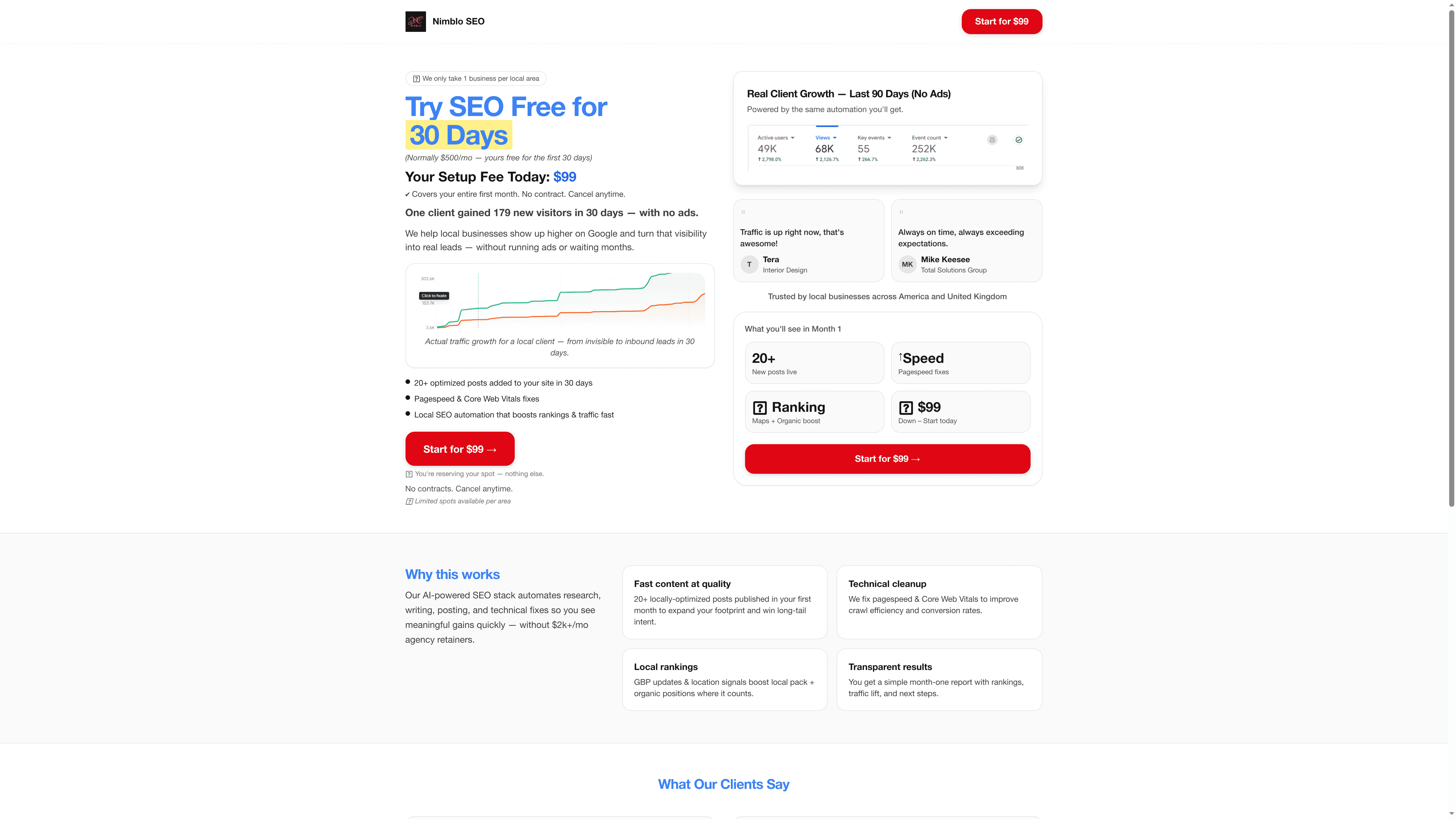
Ready to elevate your marketing results with unified tools designed for Florida SMBs Visit Nimblo.ai all-in-one platform now to start your rapid setup experience Discover how to replace costly agencies and multiple subscriptions with one powerful platform at a flat rate and no contracts Act now to gain strategic clarity and maximize every marketing dollar’s impact.
Frequently Asked Questions
What is marketing ROI?
Marketing ROI, or Marketing Return on Investment, measures the effectiveness and profitability of marketing efforts by calculating the net profit generated from marketing investments compared to total marketing costs.
Why is measuring marketing ROI important for small businesses?
Measuring marketing ROI helps small businesses understand which marketing strategies are effective, enabling them to allocate their limited resources wisely and maximize their revenue-generating potential.
How can small businesses accurately calculate marketing ROI?
To calculate marketing ROI accurately, small businesses should identify total marketing spend, calculate incremental revenue from marketing efforts, determine contribution margin percentage, and apply the ROI formula: (Revenue – Marketing Expenses) / Marketing Investment x 100.
What common mistakes should small businesses avoid when tracking ROI?
Common mistakes include overlooking indirect and long-term benefits, using inconsistent measurement periods, and focusing solely on short-term financial metrics. Small businesses should adopt a holistic approach to avoid these pitfalls.