
Nearly 60 percent of online searches now happen on mobile devices, yet many Florida business websites still fall short when it comes to SEO basics. If your website loads slowly or looks messy on a phone, potential customers are likely to bounce before you even make an impression. Creating a fast, well-designed site not only draws more visitors but also sets the stage for higher search rankings and real business growth.
Table of Contents
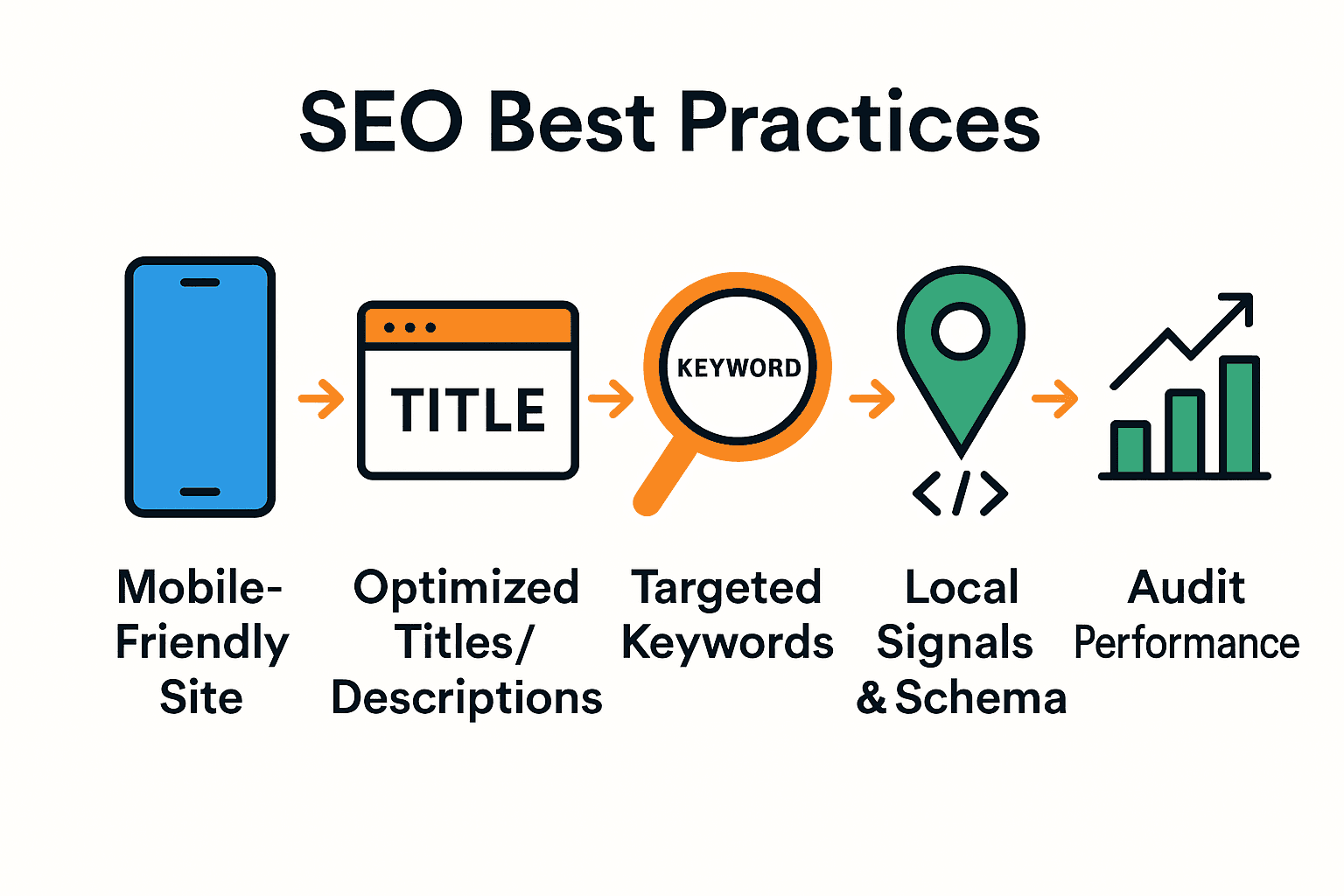
- Step 1: Prepare Your Website For SEO Success
- Step 2: Optimize Titles And Meta Descriptions Effectively
- Step 3: Implement Targeted Keyword Usage Across Pages
- Step 4: Enhance Local Signals And Schema Markup
- Step 5: Verify On-Page SEO Performance And Fix Issues
Quick Summary
| Key Point | Explanation |
|---|---|
| 1. Invest in a mobile-friendly website | Creating a responsive design improves user experience and engagement on all devices, crucial for SEO success. |
| 2. Craft unique titles and meta descriptions | Each page should have distinct titles and descriptions containing keywords to attract potential customers and improve CTR. |
| 3. Use targeted keywords naturally | Integrate specific, long-tail keywords into your content to enhance discoverability without sacrificing readability. |
| 4. Optimize local signals and schema markup | Consistency in business information and using schema markup helps search engines accurately understand your business details. |
| 5. Regularly audit on-page SEO performance | Utilize tools to check for broken links and site speed issues, resolving them promptly to maintain strong search rankings. |
Step 1: Prepare Your Website for SEO Success
Website preparation is the foundational step for achieving strong search engine visibility. In this section, you’ll learn how to optimize your Florida business website to attract more local customers and improve your search rankings.
According to PCC Small Business, investing in a well-designed, mobile-friendly website is crucial for SEO success. This means creating a responsive design that looks great and functions smoothly on smartphones, tablets, and desktop computers. Your website should load quickly, have clear navigation, and provide an excellent user experience that keeps visitors engaged.
Start by conducting a comprehensive website audit. Check your site speed using tools like Google PageSpeed Insights, ensure all pages are mobile responsive, and verify that your content is easy to read and navigate. Focus on clean, professional design that highlights your business services and makes it simple for potential customers to find the information they need. Role of Website Design in SEO can provide additional insights into creating an SEO-friendly website layout.
Pro tip: Local Florida businesses should prominently display location information, contact details, and service areas. This helps search engines understand your geographical relevance and improves local search visibility. Add schema markup to help search engines better comprehend your business details and potentially enhance your search result appearance.
Your next step will involve diving into keyword research and content optimization strategies that will further improve your website’s search engine performance.
Step 2: Optimize Titles and Meta Descriptions Effectively
Titles and meta descriptions are your website’s first impression in search results. This step will help you craft compelling, keyword rich descriptions that improve your visibility and attract more potential customers.
According to WebTech, creating effective title tags and unique meta descriptions is crucial for enhancing search engine visibility. For Florida businesses, this means developing descriptions that not only include relevant keywords but also clearly communicate your local value proposition. Each page should have a distinct title and meta description that accurately represents its content while enticing potential customers to click.
Start by writing titles that are 50 to 60 characters long and include your primary keyword and location. For example, a plumbing business in Miami might use a title like “Miami Emergency Plumbing Services | Quick Repairs”. Meta descriptions should be between 150 to 160 characters and provide a concise summary of the page content.
 SEO Press emphasizes creating unique descriptions for each page to improve click through rates.
Pro tip: Avoid keyword stuffing or using generic descriptions. Focus on creating clear, engaging text that speaks directly to your target audience. Include a call to action that encourages users to click such as “Call now for a free estimate” or “Schedule your consultation today”.
In the next step, we will explore how to strategically integrate keywords into your website content to further boost your local SEO performance.
Step 3: Implement Targeted Keyword Usage Across Pages
Keyword implementation is an art of strategic content creation that helps your Florida business become more discoverable online. In this step, you will learn how to naturally integrate keywords that attract potential customers and improve your search engine rankings.
According to PCC Small Business, creating quality content with targeted keywords is essential while avoiding keyword stuffing. This means thoughtfully weaving relevant search terms into your website content in a way that reads naturally and provides genuine value to your readers. For a Florida landscaping business, this might mean using phrases like “Orlando landscape design” or “professional lawn care services in Florida” within informative, engaging paragraphs.
Colorado State University recommends conducting thorough keyword research to understand exactly how potential customers search for your services. Start by identifying primary keywords specific to your business and location, then distribute them strategically across your website pages. Focus on incorporating keywords into headers, page titles, image alt text, and within the first 100 words of your content. Aim for a natural flow that prioritizes readability over keyword density.
Pro tip: Use long tail keywords that are more specific and less competitive.
Instead of just “plumber,” use “emergency plumber in Orlando” or “residential plumbing repair Miami.” These targeted phrases help you rank higher for specific local searches and attract more qualified leads.
In the next step, we will explore how to build high quality local backlinks that further strengthen your website’s search engine authority.
Step 4: Enhance Local Signals and Schema Markup
Local SEO signals are your digital roadmap for helping potential customers find your Florida business online. In this step, you will learn how to strengthen your local search presence and make your website more discoverable to nearby customers.
According to PCC Small Business, optimizing your website with location specific keywords is critical for local search visibility. This means consistently displaying your business name, address, and phone number across your website and other online platforms. 7 Practical Examples of Local SEO Strategies for SMBs can provide additional insights into effectively implementing these local signals.
Implement schema markup to help search engines understand your business details more precisely. This structured data tells search engines exactly who you are, what you do, and where you are located. Include specific details like your business type, service areas, operating hours, contact information, and customer reviews. Use free tools like Google’s Structured Data Markup Helper to generate the correct schema code for your website.
Pro tip: Create a Google Business Profile and ensure all information matches your website exactly. Inconsistent information across platforms can confuse search engines and potentially harm your local search rankings.
In the next step, we will explore how to build high quality local backlinks that further boost your local search authority.
Step 5: Verify On-Page SEO Performance and Fix Issues
On-page SEO performance verification is your chance to diagnose and repair potential website issues that might be hindering your search engine rankings. In this step, you will learn how to proactively identify and resolve technical problems that could impact your Florida business website’s visibility.
According to WebTech, utilizing tools like Google Search Console is essential for monitoring website performance and identifying critical issues. This involves checking for broken links, page loading speed, mobile responsiveness, and potential indexing problems. SEO Platform Guide can provide additional insights into comprehensive performance monitoring.
As recommended by SEO Press, setting up Google Search Console should be your first priority. Review the performance report to understand how search engines crawl and index your website. Pay close attention to error messages, crawl stats, and mobile usability reports. Address issues like slow page speeds, mobile compatibility problems, and broken internal links immediately.
Pro tip: Run a comprehensive technical SEO audit every three months.
 Small issues can accumulate over time and significantly impact your search rankings if left unchecked.
In the next and final step, we will explore ongoing SEO maintenance strategies to keep your Florida business website performing at its best.
Unlock Your Florida Business’s SEO Potential with Nimblo.ai
Struggling to keep up with all the on-page SEO steps like keyword optimization, schema markup, and Google Business Profile management can feel overwhelming. The article highlights how local signals and fast, responsive website design are crucial to climbing the search rankings but managing these technical details alone can hold your business back from growth. If you want to stop losing potential customers due to slow sites or inconsistent local SEO information, you need a solution that simplifies everything without the steep learning curve.
Nimblo.ai offers Florida SMBs an all-in-one platform that takes the guesswork out of on-page SEO and digital marketing. With features tailored to your local market, like AI-powered SEO tools, schema markup automation, and conversion-driven web design, you save time and avoid costly agency fees. Imagine having automated lead generation working for you while you focus on running your business.
Take charge of your website’s performance today. Visit Nimblo.ai to discover how easy it is to get a fully optimized, high-speed website with local SEO built in. Say goodbye to fragmented tools and hello to a streamlined platform designed for Florida businesses ready to grow. Don’t wait for your competitors to capture your customers—start now and watch your leads increase with the power of Nimblo.ai.
Frequently Asked Questions
What are the first steps to prepare my Florida business website for SEO?
To prepare your Florida business website for SEO success, start by conducting a comprehensive website audit. Check your site speed, mobile responsiveness, and navigation clarity to ensure a positive user experience, which can significantly enhance your search rankings.
How do I optimize titles and meta descriptions for my website?
Optimize titles by keeping them between 50 to 60 characters and including relevant keywords and location. For meta descriptions, aim for 150 to 160 characters that clearly summarize the page content and entice users with a call to action, like “Call now for a free estimate.”
What is the best way to implement targeted keyword usage across my web pages?
To implement targeted keywords effectively, conduct thorough keyword research to find terms specific to your business and location. Naturally integrate these keywords into headers and content, especially within the first 100 words, to improve your search engine visibility and user experience.
How can I enhance local SEO signals on my website?
Enhance local SEO by prominently displaying your business name, address, and phone number across your website. Implement schema markup to help search engines better understand your business, ensuring the information matches your Google Business Profile for consistency and improved local search rankings.
What tools should I use to verify my on-page SEO performance?
To verify your on-page SEO performance, use tools like Google Search Console to monitor important metrics such as page speed, broken links, and mobile usability issues. Regularly check these metrics and address identified issues promptly to maintain and improve your search rankings, ideally performing these checks every three months.