
Every Florida service business owner knows how quickly word travels, whether through online platforms or neighborhood conversations. Reputation management matters because what people find about your business on Google, social media, or local forums can make or break new leads. This article breaks down how managing both your online and offline reputation shapes the future of your business, helping local owners build trust, save time, and attract more customers with affordable digital solutions.
Table of Contents
- Defining Reputation Management For SMBs
- Major Types And Channels Explained
- How These Channels Work Together
- How Reputation Management Works Online
- Role Of Reviews, Social Media, And SEO
- How They Work Together In Practice
- Risks, Costs, And Common Mistakes
- Choosing The Right Approach For Your Business
- The Foundation Every Business Needs
Key Takeaways
| Point | Details |
|---|---|
| Importance of Reputation Management | Reputation management involves actively shaping how your business is perceived both online and offline. It’s an ongoing practice that requires continuous attention and effort. |
| Online and Offline Integration | Successful reputation management combines online presence, such as reviews and social media, with offline engagement like community interactions and in-person customer service. |
| Proactive Response Strategy | Promptly responding to reviews and feedback, both positive and negative, is essential in building trust and maintaining a favorable reputation. |
| Consistent Action and Monitoring | Establish a routine for monitoring your reputation across platforms to identify and address issues quickly, enhancing your overall brand perception. |
Defining Reputation Management for SMBs
Reputation management is far more than just responding to negative reviews online. It’s the active practice of monitoring, influencing, and shaping how your business is perceived across every digital and physical touchpoint where customers interact with your brand. For service-based businesses in Florida, this means managing how people talk about you on Google, social media, review sites, your local community, and everywhere else your name appears.
At its core, online reputation management involves controlling your public perception through digital channels like search results and social platforms. But here’s what many small business owners miss: reputation management goes beyond just the internet. It includes how your team handles customer service in person, what gets said about you at the local coffee shop, and how you show up in your community. When a potential customer searches your business name, they see your Google My Business profile, reviews across multiple platforms, social media presence, and news mentions. All of these components work together to form their first impression of you.
For Florida service businesses especially, this is critical because your success depends heavily on local word-of-mouth combined with online visibility. A customer might see your 4.8-star Google rating, then call a friend who had a bad experience three years ago. Your actual reputation lives in both spaces simultaneously. The practice of reputation management means you’re intentionally shaping that narrative by staying visible where customers look, responding promptly to feedback, and consistently delivering experiences worth talking about.

What makes this especially relevant for small business owners is that reputation management isn’t a one-time project. It’s an ongoing practice that includes several key components: setting up and optimizing your business profiles on relevant platforms, monitoring what people are saying about you across review sites and social channels, responding professionally to both positive and negative feedback, and actively encouraging satisfied customers to share their experiences. When you manage your reputation effectively, you’re essentially reducing the gap between your actual service quality and what potential customers perceive it to be.
Pro tip: Start by auditing where your business already appears online—search your business name on Google, check Yelp, and scan your social media profiles. You can’t manage what you don’t see, so knowing your current reputation landscape is your first concrete step.
Major Types and Channels Explained
Reputation management splits into two distinct categories, and understanding the difference matters for how you allocate your time and resources. Online reputation management focuses on your digital presence: search engine results, social media platforms, review sites, and anywhere customers find information about you on the internet. Offline reputation management covers the traditional channels like local news coverage, community sponsorships, word-of-mouth in your neighborhood, and how you’re perceived through in-person interactions. For most Florida service businesses, you need both working together. A customer might read your glowing Google reviews online, then hear a negative story from their neighbor at the grocery store. Your reputation isn’t controlled by one channel alone.
Let’s break down the major online channels where your reputation is being built or damaged right now. Google Search Results remain your most critical real estate because that’s where customers start investigating you. When someone searches your business name or your service category in your area, they see your website, your Google Business Profile, reviews scattered across the web, and social media links. Social media platforms have become essential for reputation management because they enable direct conversation with customers in real-time. Facebook, Instagram, and even LinkedIn allow you to respond to feedback, share customer success stories, and control the narrative around your brand. Review sites like Google My Business, Yelp, Facebook Reviews, and industry-specific platforms are where potential customers read other people’s experiences before making a decision about hiring you. Each platform has slightly different dynamics. Google reviews carry enormous weight for local search visibility. Yelp tends to have high-intent customers actively searching for services. Facebook reviews reach people already in your community.
Offline reputation management might feel less urgent, but it’s equally powerful. Local media coverage in Tampa, Miami, Orlando, or Jacksonville newspapers and radio stations builds credibility that pure online tactics cannot match. Community involvement through sponsorships, charity work, or partnerships demonstrates you’re invested in Florida beyond just making sales. Your physical storefront or office, how your team treats customers face-to-face, and the quality of your work all contribute to the reputation conversations happening in homes and businesses throughout your area. These offline touchpoints create the stories people tell their friends and family, which then influences whether they recommend you.
Here’s how online and offline reputation channels differ for Florida service businesses:
| Channel Type | Key Features | Influence on Reputation | Example Activities |
|---|---|---|---|
| Online | Public reviews, social media, search visibility | Shapes first impressions, increases discoverability | Responding to Google reviews, posting on Facebook |
| Offline | In-person interactions, community presence, local media | Builds trust through relationships, strengthens credibility | Sponsoring events, in-person customer service |
How These Channels Work Together
The real power emerges when you understand how these channels reinforce each other. A customer has a great experience with your service, leaves a positive review on Google, shares about it on Facebook, and tells their neighbor in person. That single positive experience now exists across multiple channels, multiplying its impact. Conversely, a negative experience can spiral across channels quickly. Someone complains on social media, leaves a bad review, and suddenly multiple people have heard the story. The most effective reputation management strategy treats these channels as an integrated system rather than separate tasks.
For service businesses in Florida especially, online and offline reputation management must work in tandem. You cannot ignore your community presence in favor of only managing reviews. You cannot build strong offline relationships and then neglect responding to social media comments. The businesses winning the reputation game in their markets are the ones actively managing across all these channels simultaneously.
Pro tip: Pick your three most important channels this month based on where your target customers actually spend time and focus there first, rather than trying to manage everything at once.
How Reputation Management Works Online
Online reputation management operates on a surprisingly straightforward principle: what appears when someone searches for you matters enormously. When a potential customer in Miami, Jacksonville, or Orlando types your business name into Google, they see a collection of results pulled from across the web. Your website might appear first, but so will your Google Business Profile, customer reviews, social media pages, news articles, and forum discussions. Online reputation management is the practice of actively shaping what shows up in those search results and across digital platforms to reflect your business positively.
The mechanics work through several layers. First comes visibility and search results. Search engines rank content based on relevance, recency, and authority. When you actively manage your online reputation, you’re essentially pushing positive content higher in those rankings. A well-optimized Google Business Profile with current information and customer reviews ranks higher than an abandoned one. A regularly updated website ranks higher than outdated competitors. This is why monitoring and responding to online mentions forms the foundation of effective reputation management. When someone leaves a review, posts about you on social media, or mentions your business in a forum, that content gets indexed by search engines. If you respond professionally and promptly, you control the narrative around those mentions. Negative reviews that go unanswered rank just as prominently as positive ones, but a thoughtful response from the business owner signals competence and care to potential customers reading that exchange.
The second layer involves content control and SEO positioning. Businesses that consistently generate fresh, positive content online naturally push down older negative content in search rankings. Posting regular updates on social media, publishing client testimonials, sharing before-and-after photos of your work, or posting helpful tips on your website all create positive content that ranks competitively. This is particularly important for service businesses in Florida because when someone searches for “HVAC repair near Tampa” or “plumbing services in Boca Raton,” they see local results mixed with your reviews and online presence. The businesses dominating those searches are the ones actively creating and optimizing positive content. You don’t need a huge marketing budget to compete. Consistency matters more than volume. A small business that regularly responds to reviews, posts on social media twice a week, and maintains an updated website will outrank competitors who ignore their online presence.
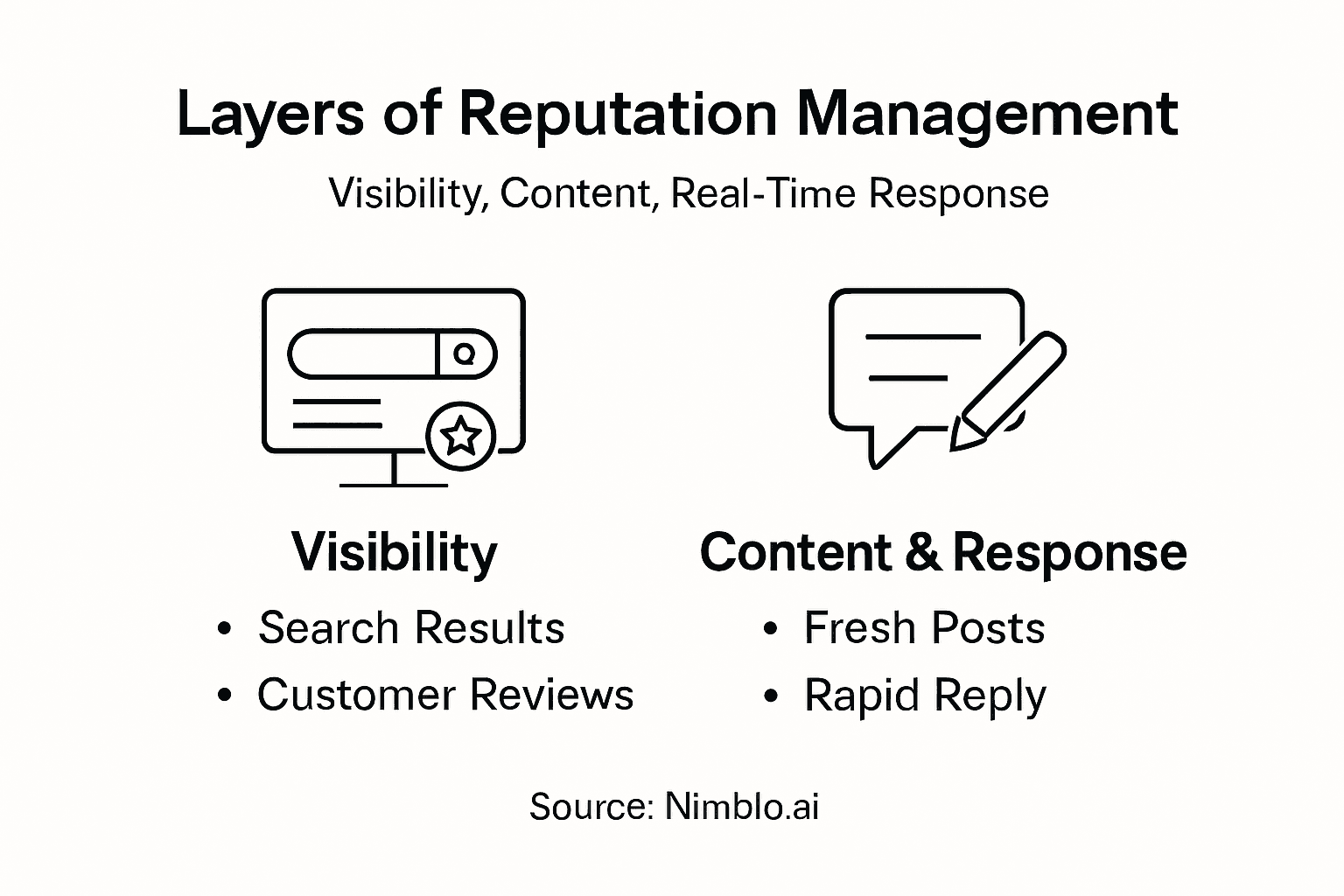
The third layer is real-time monitoring and rapid response. Your reputation isn’t built once and left alone. It’s constantly being shaped by new reviews, social media mentions, and customer feedback. Tools and techniques for managing online reputation include setting up alerts so you know when your business is mentioned, monitoring review sites daily, checking social media comments regularly, and having a system to respond within 24 hours. When a customer leaves a review, whether positive or negative, your response time and tone matter. A negative review acknowledged within hours with a genuine offer to resolve the issue shows other potential customers that you care about your service quality. A negative review ignored for weeks sends the opposite message. For Florida service businesses competing locally, this real-time responsiveness creates a competitive advantage. Your response becomes visible content that influences how others perceive you.
Pro tip: Set up Google Alerts for your business name and important service keywords to get email notifications when you’re mentioned online, then respond to every mention within 24 hours to build momentum in your online reputation.
Role of Reviews, Social Media, and SEO
These three elements work together like parts of a single machine. Reviews generate the social proof that convinces people to hire you. Social media provides the platform where conversations happen and your brand personality shines through. SEO ensures that all of it gets discovered when people search for your services. Ignore any one of these three, and your reputation management efforts become incomplete. For Florida service businesses competing in crowded local markets, mastering the intersection of these three channels is what separates thriving businesses from those struggling to fill their pipelines.
Reviews are the most direct form of social proof available to your business. When a potential customer is deciding between you and a competitor, online reviews significantly influence their trust and purchasing decisions. A business with 4.7 stars and 150 reviews will outsell a competitor with 4.9 stars and only 8 reviews because volume matters as much as rating. Each new review you receive is a fresh piece of content that search engines index and display prominently. Google reviews appear directly in search results and on maps. They’re the first thing someone sees when they search for your service category in your city. The rating badge next to your name becomes your visual calling card. Beyond just the star rating itself, the text of reviews matters enormously. When a customer writes detailed reviews describing specific problems you solved or praising your professionalism, that language gets indexed and becomes discoverable through search. Someone searching for “reliable electrician in Tampa who shows up on time” might find your business not through your website but through language in customer reviews that matches exactly what they’re searching for.
Social media transforms reviews and customer experiences into ongoing conversations. This is where your business becomes human and relatable. When you respond to a Facebook review within an hour, share before-and-after photos of your work on Instagram, or answer customer questions in comments, you’re actively managing your reputation in real-time. Social media provides transparency that builds trust in ways traditional advertising never could. A customer hesitant to hire you might see your Instagram posts showing multiple successful projects, then scroll through comments where you’re having genuine conversations with past clients. That visibility and authenticity convert hesitation into confidence. Proactive management of social media reputations through swift responses, consistent communication, and quality content leads directly to increased conversions and stronger customer relationships. For service businesses, social media also serves as proof of activity. A business that posted regularly last week and responds to comments looks more stable and trustworthy than an abandoned social profile from two years ago.
SEO is the invisible force that determines whether anyone actually sees your reviews and social media presence. Two businesses might have identical customer service and the same number of five-star reviews, but if one ranks higher in search results, that business will capture more leads. SEO involves optimizing multiple elements: your website content, your Google Business Profile, the keywords in your reviews, how your social media content uses relevant terms, and the authority of websites linking to you. When you implement content strategies that support local SEO, you’re essentially making it easier for search engines to understand that your business is relevant for customers in your specific service area looking for your specific services. The connection between reviews and SEO is particularly powerful. Google’s algorithm considers review quantity, recency, and rating when determining search rankings. A business that actively encourages customers to leave reviews will see those reviews accumulate, which then improves SEO ranking, which increases visibility, which leads to more customer inquiries, which generates more opportunities for reviews. This creates a virtuous cycle where the three elements reinforce each other.
How They Work Together in Practice
Imagine a customer searching “AC repair near Fort Lauderdale” on a Monday morning because their air conditioning stopped working. The search results show your business name with a 4.8-star rating and 87 reviews. They click on your Google Business Profile and see recent photos of your team on the job, responsive answers to customer questions, and your social media links. They click through to your Facebook page and see posts from last week with satisfied customers commenting about how quickly you responded. They read several reviews describing how you showed up within 24 hours and fixed their problem professionally. All of this information was discovered through a single search, and all three elements, reviews, social media, and SEO working together, convinced them to call you instead of a competitor.
Pro tip: After each completed job, follow up with the customer asking for a Google review, then share their positive feedback on your social media with their permission, creating a cycle where reviews and social content reinforce each other continuously.
Risks, Costs, and Common Mistakes
Reputation damage happens fast. One angry customer posts a scathing review on a Saturday night. Their friends share it in a Facebook group. By Monday morning, you have five similar complaints amplifying the original story. What took years to build can crack in days. The speed at which reputation damage spreads through social media is perhaps the most underestimated threat facing small business owners. A negative review doesn’t just sit there quietly. It gets shared, discussed, and multiplied through social networks. Search engines pick it up and rank it prominently. Potential customers see it before they ever see your website or positive reviews. For service businesses in Florida competing on reputation alone, this risk is existential.
The costs of reputation damage extend far beyond losing a single customer or two. When your business reputation deteriorates, customers stop calling. Revenue drops. Existing customers question whether they made the right choice hiring you. Your team picks up on the stress and negativity. Word spreads through your local community faster than you can respond. A contractor in Jacksonville might lose 30 percent of their pipeline from a single viral complaint. An HVAC company in Orlando might spend months recovering from a reputation crisis that originated from poor communication about a single service call. The financial impact includes obvious losses like reduced revenue, but also hidden costs like time spent on damage control, potential legal expenses if false claims are made, reduced employee morale, and the difficulty of attracting new talent to a business with a tarnished reputation. What compounds these costs is that recovery takes far longer than the damage itself. You might lose customers in a week but spend six months rebuilding trust. The customers you lose are often among your best prospects because they were motivated enough to research you online in the first place.
Common Mistakes That Create Problems
Most small business owners make the same preventable mistakes. The first major mistake is ignoring negative feedback or responding poorly. When a customer leaves a bad review, your instinct might be to defend yourself, argue the facts, or ignore it hoping it goes away. Every single one of these responses backfires. A customer reading an unanswered negative review thinks you don’t care about feedback. A customer reading a defensive response thinks the business owner is unprofessional. A customer reading no response at all assumes the complaint was legitimate and unresolved. The correct response to any negative feedback is acknowledgment within 24 hours, genuine empathy, and a sincere offer to resolve the issue offline. This transforms a potential reputation crisis into proof that you care about customer satisfaction.
The second major mistake is failing to establish a monitoring system. You cannot manage what you don’t know about. Many business owners don’t discover they have reputation problems until a customer mentions something in passing or a friend tells them about a negative review they saw weeks ago. By then, multiple people have already read it and formed opinions. Without a structured system to monitor reviews, social media mentions, and search results, you’re flying blind. This doesn’t require expensive tools. Google Alerts are free. Setting a phone reminder to check Google reviews and Facebook comments daily takes five minutes. Assigning someone on your team to monitor social media takes two hours per week. The cost of not having this system is exponentially higher than the minimal effort required to establish one.
The third mistake is lack of crisis communication planning. When reputation problems hit, you need a response plan, not panic. Who will respond to negative reviews? What will they say? How quickly? What internal communication will happen with your team? How will you gather facts before responding? Businesses that have thought through these questions in advance respond faster and more effectively. Businesses caught off-guard often make poor decisions in the moment that make things worse. You don’t need a 50-page crisis communication manual. A simple one-page document listing who responds to what, how quickly they’ll respond, and the general principles they’ll follow (honesty, empathy, accountability) transforms your response from reactive to professional.
The final common mistake is underestimating how quickly reputational risks from social media can escalate. Business owners sometimes think that one bad review or one negative social media post is just part of doing business. They delay responding. They hope it disappears. They don’t realize that in the digital age, a single incident can reach hundreds or thousands of people within hours if it resonates emotionally. By the time you realize you have a serious problem, it might already be too late to contain the damage effectively.
Compare the biggest reputation management mistakes and their long-term impact:
| Mistake | Short-Term Consequence | Long-Term Business Impact |
|---|---|---|
| Ignoring negative reviews | Loss of customer trust | Drop in referrals, reputation damage |
| Lacking monitoring systems | Missed negative feedback | Unaddressed issues spread widely |
| No crisis communication plan | Slow or poor response | Extended damage, harder recovery |
| Underestimating social media risk | Delayed reaction to incidents | Viral spread, persistent negative perception |
Pro tip: Create a simple reputation monitoring checklist done every Friday: check Google reviews, scan Facebook comments, search your business name in Google, and note any new mentions or changes in your review ratings so you catch problems early.
Choosing the Right Approach for Your Business
There’s no one-size-fits-all reputation management strategy. A plumbing company in Miami faces different reputation challenges than a marketing agency in Tampa. Your service type, customer base, current online presence, and available resources all factor into which approach makes sense for your business. The key is understanding your situation clearly before committing time and money to reputation management efforts. Generic strategies fail because they don’t account for what actually matters to your specific customers and what threats exist in your particular market.
Start by assessing where your reputation currently stands. Search your business name on Google and note what appears in the first page of results. Check your ratings and review counts on Google, Yelp, and Facebook. Read through your recent reviews to identify patterns in what customers praise and criticize. Look at your social media presence, noting how old your most recent posts are and whether you’re actively responding to comments. This audit reveals your reputation landscape honestly. You might discover you’re in better shape than you thought, or you might uncover serious gaps you didn’t realize existed. This clarity is essential because it determines what to prioritize. A business with zero reviews needs a different strategy than a business with 200 reviews and a 3-star average. A business with an active social media presence needs different tactics than one with an abandoned Facebook page from 2019.
Once you understand your current state, identify which platforms matter most for your business and customer base. Not every platform deserves equal attention. A luxury home renovation company in Jacksonville might find most of their prospects through a combination of Google search results and Facebook, making those two platforms the priority. A plumbing service business might benefit more from Google My Business optimization and Yelp management because customers actively search those channels when they have an emergency. An integrative reputation management approach that addresses strategic priorities, stakeholder relationships, operational excellence, and communications ensures you’re not randomly chasing every possible channel. Assign one person on your team responsibility for reputation management rather than letting it scatter across multiple people with no clear ownership. That person becomes your “community manager” accountable for monitoring platforms, responding to feedback, and maintaining consistency. This role doesn’t require hiring someone new. It often means adding two to three hours per week to someone’s existing responsibilities, but it transforms reputation management from chaotic to systematic.
The Foundation Every Business Needs
Regardless of your specific situation, every Florida service business should implement these foundation-level reputation management practices. First, claim and optimize your Google Business Profile. This is non-negotiable. Your Google profile is where most local customers find you, and it’s where your reviews appear most prominently. Add accurate business information, upload quality photos of your work, and request that satisfied customers leave reviews. Second, establish a process for requesting reviews from satisfied customers immediately after completing work. Don’t wait weeks. When the work is done and the customer is happy, that’s when they’re most likely to leave a review. A simple email or text message with a direct link to your Google review page takes 30 seconds to send but generates enormous returns. Third, commit to responding to every review, positive or negative, within 24 hours. This demonstrates professionalism and shows potential customers that you take feedback seriously. Negative reviews that receive thoughtful responses actually build trust because customers see that problems get addressed.
Beyond these fundamentals, your approach should reflect your business reality. A roofing contractor with a large team might benefit from implementing marketing automation workflows that automatically request reviews and send follow-up communications after projects complete. A solo HVAC technician might focus on maintaining a simple monthly social media posting schedule and staying on top of Google reviews. A services company with higher price points might invest more effort in relationship building and community involvement because your customer lifetime value justifies the effort. A business competing primarily on price might focus intensely on review volume and response speed because those factors influence local search rankings more directly.
The most important principle is consistency over perfection. A business that does basic reputation management consistently every single week will outpace a business that tries to do everything perfectly once per month. Pick an approach that fits your capacity, then commit to it systematically. Start with the foundations, then layer additional tactics as your team gains experience and bandwidth increases.
Pro tip: Pick three specific days each month as your reputation management days: one for monitoring and responding to reviews, one for requesting reviews from recent customers, and one for updating social media content with customer success stories.
Take Control of Your Florida SMB Reputation Today
Managing your online and offline reputation takes time and expertise. The challenges outlined in this article show how crucial it is to actively monitor reviews, respond to feedback promptly, and boost your local SEO to capture trusted leads. If you feel overwhelmed keeping up with Google Business Profile updates, social media conversations, and review responses all on your own, you are not alone. Florida small business owners like you need reliable tools that simplify reputation management while improving visibility in local searches.
Unlock the power of an all-in-one solution designed specifically for Florida SMBs. Nimblo.ai offers AI-powered local SEO, automated follow-ups, optimized website design, and effortless Google Business Profile management in a single platform. Save your valuable time and resources with streamlined marketing automation that delivers measurable lead growth and builds your positive reputation in your community. Don’t let unmanaged reviews or outdated online profiles hold your business back. Explore how you can start improving your brand perception today by visiting Nimblo.ai Reputation Management. Take the first step toward controlling your reputation and growing your business now.
Frequently Asked Questions
What is reputation management in the context of small and medium-sized businesses?
Reputation management involves monitoring, influencing, and shaping how a business is perceived by customers across both digital and physical touchpoints. It includes managing online reviews, social media presence, and offline interactions that impact customer perceptions.
Why is online reputation management crucial for Florida service businesses?
Online reputation management is critical because many potential customers find businesses through search engines and social media. Positive reviews and an active online presence can significantly influence a customer’s decision to choose a service provider.
How can small businesses improve their online reputation?
Small businesses can improve their online reputation by regularly updating their Google Business Profiles, actively requesting reviews from satisfied customers, responding to all feedback promptly, and creating and sharing consistent positive content on social media.
What are the risks of neglecting reputation management?
Neglecting reputation management can lead to potential customers encountering negative reviews without responses, which may damage trust and credibility. This can result in a loss of business, reduced customer loyalty, and a decline in overall revenue.