
Over 78 percent of local mobile searches end with an offline purchase by an american consumer. For small and medium-sized businesses, this underscores how crucial a strong local digital presence has become. Success today is not just about being found online but about building trusted connections within your own neighborhood. If you want practical ways to stand out in local search and attract more real-world customers, it starts with understanding how local SEO works.
Table of Contents
- Defining SEO for Local Businesses
- Key Local SEO Ranking Factors in 2025
- Optimizing Google Business Profiles for SMBs
- Implementing Schema Markup and Local Content
- Common SEO Mistakes and How to Avoid Them
Key Takeaways
| Point | Details |
|---|---|
| Local SEO Importance | Local SEO enhances online visibility for small and medium-sized businesses within their geographic areas, facilitating connections with the community. |
| Key Ranking Factors for 2025 | Businesses should focus on hyper-localized content, consistent NAP information, and mobile-friendly designs to improve local search rankings. |
| Google Business Profile Optimization | A well-optimized Google Business Profile is crucial for attracting potential customers and requires accurate information and active customer engagement. |
| Avoiding Common Mistakes | To maintain effective local SEO, businesses must avoid inconsistencies in NAP details, neglecting updates on their Google Business Profile, and lacking localized content. |
Defining SEO for Local Businesses
Search engine optimization (SEO) for local businesses represents a targeted digital marketing strategy designed to help small and medium-sized enterprises increase their online visibility within specific geographic areas. Local SEO focuses on optimizing a business’s digital presence to attract more customers from relevant local searches, essentially putting your business on the map – literally and figuratively.
At its core, local SEO involves strategically enhancing your online profiles and website content to rank higher in location-based search results. This means when potential customers in your area search for services or products you offer, your business appears prominently in search engine results pages (SERPs). Key elements include optimizing your Google Business Profile, ensuring consistent business name, address, and phone number (NAP) across online directories, generating local customer reviews, and creating location-specific website content.
For Florida small businesses, local SEO isn’t just about visibility – it’s about connecting with your immediate community. Consider that 78% of local mobile searches result in offline purchases, making your digital strategy a critical bridge between online discovery and real-world customer interactions. This approach allows businesses to compete effectively against larger competitors by targeting hyper-local audience segments and demonstrating immediate relevance to potential customers.
Successful local SEO strategies typically incorporate several key tactics:
- Precise location-based keyword targeting
- Mobile-responsive website design
- Consistent business information across platforms
- High-quality, locally-relevant content
- Active management of online reviews and ratings
By understanding and implementing these strategies, local businesses can transform their digital presence from an afterthought to a powerful customer acquisition engine.
Key Local SEO Ranking Factors in 2025
As digital marketing continues to evolve, local SEO ranking factors for small businesses have become increasingly sophisticated and nuanced. Search algorithms now prioritize hyper-localized, contextually relevant content that demonstrates genuine community connection and expertise. These emerging ranking factors go far beyond traditional keyword optimization, requiring businesses to develop comprehensive, integrated digital strategies.
In 2025, the most critical local SEO ranking factors will center on several key dimensions. Google’s algorithm continues to prioritize proximity, relevance, and prominence – but with heightened complexity. Businesses must focus on creating rich, location-specific content, maintaining consistent and accurate business information across multiple platforms, generating authentic customer reviews, and developing robust, mobile-responsive digital experiences. Local SEO best practices for 2025 suggest that businesses must think beyond mere visibility and focus on creating meaningful digital interactions.
Key ranking factors businesses should prioritize include:
- Hyper-localized content targeting specific neighborhood or community interests
- Mobile page speed and responsive design
- Consistent NAP (Name, Address, Phone) information across digital platforms
- High-quality, genuine customer reviews and ratings
- Schema markup for enhanced local search visibility
- Active engagement on Google Business Profile
- Local backlink development from reputable community sources
Technological advancements like AI and machine learning are transforming local SEO, enabling more sophisticated, personalized search experiences.
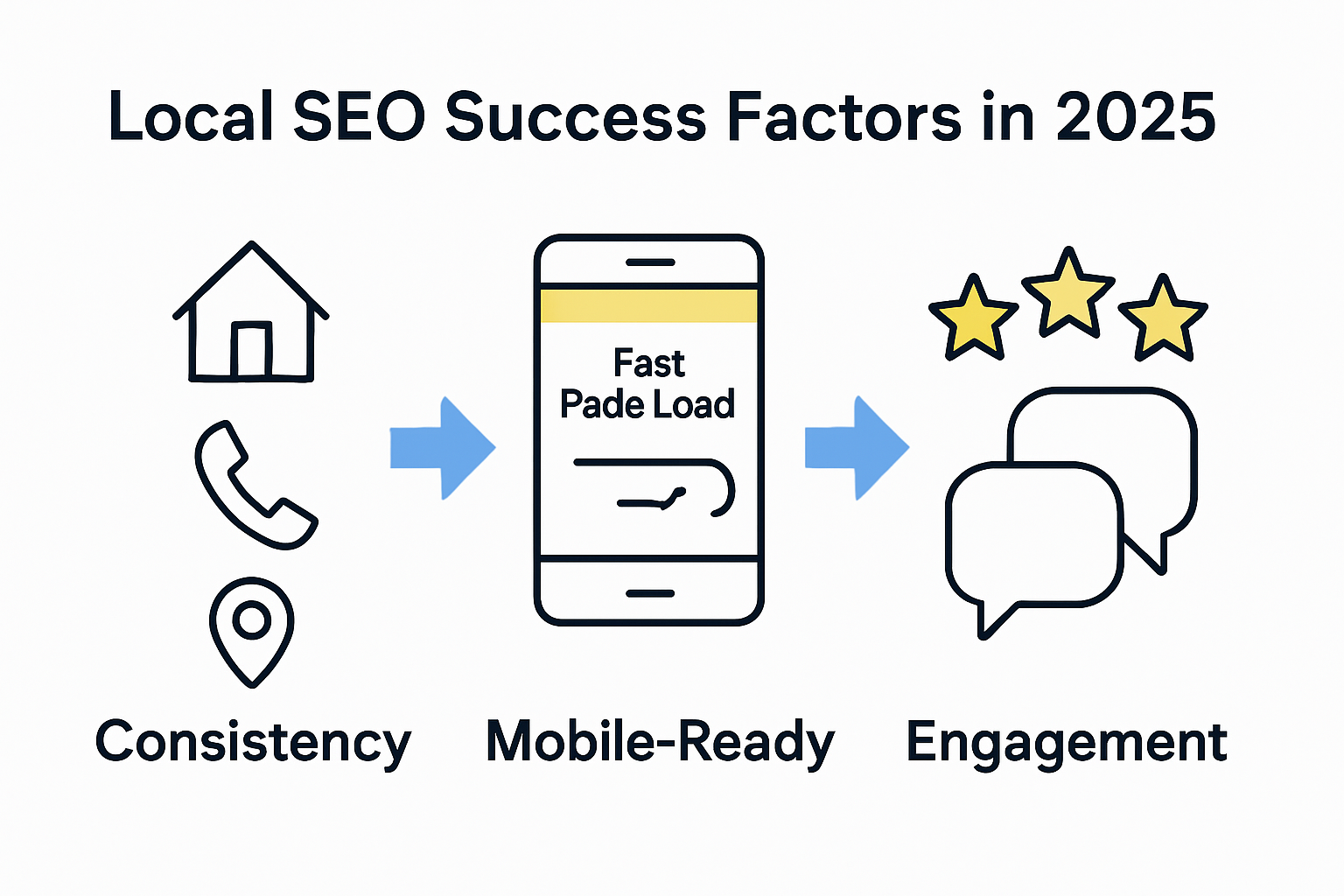 Businesses that adapt quickly and develop authentic, community-focused digital strategies will gain significant competitive advantages in local search rankings.

Optimizing Google Business Profiles for SMBs
Google Business Profile represents a critical digital asset for small and medium-sized businesses seeking to enhance their local online visibility. Local digital presence has transformed from a luxury to a necessity, with your business profile serving as the primary touchpoint between potential customers and your brand’s digital identity. According to LocalFalcon, optimizing these profiles involves ensuring accurate business information, regularly updating posts, and actively engaging with customer reviews to boost local search visibility.
Effective Google Business Profile optimization requires a strategic, multi-dimensional approach. Key optimization elements include comprehensive business details, high-quality visual content, accurate contact information, and consistent category selections. Inqnest research highlights that SMBs must maintain up-to-date NAP (Name, Address, Phone) details, incorporate professional photos, and proactively encourage customer reviews to improve local search rankings.
Practical steps for Google Business Profile optimization include:
- Verify your business location
- Complete every section of your profile
- Add high-resolution, professional business images
- Respond to customer reviews promptly and professionally
- Post regular updates about services, promotions, and events
- Utilize all available profile features like messaging and booking
- Include relevant business categories and attributes
- Add service area and business hours
Beyond basic optimization, successful Google Business Profiles in 2025 will leverage advanced features like posts, Q&A sections, and rich media to create engaging, informative digital experiences that not only attract potential customers but also build trust and credibility in your local market.
Implementing Schema Markup and Local Content
Schema markup represents a sophisticated coding language that helps search engines understand the context and nuance of your business’s digital content. For local small and medium-sized businesses, implementing schema markup is no longer optional but a critical strategy for enhancing online visibility and search engine comprehension. This structured data provides search engines with precise information about your business, enabling more accurate and rich search result displays.
Local content creation goes hand in hand with schema markup, transforming your digital presence from generic to hyper-targeted. Local businesses can leverage schema markup to highlight key information like business type, service areas, operating hours, contact details, and customer reviews. By creating content that is not just keyword-rich but contextually relevant to your specific community, you signal to search engines that your business is a credible, locally-focused entity.
Key implementation strategies for schema markup and local content include:
- Identify the most appropriate schema types for your business (local business, service, product)
- Use JSON-LD format for implementing schema markup
- Include detailed business information like address, phone number, and hours
- Create location-specific content that addresses local customer needs
- Embed customer reviews and testimonials with structured markup
- Develop neighborhood or city-specific landing pages
- Integrate local events, news, and community information
- Ensure mobile responsiveness for all local content
Successful local SEO in 2025 will demand more than superficial optimization. Businesses must develop a holistic approach that combines technical schema implementation with genuine, community-focused content that resonates with local audiences and search engine algorithms alike.
Common SEO Mistakes and How to Avoid Them
Local SEO strategy requires precision and consistent effort, but many small businesses inadvertently undermine their digital marketing potential through common yet critical mistakes. According to DesignGrid, these errors often involve inconsistent business information across online platforms, neglecting Google Business Profile optimization, and failing to develop meaningful local backlink strategies.
Visualmodo research highlights additional pitfalls that can significantly impact local search performance, including overlooking localized content creation, ignoring mobile optimization, and failing to engage authentically with customer reviews. These mistakes can dramatically reduce a business’s online visibility and potential customer engagement, making it crucial to understand and proactively address potential SEO weaknesses.
Common local SEO mistakes to avoid include:
- Inconsistent business name, address, and phone number (NAP) across platforms
- Neglecting Google Business Profile updates and optimization
- Lack of localized, community-specific content
- Ignoring mobile website performance and responsiveness
- Minimal or non-existent customer review management
- Overlooking local backlink opportunities
- Using generic, non-location-specific keywords
- Failing to implement proper schema markup
Successful local SEO demands a holistic approach that combines technical optimization, genuine community engagement, and a deep understanding of your local market’s unique digital landscape. Businesses that treat SEO as an ongoing, adaptive process will consistently outperform those viewing it as a one-time task.
Unlock Your Local Business Potential with All-in-One SEO Solutions
The article highlights the crucial role of precise local SEO strategies like Google Business Profile optimization, schema markup, and mobile-responsive design to dominate local search rankings in 2025. If you are a Florida SMB struggling with inconsistent business information, slow websites, or scattered marketing tools, these challenges can feel overwhelming and costly. Achieving hyper-local relevance and authentic community engagement demands a unified approach that goes beyond just SEO basics.
Nimblo.ai understands these pain points and offers an easy-to-use platform that consolidates your SEO, website management, CRM, and marketing automation into one affordable solution. With AI-powered local SEO features, real-time Google Business Profile management, and conversion-optimized web design, you can accelerate lead generation while saving time and money. Say goodbye to juggling multiple agencies or platforms and unlock measurable growth in your local market.
Ready to turn the complex world of local SEO into a straightforward growth engine for your business?
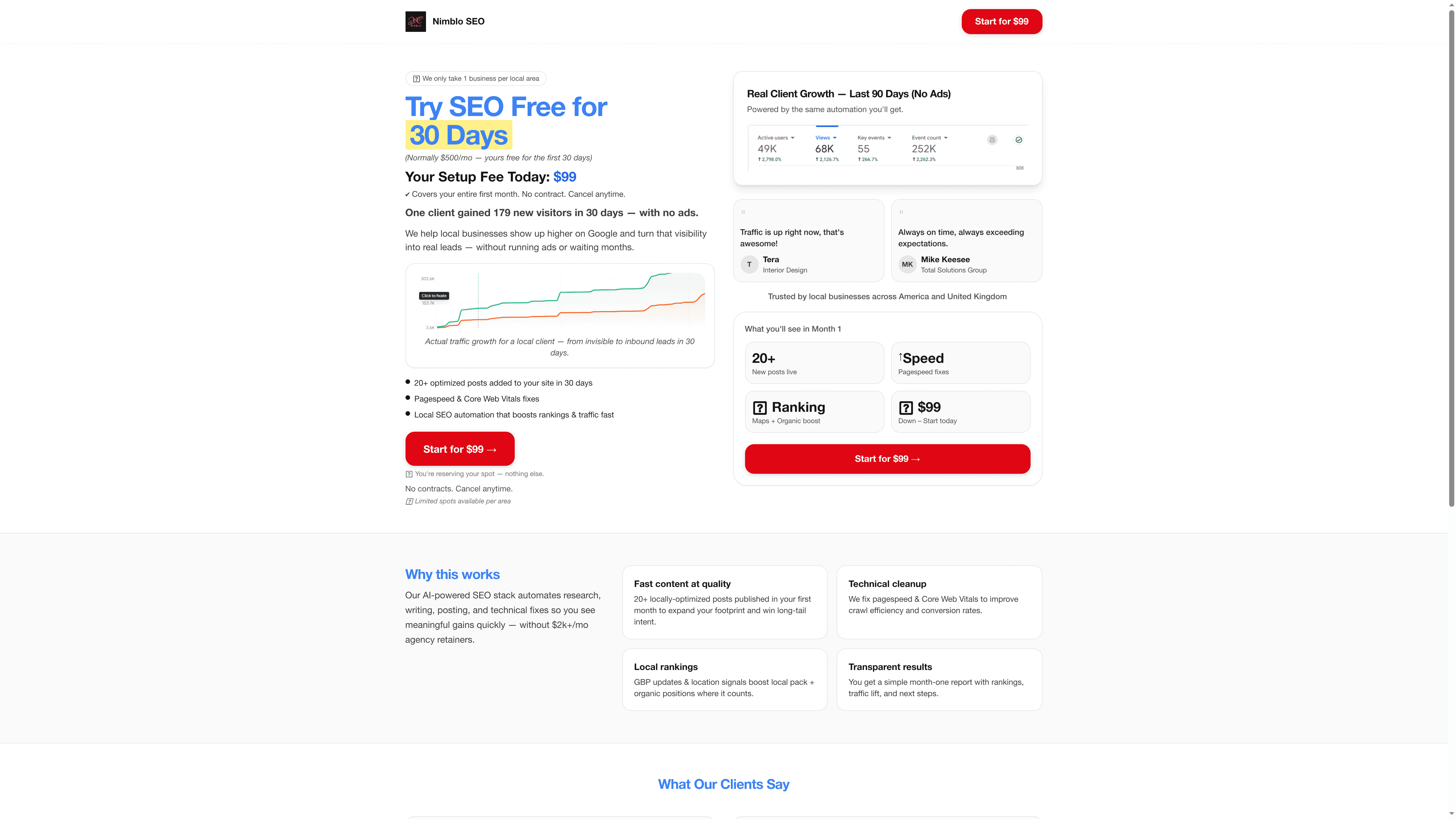
Take control today with Nimblo.ai and start your journey towards rapid local SEO success. Discover how our platform’s comprehensive features address key challenges covered in this guide by visiting Nimblo’s all-in-one SEO solution. Don’t wait until your competitors outpace you in local search results—empower your Florida business now with Nimblo’s expert tools and support.
Frequently Asked Questions
What is local SEO?
Local SEO is a digital marketing strategy focused on optimizing a business’s online presence to attract more customers from relevant local searches, improving visibility in search engine results based on geographic location.
Why is it important for small businesses to implement local SEO?
Local SEO is crucial for small businesses as it connects them with their immediate community, allowing them to compete with larger competitors and drive traffic from local customers who are likely to make offline purchases after discovering the business online.
What are the key factors for optimizing a Google Business Profile?
Key factors for optimizing a Google Business Profile include ensuring accurate business information, adding high-quality images, responding to customer reviews, regularly updating posts, and including relevant business categories and attributes.
How can schema markup benefit local businesses?
Schema markup helps search engines better understand a business’s context and content, enhancing online visibility and allowing for rich search result displays. It communicates crucial information like business type, service areas, and operating hours effectively to search engines.