
Over eighty percent of American customers use Google to find local services, yet many Florida small businesses remain buried in search results. For owners who want to be seen by more local clients, the right strategy matters. This guide reveals clear steps to help you sharpen your online presence, grow visibility on local platforms, and automate lead generation with affordable, results driven digital marketing—all tailored for service oriented businesses in Florida.
Table of Contents
- Optimize Google Business Profile for Local Visibility
- Use Location-Based Keywords in Content and Meta Tags
- Speed Up Your Website for Better User Experience
- Add Schema Markup to Enhance Search Results
- Automate Customer Follow-Ups with Local Relevance
- Generate and Manage Online Reviews Efficiently
- Track and Adjust SEO Performance with Analytics
Quick Summary
| Key Message | Explanation |
|---|---|
| 1. Optimize Your Google Business Profile | Claim and regularly update your profile for better local visibility and customer engagement. |
| 2. Use Location-Based Keywords | Incorporate specific regional terms in your website content to enhance local search rankings. |
| 3. Improve Your Website Speed | Analyze and optimize your website to load faster, retaining more visitors and boosting SEO. |
| 4. Implement Schema Markup | Use structured data to enhance search results visibility and attract more clicks from potential customers. |
| 5. Manage Online Reviews Effectively | Proactively encourage and respond to reviews to build social proof and improve customer trust. |
1. Optimize Google Business Profile for Local Visibility
Your Google Business Profile is the digital storefront for your Florida small business in local search results. By strategically optimizing this free tool, you can dramatically improve your visibility and attract more local customers.
A well-crafted Google Business Profile serves as your primary digital representation on Google Search and Maps. Google uses these profiles to determine which businesses appear in the critical local search results, making them an essential component of local SEO strategy.
Successful optimization requires comprehensive and accurate business information. Start by claiming your profile and verifying your business location. Ensure you select the most precise business category that describes your services, as this directly impacts search relevance. Include high quality photos that showcase your business environment, products, and team members. These visual elements significantly increase user engagement and profile visibility.
Regularly update your profile with current hours, contact information, and service offerings. Encourage satisfied customers to leave reviews and respond professionally to all feedback. This ongoing management signals to Google that your business is active and customer focused.
Key elements to prioritize include:
- Accurate business name, address, and phone number
- Comprehensive business description
- Relevant service and product listings
- Professional, high resolution images
- Current operational hours
- Accurate business category
Pro tip: Update your Google Business Profile at least once per month to maintain optimal local search performance and keep your information current.
2. Use Location-Based Keywords in Content and Meta Tags
Location based keywords are the secret weapon for Florida small businesses looking to dominate local search results. By strategically incorporating city and region specific terms, you can dramatically improve your website’s visibility to potential customers searching in your area.
Search engines like Google prioritize local search relevance through precise keyword metadata, which means including specific geographic identifiers can significantly boost your local search rankings. For Florida businesses, this means moving beyond generic service descriptions and embedding precise local context into your digital content.
Start by identifying keywords that combine your service or product with specific Florida locations. For example, instead of using “landscaping services,” use “Orlando landscape design” or “Tampa commercial landscaping.” These granular keywords help search engines understand your precise service area and match you with local customer searches.
Incorporate these location based keywords strategically across multiple digital touchpoints:
- Website page titles
- Meta descriptions
- Headers and subheaders
- Website content
- Image alt text
- URL structures
Important considerations: Avoid keyword stuffing. Natural, contextually relevant placement matters more than sheer quantity. Your content should read smoothly while maintaining geographic specificity.
Pro tip: Create a spreadsheet tracking location specific keywords for each service area to ensure consistent and strategic implementation across your digital marketing materials.
3. Speed Up Your Website for Better User Experience
Website speed is more than a technical detail its a critical factor in attracting and retaining potential customers for Florida small businesses. Slow loading websites can cost you valuable leads and search engine rankings.
Google’s PageSpeed Tools offer comprehensive insights into website performance optimization, demonstrating how critical loading speed is for user engagement. Research shows that websites loading within two seconds retain significantly more visitors compared to slower sites.
Improving website speed involves multiple strategic approaches. Start by analyzing your current website performance using free tools like Google PageSpeed Insights. These diagnostics provide specific recommendations for reducing load times and enhancing user experience.
Key strategies to accelerate website performance include:
- Compress and optimize image file sizes
- Minimize complex JavaScript and CSS files
- Enable browser caching
- Use content delivery networks
- Reduce server response times
- Eliminate unnecessary plugins
- Implement lazy loading for images
Each optimization incrementally improves your site’s speed and search engine ranking. Remember that mobile performance matters just as much as desktop speed. Many Florida customers will access your site through smartphones and expect rapid loading.
Pro tip: Run website speed tests monthly and treat performance optimization as an ongoing process rather than a one time fix.
4. Add Schema Markup to Enhance Search Results
Schema markup is the secret weapon for Florida small businesses looking to stand out in search results. This powerful code helps search engines understand your website content more precisely and display richer search results.
Schema.org provides a comprehensive framework for adding semantic markup that transforms how your business appears in search listings. By implementing structured data, you can create enhanced search results that attract more clicks and provide potential customers with immediate valuable information.
Schema markup works by adding specific code to your website that tells search engines exactly what your content means. For local businesses, this means you can highlight critical details like business type, location, hours, services, and customer reviews directly in search results.
Key schema markup types for Florida SMBs include:
- Local Business schema
- Service schema
- Product schema
- Review and rating schema
- Event schema
- Contact information schema
- Opening hours schema
Implementation requires adding JSON-LD structured data to your website. While this might sound technical, many WordPress plugins and online tools can help you generate the correct code without advanced programming skills.
Important: Always validate your schema markup using Google’s Structured Data Testing Tool to ensure proper implementation and avoid potential errors.
Pro tip: Test your schema markup monthly and update information regularly to maintain accuracy and maximize search engine visibility.
5. Automate Customer Follow-Ups with Local Relevance
Customer follow-ups are the heartbeat of sustainable business growth for Florida small businesses. Automated systems can transform how you engage with potential and existing customers while maintaining a personal touch.
Recent research highlights the critical balance between technological efficiency and human connection in customer relationship management. Automation allows you to reach out consistently without sacrificing the personalized experience local customers expect.
Successful automated follow-up strategies involve creating targeted workflows that respond to specific customer interactions. This might include sending personalized emails after a service inquiry, scheduling reminder texts for appointments, or sharing localized content based on customer preferences.
Key components of effective automated follow-up systems:
- Segmented customer contact lists
- Personalized messaging templates
- Triggered communications based on customer actions
- Localized content specific to Florida regions
- Timely and relevant communication windows
- Multi channel follow-up options
- Analytics to track engagement rates
For Florida small businesses, localization is critical. Your automated messages should reflect local language, reference nearby landmarks, or include region specific offers that demonstrate your understanding of the community.
Important: Always provide an easy opt out mechanism and respect customer communication preferences to maintain trust.
Pro tip: Create customer persona profiles that help you design automation workflows reflecting genuine local customer needs and communication styles.
6. Generate and Manage Online Reviews Efficiently
Online reviews are the digital word of mouth that can make or break a Florida small business. They serve as powerful social proof that influences potential customers and search engine rankings.
The U.S. Federal Trade Commission emphasizes the critical importance of authentic and trustworthy online reviews in consumer decision making processes. Potential customers rely heavily on these recommendations when choosing local services.
Efficient review management involves a proactive strategy that encourages satisfied customers to share their experiences while professionally handling all feedback. Develop a systematic approach to soliciting reviews that feels natural and genuine.
Key strategies for review generation and management:
- Create easy review submission processes
- Train staff to request reviews at optimal moments
- Respond promptly to all reviews positive and negative
- Use automated review request systems
- Monitor reviews across multiple platforms
- Share positive reviews on your website and social media
- Address negative feedback constructively
Each review represents an opportunity to demonstrate your commitment to customer satisfaction. Potential clients read between the lines looking for businesses that value their customers and take feedback seriously.
Important: Always maintain authenticity. Never purchase fake reviews or attempt to manipulate ratings artificially.
Pro tip: Set a weekly 30 minute review management session to track feedback trends and systematically respond to new reviews across different platforms.
7. Track and Adjust SEO Performance with Analytics
Analytics are the compass that guides your digital marketing strategy for Florida small businesses. Without measuring performance, you are essentially navigating your online presence blindfolded.
SEO metrics provide comprehensive insights into website performance and user engagement, allowing businesses to make data driven decisions that improve search rankings and attract more local customers.
Successful analytics tracking involves monitoring key performance indicators that reveal how potential customers interact with your online presence. Focus on metrics that directly impact your business goals such as local search rankings, website traffic, conversion rates, and user behavior.
Critical metrics to track include:
- Organic search traffic
- Keyword rankings
- Click through rates
- Bounce rates
- Time spent on website
- Conversion rates
- Geographic user distribution
- Mobile vs desktop performance
Implement tools like Google Analytics and Google Search Console to gain deep insights. These platforms offer free resources that help you understand your audience and optimize your digital strategy effectively.
Important: Review your analytics monthly and be prepared to adjust your strategy based on emerging trends and performance data.
Pro tip: Create a monthly dashboard that compares current performance against previous periods to quickly identify improvement areas and emerging opportunities.
Below is a comprehensive table summarizing the optimization strategies for small businesses discussed throughout the article.
| Optimization Strategy | Key Actions | Benefits |
|---|---|---|
| Google Business Profile | Claim and verify profile; update information regularly; include high-quality photos; manage reviews. | Improved local search visibility and customer engagement. |
| Location-Based Keywords | Use specific city names in keywords; integrate across metadata, headers, and content. | Enhanced local search relevance and website ranking. |
| Website Speed Optimization | Optimize images and code; enable caching; use CDNs; minimize server response times. | Better user experience and retention, higher search rankings. |
| Schema Markup | Implement structured data for local business, services, and reviews; validate using Google’s tools. | Enhanced search appearance with rich snippets and localized information. |
| Customer Follow-Ups | Automate messaging workflows using localized content; segment contacts and track engagement analytics. | Personalized engagement and increased customer retention rates. |
| Review Management | Encourage reviews; simplify submission process; respond to feedback constructively. | Build trust and enhance online reputation. |
| SEO Performance Tracking | Monitor metrics like traffic, bounce rates, conversion rates; use tools like Google Analytics and Search Console. | Data-driven adjustments to optimize search strategies and outcomes. |
Unlock Powerful Local SEO for Your Florida SMB Today
Navigating the challenges of local SEO, website speed, and customer engagement can feel overwhelming for Florida small and medium businesses aiming to grow their leads and outshine competitors. This article highlights the importance of optimizing your Google Business Profile, using location-based keywords, speeding up your site, and automating follow-ups to boost your local search performance and customer retention. If you want to stop juggling multiple costly tools and fragmented marketing efforts, there is a smarter way.
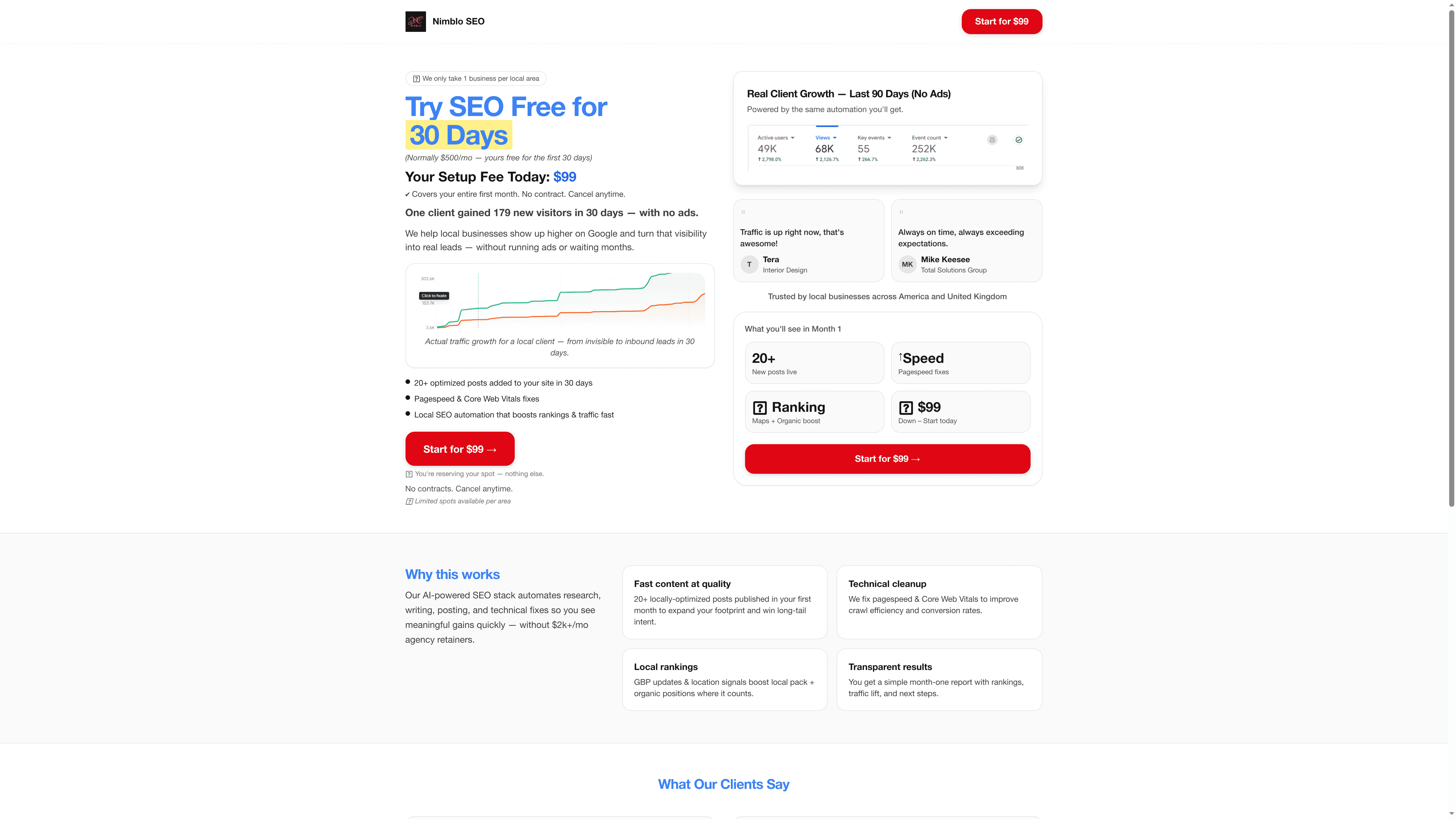
Experience the ease and effectiveness of an all-in-one platform designed specifically for Florida SMBs. Nimblo.ai offers AI-powered local SEO optimization, lightning-fast website performance, automated lead generation, and seamless Google Business Profile management to deliver measurable results. Join local businesses benefiting from expert-driven solutions that save you time and money without sacrificing quality. Ready to accelerate your Florida small business growth with a flat rate and no contracts? Visit Nimblo.ai now and turn your SEO efforts into real leads.
Frequently Asked Questions
What are the key elements to optimize my Google Business Profile for local visibility?
To optimize your Google Business Profile, ensure you have accurate business information, including your name, address, and phone number. Also, regularly update your hours and service offerings, and encourage customers to leave reviews while responding professionally to feedback.
How can I identify and incorporate location-based keywords for my Florida small business?
Identify keywords that combine your services with specific Florida locations, such as “Miami plumbing services.” Integrate these keywords naturally into your website content, page titles, and meta descriptions to enhance your search relevance.
What steps can I take to improve my website’s loading speed?
To improve your website loading speed, start by compressing image sizes and minimizing complex scripts. Regularly test your website speed and aim for a loading time of under two seconds to keep visitors engaged.
How do I implement schema markup for my website?
Implement schema markup by adding structured data code, like JSON-LD, to your site to help search engines understand your content. Focus on types like Local Business schema and validate your markup to ensure it displays correctly in search results.
What strategies can I use to generate and manage online reviews efficiently?
To generate and manage online reviews, create a simple process for customers to leave feedback and train your staff to ask for reviews after positive interactions. Respond promptly to all reviews, both good and bad, to show that you value customer input.
How do I track and adjust my SEO performance with analytics?
To track SEO performance, monitor key metrics such as organic search traffic and conversion rates using analytics tools. Review these metrics monthly and adjust your strategies based on the performance data to optimize your online presence.