
Nearly 88 percent of American small business owners report that sorting through analytics is one of their biggest digital marketing challenges. For Florida service-focused SMBs, understanding website data can make a real difference between guesswork and strategic growth. Discover how the right all-in-one SaaS solution transforms analytics into clear insights, helping you attract better leads and see measurable ROI without feeling overwhelmed.
Table of Contents
- Website Analytics Defined for SMB Owners
- Key Metrics That Drive Local Results
- Top Analytics Tools and Their Functions
- How Analytics Optimize Leads and ROI
- Avoiding Common Pitfalls With Data
Key Takeaways
| Point | Details |
|---|---|
| Website Analytics Enhance Performance | SMB owners in Florida should leverage website analytics to gain actionable insights for improved marketing and business outcomes. |
| Key Metrics Drive Growth | Focus on essential website metrics like conversion rates and bounce rates to understand customer interactions and improve local strategies. |
| Utilize Effective Tools | Employ analytics tools such as Google Analytics or Tableau to visualize data and make informed decisions based on customer behavior. |
| Avoid Common Pitfalls | Be cautious of vanity metrics and ensure data quality through systematic approaches to avoid misinterpreting analytical findings. |
Website Analytics Defined for SMB Owners
Website analytics represents the strategic process of measuring, collecting, and analyzing digital data to understand how businesses perform online. For small and medium business (SMB) owners in Florida, this approach transforms raw website data into actionable insights that can dramatically improve marketing effectiveness and bottom-line results.
At its core, website analytics goes far beyond simple traffic counting. Web analytics is the measurement, collection, analysis, and reporting of web data to understand and optimize web usage, allowing business owners to track critical performance metrics like visitor behavior, conversion rates, and engagement patterns. These insights help SMBs make informed decisions about their digital strategy, identifying what’s working and where improvements are needed.
The key components of effective website analytics typically include tracking visitor sources, understanding user navigation paths, measuring conversion rates, and analyzing demographic information. By leveraging tools that provide comprehensive data visualization, Florida SMB owners can quickly identify trends, optimize marketing campaigns, and allocate resources more strategically. Analytics transforms raw data into insights for better decision-making, enabling businesses to move beyond guesswork and implement data-driven strategies.
Pro Tip: Start by focusing on three core metrics: traffic sources, conversion rate, and average time on site to get a quick snapshot of your website’s performance.
Key Metrics That Drive Local Results
For Florida small and medium business owners, understanding website metrics is crucial to transforming digital performance and driving local growth. These data points serve as a roadmap, revealing how potential customers interact with your online presence and highlighting opportunities for strategic improvement.

Key website metrics crucial for driving local results include pageviews, average time on page, bounce rate, actions per visit, and traffic sources. By carefully tracking these indicators, SMBs can gain deep insights into customer behavior and preferences. For instance, a high bounce rate might signal that your website’s landing pages aren’t effectively capturing visitor interest, while low average time on page could indicate that your content isn’t engaging enough to hold potential customers’ attention.
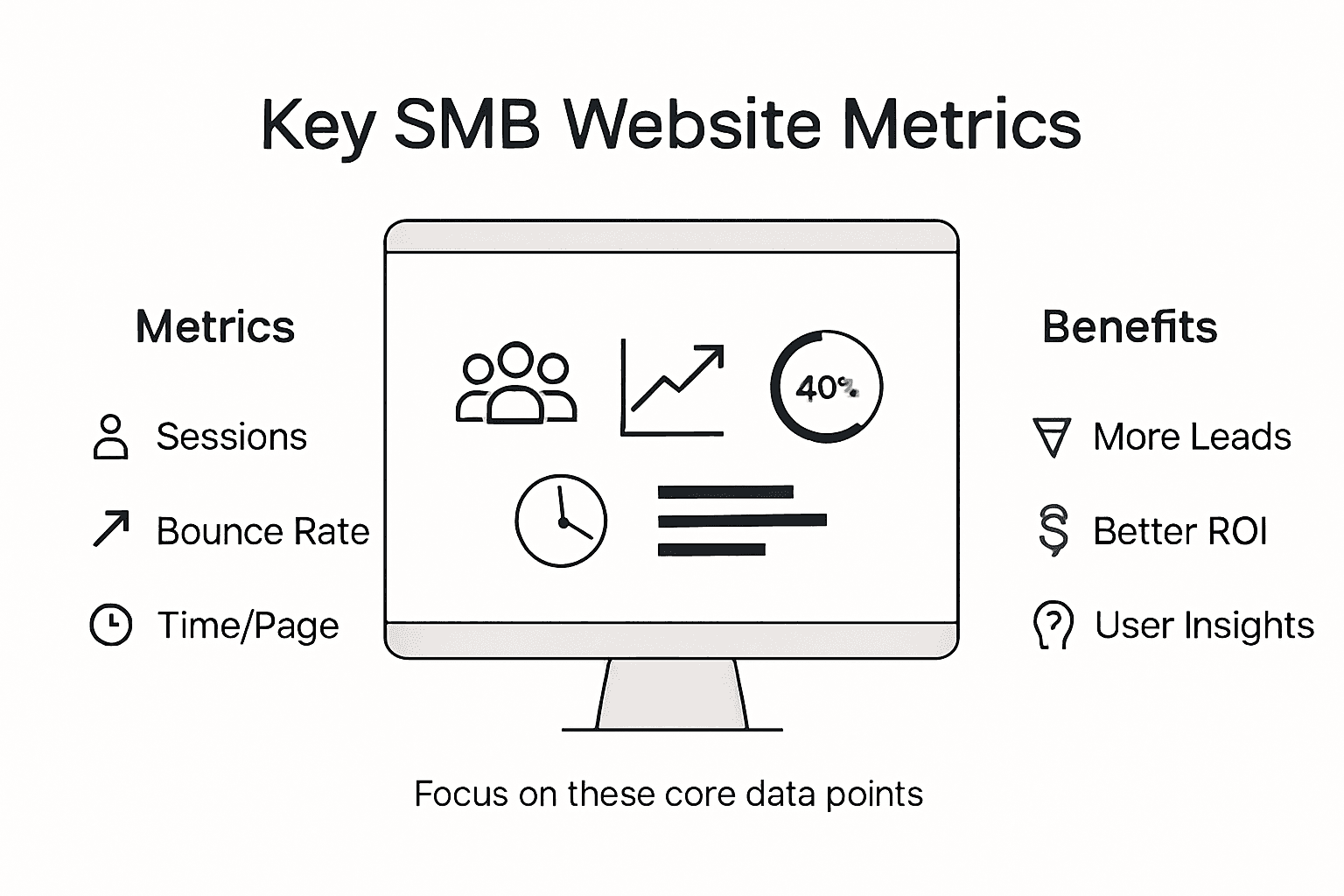
In Google Analytics, critical metrics for local business success include sessions, users, bounce rate, and average session duration. These metrics become even more powerful when combined with location-specific dimensions, allowing Florida business owners to understand precisely how local customers interact with their digital platforms. By analyzing these data points, you can refine your website design, optimize content strategy, and create more targeted marketing campaigns that resonate with your specific local audience.
Pro Tip: Set up custom dashboards in your analytics platform to track your most important local business metrics, making it easier to spot trends and make quick, data-driven decisions.
Below is a summary of critical website metrics and their strategic impact:
| Metric | What It Measures | Why It Matters |
|---|---|---|
| Bounce Rate | Users who leave quickly | Reveals landing page issues |
| Sessions | Visits to your website | Tracks engagement volume |
| Pages per Visit | Average pages viewed | Indicates content relevance |
| Conversion Rate | Actions taken per visit | Measures marketing success |
| Average Session Duration | Time spent per visit | Signals user engagement |
Top Analytics Tools and Their Functions
Florida small business owners have a growing array of powerful website analytics tools designed to transform raw data into actionable marketing insights. Understanding these platforms can mean the difference between guessing about your digital performance and making precision-driven strategic decisions.
Top analytics tools include platforms like Tableau, Microsoft Power BI, RapidMiner, and KNIME, which offer diverse functions from data visualization to predictive analytics. These sophisticated solutions enable SMBs to analyze complex datasets, uncovering hidden patterns in customer behavior and website interactions. Each tool brings unique capabilities, allowing business owners to track performance metrics, visualize trends, and predict future marketing opportunities with unprecedented accuracy.
Popular web analytics software such as Google Analytics, Matomo, and Open Web Analytics provide functions including visitor tracking, event monitoring, traffic source identification, and conversion analysis. For Florida businesses, these tools are not just technical platforms but strategic assets that decode digital audience behaviors. By integrating location-specific insights, SMBs can understand exactly how local customers interact with their online presence, enabling hyper-targeted marketing strategies that drive real business growth.
Pro Tip: Compare at least three analytics tools using their free versions before committing, ensuring you select a platform that matches your specific business reporting needs and technical comfort level.
Here’s how popular analytics tools differ in features and business value:
| Tool Name | Primary Function | Ease of Use | Business Benefit |
|---|---|---|---|
| Google Analytics | Website visitor tracking | Simple setup | Identifies user behavior patterns |
| Tableau | Data visualization | Moderate learning | Uncovers deep performance trends |
| Power BI | Dashboard reporting | Integrated with MS | Consolidates business metrics |
| RapidMiner | Predictive analytics | Advanced skills | Forecasts marketing outcomes |
| Matomo | Privacy-focused tracking | Quick deployment | Own data, enhance compliance |
How Analytics Optimize Leads and ROI
Website analytics represent a powerful strategic tool for Florida small and medium businesses to transform digital performance into measurable financial growth. By translating complex user interactions into clear, actionable insights, these platforms enable SMBs to make precision-driven decisions that directly impact bottom-line results.
Marketing analytics involves collecting and analyzing data to measure the effectiveness of campaigns and optimize return on investment (ROI). This approach allows businesses to track critical metrics like conversion rates, bounce rates, and engagement levels, providing a comprehensive view of how potential customers interact with digital platforms. By understanding these nuanced interactions, SMBs can strategically refine their marketing approaches, target high-value customer segments, and allocate resources with unprecedented efficiency.
Advanced analytics enables businesses to solve marketing challenges by integrating data-driven insights with human intuition. Through descriptive, predictive, and prescriptive models, businesses can optimize pricing strategies, personalize customer experiences, and continuously adapt to emerging market trends. For Florida SMBs, this means moving beyond traditional guesswork and implementing a dynamic, responsive marketing strategy that evolves in real time based on actual customer behavior and preferences.
Pro Tip: Set up automated monthly reports that compare your key performance indicators, allowing you to quickly identify trends and make data-driven adjustments to your marketing strategy.
Avoiding Common Pitfalls With Data
Navigating the complex world of website analytics requires more than just collecting data—it demands strategic insight and a nuanced understanding of potential missteps that can derail your digital marketing efforts. Florida small and medium business owners must develop a sophisticated approach to data interpretation to truly unlock meaningful business intelligence.
Common pitfalls in web analytics include focusing on irrelevant metrics, expecting immediate results without proper analysis, relying on a single tool, under-allocating resources to analytics, and misinterpreting data. Many SMBs fall into the trap of chasing vanity metrics that look impressive but provide little actual business value. Instead, businesses should concentrate on metrics directly tied to revenue generation, customer acquisition, and long-term growth strategies specific to their local market.
Data pitfalls encompass biased or unclear data collection, inconsistent definitions across systems, lack of data provenance, and data drift over time. Ensuring data quality requires a systematic approach that includes multiple-source integration, establishing clear data definitions, conducting regular audits, and implementing robust validation processes. For Florida SMBs, this means creating a comprehensive data management strategy that goes beyond surface-level analytics and provides truly actionable insights.
Pro Tip: Create a standardized data interpretation checklist that includes validation steps, helping your team consistently evaluate and verify analytical findings before making strategic decisions.
Unlock Your Florida SMB’s Growth Potential with Smart Website Analytics
The challenge many Florida small and medium business owners face is turning overwhelming website data into clear, actionable strategies that boost leads and maximize ROI. This article highlights crucial concepts like conversion rate, bounce rate, and local SEO insights that help make sense of digital performance. If you are looking to avoid common analytics pitfalls and want a streamlined way to track and optimize your online presence, it is time to consider an all-in-one platform designed just for your needs.
Nimblo.ai offers a powerful solution that consolidates SEO, website management, CRM, and marketing automation into a single, easy-to-use platform tailored for Florida SMBs. Enjoy AI-driven local SEO, conversion optimized websites, and automated lead generation that transform analytics insights into real growth without juggling multiple tools or agencies. Start benefiting from rapid setup, flat-rate pricing, and local support that helps you act decisively on your data.
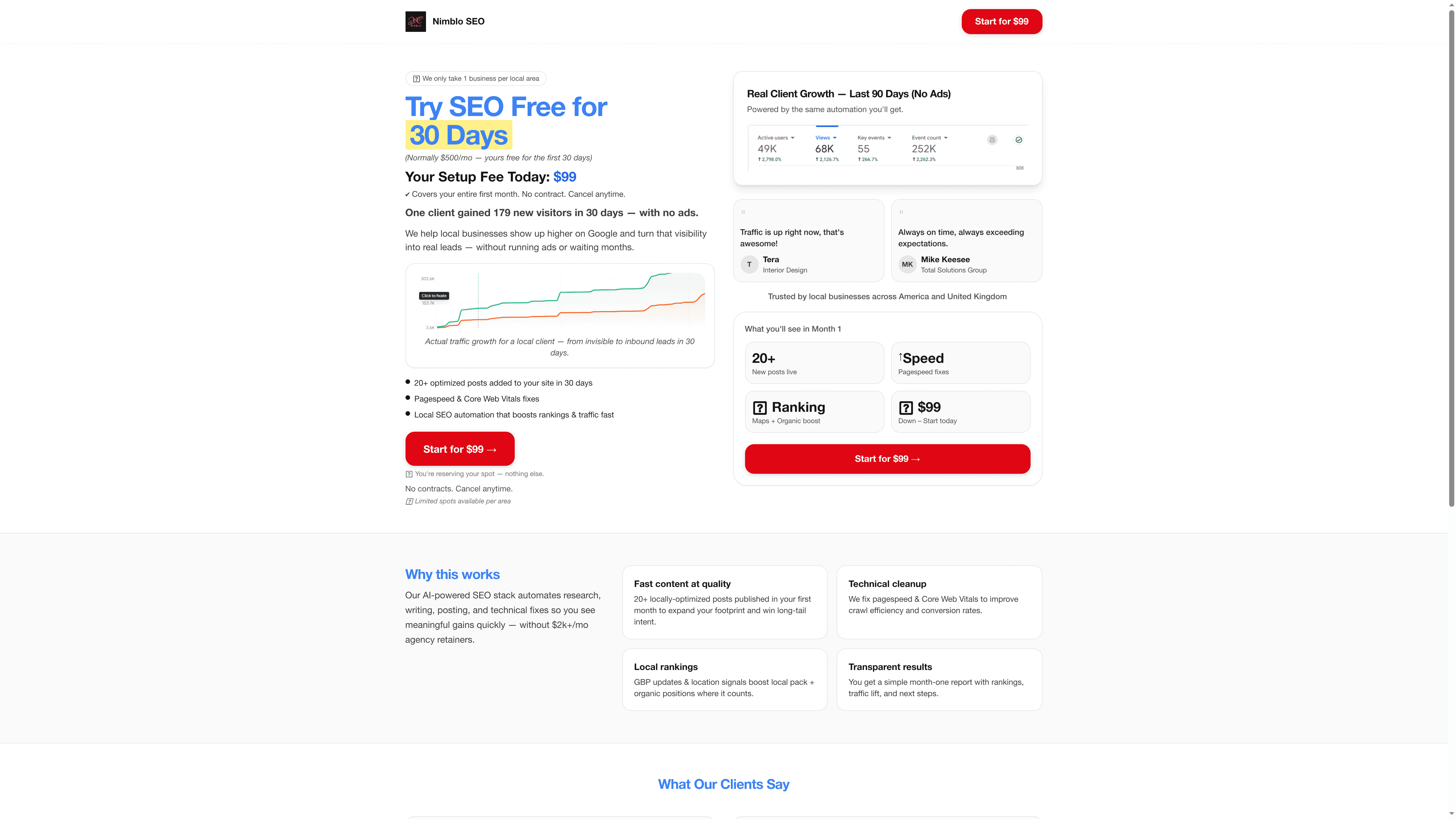
Ready to move beyond guesswork and harness the full power of website analytics for your business? Visit Nimblo.ai today to explore how our platform helps Florida SMBs boost leads through smart automation and local optimization. Learn more about our AI-powered local SEO and conversion optimized web design features that deliver measurable results fast. Don’t wait — take control of your digital marketing and watch your business grow now.
Frequently Asked Questions
What are the key metrics to track in website analytics for SMBs?
Key metrics include bounce rate, sessions, pages per visit, conversion rate, and average session duration. These metrics reveal how users interact with your website and help identify areas for improvement.
How can website analytics improve ROI for small businesses?
Website analytics provide insights into user behavior and campaign effectiveness, enabling businesses to optimize their marketing strategies, allocate resources efficiently, and ultimately enhance return on investment (ROI).
What common pitfalls should SMBs avoid when analyzing website data?
Common pitfalls include focusing on irrelevant metrics, expecting immediate results, relying solely on one tool, and misinterpreting data. It’s crucial to prioritize metrics tied to revenue and create a robust data management strategy.
How can I effectively visualize website analytics data?
Using tools like Tableau, Google Analytics, or Microsoft Power BI can help visualize website analytics data. These platforms allow you to track performance metrics and identify trends through interactive dashboards and reports.