
More than half of American small businesses find it challenging to keep up with customer follow-ups and sales opportunities. For many Florida-based owners, sorting through endless spreadsheets eats up valuable time and limits growth. Choosing the right customer relationship management system gives your team an organized way to track every lead and conversation. This guide covers what CRM really means, breaks down affordable options, and explains how the right tools can help your business deliver outstanding service without draining your budget.
Table of Contents
- Customer Relationship Management Defined For SMBs
- Types Of CRM Solutions Small Businesses Use
- Core CRM Features And How They Work
- Costs, ROI, And Implementation Insights
- Common CRM Mistakes And What To Avoid
Key Takeaways
| Point | Details |
|---|---|
| Strategic CRM Importance | CRM systems help small businesses enhance customer interactions and drive personalized engagement through data analysis. |
| Types of CRM Solutions | Operational, Analytical, and Collaborative CRMs address distinct needs, improving efficiency, insights, and communication. |
| Core Features Impact | Key features like contact management and sales pipeline tracking enable better decision-making and customer retention. |
| Implementation Considerations | Careful planning, understanding costs, and ensuring user adoption are crucial for successful CRM integration and ROI. |
Customer Relationship Management Defined for SMBs
Customer Relationship Management (CRM) represents a strategic approach that helps small businesses transform how they interact with customers, tracking and optimizing every engagement. At its core, CRM is about building stronger connections by understanding customer needs, preferences, and behaviors through systematic data collection and analysis.
For small businesses, CRM goes beyond simple contact management. Strategic CRM systems enable personalized communication and customer segmentation, allowing companies to tailor their interactions and marketing efforts with unprecedented precision. These systems typically operate across three critical dimensions: operational CRM (automating marketing and sales processes), analytical CRM (extracting meaningful insights from customer data), and collaborative CRM (facilitating information sharing across different business departments).
Most CRM platforms for SMBs offer core features designed to streamline customer interactions, including:
- Contact and lead tracking
- Sales pipeline management
- Communication history logging
- Customer interaction analytics
- Automated follow-up workflows
- Performance reporting and insights
By implementing a robust CRM strategy, small businesses can dramatically improve customer retention, increase sales efficiency, and create more personalized customer experiences that differentiate them from competitors.
Pro tip: Start with a simple CRM system that integrates easily with your existing tools and focus on consistent data entry to maximize your insights and customer relationship potential.
Types of CRM Solutions Small Businesses Use
Small businesses have diverse CRM needs, which has led to the development of three primary CRM solution types designed to address specific operational challenges. These solution categories help companies streamline customer interactions and optimize business processes through targeted technological approaches.
The three core CRM solution types include:
- Operational CRM: Focuses on automating customer-facing business processes
- Handles sales force automation
- Manages marketing campaign workflows
- Streamlines customer service interactions
- Tracks customer communication channels
- Analytical CRM: Provides deep insights into customer behavior and preferences
- Analyzes customer interaction data
- Generates performance reports
- Helps predict customer trends
- Supports strategic decision-making
- Collaborative CRM: Facilitates information sharing across departments and external partners
- Enables cross-departmental communication
- Synchronizes customer interaction data
- Improves overall customer experience coordination
- Supports integrated customer relationship strategies
Modern CRM platforms for small businesses often combine these approaches, offering scalable cloud-based solutions that adapt to changing business needs. The right CRM system can transform how small businesses manage customer relationships, turning data into a strategic advantage.
Here’s a concise comparison of CRM solution types and their unique strengths for small businesses:
| CRM Type | Primary Focus | Key Benefit |
|---|---|---|
| Operational CRM | Automate daily processes | Increased team efficiency |
| Analytical CRM | Leverage customer data | Smarter business decisions |
| Collaborative CRM | Share information seamlessly | Unified customer approach |
Pro tip: Select a CRM solution that offers flexible integration options and provides a user-friendly interface to ensure smooth adoption across your team.
Core CRM Features and How They Work
Customer Relationship Management (CRM) systems provide small businesses with a comprehensive toolkit for managing customer interactions and streamlining business processes. Core features of modern CRM platforms enable businesses to capture, track, and leverage customer data more effectively than ever before.

Key CRM features that drive business growth include:
Contact Management
- Store comprehensive customer contact information
- Track interaction history
- Segment customers by demographics, behavior, and preferences
- Create detailed customer profiles
Sales Pipeline Management
- Monitor potential sales opportunities
- Track lead progression
- Estimate conversion probabilities
- Prioritize high-potential prospects
Marketing Automation
- Design targeted email campaigns
- Personalize communication based on customer data
- Automate follow-up sequences
- Track campaign performance and engagement
Customer Support Tools
- Log and manage service requests
- Track resolution times
- Maintain comprehensive support interaction records
- Enable quick response to customer inquiries
Reporting and Analytics
- Generate performance dashboards
- Analyze customer behavior trends
- Identify sales and marketing opportunities
- Provide data-driven insights for strategic decisions
Modern CRM solutions integrate these features seamlessly, providing small businesses with powerful tools to enhance customer relationships and drive operational efficiency.
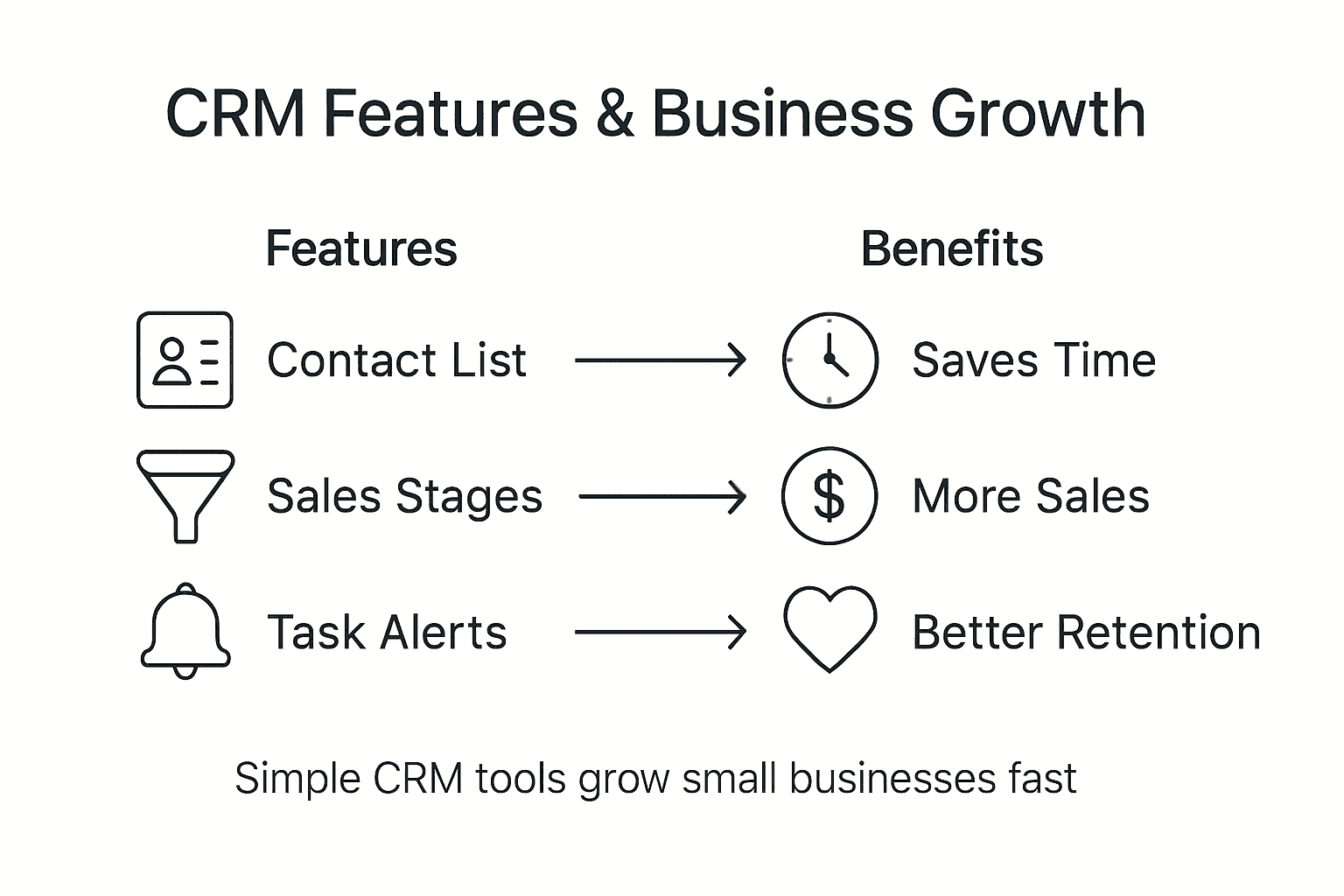
This table summarizes how core CRM features directly impact business outcomes:
| Feature | Business Impact |
|---|---|
| Contact Management | Enables deep customer understanding |
| Sales Pipeline Tracking | Improves sales forecasting |
| Marketing Automation | Increases campaign effectiveness |
| Customer Support Tools | Boosts satisfaction and retention |
| Analytics & Reporting | Drives strategic improvement |
Pro tip: Choose a CRM platform that offers mobile access and easy integration with your existing business tools to maximize productivity and user adoption.
Costs, ROI, and Implementation Insights
Implementing a Customer Relationship Management (CRM) system requires careful financial planning and strategic consideration. Successful CRM adoption involves understanding both direct and indirect costs associated with technological transformation, making it crucial for small businesses to approach implementation methodically.
CRM implementation costs typically break down into several key categories:
Direct Costs
- Software licensing fees
- Initial system configuration
- Hardware infrastructure upgrades
- Professional implementation services
Indirect Costs
- Employee training programs
- Potential productivity disruptions
- Process redesign expenses
- Change management initiatives
Return on Investment (ROI) Considerations
- Increased sales efficiency
- Improved customer retention rates
- Reduced customer acquisition costs
- Enhanced marketing campaign targeting
- Streamlined operational workflows
The most effective CRM implementations view the system as a strategic business investment rather than a mere technological tool. Aligning people, processes, and technology is critical for maximizing CRM potential and achieving meaningful business outcomes.
Small businesses should expect a strategic payback period of 6 to 12 months, with continuous improvements in customer relationship management and operational efficiency.
Pro tip: Conduct a comprehensive internal assessment of your business processes before CRM implementation to ensure maximum system customization and user adoption.
Common CRM Mistakes and What to Avoid
Navigating CRM implementation requires strategic awareness and proactive planning. Small businesses often encounter critical mistakes that can undermine their customer relationship management efforts, making it essential to understand and anticipate potential pitfalls.
Top CRM Implementation Mistakes:
- Technology Over Strategy
- Treating CRM as a software solution, not a business strategy
- Neglecting process alignment
- Focusing on features instead of outcomes
- Implementing without comprehensive planning
- Poor User Adoption
- Insufficient training programs
- Complex user interfaces
- Lack of employee engagement
- Minimal change management support
- Unrealistic Expectations
- Expecting immediate results
- Overlooking cultural transformation requirements
- Underestimating implementation complexity
- Assuming technology alone solves relationship challenges
- Misunderstanding Customer Value
- Overemphasizing customer profitability metrics
- Neglecting long-term relationship potential
- Segmenting customers solely by transaction value
- Ignoring emotional and relational aspects of customer interactions
Successful CRM implementation demands a holistic approach that balances technological capabilities with strategic human-centric relationship management. Small businesses must view CRM as an evolving ecosystem of people, processes, and technology.
Pro tip: Create a cross-functional implementation team that includes representatives from sales, marketing, and customer service to ensure comprehensive CRM strategy and user buy-in.
Unlock Growth for Your Small Business with Smarter CRM Solutions
The article highlights how crucial it is for small businesses to adopt a strategic CRM system that aligns people, processes, and technology to build stronger customer relationships and boost efficiency. Many SMBs face challenges like fragmented tools, poor user adoption, and unclear ROI when trying to implement a CRM. You want a platform that simplifies your operations with features like sales automation, marketing workflows, and insightful analytics all in one place.
Nimblo.ai specializes in helping Florida-based small and medium businesses by providing an all-in-one CRM and marketing automation platform designed to eliminate tool fragmentation and reduce costs. With Nimblo.ai’s rapid setup, AI-powered local SEO, automated lead follow-ups, and conversion-focused web design, you can finally turn your customer data into a powerful growth engine without the usual complexity or high expenses. Discover how Nimblo.ai delivers measurable improvements in lead generation and customer engagement through a platform built for your local market.
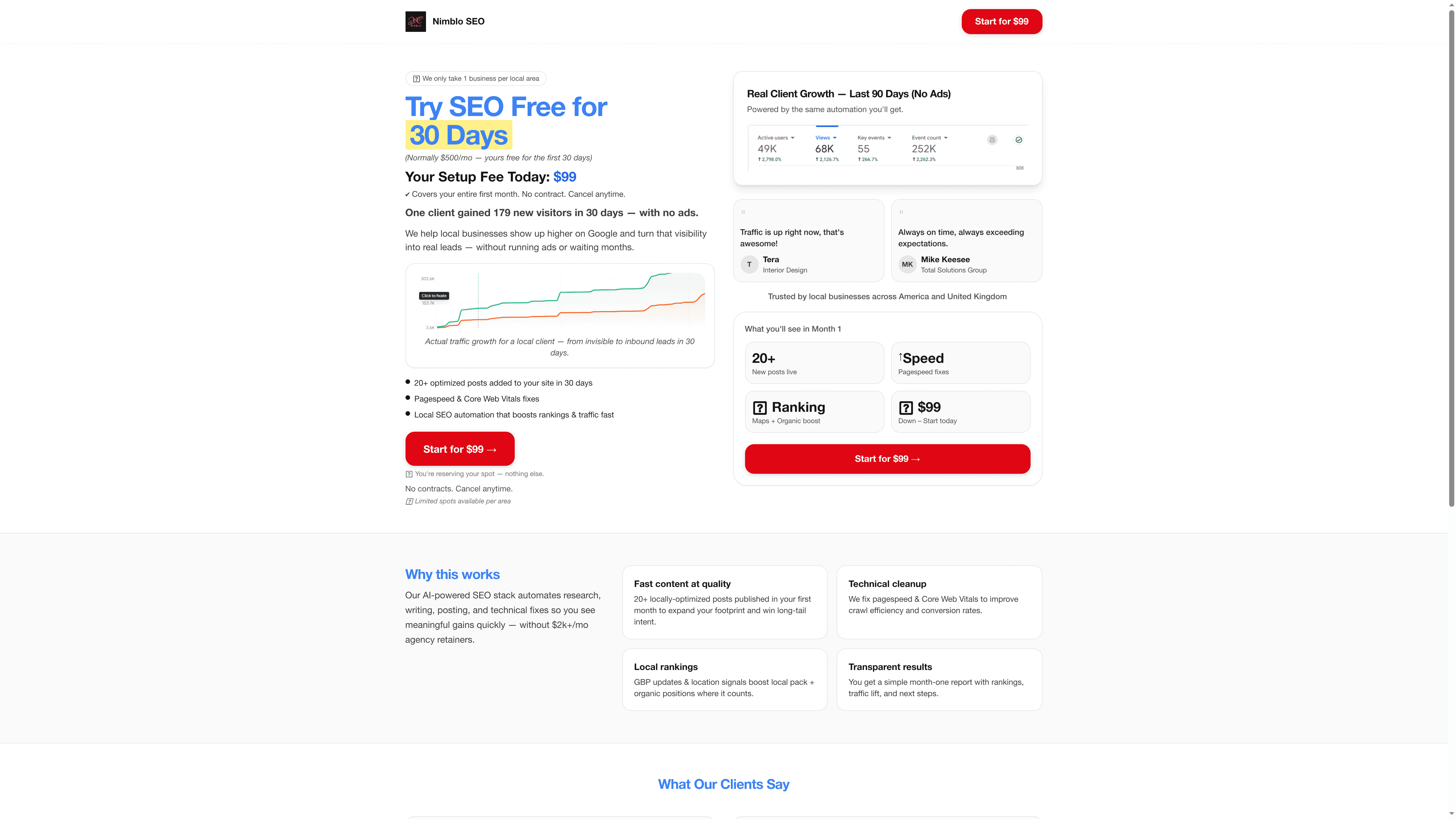
Ready to stop juggling multiple tools and start driving customer growth fast With Nimblo.ai you get a cost-effective, user-friendly CRM solution tailored to your small business needs in Florida Get started today to experience seamless digital marketing and CRM integration at a flat monthly rate with no contracts Explore more at Nimblo.ai’s all-in-one CRM & marketing platform and see how easy smart customer relationship management can be. Learn why local businesses trust Nimblo.ai for high-speed website performance and automation and take your CRM strategy to the next level.
Frequently Asked Questions
What is CRM and how does it benefit small businesses?
CRM stands for Customer Relationship Management, and it helps small businesses improve customer interactions by systematically collecting and analyzing data. Benefits include enhanced customer retention, increased sales efficiency, and the ability to create personalized experiences for customers.
What are the different types of CRM solutions available for small businesses?
There are three primary CRM types for small businesses: Operational CRM, which automates customer-facing processes; Analytical CRM, which analyzes data for insights; and Collaborative CRM, which facilitates information sharing across departments and partners.
What are the key features to look for in a CRM system?
Key features to look for include contact management, sales pipeline management, marketing automation, customer support tools, and reporting and analytics. These features enable effective tracking and management of customer relationships, leading to better business outcomes.
How can small businesses determine the ROI of their CRM investment?
To determine ROI, small businesses should consider both direct and indirect costs associated with CRM implementation, as well as benefits like increased sales efficiency, improved customer retention rates, and streamlined operations. A payback period of 6 to 12 months is common, with ongoing improvements expected over time.