
Traditional marketing agencies often demand high fees, but an integrated system can lower costs for the average American business by as much as 60 percent each month. Florida small business owners know that competing locally means more than just being seen online. With unified marketing solutions, you get better local SEO, automate daily tasks, and maintain high quality without breaking your budget. Find out how digital integration gives your Florida company an american edge in a rapidly changing market.
Table of Contents
- Defining Comprehensive Marketing Solutions For SMBs
- Types Of Marketing Solutions And Key Differences
- Core Features: Automation, SEO, And Integration
- Real-World Applications For Florida Businesses
- Cost Savings Versus Traditional Agencies
- Avoiding Common Adoption Mistakes
Key Takeaways
| Point | Details |
|---|---|
| Comprehensive Marketing Solutions | Integrated marketing strategies help SMBs enhance their online presence by utilizing tools like SEO, CRM, and automation for improved efficiency. |
| Automation and Integration | Adopting automation technologies and platform integration streamlines workflows and supports effective customer engagement. |
| Cost Efficiency | Digital marketing platforms provide significant cost savings compared to traditional agencies, while delivering comparable or superior services. |
| Avoiding Common Mistakes | Businesses should prioritize user-friendly marketing tools and comprehensive staff training to ensure effective adoption and maximize ROI. |
Defining Comprehensive Marketing Solutions for SMBs
Comprehensive marketing solutions represent strategic digital approaches designed specifically to help small and medium businesses optimize their online presence and operational effectiveness. Digital marketing tools now provide integrated capabilities that enable SMBs to compete effectively in increasingly complex digital marketplaces.
These solutions typically encompass multiple interconnected technologies and strategies targeting key business objectives. Core components often include search engine optimization (SEO), content marketing, email campaigns, website management, customer relationship management (CRM), and analytics platforms. The primary goal is creating a unified system that streamlines marketing efforts, reduces operational complexity, and generates measurable results for small businesses.
Digital marketing integration allows SMBs to achieve more sophisticated outcomes than traditional fragmented approaches. Comprehensive strategies transform how small businesses engage potential customers by providing centralized tools that track interactions, automate follow-ups, and optimize conversion pathways.
Pro tip: Select marketing solutions that offer seamless integrations and provide clear, actionable analytics to maximize your investment and track real business growth.
Types of Marketing Solutions and Key Differences
Marketing solutions for small and medium businesses span a diverse range of technological and strategic approaches designed to address specific business challenges. Research categorizes these solutions into distinctive types that serve unique organizational needs, including traditional advertising, digital marketing, marketing automation, customer relationship management (CRM) integration, and advanced data analytics platforms.
Each marketing solution type offers distinctive capabilities and strategic advantages. Traditional advertising focuses on offline channels like print, radio, and local media, while digital marketing emphasizes online presence through websites, social media, and search engine optimization. Marketing automation platforms introduce intelligent workflow management, enabling businesses to streamline repetitive tasks, segment audiences, and personalize customer interactions with minimal manual intervention.
CRM integration represents a sophisticated approach to marketing solutions, allowing businesses to centralize customer data and track interactions across multiple touchpoints. Advanced marketing analytics now enable SMBs to leverage big data for more precise customer targeting and competitive strategy development, transforming how small businesses understand and engage their market segments.
Pro tip: Evaluate marketing solutions based on your specific business goals, scalability requirements, and budget, prioritizing platforms that offer seamless integration and actionable insights.
Core Features: Automation, SEO, and Integration
Marketing solutions for small and medium businesses increasingly rely on sophisticated automation technologies that streamline complex operational workflows. Key marketing automation features enable businesses to manage customer data, execute targeted campaigns, and track performance analytics with unprecedented efficiency, transforming how companies approach digital engagement.
Search engine optimization (SEO) represents a critical component of modern marketing strategies, focusing on improving online visibility and attracting targeted web traffic. Effective SEO integrates seamlessly with automation platforms, allowing businesses to dynamically optimize content, track keyword performance, and adjust marketing strategies in real time. This integration ensures that marketing efforts are not just automated, but strategically aligned with search engine algorithms and customer search behaviors.

Platform integration emerges as a fundamental feature of advanced marketing solutions, connecting customer relationship management (CRM) systems, content management platforms, email marketing tools, and analytics dashboards into a unified ecosystem. Comprehensive digital marketing strategies now emphasize cross-platform connectivity to improve marketing efficiency and customer engagement, enabling small businesses to compete effectively with more resource-rich competitors.
Pro tip: Select marketing solutions that offer robust API capabilities and native integrations, ensuring your marketing tools communicate seamlessly and provide comprehensive insights across all business channels.
Real-World Applications for Florida Businesses
Digital marketing solutions have transformed how Florida small businesses approach customer acquisition and market expansion. Statistical data reveals specific trends in digital marketing channels used by regional small and medium enterprises, showcasing how local businesses leverage tools like social media marketing, local search optimization, and targeted digital advertising to compete effectively in Florida’s dynamic marketplace.
Restaurants, retail shops, and service providers across cities like Miami, Orlando, and Tampa are increasingly adopting integrated marketing technologies to streamline their operations. These businesses use advanced SEO strategies to improve local search visibility, implement automated email marketing campaigns to retain customers, and utilize customer relationship management systems to track and personalize interactions. By adopting comprehensive digital marketing solutions, these enterprises can create more targeted marketing approaches that resonate with their specific local audiences.
Regional digital transformation strategies demonstrate how Florida small businesses use marketing technologies to enhance competitiveness across diverse sectors. From family-owned construction companies in Jacksonville to boutique hospitality services in Key West, businesses are using data-driven marketing tools to optimize their online presence, automate customer communications, and generate more qualified leads with reduced marketing expenditures.
Pro tip: Conduct a quarterly review of your digital marketing performance metrics to identify which channels and strategies deliver the most cost-effective results for your specific Florida market segment.
Cost Savings Versus Traditional Agencies
Digital marketing solutions are fundamentally reshaping how small businesses approach marketing expenditures, offering significant cost advantages over traditional agency models. Comprehensive technology platforms demonstrate substantial cost efficiencies compared to conventional marketing retainer arrangements, enabling businesses to reduce overhead while maintaining sophisticated marketing capabilities.
Traditional marketing agencies typically charge premium rates that can range from $2,500 to $10,000 monthly, whereas integrated digital marketing platforms provide similar or superior services at a fraction of the cost. These technology-driven solutions eliminate expensive agency overhead by automating complex marketing tasks, providing real-time analytics, and enabling direct management of marketing campaigns without intermediary consultants. Small businesses can now access advanced marketing technologies that were previously available only to large corporate entities with substantial budgets.
Small businesses can achieve substantial cost reductions by leveraging automation and integrated digital marketing tools, which dramatically lower labor costs and improve operational efficiency. Automated workflows replace manual marketing processes, reducing human resource expenses while simultaneously improving marketing precision and targeting. For Florida small businesses, this translates into more predictable marketing expenditures and higher return on investment compared to traditional agency partnerships.
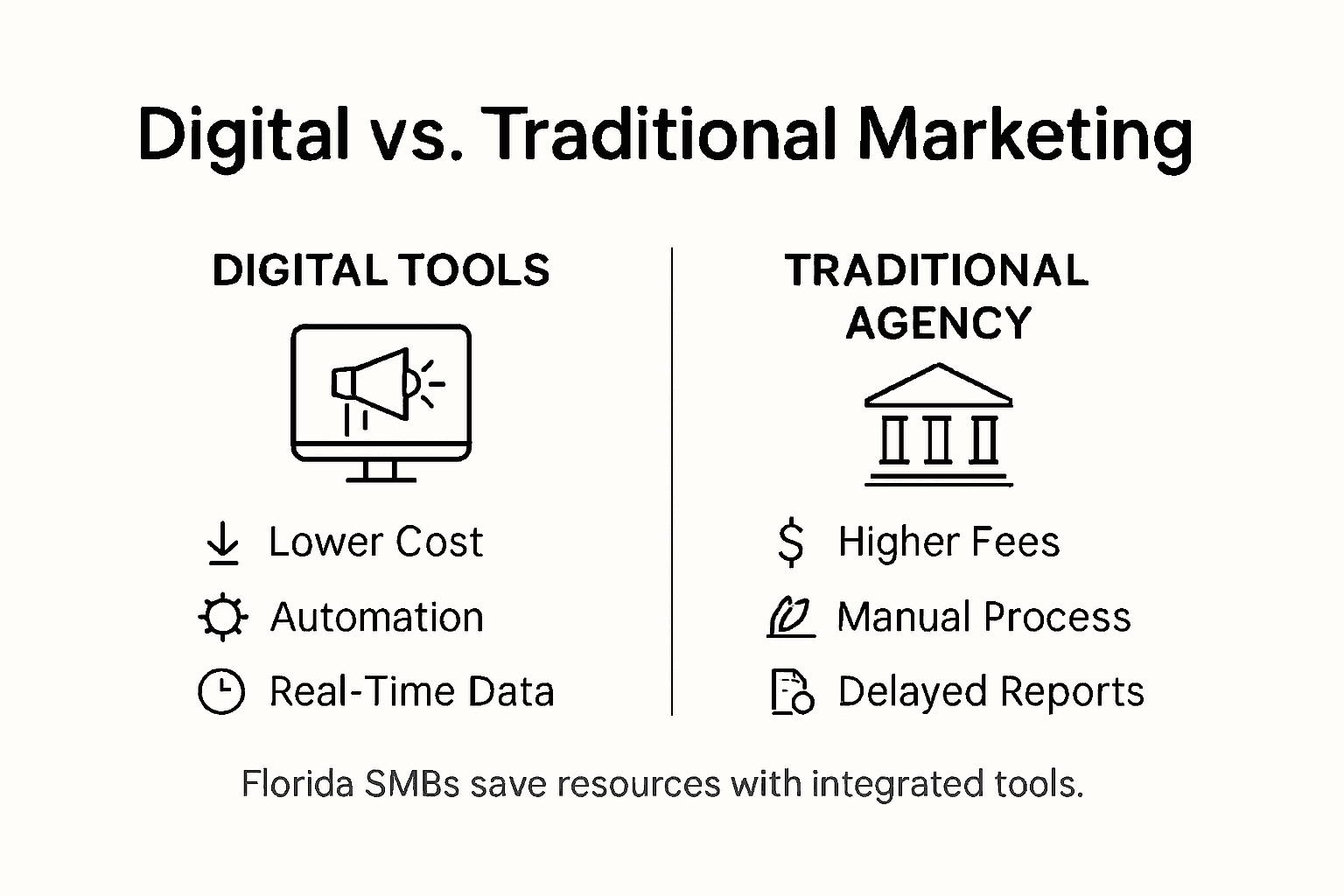
Here’s a quick comparison of traditional and integrated digital marketing for SMBs:
| Criteria | Traditional Agencies | Integrated Digital Marketing Platforms |
|---|---|---|
| Monthly Cost Range | $2,500–$10,000 | $300–$1,500 |
| Campaign Flexibility | Slower changes, fixed plans | Real-time adjustments |
| Reporting | Manual, less frequent | Automated, real-time dashboards |
| Control Over Campaigns | Agency-managed decisions | Direct business management |
| Scalability | Limited by agency resources | Platforms scale with business growth |
Pro tip: Calculate your current marketing expenses and compare them against integrated digital marketing platforms to identify potential cost savings of 40-60% while maintaining or improving marketing performance.
Avoiding Common Adoption Mistakes
Digital transformation presents significant challenges for small businesses seeking to implement marketing technologies effectively. Many SMBs encounter critical mistakes during technology adoption that can undermine their digital strategy, ranging from misaligned technology selection to inadequate organizational preparation.
One of the most prevalent errors is selecting overly complex marketing tools without considering actual business needs and team capabilities. Small businesses often invest in sophisticated platforms that promise extensive features but require significant technical expertise to implement and manage. Instead, businesses should prioritize user-friendly solutions with intuitive interfaces, robust support systems, and clear onboarding processes that enable gradual skill development and minimize technical barriers.
Successful digital marketing solution adoption requires careful evaluation of integration capabilities and comprehensive staff training, not just technological investment. Many Florida small businesses fail by treating new marketing technologies as standalone tools rather than integrated systems that require holistic implementation. Effective adoption involves understanding how different platforms communicate, ensuring data consistency, and creating standardized workflows that leverage automation while maintaining human oversight and strategic direction.
Below is a summary of common SMB adoption mistakes and recommended solutions:
| Common Mistake | Business Impact | Recommended Solution |
|---|---|---|
| Overspending on complex tools | Low usage, wasted investment | Start with user-friendly platforms |
| Lack of staff training | Poor adoption, workflow errors | Implement structured training |
| Ignoring integration requirements | Data silos, inefficient processes | Evaluate and prioritize integrations |
| No performance review cycle | Missed improvement opportunities | Schedule regular metric reviews |
Pro tip: Conduct a comprehensive skills assessment of your team before implementing new marketing technologies and develop a structured training program that matches your technology investment.
Unlock Florida SMB Growth with an All-in-One Marketing Solution
The article highlights common challenges Florida small and medium businesses face when trying to unify their digital marketing efforts—from managing complex tools to avoiding costly traditional agencies. If you are striving to boost your online presence while cutting marketing expenses, solving these pain points is critical. Key goals include integrating SEO, website management, CRM, and marketing automation into a streamlined system that delivers measurable results without overwhelming your team or budget.
Nimblo.ai answers this call by offering a single platform designed specifically for Florida SMBs. With features like AI-powered local SEO, Google Business Profile management, and automated lead generation, Nimblo.ai helps you simplify your marketing while accelerating growth. Business owners in Miami, Orlando, and Tampa who have switched to Nimblo report significant lead increases and cost savings compared to traditional agencies. The platform’s rapid setup and local expertise ensure you can start optimizing your presence immediately without steep learning curves or contract commitments.
Experience firsthand the power of streamlined marketing that delivers fast, local impact. Explore how you can take advantage of an integrated digital solution.
Elevate your marketing game today with Nimblo.ai and see the difference of a platform built for Florida SMBs.
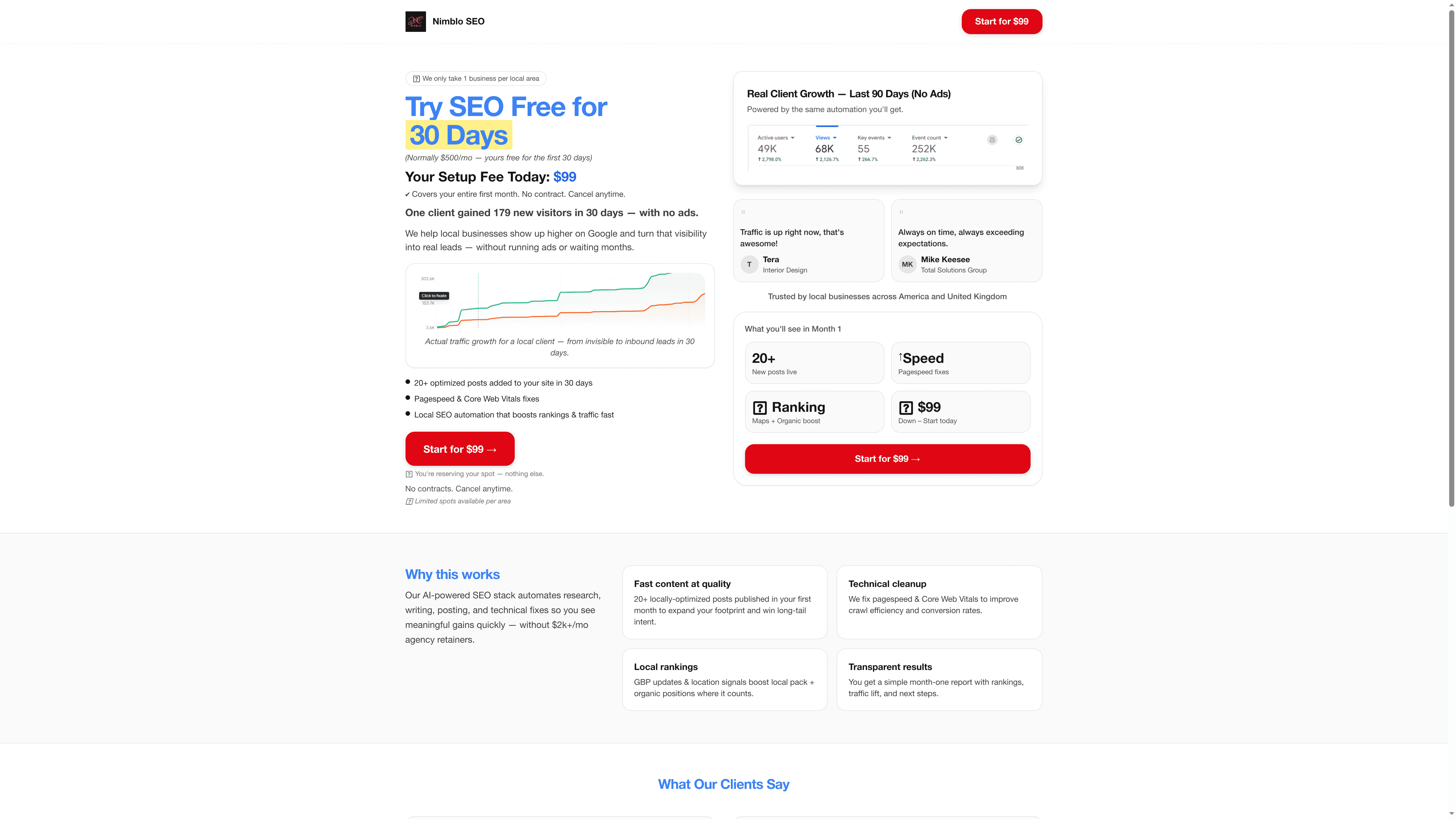
Ready to leave fragmented tools behind and drive real results? Visit Nimblo.ai’s all-in-one platform to get started now and transform your digital marketing for just $500/month with no contracts. Don’t wait to unlock better leads and smarter marketing management.
Frequently Asked Questions
What are comprehensive marketing solutions for small businesses?
Comprehensive marketing solutions are integrated digital strategies that help small and medium-sized businesses optimize their online presence, streamline marketing efforts, and achieve measurable results through technologies like SEO, content marketing, automation, and CRM.
How can marketing automation benefit small businesses?
Marketing automation helps small businesses streamline operational workflows by managing customer data, executing targeted campaigns, and providing performance analytics efficiently, allowing business owners to focus on strategy rather than repetitive tasks.
What role does SEO play in comprehensive marketing solutions?
SEO is crucial for enhancing online visibility and attracting targeted web traffic. It integrates with marketing automation platforms to ensure businesses can dynamically optimize content and adjust strategies in real time, aligning their efforts with customer search behaviors.
What common mistakes should SMBs avoid when adopting digital marketing solutions?
Common mistakes include overspending on complex tools, lack of staff training, ignoring integration requirements, and failing to conduct regular performance reviews, which can lead to inefficient processes and wasted investments.