
Running a small business means wearing every hat at once, and marketing often becomes a pile of random experiments with little to show for it. You post on social media one week, try a paid ad the next, and wonder why nothing sticks. The problem is not effort. It is the absence of a system. Small businesses with structured plans are 6.7 times more likely to succeed than those without one. This guide gives you a practical, step-by-step marketing checklist built on real benchmarks, proven tactics, and clear priorities so you can stop guessing and start growing.
Table of Contents
- Lay the groundwork: Essential pre-marketing steps
- Audit, plan, and set goals: The core checklist overview
- Comparing high-ROI tactics: Email, SEO, and content marketing
- Local advantage: Making the most of local SEO and community engagement
- Tracking results, optimizing spend, and when to get expert help
- Why focusing beats spreading thin: What most small business owners miss
- Turn your checklist into action with smart tools
- Frequently asked questions
Key Takeaways
| Point | Details |
|---|---|
| Start with a strategy | Planning and choosing the right marketing channels first greatly increases your chance of consistent growth. |
| Work the checklist | Following a step-by-step marketing process reduces wasted budget and delivers better results. |
| Local and email win | Local SEO and email marketing have the highest ROI for small budgets in 2026. |
| Track and refine | Regularly review your marketing metrics and adjust tactics each quarter for the best outcomes. |
Lay the groundwork: Essential pre-marketing steps
After understanding the importance of a structured approach, it is time to dive into the core pre-marketing steps that set up every other checklist item for success.
Before you spend a dollar or an hour on campaigns, you need a foundation. Skipping this step is the most common reason small business marketing fails. You end up promoting to the wrong people, on the wrong platforms, with a message that does not land.
Pre-marketing essentials include defining your target audience, clarifying your value proposition, building buyer personas, mapping the customer journey, choosing core channels, setting up a mobile-friendly website, adding lead capture, and configuring a basic CRM. That list sounds long, but most of it is a one-time setup that pays off for years.
Here is what to tackle first:
- Define your buyer persona. Who is your ideal customer? Age, income, job, biggest frustration, and how they search for solutions.
- Write your unique value proposition. One sentence that explains why someone should choose you over a competitor.
- Map the customer journey. Awareness, consideration, decision. Know what content or touchpoint fits each stage.
- Pick one to two marketing channels based on where your audience actually spends time. Use choosing marketing channels as a guide.
- Check your website on mobile. Over 60% of searches happen on phones. A slow or broken mobile site kills conversions.
- Set up a simple CRM. Even a free tool like HubSpot CRM helps you track leads without losing them in your inbox.
“Prioritize the foundation before tactics. Focus 80% of your budget on proven channels.”
Pro Tip: Do not try every channel at once. Focused effort on one or two platforms consistently outperforms scattered presence across five.
Audit, plan, and set goals: The core checklist overview
With your foundation in place, the next step is working through the actionable checklist for small business marketing, focusing on tasks that drive the most growth.
A marketing checklist is only useful if it is tied to real numbers. Vague goals like “get more customers” do not tell you when you are winning or losing. Here is the core checklist every small business should run through:
- Audit your digital presence. Review your website, social profiles, and search rankings. Fix broken links, outdated info, and missing contact details.
- Set SMART goals tied to revenue. Use setting SMART marketing goals to connect marketing activity to actual sales targets.
- Optimize your website and invest in content. Blogs, videos, and guides that answer your customers’ real questions build trust and traffic over time.
- Run consistent email campaigns. Even two emails per month keeps your audience warm and drives repeat purchases.
- Engage on one to two social platforms. Consistency beats volume. Show up reliably where your customers already are.
- Apply local SEO strategies. Claim your Google Business Profile, collect reviews, and use location-specific keywords.
- Track your KPIs. Conversion rate, cost per acquisition, and return on ad spend (ROAS) are your scoreboard.
According to 2026 marketing benchmarks, Google Ads median click-through rate sits at 3.2%, conversion rate at 3.8%, email open rates range from 34 to 40%, and a healthy ROAS target for small budgets is 2.5 to 3.8 times spend. Use these as decision criteria, not just trivia.
Also worth noting: 66% of small businesses spend under $1,000 per year on marketing. That is not necessarily a problem if those dollars are targeted. The businesses that outperform are the ones with written plans, not bigger budgets.
Comparing high-ROI tactics: Email, SEO, and content marketing
Now that you know the essential steps, let us compare the highest-impact marketing tactics and choose what aligns with your strengths and resources.
Not all marketing tactics are created equal. Three stand out consistently for small businesses with limited budgets and limited time.

Key tactics by ROI: email marketing returns $36 for every $1 spent, SEO returns $22 for every $1, and content marketing generates 20% more leads compared to outbound methods. These are not theoretical numbers. They reflect real campaign data across thousands of small businesses.
| Tactic | ROI | Effort level | Best for |
|---|---|---|---|
| Email marketing | $36 per $1 | Low to medium | Repeat buyers, nurture sequences |
| SEO | $22 per $1 | Medium to high | Long-term traffic, local visibility |
| Content marketing | 20% more leads | Medium | Education, discovery, trust-building |
| Paid social ads | Variable | Medium | Fast reach, promotions |
Email wins on pure ROI because it reaches people who already opted in. They know you. They trust you. A well-timed email about a sale or new service converts far better than a cold ad.
SEO, especially SEO for local businesses, builds compounding value. A blog post you write today can drive traffic for three years. Pair it with website SEO optimization and you create a traffic engine that works while you sleep.
Content marketing takes longer to show results but builds the kind of trust that paid ads cannot buy. A local bakery that publishes weekly recipes and pairs them with an email list sees repeat orders climb because customers feel connected, not just marketed to.
Pro Tip: Prioritize what you can do consistently. Two emails per month beats one per quarter every single time. Consistency signals reliability to both your audience and search engines.
Local advantage: Making the most of local SEO and community engagement
With a clear sense of your main channels, you can now maximize your impact by doubling down on local marketing techniques and authentic engagement.
Local SEO is the single biggest equalizer for small businesses competing against national chains. A well-optimized Google Business Profile can put you above a Fortune 500 company in local search results. That is a real advantage, and it costs almost nothing.
Localizing for your community reduces wasted spend, avoids channel overload, and keeps your messaging relevant to the people most likely to walk through your door or call your number.
| Strategy | Estimated cost | Expected outcome |
|---|---|---|
| Google Business Profile | Free | Higher local search visibility |
| Review generation campaign | Free to low | Improved trust and click-through |
| Local content (blog, events) | Low | Community engagement, SEO lift |
| Broad paid search ads | Medium to high | Wide reach, lower local precision |
Here is your local presence checklist:
- Claim and fully complete your Google Business Profile
- Ask every satisfied customer for a review (and respond to all reviews)
- Create content tied to local events, neighborhoods, or regional topics
- Build partnerships with complementary local businesses
- Sponsor a community event or local cause that aligns with your brand
For a deeper look at execution, the local SEO workflow and examples of local SEO resources walk through specific tactics. You can also use local search ranking tips to prioritize which optimizations move the needle fastest.
Avoid the trap of spreading yourself thin. Three well-executed local tactics beat ten mediocre ones.
Tracking results, optimizing spend, and when to get expert help
To make sure your efforts actually move the needle, you need to track, review, and optimize. Here is how to embed improvement into your process.
Marketing without measurement is just spending. The goal is to know, within 30 days, whether a tactic is working or wasting your time and money.
Small businesses typically allocate 7 to 8% of revenue to marketing. The average ad budget runs around $78,000 per year for established businesses, but most small operators work with far less. The key is not the size of the budget. It is the discipline of tracking every dollar.
Here is a simple monthly and quarterly review process:
- Pull your core metrics. Conversion rate, cost per acquisition, email open rate, and ROAS every month.
- Compare against your benchmarks. Use the numbers from Section 3 as your baseline.
- Identify your top performer. Double down on the one tactic driving the most conversions.
- Pause what is underperforming. If a channel has not shown results in 90 days, redirect that budget.
- Review your full plan quarterly. Use marketing plan frameworks to structure your quarterly review and reset priorities.
Free tools like Google Analytics, Google Search Console, and your email platform’s built-in dashboard give you most of what you need. You do not need expensive software to start.
Pro Tip: Outsource specialized tasks like video production or paid ad management if you lack the expertise. A bad paid ad campaign can burn your budget in days. A specialist pays for themselves quickly.
Why focusing beats spreading thin: What most small business owners miss
At this point, the evidence-backed tactics are clear. Here is what most owners overlook when trying to move faster.
The most common mistake is not laziness. It is ambition without focus. Owners see a new platform, a new ad format, or a new AI tool and feel pressure to jump on it immediately. The result is a scattered presence that builds nothing.
Performance marketing data consistently shows that inbound strategies, local SEO, and email outperform broad paid campaigns for small budgets. AI tools can help you scale content and automate follow-ups, but they amplify your existing strategy. They do not replace one.
In 2026, small businesses that measure and focus are consistently outperforming bigger brands on their own turf. The edge is not a bigger budget or a flashier tool. It is the discipline to review results, cut what does not work, and go deeper on what does.
New trends will always compete for your attention. Use them selectively. If a new channel or tool fits your core checklist, test it with a small budget. If it does not, ignore it until it proves itself elsewhere.
Pro Tip: Review your checklist every quarter and update it based on actual metrics, not marketing gut feel. What worked in Q1 may need adjustment by Q3.
Turn your checklist into action with smart tools
Executing your checklist is much easier when you have the right support. Here is how you can take action today.
Knowing what to do is only half the battle. The other half is building systems that make it repeatable without burning out your team. That is where automation changes everything for small businesses.
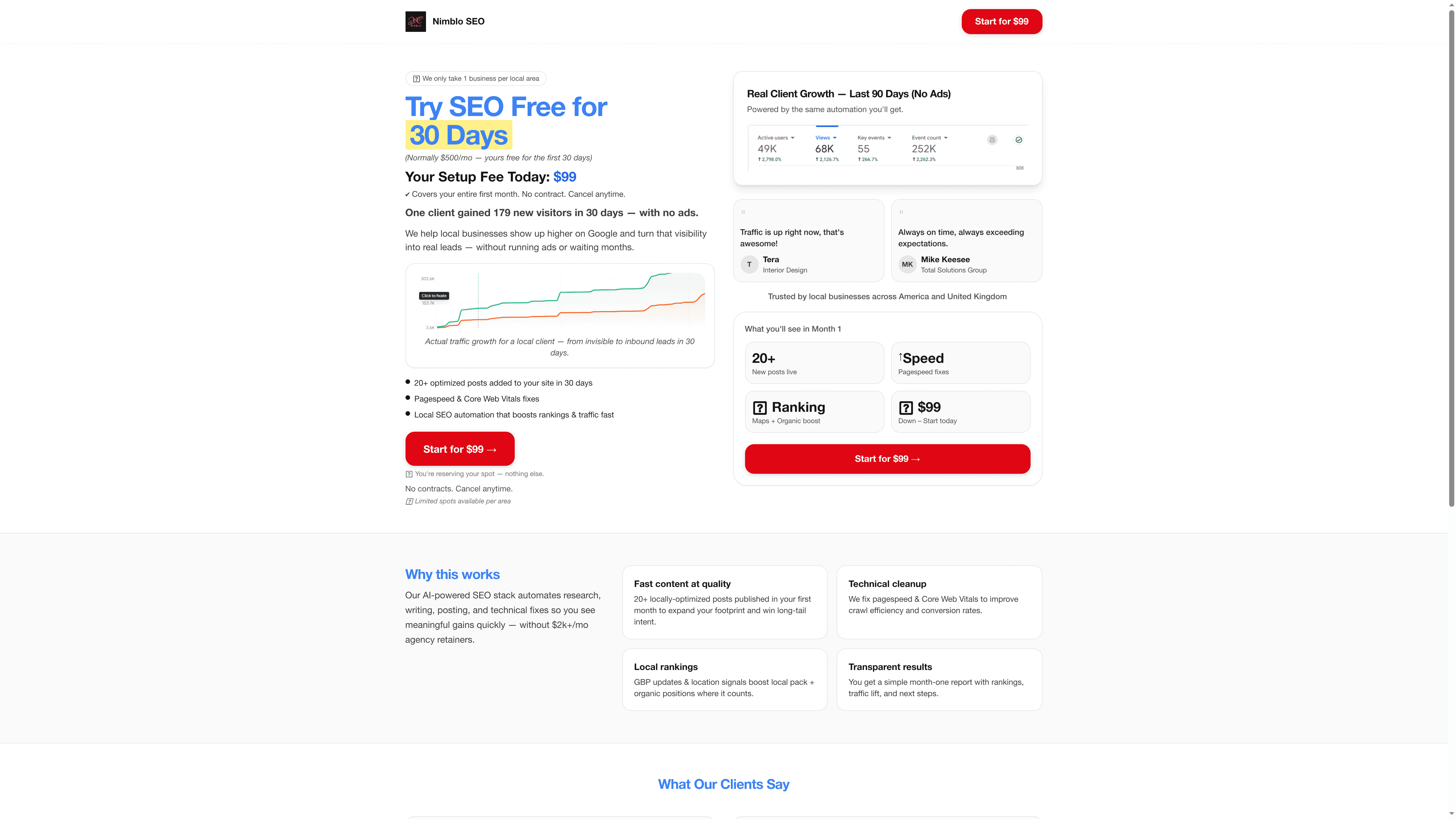
Nimblo.ai helps small and mid-sized businesses implement AI marketing tools for small business that automate the repetitive parts of your checklist, from email sequences to lead tracking to performance reporting. Instead of manually pulling metrics or chasing follow-ups, your team focuses on strategy and relationships. If you are ready to move from checklist to consistent execution, Nimblo’s automation pods are built to fit directly into your existing workflow and deliver measurable results within 120 days.
Frequently asked questions
How much should a small business spend on marketing?
Experts recommend allocating 7 to 8% of revenue to marketing, but many successful small businesses use under $1,000 per year by focusing on high-impact actions like email and local SEO.
What is the most effective marketing strategy for small businesses in 2026?
Email marketing, local SEO, and consistent content deliver the highest ROI per dollar for most industries, with email returning $36 for every $1 spent.
How often should I review or update my marketing plan?
Quarterly reviews are essential to stay agile, catch underperforming tactics early, and reallocate budget toward what is actually working.
Do I need to be on every social media channel?
No. Focus on one to two channels that match your audience’s habits. Spreading across too many channels dilutes your effort and produces weaker results than consistent presence on fewer platforms.
Recommended
- Create a Small Business Marketing Plan for Florida SMBs – Nimblo
- 7 Essential Small Business Marketing Tips for Florida SMBs – Nimblo
- 7 Cost-Effective Marketing Automation Tips for SMBs – Nimblo
- 7 Essential Steps for a Marketing Automation Checklist – Nimblo
- Small business marketing checklist for growth in 2026
- Digital Marketing Checklist for Small Business: 7 Essential Steps – Titan Blue Australia