
For many Florida business owners, juggling multiple digital marketing tools while striving for real results can feel overwhelming. Growing a service business in a competitive market demands more than just traffic—it requires actionable web conversions that drive real value. By focusing on web conversion, you unlock ways to transform curious visitors into loyal clients, streamline costs, and create a measurable impact on your bottom line.
Table of Contents
- Web Conversion Explained For Small Businesses
- Types Of Web Conversions Service Firms Track
- How Conversion Works: Setting And Measuring Goals
- Factors That Influence Conversion Rates
- Financial Impact Of Web Conversion Improvements
- Top Conversion Mistakes And How To Avoid Them
Key Takeaways
| Point | Details |
|---|---|
| Understanding Web Conversion | Web conversion is essential for small businesses, tying directly into their survival and growth in the digital marketplace. Tracking user interactions can reveal how effectively website traffic translates into business value. |
| Importance of User Experience | A seamless user experience, characterized by smooth navigation and clear calls to action, is crucial for driving conversions. Optimizing website elements can significantly enhance visitor engagement and conversion rates. |
| Diverse Conversion Types | Service firms should track multiple web conversion types to capture various user actions, enabling a comprehensive understanding of customer engagement and optimizing marketing strategies. |
| Continuous Improvement | Setting clear conversion goals and regularly analyzing performance data is vital. Businesses should adopt a process of continuous testing and optimization to adapt to changing user behaviors and market trends. |
Web conversion explained for small businesses
Web conversion represents the critical process where website visitors transform from casual browsers into active customers or leads. For small businesses, understanding web conversion is not just a marketing strategy it’s a survival mechanism in the digital marketplace. Tracking user interaction metrics reveals how effectively a website turns potential interest into tangible business outcomes.
At its core, web conversion measures the percentage of website visitors who complete a desired action such as purchasing a product, signing up for a newsletter, or requesting a consultation. These actions directly translate website traffic into measurable business value. Small businesses typically track conversion rates across multiple channels including product purchases, contact form submissions, phone calls, email signups, and software demo requests.

Successful web conversion depends on strategic user experience design that makes taking action seamless and compelling. User behavior analysis demonstrates that smooth navigation, clear value propositions, and intuitive design significantly increase the likelihood of visitors converting. Key elements that drive conversions include fast page load times, mobile responsiveness, transparent pricing, customer testimonials, and straightforward call-to-action buttons.
Pro tip: Implement heatmap tracking tools to understand exactly where visitors click and how they interact with your website, enabling data-driven design improvements.
Types of web conversions service firms track
Service firms track multiple web conversion types that reflect their unique business objectives and customer engagement strategies. Conversion marketing metrics help businesses understand how effectively their digital platforms transform website visitors into active customers or leads. These conversion measurements go far beyond simple sales transactions, encompassing a range of interactions that signal potential business growth.
The most common web conversion types service firms monitor include direct sales conversions, lead generation submissions, newsletter signups, software or resource downloads, consultation request forms, and engagement actions like whitepaper downloads or webinar registrations. Each conversion type provides insights into different stages of the customer journey, helping firms understand where potential clients are most likely to take meaningful actions. Digital marketing strategies rely on tracking these nuanced conversion points to optimize marketing spend and improve overall business performance.
Successful service firms develop sophisticated conversion tracking systems that integrate multiple data points. This approach allows them to create comprehensive performance dashboards showing how different marketing channels, content types, and user experiences contribute to their overall business goals. By understanding conversion rates across various touchpoints, businesses can make data-driven decisions about where to invest their marketing resources and how to refine their digital strategies for maximum impact.
Pro tip: Create a conversion tracking spreadsheet that maps each web conversion type against its specific business value to prioritize and optimize your digital marketing efforts.
Here’s a summary of common web conversion types and their typical business value for service firms:
| Conversion Type | Example Action | Business Value |
|---|---|---|
| Direct Sales | Purchase completion | Immediate revenue generation |
| Lead Generation | Contact form submission | Builds sales pipeline |
| Newsletter Signup | Email registration | Nurtures ongoing relationships |
| Resource Download | Whitepaper or ebook download | Qualifies interested prospects |
| Consultation Request | Booking a meeting | Opportunity for personalized pitch |
| Webinar Registration | Signup for online event | Drives engagement and education |
How conversion works: Setting and measuring goals
Web conversion fundamentally begins with establishing clear, strategic goals that directly align with a business’s core objectives. Conversion rate calculation requires businesses to define specific, measurable actions that represent meaningful customer interactions. These goals might range from product purchases and lead form submissions to newsletter signups and consultation requests, each representing a distinct milestone in the customer journey.
Measuring conversion effectiveness involves a systematic approach of tracking and analyzing user behavior across multiple digital touchpoints. Businesses calculate conversion rates by dividing the number of completed desired actions by the total number of website visitors, providing a quantitative metric of performance. Conversion-centered design principles recommend using visual cues, clear navigation, and strategic page elements that guide users toward taking specific actions, making the conversion path as intuitive and frictionless as possible.
Successful conversion goal setting requires a nuanced understanding of customer behavior and continuous iteration. Businesses should establish baseline metrics, implement tracking tools, and regularly analyze conversion data to identify potential improvements. This might involve A/B testing different website designs, refining call-to-action placements, or adjusting messaging to better resonate with target audiences. The most effective conversion strategies treat goal measurement as an ongoing process of learning and optimization, constantly adapting to changing user preferences and market dynamics.
Pro tip: Create a conversion tracking dashboard that displays real-time metrics, allowing you to quickly identify and respond to changes in user behavior and conversion performance.
Factors that influence conversion rates
Website design and user experience sit at the core of conversion rate success. User experience research demonstrates that multiple interconnected factors determine whether visitors will complete desired actions. The most critical elements include website loading speed, mobile responsiveness, intuitive navigation, clear value propositions, and strategically placed call-to-action buttons that guide users through a seamless interaction journey.
Visual design plays a pivotal role in conversion effectiveness. Conversion-centered design principles emphasize the importance of visual hierarchy, color contrast, and strategic placement of persuasive elements. Key conversion influencers include social proof indicators like customer testimonials, trust badges, clear pricing information, and compelling headlines that immediately communicate unique value propositions. The psychological aspects of design can significantly impact a visitor’s decision to take action.
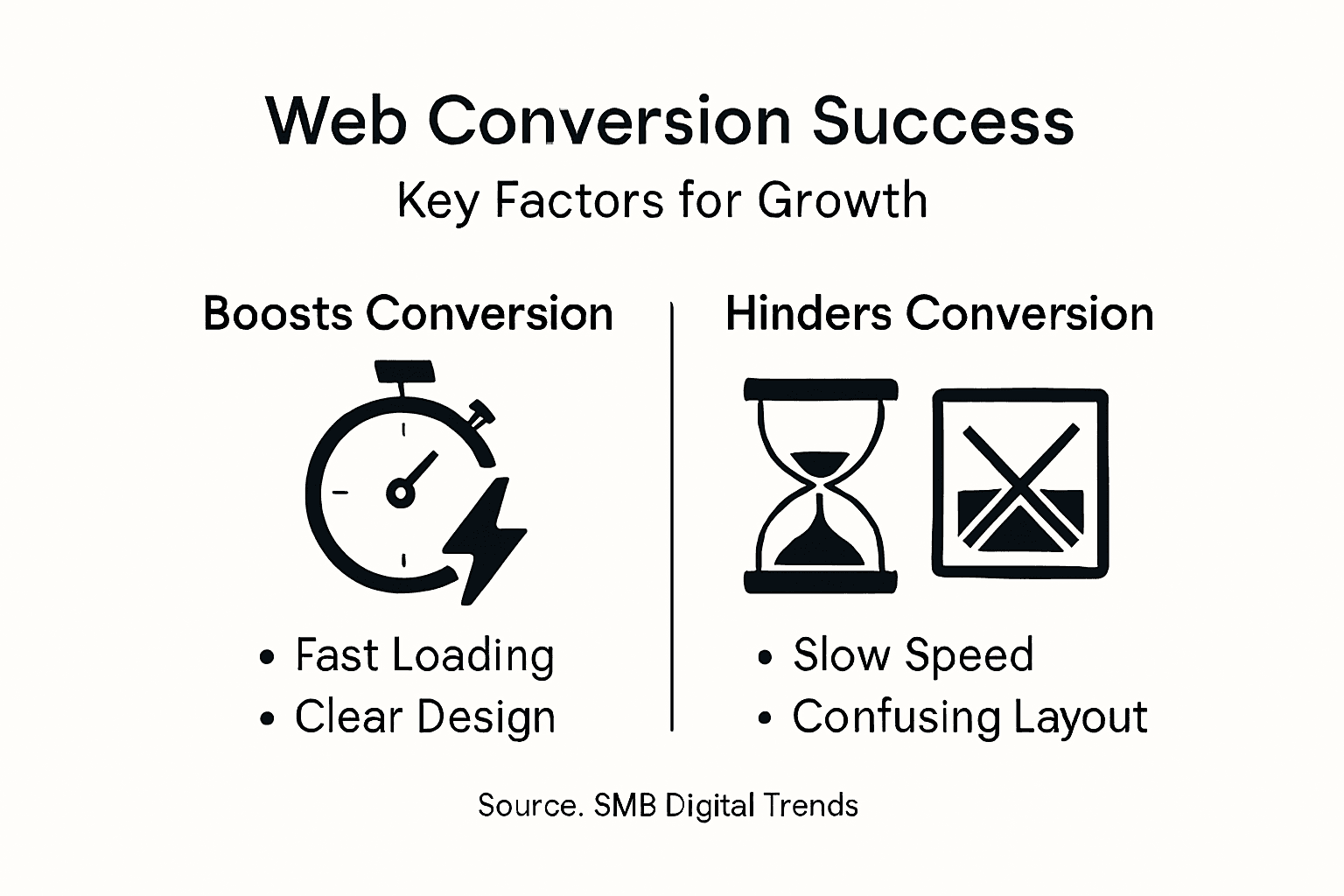
Technical performance and content relevance are equally crucial conversion factors. Websites must load quickly across all devices, provide mobile-friendly experiences, and deliver content that directly addresses user needs and pain points. Businesses should focus on creating transparent, easy-to-understand messaging that reduces friction in the conversion process. This involves minimizing form fields, offering multiple contact options, providing clear next steps, and ensuring that each page element supports the ultimate conversion goal.
Pro tip: Conduct monthly conversion rate audits by analyzing user behavior recordings and heatmaps to identify and eliminate potential barriers in your website’s conversion path.
The following table contrasts factors that boost vs. hinder web conversion rates for small businesses:
| Influencing Factor | Boosts Conversion | Hinders Conversion |
|---|---|---|
| Page Load Speed | Faster than 2 seconds | Slow loading times |
| Mobile Design | Responsive layout | Desktop-only design |
| Navigation | Simple and intuitive | Complex or hidden menus |
| Value Proposition | Clear and visible | Vague or confusing message |
| Call-to-Action | Prominent and direct | Weak or poorly placed |
| Trust Signals | Testimonials and badges | No social proof present |
Financial impact of web conversion improvements
Web conversion improvements represent a direct pathway to substantial financial growth for small businesses. Digital transformation strategies demonstrate that businesses investing in online conversion optimization can potentially double their revenue compared to those with static digital approaches. These improvements translate into tangible financial benefits by reducing customer acquisition costs, increasing sales efficiency, and expanding market reach without proportional increases in marketing expenditure.
The financial impact of enhanced web conversions extends beyond immediate revenue gains. Small businesses can experience significant cost reductions by streamlining their digital marketing processes, automating lead generation, and creating more targeted customer interactions. Online presence optimization enables businesses to capture more qualified leads with lower marketing spend, effectively improving their return on investment and creating a more sustainable growth model.
Quantifiable financial benefits emerge from strategic conversion improvements. Businesses can expect reduced customer acquisition costs, higher average transaction values, increased customer retention rates, and more predictable revenue streams. By implementing data-driven conversion optimization techniques, small businesses can transform their websites from passive information platforms into active revenue generation tools. The cumulative effect of these improvements can result in significant long-term financial advantages that compound over time.
Pro tip: Calculate your current conversion rate baseline and set incremental improvement targets, tracking the direct financial impact of each percentage point increase in website conversions.
Top conversion mistakes and how to avoid them
Many small businesses unknowingly sabotage their web conversion potential by making critical design and communication errors. Conversion rate optimization reveals that common mistakes often stem from overcomplicated website designs, unclear messaging, and neglecting user experience principles. These errors can dramatically reduce the likelihood of visitors taking desired actions, ultimately hindering business growth.
Technical and strategic mistakes frequently undermine conversion effectiveness. Slow website loading speeds, non-responsive mobile designs, excessive form fields, and weak call-to-action buttons create unnecessary friction in the customer journey. Digital presence challenges demonstrate that businesses often lack the resources or knowledge to create streamlined, user-friendly digital experiences. Key mistakes include inconsistent branding, hidden contact information, complex navigation structures, and failure to address customer pain points directly and transparently.
Avoiding conversion mistakes requires a systematic approach focused on continuous improvement and user-centric design. Businesses should prioritize simplifying website navigation, creating clear and compelling value propositions, implementing responsive design, reducing form complexity, and using persuasive visual elements that guide users toward desired actions. Regular user testing, heat mapping, and conversion rate analysis can help identify and eliminate barriers that prevent potential customers from completing conversions.
Pro tip: Conduct quarterly user experience audits using screen recording and heatmap tools to identify and eliminate conversion barriers in real-time.
Unlock Your SMB’s Growth Potential with Streamlined Web Conversion Solutions
Small and medium businesses in Florida face unique challenges turning website visitors into loyal customers. This article highlights common pain points such as slow page loads, complicated user journeys, and ineffective lead tracking — all factors that hinder your conversion rates and stall growth. You want clear value propositions, fast local SEO, and automated lead generation that doesn’t drain your budget or require juggling multiple tools. Nimblo.ai understands these hurdles and offers an all-in-one platform built exactly for your needs.
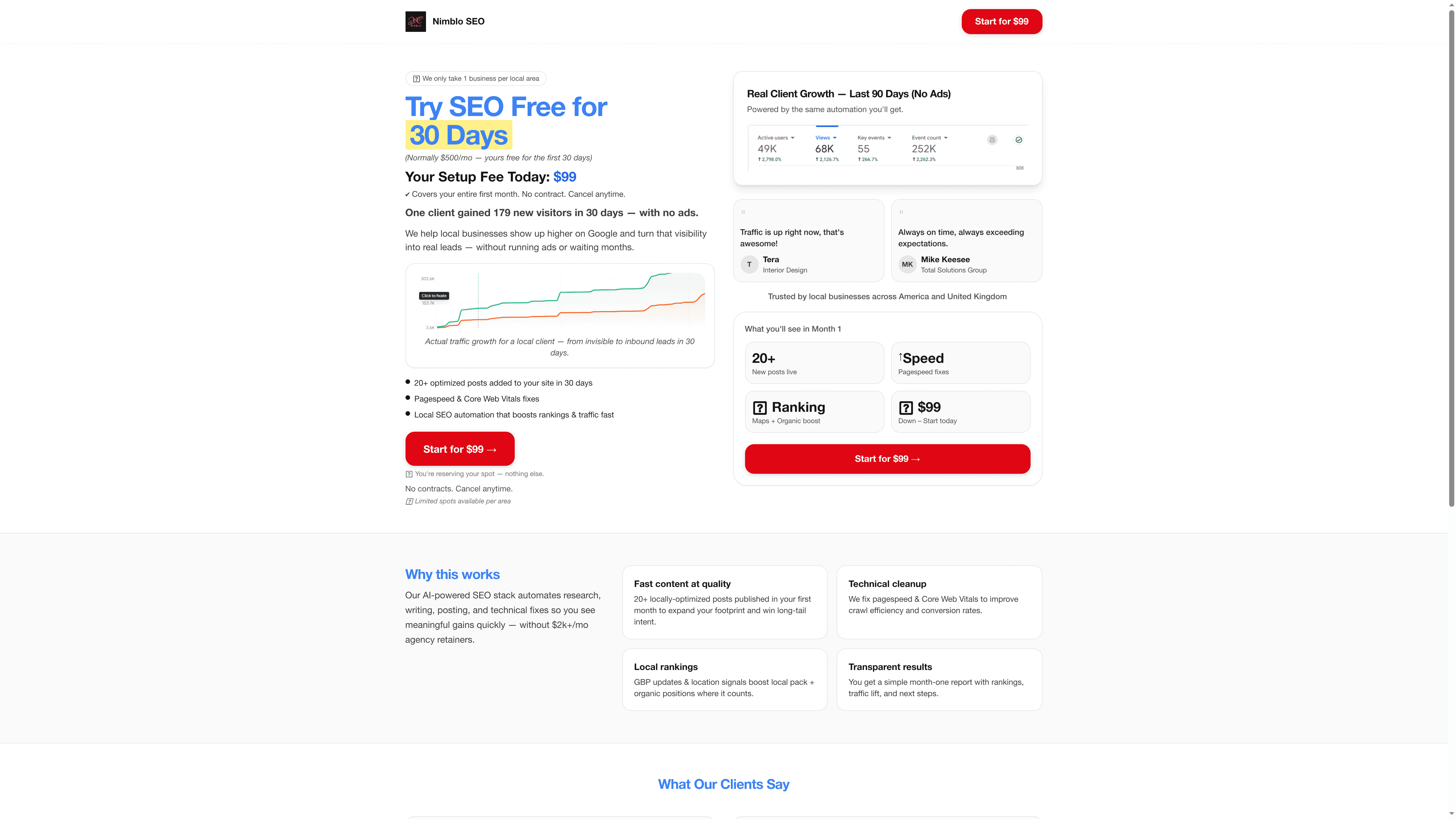
Experience rapid setup combined with AI-powered local SEO and high-speed website performance tailored for Florida SMBs. Our conversion-optimized design and automation tools simplify follow-ups and help you track every lead effortlessly. Stop wasting resources on disconnected services and start maximizing your return on marketing investment today. See why local businesses trust Nimblo.ai’s flat-rate platform as a smart alternative to costly agencies and fragmented tech stacks. Visit this page to get started now and turn your website into a powerful growth engine.
Frequently Asked Questions
What is web conversion and why is it important for small businesses?
Web conversion refers to the process where website visitors become active customers or leads by completing desired actions. It’s crucial for small businesses as it translates traffic into measurable business value, impacting overall growth and revenue.
How can small businesses improve their web conversion rates?
Small businesses can enhance web conversion rates by optimizing website design for user experience, speeding up page load times, ensuring mobile responsiveness, and creating clear calls-to-action that guide users toward important actions like purchases or sign-ups.
What are the most common types of web conversions that service firms track?
Service firms track a range of conversion types, including direct sales, lead generation submissions, newsletter signups, resource downloads, consultation requests, and webinar registrations. Each of these metrics provides insight into different stages of the customer journey.
How do businesses measure their conversion rates effectively?
Businesses measure conversion rates by dividing the number of desired actions completed (like purchases or sign-ups) by the total number of website visitors. This provides a quantifiable metric to assess performance and identify areas for improvement.