
Most American small business owners are surprised to learn that nearly 40 percent of customers leave a website if it loads too slowly. In Florida, competition for online visibility grows every month, making every detail on your website count. Discover how clear business goals, strategic platform choices, and local SEO practices can help service-based SMBs cut costs and attract more leads with practical steps any American entrepreneur can apply today.
Table of Contents
- Step 1: Define Business Goals And Audience Needs
- Step 2: Choose A High-Speed Website Platform
- Step 3: Implement Conversion-Driven Site Structure
- Step 4: Optimize For Local Seo And Mobile Devices
- Step 5: Verify Site Performance And Lead Capture
Quick Summary
| Essential Insight | Clarification |
|---|---|
| 1. Define Clear Goals | Establish specific, measurable business objectives to align with audience needs for optimal website design effectiveness. |
| 2. Select a Fast Platform | Choose a website platform that ensures speed and reliability to enhance user experience and retain customers. |
| 3. Optimize Site Structure | Create a conversion-focused site design with clear navigation and strong calls-to-action to guide users toward desired actions. |
| 4. Enhance Local SEO | Optimize local search visibility with accurate business profiles and location-specific keywords to attract nearby customers. |
| 5. Monitor Performance Regularly | Continuously track key metrics like load speed and conversion rates to identify areas for improvement and ensure lead capture success. |
Step 1: Define business goals and audience needs
Successfully building an effective website starts with crystal clear business goals and a deep understanding of your target audience. By mapping out precise objectives and audience insights, you create a strategic foundation that drives website design decisions and ensures your online presence resonates with potential customers.
Begin by conducting a comprehensive audience analysis that goes beyond basic demographics. Analyze target audience characteristics through multiple lenses: age, income, professional roles, challenges, and online behaviors. Create 3-4 detailed user personas representing your primary customer segments. Each persona should include specific details like professional motivations, pain points, preferred communication channels, and typical online interactions.
Next, translate those audience insights into specific business objectives. Your goals should be specific, measurable, and directly connected to your audience needs. For instance, if you serve small business owners seeking digital marketing solutions, your goals might include generating qualified leads, reducing customer acquisition costs, or improving conversion rates. Design briefs help align these objectives by providing a clear roadmap for how your website will meet both user expectations and business targets.
Pro tip: Revisit and refine your audience personas and business goals quarterly to ensure your website remains strategically aligned with evolving market dynamics and customer preferences.
Step 2: Choose a high-speed website platform
Selecting the right website platform is critical for small business success in the digital marketplace. Your platform determines website performance, user experience, and ultimately your ability to attract and retain customers.
When evaluating website platforms, prioritize speed and reliability. Website deployment strategies require careful consideration of technical requirements and traffic demands. Look for platforms offering robust hosting, fast loading times, mobile responsiveness, and scalability. Cloud-based solutions often provide superior performance for small businesses, allowing you to manage resources efficiently without significant upfront infrastructure investments.
Consider key factors like hosting speed, security features, ease of management, and integration capabilities. Some platforms specialize in specific industries or business sizes, so research options that align with your unique needs. Cloud storage platforms can offer cost effective solutions with excellent performance metrics for small to medium businesses seeking professional online presence.
Here’s a summary of how each website platform feature can affect small business outcomes:
| Platform Feature | Impact on User Experience | Business Benefit |
|---|---|---|
| Hosting Speed | Fast page loads, minimal wait | Lower bounce rates, better SEO |
| Security Features | Safe browsing environment | Protects customer data, builds trust |
| Ease of Management | Quick updates, reduced errors | Lower maintenance costs |
| Integration Options | Seamless business workflows | Enables automation, expands reach |
Pro tip: Test potential website platforms using performance benchmarking tools and request free trials to ensure they meet your specific speed and functionality requirements.
Step 3: Implement conversion-driven site structure
Creating a website that transforms visitors into customers requires strategic planning and intentional design. Your site structure plays a critical role in guiding potential customers through a seamless journey that ultimately leads to conversions.

Semantic HTML document structuring provides the foundation for an effective conversion-focused website. Start by organizing your content with clear, logical navigation that helps users find information quickly. Place critical information like value propositions, key services, and contact details in prominent locations. Your homepage should immediately communicate who you are and what problems you solve for your customers. Implement clear call-to-action buttons that stand out visually and guide users toward desired actions like scheduling consultations, requesting quotes, or making purchases.
Each page should have a singular focus and a direct path to conversion. Minimize distractions, use whitespace effectively, and create visual hierarchies that draw attention to the most important elements. Ensure your site structure supports mobile responsiveness, as many customers will access your website through smartphones. Test your navigation flow regularly and use analytics to understand how users interact with your site and where they might drop off in the conversion process.
Pro tip: Conduct user testing and analyze heat maps to continuously refine your site structure and optimize conversion pathways.
Step 4: Optimize for local SEO and mobile devices
Successful small businesses understand that online visibility starts with strategic local search optimization and seamless mobile experiences. Your website must not only attract potential customers but also provide an effortless interaction across all devices and local search platforms.
Local search engine optimization requires targeted strategies that help your business stand out in geographic-specific search results. Start by claiming and optimizing your Google Business Profile with accurate business details, high-quality images, and consistent contact information. Incorporate location-specific keywords naturally throughout your website content, ensuring you mention your city, neighborhood, and service areas. Use schema markup to help search engines understand your local business context and improve your chances of appearing in map listings and local pack results.
Mobile optimization goes beyond responsive design. Follow mobile web best practices by creating fast loading pages, using readable font sizes, and ensuring touch friendly navigation elements. Compress images, minimize javascript, and implement accelerated mobile pages (AMP) to improve site speed. Your mobile site should provide the same comprehensive information as your desktop version while maintaining intuitive navigation and clear call to action buttons.
Pro tip: Regularly use Google’s Mobile Friendly Test and PageSpeed Insights to continuously monitor and improve your website’s mobile performance and local search rankings.
Step 5: Verify site performance and lead capture
Successful websites demand continuous monitoring and optimization to ensure they effectively attract and convert potential customers. Your goal is to create a seamless digital experience that captures leads while delivering exceptional performance.
Website performance monitoring requires systematic tracking of critical metrics that reveal how users interact with your site. Implement comprehensive analytics tools to measure key performance indicators like page load speed, bounce rates, conversion rates, and user engagement. Track which pages generate the most leads and identify potential bottlenecks in your conversion funnel. Pay special attention to form submission rates, click through rates on call to action buttons, and time spent on key landing pages.
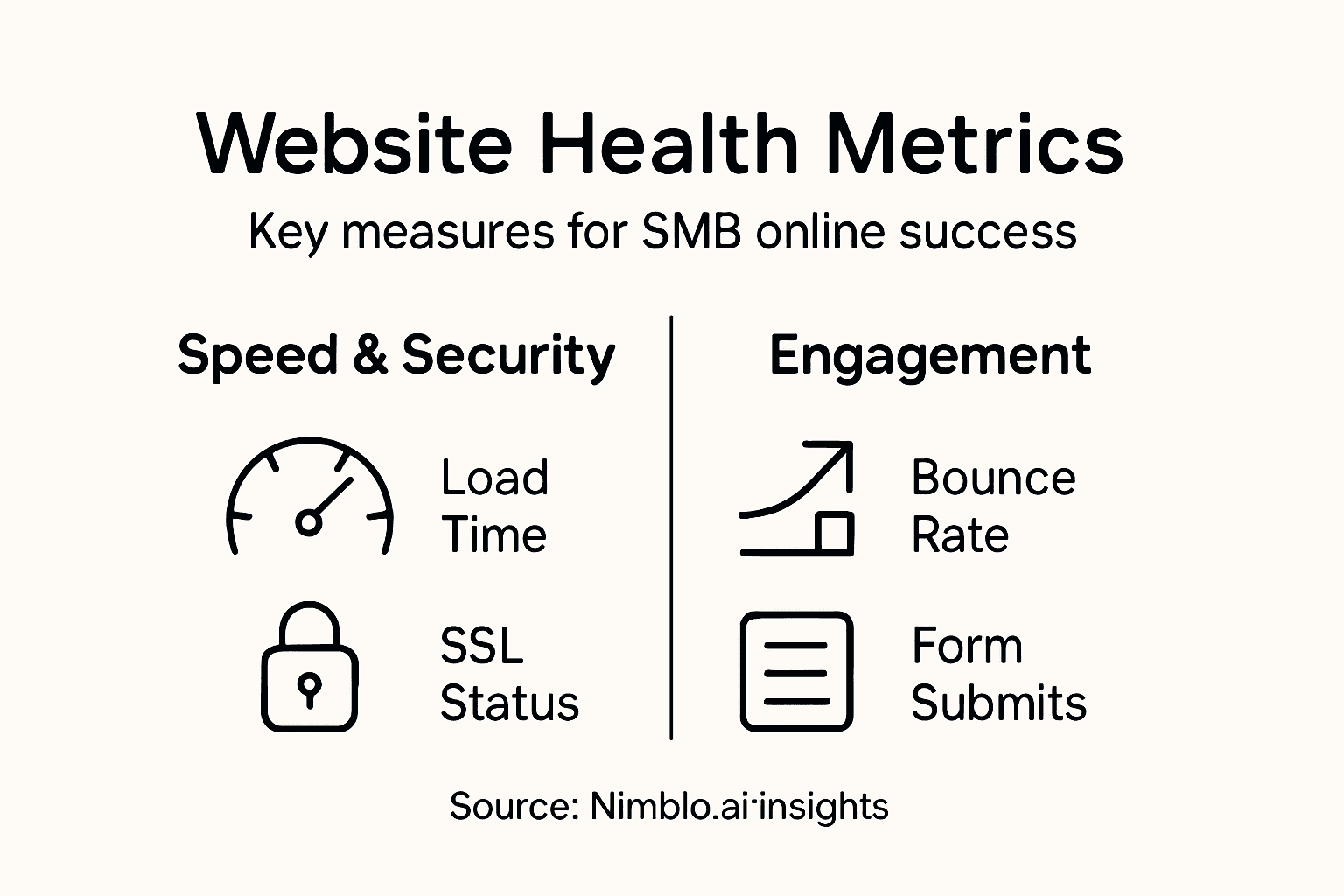
Establish clear performance benchmarks and service level objectives that align with your business goals. Regularly conduct performance audits using tools like Google Analytics, PageSpeed Insights, and conversion tracking software. Analyze user behavior patterns to understand where potential customers might be dropping off and optimize those specific areas. Test different lead capture form designs, experiment with placement and messaging, and use A B testing to continuously improve your website performance. Site reliability techniques can help you maintain consistent user experiences and minimize potential technical barriers to lead generation.
Use this reference table to track essential performance metrics for continuous website improvement:
| Metric | What It Measures | Value for Small Businesses |
|---|---|---|
| Page Load Speed | Time to display content | Better user retention, improved SEO |
| Conversion Rate | Visitors who take action | Measures effectiveness of site |
| Bounce Rate | Early visitor exits | Identifies potential navigation issues |
| Form Submission Rate | Completed lead forms | Indicates lead capture performance |
Pro tip: Set up automated performance alerts and schedule monthly comprehensive reviews to proactively identify and address any emerging website performance or lead capture issues.
Accelerate Your SMB Success with Smarter Website Design and Local SEO
Designing a website that truly converts can be challenging for small and medium businesses seeking local growth in Florida. The article highlights key issues like choosing the right platform for fast loading, implementing semantic structure for smooth navigation, and optimizing for mobile and local SEO to capture more leads. If you feel overwhelmed by juggling multiple tools or unsure how to meet these critical requirements, you are not alone.
Nimblo.ai’s all-in-one solution is built precisely to solve these challenges. Our platform streamlines your digital marketing stack by providing AI-powered local SEO optimization, high-speed hosting, easy website management, and automated lead capture. We eliminate the complexity of coordinating separate tools and agencies so you can focus on growing your business. With expert support tailored for Florida SMBs and a flat rate of $500/month with no contracts, Nimblo helps you deliver a conversion-driven website that truly performs.
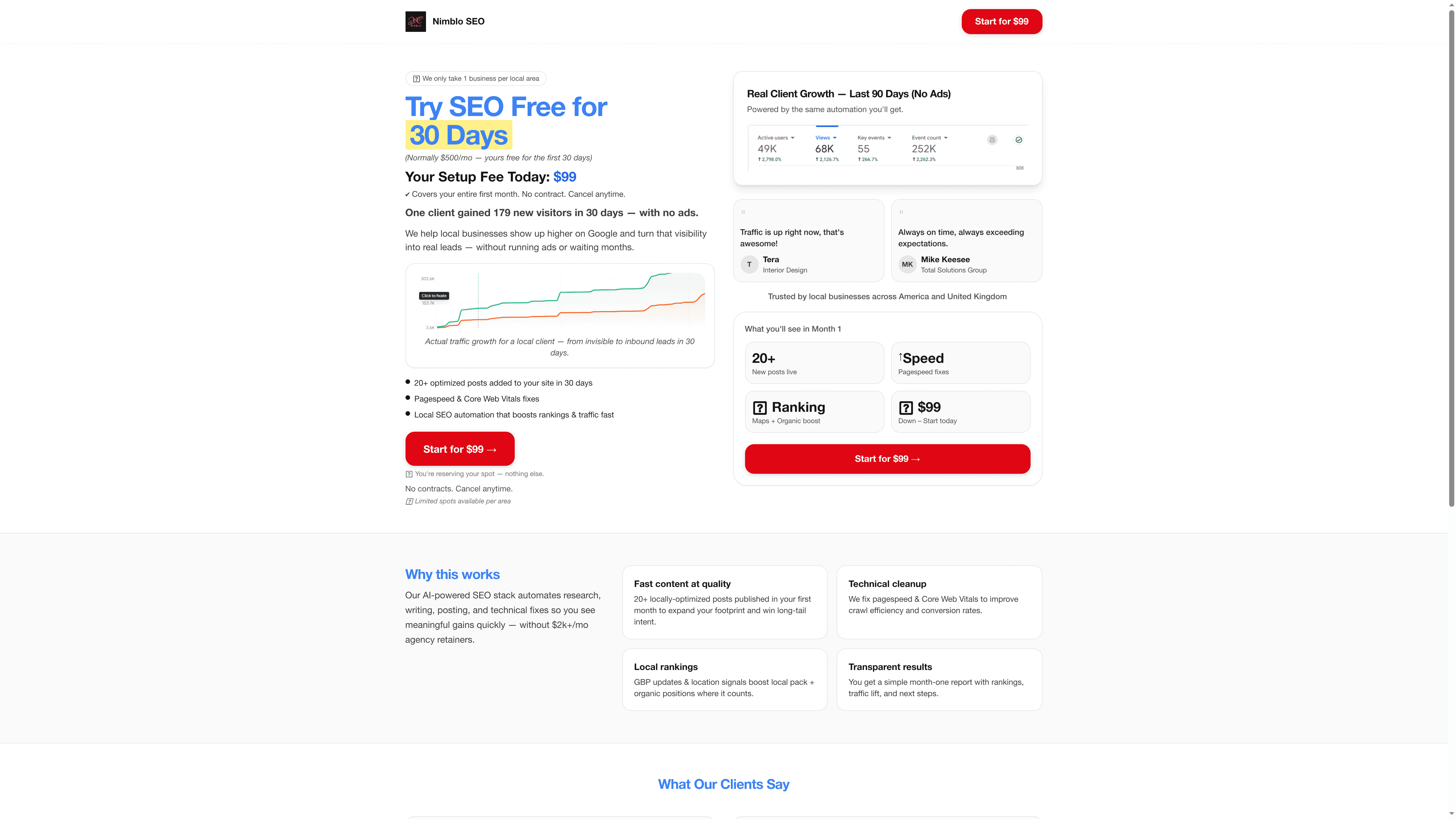
Ready to transform your website into a powerful local lead generator? Discover how Nimblo’s SEO, website, and automation suite makes rapid setup simple and affordable. Take control of your SMB’s online success today by visiting Nimblo.ai and learn more about our conversion-optimized web design and AI-powered local SEO solutions. Don’t settle for less when you can master your digital presence with ease.
Frequently Asked Questions
What are the key business goals to consider when designing a website for small businesses?
Clearly defined business goals are essential for effective website design. Start by identifying your primary objectives, such as generating more leads or improving customer engagement, and ensure these goals align with your target audience’s needs.
How can I analyze my target audience for website design?
Conduct a comprehensive audience analysis to understand your potential customers better. Use to create detailed user personas that reflect characteristics such as age, income, challenges, and preferred communication methods, ensuring your website resonates with them.
What features should I prioritize when choosing a website platform for my small business?
Focus on speed, security, and ease of management when selecting a website platform. Evaluate platforms based on their hosting speed, security features, and integration capabilities to find the best fit for your business needs.
How can I structure my website to increase conversions?
Implement a clear and logical site structure that guides visitors toward desired actions. Organize your content, use visual hierarchies, and incorporate prominent call-to-action buttons to enhance the user experience and encourage conversions.
What are effective strategies for optimizing my website for local SEO?
Start by claiming and optimizing your Google Business Profile and incorporating location-specific keywords throughout your content. Ensure consistent business details and leverage schema markup to increase your visibility in local search results.
How do I monitor my website’s performance and capture leads effectively?
Utilize analytics tools to track key performance metrics such as page load speed and conversion rates. Regularly review this data to identify areas for improvement, adjust your strategies, and enhance your lead capture process.