
TL;DR:
- BPM is a strategic, continuous discipline that improves process design, execution, and optimization.
- Successful BPM projects deliver high ROI through cost reduction, error elimination, and increased agility.
- Integrating AI with BPM requires careful governance to manage bias, complexity, and hybrid workflows effectively.
Most enterprise leaders know their operations could run better. But BPM initiatives reduce costs by 30% and deliver over 15% IRR in 80% of projects, which means the gap between knowing and acting is costing real money. Business process management, or BPM, is not a software category or a one-time project. It is a strategic discipline that changes how work gets designed, executed, and improved across your entire organization. This article breaks down what BPM actually is, why the ROI data is so compelling, and how enterprise leaders can apply it without falling into the most common traps.
Table of Contents
- What is business process management?
- How BPM delivers value: ROI and strategic benefits
- BPM and process automation: Critical differences and synergy
- Evolving BPM with AI and automation: New challenges and opportunities
- Implementing BPM: Steps, pitfalls, and getting buy-in
- What most BPM guides miss: Why process redesign matters more than automation
- Ready to optimize? Next steps for applying BPM in your organization
- Frequently asked questions
Key Takeaways
| Point | Details |
|---|---|
| BPM drives measurable ROI | Organizations adopting BPM report significant cost reductions and rapid performance gains. |
| Redesign before automating | Process improvement should precede automation for lasting results and higher project success rates. |
| AI amplifies BPM benefits | AI-driven automation unlocks even more value but must be governed to manage risks. |
| Buy-in is essential | Securing cross-functional support is a top predictor of BPM initiative success. |
| Use adaptive methods | Structured (BPMN) and dynamic (ACM) approaches are both necessary for modern, flexible operations. |
What is business process management?
BPM is a formal, structured approach to designing, executing, monitoring, and continuously improving the processes that drive your business. Think of it as the operating system beneath your operations. Every time an invoice moves through approvals, a new hire gets onboarded, or a customer complaint gets resolved, a process is running. BPM makes those processes visible, measurable, and improvable.
The global BPM market is valued at $14.46 billion and growing at a 19.9% compound annual growth rate, which signals that organizations worldwide are treating this as a strategic priority, not a back-office concern.
The BPM lifecycle follows five core stages:
- Design: Map out how a process should work, including inputs, outputs, roles, and decision points.
- Model: Create a visual or digital representation of the process, often using BPMN notation.
- Execute: Deploy the process with the right tools, people, and systems in place.
- Monitor: Track performance using defined KPIs to identify delays, errors, or bottlenecks.
- Optimize: Use data and feedback to continuously refine the process.
BPM also recognizes that not all processes are alike. Structured processes follow fixed rules, like payroll. Semi-structured processes involve judgment calls, like customer escalations. Dynamic processes are highly variable, like crisis response. Each type requires a different management approach.
BPM is not the same as project management, which is temporary and goal-bound. BPM is ongoing. It also goes far beyond simple workflow tools, which automate steps but rarely address root causes or measure outcomes. BPM assigns process owners, sets KPIs, and builds a culture of continuous improvement.
How BPM delivers value: ROI and strategic benefits
The business case for BPM is not theoretical. Organizations that commit to it see measurable financial and operational returns, often faster than expected.

| Metric | Typical BPM outcome |
|---|---|
| Production cost reduction | Up to 30% |
| Error reduction via automation | Up to 90% |
| Projects with 15%+ IRR | 80% of initiatives |
| 5-year ROI (Bizagi clients) | 429% average |
| Annual benefit per organization | $3.8M average |
These are not outliers. Lincoln Trust achieved 120% ROI in under a year, while Bizagi clients averaged 429% five-year ROI and $3.8 million in annual benefit. These results come from organizations that treated BPM as a strategic investment, not a cost center.
The value drivers behind these numbers fall into three categories. First, cost efficiency: eliminating redundant steps, reducing rework, and cutting manual labor frees up significant budget. Second, error reduction: automation reduces errors by up to 90%, which matters enormously in regulated industries where mistakes carry compliance costs. Third, agility: when processes are mapped and monitored, leaders can adapt them quickly when market conditions shift.
Stat to know: Organizations with mature BPM practices are significantly more likely to respond to disruption faster than competitors still running on undocumented, ad hoc workflows.
BPM also reduces the organizational drag that comes from siloed departments making local decisions that create downstream chaos. When process ownership is clear and KPIs are shared, cross-functional alignment becomes far easier to achieve and sustain.
BPM and process automation: Critical differences and synergy
Automation is not BPM. This distinction matters more than most leaders realize, and confusing the two is one of the most expensive mistakes an enterprise can make.
| Dimension | BPM | Process automation |
|---|---|---|
| Scope | Holistic, strategic | Tactical, task-level |
| Focus | Process design and governance | Execution and speed |
| Outcome | Sustainable improvement | Faster task completion |
| Risk if misapplied | Missed optimization | Automating broken processes |
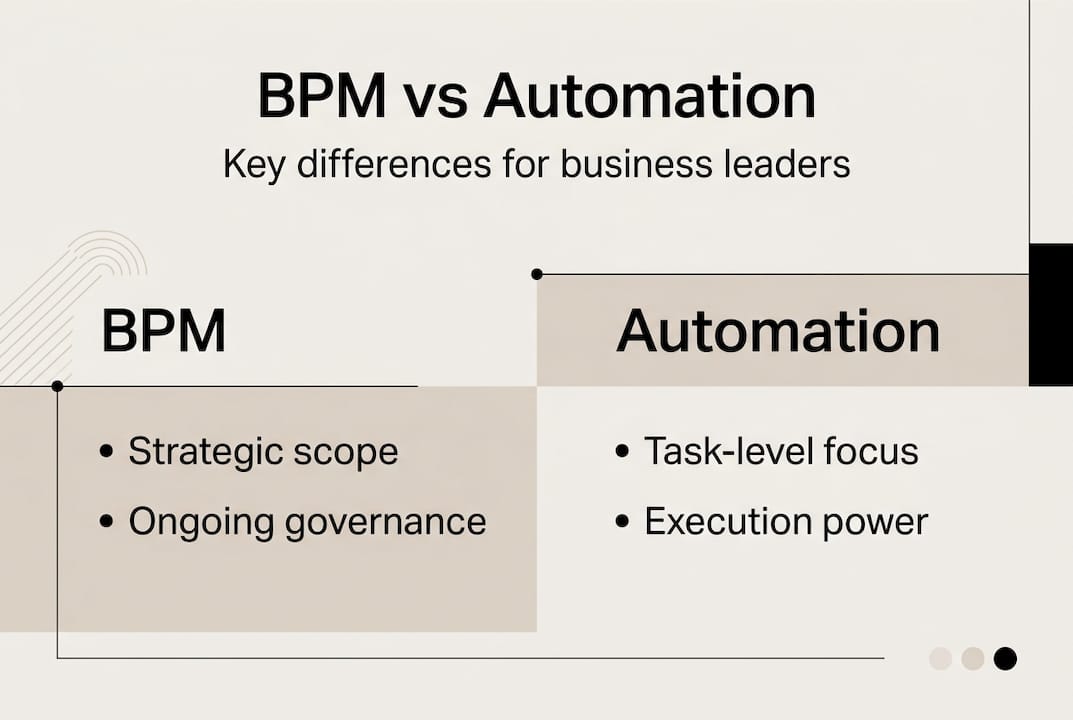
BPM provides the governance layer. Automation provides the execution power. When you automate without redesigning the underlying process, you simply do the wrong thing faster. 40% of BPM projects fail due to poor buy-in and skipping the process redesign phase before automation begins.
For structured, repeatable processes, BPMN (Business Process Model and Notation) is the standard. It gives teams a shared visual language for mapping workflows, decision gates, and handoffs. For dynamic or knowledge-intensive processes, ACM (Adaptive Case Management) is more appropriate. ACM allows human judgment to guide the process while still maintaining oversight and auditability.
Pro Tip: Start automation efforts with the cross-functional processes that cause the most visible pain. These are the ones where handoffs break down, delays accumulate, and no single team owns the outcome. Fixing these first generates the fastest ROI and builds internal credibility for broader BPM adoption. You can also review cost-effective automation tips and explore our agentic AI guide for deeper context on automation governance.
The bottom line: BPM without automation is slow. Automation without BPM is reckless. Together, they are transformational.
Evolving BPM with AI and automation: New challenges and opportunities
AI is changing what BPM can do, but it is also introducing new governance challenges that enterprise leaders cannot afford to ignore.
Modern BPM must now govern hybrid processes where humans and AI agents work together. This is genuinely new territory. AI agents require governance to prevent bias and over-reliance, and flexible BPMN and ACM approaches enable organizations to manage both structured and dynamic processes effectively.
The governance challenges are specific. AI agents can introduce bias when trained on historical data that reflects past inequities. They can also create idempotency problems in event-driven processes, where the same trigger fires multiple times and produces unintended duplicate actions. Timing dependencies in automated pipelines add another layer of complexity that traditional BPM frameworks were not designed to handle.
Best practices for AI-BPM synergy include:
- Map AI decision points explicitly within your BPMN diagrams so they are auditable.
- Define escalation paths for when AI confidence falls below a threshold.
- Build continuous learning loops so process KPIs feed back into model retraining.
- Use ACM for processes where AI recommendations inform but do not replace human judgment.
- Establish bias review cycles as a formal part of your BPM optimization stage.
Pro Tip: Never deploy an AI agent into a live process without a pilot phase that includes measurable KPIs and a defined rollback plan. The pilot is not just a test. It is your governance proof point. Explore how AI in digital marketing applies similar principles, and review our agentic AI governance framework for enterprise-grade implementation guidance.
“The organizations winning with AI-driven BPM are not the ones deploying the most agents. They are the ones with the clearest process maps and the most disciplined governance.”
Implementing BPM: Steps, pitfalls, and getting buy-in
74% of BPM projects report improved organizational agility, but that success is not automatic. It depends on disciplined execution and genuine leadership commitment.
Here is a practical roadmap for launching a BPM initiative:
- Identify high-impact processes: Start with processes that are broken, visible, and cross-functional. These offer the fastest wins.
- Assign process owners: Every process needs a named owner with authority to make changes and accountability for outcomes.
- Map the current state: Document what actually happens, not what the org chart says should happen. The gap is usually revealing.
- Redesign before automating: Fix the logic, eliminate waste, and clarify decision rights before touching any technology.
- Select appropriate tools: Low-code and no-code BPM platforms reduce implementation time and lower the barrier for non-technical teams. Review marketing automation steps for practical sequencing guidance.
- Execute and monitor: Deploy the redesigned process, track KPIs from day one, and set a review cadence.
- Optimize continuously: Use monitoring data to drive iterative improvements, not just a one-time fix.
Common pitfalls to avoid:
- Launching without executive sponsorship, which stalls cross-department collaboration.
- Skipping the current-state mapping phase and jumping straight to technology selection.
- Overcomplicating the tech stack before proving value with a simpler pilot.
- Treating BPM as an IT project rather than a business transformation initiative.
Buy-in checklist for sponsors: Can you name the process owner? Do you have baseline KPIs? Is there a defined pilot scope? Have impacted teams been consulted? If you cannot answer yes to all four, you are not ready to launch.
What most BPM guides miss: Why process redesign matters more than automation
Here is the uncomfortable truth most BPM vendors will not tell you: the technology is rarely the hard part. The hard part is convincing your organization to stop defending broken processes.
We have seen it repeatedly. A team identifies a painful workflow, gets excited about automation, and deploys a bot that executes the flawed process at three times the speed. The errors multiply. The frustration grows. The project gets labeled a failure, and BPM gets blamed for a problem that was actually a redesign problem.
40% of BPM projects fail due to poor buy-in and skipping process redesign. That statistic should be a warning label on every automation platform.
The next wave of BPM will not be defined by which AI tools organizations adopt. It will be defined by which organizations build the cultural muscle to question their own processes, trust their data, and adapt continuously. That requires leaders who champion redesign as a discipline, not just digital tools as a shortcut. If you want to understand how AI and cost cutting intersect with process discipline, the lesson is the same: clarity before automation, always.
The organizations that will lead in 2026 and beyond are the ones treating BPM as a leadership practice, not a software purchase.
Ready to optimize? Next steps for applying BPM in your organization
If this article has clarified one thing, it is that BPM done right is a competitive advantage, not a back-office project. The gap between organizations with mature process discipline and those without is widening every year.
Nimblo embeds cross-functional automation teams directly into your operations, combining AI engineers, workflow architects, and domain experts in a structured 120-day engagement. We help enterprise leaders map, redesign, and automate their highest-impact processes with measurable KPIs from day one. If you are ready to move from process chaos to operational clarity, explore our AI solutions for BPM and see how a pilot engagement could deliver results in your environment.
Frequently asked questions
What are the key stages of BPM?
The core BPM lifecycle includes five stages: design, model, execute, monitor, and optimize. Each stage builds on the previous one to create a continuous improvement loop.
How is BPM different from simple automation?
BPM is a holistic discipline that governs how processes are designed, managed, and improved across the organization. Automation is a tactical tool that executes specific tasks faster, and it works best when BPM provides the governance layer.
What is BPMN and when should it be used?
BPMN stands for Business Process Model and Notation, and it is best used for structured, repeatable processes where clear visual documentation of workflows, decision points, and handoffs is needed.
How can AI improve BPM outcomes?
AI enhances BPM by automating complex decisions, reducing errors, and enabling adaptive process management. However, AI agents need governance frameworks to prevent bias and ensure accountability within the process.
What are the main risks when launching a BPM initiative?
The biggest risks are poor executive buy-in, automating without redesign, and overcomplicating the technology stack before proving value with a focused pilot. Addressing these three factors dramatically improves project success rates.