
TL;DR:
- Digital footprints include active, passive, and inferred data across multiple systems and third parties.
- Proper management reduces cyber risk, protects reputation, and ensures regulatory compliance.
- Continuous monitoring, audits, and strategic removal are essential for minimizing enterprise digital footprints.
Every minute, your organization generates data trails you never deliberately created. The average person alone generates 1.7MB per second, roughly 1.2TB per year, and enterprises multiply that figure across thousands of employees, systems, and third-party integrations. Most leaders still think of digital footprints as social media posts or press releases. That framing is dangerously incomplete. Your organization’s true footprint spans server logs, API calls, vendor contracts, device metadata, and AI-inferred behavioral profiles. Understanding what that footprint actually contains, and how it shapes your risk, reputation, and compliance posture, is one of the highest-leverage decisions you can make in 2026.
Table of Contents
- Understanding the digital footprint: Types and mechanics
- Why digital footprints matter for enterprises
- Enterprise risks and the evolving landscape: AI, compliance, and edge cases
- How to manage and minimize your organization’s digital footprint
- Perspective: The digital footprint blind spot most leaders miss
- Take the next step in digital footprint management
- Frequently asked questions
Key Takeaways
| Point | Details |
|---|---|
| Digital footprint is holistic | It includes both intentional and automatically collected online data from your organization. |
| Business value and risk | Footprints affect reputation, compliance, hiring, and cybersecurity for enterprises. |
| AI and third-party data | Passive, inferred, and external data now drive most enterprise digital risk. |
| Management requires ongoing action | Regular audits, automation, and staff training are essential for reduction and compliance. |
| Strategic mindset shift | Leaders should prioritize visibility and control over deletion alone for digital footprints. |
Understanding the digital footprint: Types and mechanics
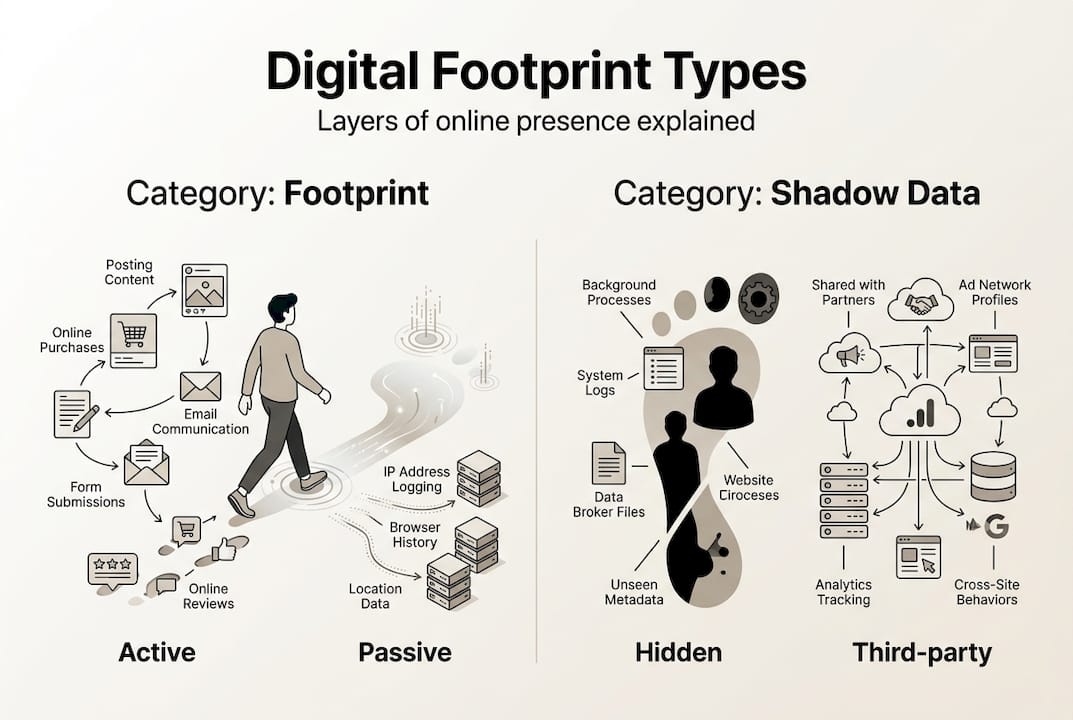
A digital footprint is the cumulative record of all data an organization generates, shares, or triggers through its digital activity. That definition sounds simple, but the mechanics behind it are anything but. For enterprises, the footprint is not a single file or database. It is a distributed, constantly growing collection of traces spread across dozens of systems, vendors, and jurisdictions.
The clearest way to organize this is by separating active and passive data types. Active footprints are intentional: press releases, social media posts, published job listings, product documentation, and official email correspondence. Passive footprints are collected automatically, often without any deliberate action from your team. These include:
- IP address logs recorded by every server your employees contact
- Browser and device fingerprints that identify hardware and software configurations
- Cookies and session tokens placed by third-party analytics and advertising platforms
- Geolocation data captured by mobile apps and location-enabled services
- Login histories stored by SaaS platforms, cloud providers, and identity management systems
Beyond active and passive data, there is a third layer that most organizations completely ignore: the digital shadow. This refers to data held by parties you never directly engaged with, including data brokers, aggregators, and archived web crawlers. Your digital shadow can include outdated executive profiles, cached versions of internal pages indexed before access controls were applied, and inferred company attributes built from public signals.
For a broader view of how these layers connect, the concept of digital presence helps frame the relationship between what you publish and what persists without your input.
| Footprint type | Source | Control level |
|---|---|---|
| Active | Intentional posts, filings, communications | High |
| Passive | Cookies, IP logs, behavioral tracking | Low |
| Digital shadow | Data brokers, third-party archives | Very low |
Pro Tip: Even “deleted” content rarely disappears. Server logs, web archive snapshots, and data broker records can retain information for years after you remove it from your own systems. Assume persistence, not erasure, as your default operating model.
Why digital footprints matter for enterprises
The business stakes attached to your digital footprint are concrete and measurable. Mismanaging your footprint affects five distinct enterprise domains: reputation, cybersecurity, human resources, regulatory compliance, and search visibility.
On the reputation side, your footprint is often the first thing a potential partner, investor, or regulator encounters. 90% of employers screen candidates via social media, and 70% actively use these methods as part of hiring decisions. The same scrutiny applies to vendor due diligence and M&A evaluations. A poorly managed footprint signals operational immaturity.
| Domain | Positive footprint impact | Negative footprint impact |
|---|---|---|
| Reputation | Trust, authority, partnership eligibility | Damaged credibility, lost deals |
| Cybersecurity | Reduced attack surface | Exposed credentials, phishing vectors |
| Compliance | Audit readiness, reduced fines | GDPR/CCPA violations, penalties |
| HR and talent | Employer brand strength | Candidate distrust, retention risk |
| SEO and visibility | Organic reach, thought leadership | Negative content ranking, suppression cost |
From a cybersecurity perspective, every piece of exposed data is a potential attack vector. Leaked employee email formats, published org charts, and indexed internal tools all provide reconnaissance value to bad actors. This is not theoretical. Phishing campaigns routinely use publicly available footprint data to craft convincing impersonation attempts.
Compliance is where the financial exposure becomes most direct. GDPR and CCPA both impose obligations tied to what data you hold, where it flows, and how long you retain it. Regulated industries like healthcare and finance face additional layers under HIPAA and SOX. Effective enterprise reputation management and footprint governance are increasingly treated as the same discipline by compliance officers.
“99% of organizations now see ROI on privacy investments, and 90% have expanded their privacy programs as a result.”
That shift reflects a broader recognition: managing your digital presence and brand is not a marketing function alone. It is an enterprise risk function.
Enterprise risks and the evolving landscape: AI, compliance, and edge cases
AI has fundamentally changed the risk calculus for enterprise digital footprints. Where traditional data collection was largely transactional, AI systems ingest behavioral signals, correlate them across sources, and build inferred profiles that go far beyond what any single data point would suggest. Your organization’s footprint is no longer just what you shared. It includes what AI systems have inferred about you from aggregated signals.

AI and third-party data increase both the volume and persistence of enterprise risk. This is prompting regulatory responses across the EU, US states, and Asia-Pacific jurisdictions. The challenge is that most compliance frameworks were written before generative AI became a core enterprise tool, leaving significant gray areas around training data, output retention, and model accountability.
Here are the top risk vectors enterprises need to track in 2026:
- IoT and connected devices that continuously transmit operational data to vendor clouds
- Shadow IT where employees use unsanctioned tools that collect and store company data outside IT governance
- Geographic compliance mismatches where data processed in one jurisdiction violates the laws of another
- Post-deletion persistence where data removed from primary systems remains in backups, logs, or third-party records
- AI-inferred identities built from behavioral and metadata signals without any direct data sharing
The perception gap is striking. 81% of Americans feel no control over their personal data, and 85% say data localization requirements increase operational cost and risk. Enterprise leaders report similar frustration: the regulatory surface keeps expanding while the tools to manage it lag behind.
For organizations building out their AI-driven digital strategy, the footprint question is inseparable from governance. Every AI tool you adopt extends your footprint in ways that traditional IT audits were not designed to capture.
How to manage and minimize your organization’s digital footprint
Managing your enterprise digital footprint is not a one-time project. It is an ongoing operational discipline. The good news is that a structured approach delivers measurable results quickly. Audit tools can surface up to 80% of forgotten accounts and legacy integrations in a single scan cycle, giving you an immediate baseline to work from.
Here is a practical framework to get started:
- Conduct a full digital audit. Map every system, vendor, and integration that touches company data. Include SaaS subscriptions, marketing platforms, and any third-party tools employees use independently.
- Minimize data exposure. Apply the principle of least privilege to data sharing. If a vendor does not need a field, do not provide it. Review API permissions quarterly.
- Enforce structured offboarding. Departing employees leave behind access credentials, shared accounts, and personal device data. Automate the revocation process.
- Implement secure disposal protocols. Deleting a file is not the same as destroying the data. Use certified data destruction for hardware and verified deletion for cloud storage.
- Integrate automation for continuous monitoring. Manual audits are too slow for the pace at which footprints grow. Automated scanning tools flag new exposures in real time.
Useful tools for enterprise footprint management include privacy-focused browsers for sensitive workflows, VPN infrastructure for remote access, employee training modules on data hygiene, and automated compliance workflow tools. For a broader view of how digital marketing tools intersect with footprint management, the overlap is larger than most teams realize.
Pro Tip: Start your footprint reduction effort with legacy and forgotten accounts, not your active systems. These dormant records carry the highest risk per hour of remediation effort, and strategic deletion of stale data reduces your attack surface faster than any other single action.
Balancing privacy controls with marketing agility is a real tension. The goal is not to eliminate your digital presence but to make it intentional, auditable, and defensible.
Perspective: The digital footprint blind spot most leaders miss
Most enterprise leaders approach digital footprint management as a content moderation problem. They focus on what their organization publishes, monitor brand mentions, and occasionally audit their social profiles. That is a reasonable starting point, but it addresses maybe 20% of the actual risk.
The other 80% lives in passive, third-party, and inferred data that organizations never directly created and cannot directly control. Data brokers hold corporate relationship maps built from public filings, event registrations, and purchasing signals. AI platforms infer organizational priorities from job postings and patent filings. Archived web crawlers preserve internal pages that were indexed before your security team noticed.
The uncomfortable truth is that your hidden reputation risks are not in your published content. They are in the data trails you never knew existed. The strategic reframe here is to prioritize discovery and visibility before you prioritize deletion or filtering. You cannot manage what you have not mapped. Leaders who invest in continuous footprint discovery consistently outperform those who focus only on outbound content governance. Visibility is the leverage point.
Take the next step in digital footprint management
Understanding your digital footprint is the first move. Acting on it at enterprise scale requires automation, structured workflows, and domain expertise working together.

Nimblo.ai deploys embedded automation pods directly into your operations, combining AI engineers, workflow architects, and compliance-focused domain experts in a structured 120-day engagement. The result is a mapped, monitored, and defensible digital footprint with measurable risk reduction from week one. If you are ready to move from awareness to action, explore what an enterprise digital footprint solution looks like when it is built around your specific workflows, regulatory requirements, and operational realities.
Frequently asked questions
What is the difference between an active and passive digital footprint?
An active digital footprint is data you intentionally share online, while a passive footprint is data collected automatically, often without your direct knowledge. For enterprises, passive data typically represents the larger and harder-to-control portion.
How do digital footprints impact enterprise reputation and compliance?
Digital footprints affect reputation, compliance standing, and overall business value. Mismanagement can trigger GDPR or CCPA violations, damage partner trust, and create exploitable security gaps.
What tools can enterprises use to reduce their digital footprint risk?
Audit tools and privacy platforms are the most effective starting points, supplemented by automation systems that continuously monitor for new exposures across SaaS, cloud, and third-party environments.
Why is passive or third-party data a bigger risk than active content?
Passive and third-party footprints carry higher risk because they persist longer, are harder to detect, and can be used for profiling or targeted attacks without the organization ever knowing the data exists.
Are digital footprints permanent?
Most digital footprints can be reduced but not fully erased. Server logs and data brokers may retain records long after you delete them from your own systems, which is why ongoing monitoring matters more than one-time cleanup.