
TL;DR:
- Customer engagement involves ongoing behavioral interactions, while customer experience reflects overall impressions.
- Successful engagement strategies combine behavioral segmentation, lifecycle management, multichannel orchestration, and AI personalization.
- Over-automation can harm trust; balancing AI with human touchpoints in high-stakes moments is essential.
Most enterprise operations executives use “customer engagement” and “customer experience” as if they mean the same thing. They don’t, and the difference is costing companies real revenue. Customer engagement centers on repeated behavioral interactions: the clicks, replies, and return visits that signal a customer is actively invested in your brand. Customer experience is the impression left after a single interaction. Confusing the two leads to misaligned strategies, wasted automation spend, and loyalty programs that never quite land. This article breaks down what engagement actually means, the frameworks that drive it, the risks of over-automating it, and the action steps you need to operationalize it at scale.
Table of Contents
- Defining customer engagement: Beyond the buzzword
- Pillars of customer engagement in the AI era
- AI-driven automation: Opportunities and limitations
- Integrating engagement: Action steps for enterprise success
- A fresh perspective: Rethinking the human-AI balance in engagement
- Accelerate your engagement strategy with AI solutions
- Frequently asked questions
Key Takeaways
| Point | Details |
|---|---|
| Engagement vs. experience | Customer engagement tracks behavioral interactions, distinct from general customer experience. |
| AI amplifies engagement | AI-driven approaches enable scalable personalization and lifecycle management at the enterprise level. |
| Balance automation and empathy | Relying solely on automation can erode trust and growth; human oversight is essential. |
| Actionable frameworks exist | A strategic mix of segmentation, channel integration, and continuous monitoring drives results. |
Defining customer engagement: Beyond the buzzword
The word “engagement” gets thrown around in boardrooms and marketing decks without much precision. That vagueness is a strategic liability. For enterprise leaders, a working definition is essential before any automation investment makes sense.
Customer engagement is the ongoing interactions between customers and brands across touchpoints, focusing on behavioral involvement like messages, clicks, and replies to indicate interest in staying involved. Notice what that definition emphasizes: behavioral involvement. Not sentiment. Not satisfaction scores. Actual actions that signal a customer is choosing to stay in the conversation.
Contrast that with customer experience (CX). CX captures the overall impression a customer forms from navigating your product, website, or service. It’s holistic and retrospective. Engagement is specific and forward-looking. Here’s why that distinction matters in practice:
- CX asks: “How did the customer feel after this interaction?”
- Engagement asks: “Is the customer coming back, clicking through, and responding?”
- CX is measured through surveys, NPS, and satisfaction scores.
- Engagement is measured through open rates, session frequency, reply rates, and feature adoption.
- CX reflects quality of a moment. Engagement reflects the health of an ongoing relationship.
The business stakes are significant. As the CX-to-loyalty link remains elusive for 70% of CX leaders, engagement metrics offer a more direct and actionable signal of whether your customers are actually sticking around.
“Engagement is not what customers think about you. It’s what they do next.”
For enterprises deploying AI in marketing, this distinction is foundational. AI systems thrive on behavioral data. They can optimize send times, predict churn, and trigger personalized journeys, but only if the underlying engagement signals are being tracked correctly. If your team is feeding AI a diet of satisfaction surveys instead of behavioral data, you’re optimizing for the wrong outcome.
Engagement also scales differently than experience. You can improve CX by redesigning a single touchpoint. Improving engagement requires a systemic view of how customers move through your entire ecosystem over time. That systemic view is where enterprise AI automation has its greatest leverage.
Pillars of customer engagement in the AI era
With a clear definition in place, the next question is: what actually moves the engagement needle? The answer lies in five foundational pillars that shape every high-performing engagement strategy.
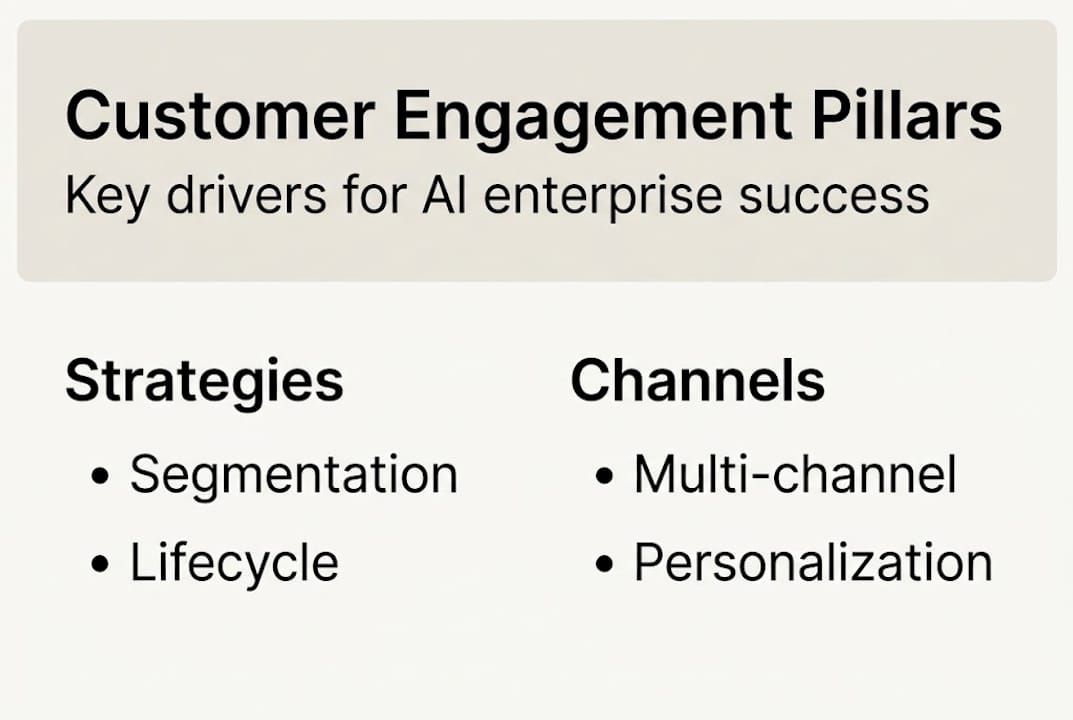
Core methodologies include behavioral segmentation, lifecycle management, frequency caps, multi-channel integration, and AI-driven personalization like next-best-action using ML models and digital twins. Each of these deserves operational attention.

| Pillar | Real-world example | AI impact potential |
|---|---|---|
| Behavioral segmentation | Grouping users by purchase frequency | High: dynamic cohort updates |
| Lifecycle management | Onboarding vs. retention journeys | High: automated stage triggers |
| Frequency management | Capping email sends to avoid fatigue | Medium: predictive send optimization |
| Multi-channel integration | Unified messaging across app, email, SMS | High: cross-channel orchestration |
| AI-driven personalization | Next-best-action recommendations | Very high: real-time ML scoring |
Here’s how to approach these pillars in sequence:
- Behavioral segmentation comes first. You cannot personalize what you haven’t categorized. Build dynamic segments based on recency, frequency, and monetary value, then layer in behavioral signals like feature usage or content consumption.
- Lifecycle management maps the customer journey from acquisition through advocacy. Each stage requires different engagement tactics, and AI can automate the transitions between them.
- Frequency management prevents engagement fatigue. Too many messages erode trust faster than silence. ML models can predict optimal contact windows per customer.
- Multi-channel integration ensures consistency. A customer who clicks an email and then visits your app should experience a seamless continuation, not a reset.
- AI-driven personalization ties it all together. Digital twins, which are virtual models of individual customer behavior, allow enterprises to simulate how a customer might respond before sending a single message.
Pro Tip: Don’t try to implement all five pillars at once. Rank them by engagement lift versus implementation complexity. Behavioral segmentation and lifecycle management typically deliver the fastest ROI with the least technical debt. Start there, then layer in automation vs manual engagement comparisons to validate your investment before scaling multichannel marketing infrastructure.
AI-driven automation: Opportunities and limitations
AI automation promises scale, consistency, and precision in customer engagement. It also carries real risks that enterprise leaders often underestimate until something goes wrong.
The benefits are well-documented. Automation enables real-time behavioral triggers, reduces manual workload, and allows personalization at a scale no human team can match. A customer who abandons a cart at 11 PM can receive a tailored recovery message within minutes, without a single human involved. That kind of responsiveness builds engagement.
But the limitations are equally real. Consider the following:
- Cultural mismatch: AI models trained on one demographic’s behavior can misfire badly in different cultural contexts. Tone, timing, and channel preferences vary widely.
- Trust erosion: Customers who feel they’re talking to a bot, especially during high-stakes moments, disengage fast.
- Over-automation fatigue: Automated journeys that feel mechanical or irrelevant push customers toward competitors.
The data is pointed. Over-automation can frustrate customers, erode trust, and harm growth, with 30% of firms seeing negative impacts on total experience (TX) growth. That’s not a marginal risk. That’s nearly one in three enterprises actively damaging their customer relationships through automation choices.
| Factor | Manual engagement | AI-driven engagement |
|---|---|---|
| Speed | Slow | Near real-time |
| Consistency | Variable | High |
| Emotional resonance | High | Medium to low |
| Error rate | Higher (human) | Lower (systematic) |
| Scalability | Limited | Virtually unlimited |
Pro Tip: The most resilient engagement strategies use AI to handle volume and timing while preserving human touchpoints for high-value, high-emotion moments. Map your customer journey and identify the three to five moments where a human response would dramatically outperform automation. Protect those moments. For everything else, explore AI in digital marketing and the agentic AI efficiency guide to find the right automation fit for your operational context.
Integrating engagement: Action steps for enterprise success
Knowing the pillars and pitfalls is useful. Acting on them is what separates high-performing enterprises from the rest. Here’s a practical framework for operationalizing AI-driven customer engagement.
The engagement audit-to-iteration cycle:
- Audit: Map every touchpoint where customers interact with your brand. Identify which generate behavioral data and which generate only sentiment data. Close the gaps.
- Segment: Build behavioral cohorts using the data you’ve audited. Prioritize segments with the highest revenue potential or churn risk.
- Automate: Deploy behavioral segmentation and lifecycle triggers using ML models and multi-channel orchestration. Start with two or three high-impact journeys.
- Monitor: Track KPIs weekly, not quarterly. Engagement moves fast, and lagging indicators will leave you reacting instead of leading.
- Iterate: Use A/B testing and cohort analysis to refine messaging, timing, and channel mix. Engagement optimization is never finished.
KPIs that actually matter for enterprise engagement:
- Message response rate and reply velocity
- Campaign engagement rate by channel
- Feature adoption rate for digital products
- Customer retention rate by segment
- Sentiment trend over time (not just point-in-time NPS)
- Churn prediction score accuracy
Stat to know: 70% of CX leaders struggle to link CX investments to loyalty outcomes, making behavioral engagement metrics the more reliable strategic compass.
This is where automation tips and a solid step-by-step guide become operational assets rather than reading material. The framework above only works if it’s embedded in your team’s daily workflow, not sitting in a strategy deck.
One often-overlooked step is governance. Define who owns engagement data, who can trigger automated journeys, and how often models are retrained. Without governance, even the best engagement architecture drifts toward irrelevance as customer behavior evolves.
A fresh perspective: Rethinking the human-AI balance in engagement
Here’s an uncomfortable truth most AI vendors won’t tell you: the more you automate customer engagement, the more you need to invest in the moments you don’t automate.
Enterprise leaders often treat automation as a destination. Get the workflows running, let the models optimize, and watch engagement metrics climb. That works, until it doesn’t. Over-automation harms total experience growth for nearly a third of firms, and the damage is rarely visible until customers have already left.
The paradigm shift worth making is this: design for “the moments that matter.” AI is exceptional at handling volume, timing, and personalization at scale. It is poor at reading grief, frustration, cultural nuance, or the kind of trust that forms when a real person says the right thing at the right moment. The enterprises winning at engagement in 2026 are not the ones with the most automation. They’re the ones who know exactly where automation ends and human judgment begins.
This isn’t anti-AI. It’s pro-strategy. Use marketing automation transformation to free your team from repetitive tasks so they can focus on the high-stakes interactions that actually build loyalty. That’s the balance worth optimizing for.
Accelerate your engagement strategy with AI solutions
The frameworks in this article only create value when they’re operationalized inside your actual business workflows, not just theorized in planning sessions.
Nimblo’s embedded automation pods bring together AI engineers, workflow architects, and domain experts who work directly inside your operations. Within a structured 120-day engagement cycle, we help enterprise teams audit behavioral data gaps, deploy intelligent engagement journeys, and build the governance structures that keep AI performing over time. If you’re ready to move from strategy to measurable outcomes, the Nimblo AI engagement platform is built for exactly this kind of transformation. Let’s build engagement infrastructure that actually sticks.
Frequently asked questions
How does customer engagement differ from customer experience?
Customer engagement focuses on ongoing behavioral interactions such as clicks and replies, while customer experience encompasses overall perceptions from navigating or using products. Engagement is forward-looking and behavioral; experience is retrospective and perceptual.
What are key strategies to improve customer engagement with AI?
Use behavioral segmentation and lifecycle management alongside multi-channel integration and machine learning-based personalization to enhance engagement at scale. Prioritize pillars with the highest engagement lift relative to implementation complexity.
What are the risks of over-automating customer engagement?
Over-automation can frustrate customers, erode trust, and harm growth, with 30% of firms seeing negative impacts on total experience. The fix is preserving deliberate human touchpoints at high-stakes moments in the customer journey.
Which KPIs should enterprises track for effective engagement?
Track behavioral engagement metrics like message response rate, campaign engagement by channel, feature adoption, customer retention rate, and churn prediction score accuracy. These signals are more actionable than satisfaction surveys alone.