
TL;DR:
- Optimizing Google Business Profiles and NAP consistency are crucial for local search ranking improvements.
- Creating unique, locally relevant landing pages with structured data significantly boosts organic local traffic.
- Implementing centralized systems and AI-powered automation maximizes enterprise local SEO success.
Many enterprise leaders pour significant budgets into digital marketing yet still struggle to convert that spend into measurable local website traffic. The local pack’s top three results capture 126% more traffic than positions below them, which means ranking locally is not just a nice-to-have. It’s a revenue lever. The good news: enterprises that apply structured, evidence-backed strategies can realistically achieve up to 300% growth in local organic traffic. This guide maps exactly how to do it, step by step, so your team can move from scattered tactics to a repeatable system.
Table of Contents
- Optimize your Google Business Profile for maximum impact
- Build NAP consistency and powerful citations at scale
- Create unique local landing pages and content that drives engagement
- Leverage reviews, local backlinks, and AI-powered strategies
- A smarter enterprise approach: Systems, not tactics
- Next steps: Optimize your enterprise traffic with Nimblo
- Frequently asked questions
Key Takeaways
| Point | Details |
|---|---|
| Optimize GBP first | A precise, complete Google Business Profile unlocks dramatic local pack traffic and credibility boosts. |
| Standardize NAP data | Consistent business info across directories prevents lost traffic and drives discovery views. |
| Unique local content | Each location needs its own landing page with 60% unique, hyperlocal details for SEO effectiveness. |
| Steady reviews and local links | Continuous review velocity and community-based backlinks power ongoing reputation and search authority. |
| Embrace systems and AI | Enterprise-level solutions and schema leverage automation, AI monitoring, and holistic strategies for scalable growth. |
Optimize your Google Business Profile for maximum impact
Having established the potential of local pack visibility, let’s begin with the cornerstone: an optimized Google Business Profile (GBP). Your GBP is the single most visible local signal Google uses to rank your business in map results and local packs. For enterprises with multiple locations, getting this right at scale is both the biggest challenge and the biggest opportunity.
Start by claiming and verifying every location individually. This sounds obvious, but many enterprises discover unverified or duplicate listings hiding in their account. Once verified, your GBP setup becomes the foundation for everything else.
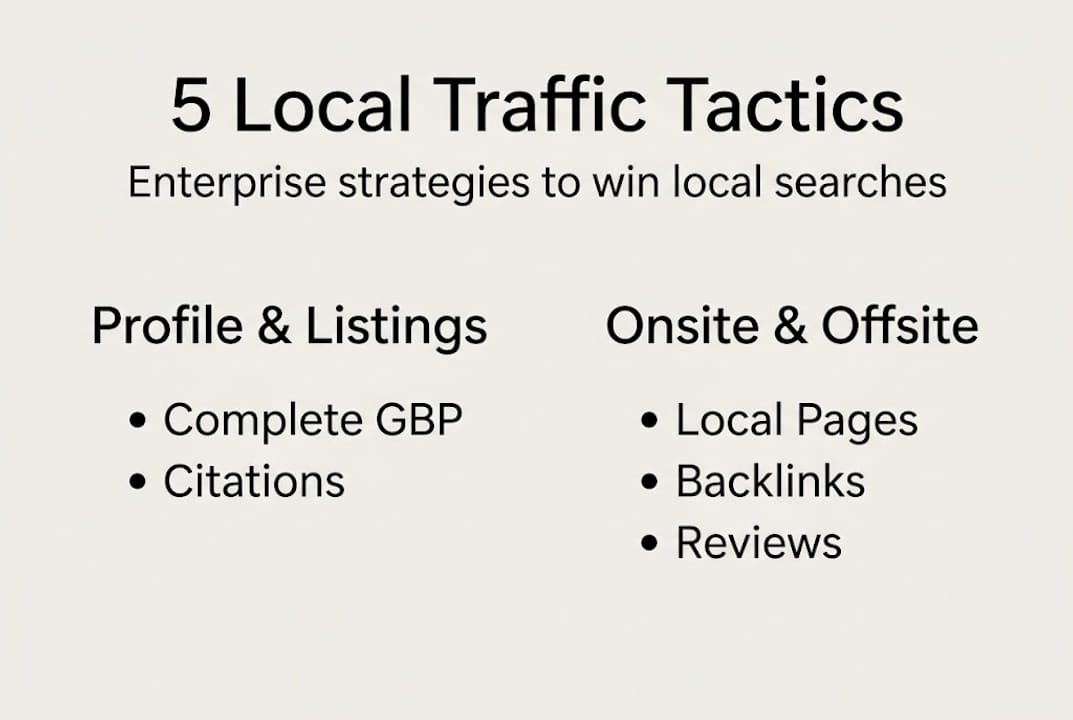
Category selection is where most enterprises leave ranking power on the table. The primary GBP category is the number one factor for local pack ranking, outweighing even business name keywords. Choose the most precise category that describes your core service, not a broad umbrella. Then add secondary categories for supporting services.
Complete every available field. Attributes, services, business hours, holiday hours, photos, and weekly posts all contribute to profile completeness. Complete profiles are 2.7x more reputable in the eyes of searchers, and businesses with photos receive 42% more direction requests than those without.
GBP completion: basic vs. optimized
| Profile element | Basic setup | Optimized setup |
|---|---|---|
| Categories | 1 generic | 1 precise primary + 3 secondary |
| Photos | Logo only | Interior, exterior, team, products |
| Posts | None | Weekly updates with offers/events |
| Attributes | Skipped | All relevant attributes filled |
| Review responses | Occasional | Every review within 48 hours |
Review management deserves its own focus. Review velocity, meaning how frequently new reviews arrive, matters more than total volume. A location receiving five reviews per month consistently outperforms one that collected 200 reviews two years ago and stopped.
Key actions for enterprise GBP optimization:
- Audit all locations for verification status quarterly
- Assign a dedicated owner per location group for review responses
- Use GBP features like Q&A, products, and service menus
- Schedule weekly posts tied to local promotions or events
- Monitor the GBP step-by-step process for new locations during expansion
Pro Tip: Use Google’s bulk location management tool if you have 10 or more locations. It lets you push category and attribute updates across your entire portfolio simultaneously, saving hours of manual work.
Build NAP consistency and powerful citations at scale
After GBP optimization, the next step is ensuring consistency and reach across directories and platforms. NAP stands for Name, Address, and Phone number. When your NAP data appears differently across Yelp, Apple Maps, Bing, and dozens of niche directories, search engines treat those signals as conflicting, which suppresses your local rankings.
Citations contribute approximately 16% to local pack ranking weight. That’s a significant slice, and enterprises with inconsistent data across hundreds of listings are actively losing ground.
Here’s a structured process for getting citation management right at scale:
- Audit existing citations using a tool like Yext or BrightLocal to surface every mention of your business across the web.
- Standardize your NAP format across all branches. Decide on abbreviations (St. vs. Street), suite formats, and phone number formatting before you begin corrections.
- Use bulk API tools such as Yext or RioSEO to push standardized data to directories simultaneously rather than updating each one manually.
- Suppress or merge duplicates immediately. Duplicate listings confuse both users and search algorithms.
- Group locations by region or brand tier so you can apply location-specific categories and attributes without losing brand consistency.
Centralized platforms that use AI-driven citation tactics have shown a 28% jump in discovery views within 90 days of implementation. That’s not incremental progress. That’s a measurable shift in how often your locations surface in local search.
“Inconsistent NAP data is one of the most common and most damaging errors in enterprise local SEO. A single address format mismatch across 50 directories can suppress rankings for an entire location group.”
Pro Tip: Create a master NAP spreadsheet that serves as the single source of truth for all locations. Every new listing, update, or expansion starts from this document. Treat it like a product database, not a marketing asset.
For local SEO strategies that go beyond citations, think about building out your directory presence in industry-specific platforms relevant to your sector, whether that’s healthcare, construction, or financial services.
Create unique local landing pages and content that drives engagement
With your citations supporting a unified presence, the next crucial step is enhancing your site structure with local content. Generic location pages that swap out only the city name are not just ineffective. They can trigger search penalties for thin or duplicate content.

Service landing pages are the number one localized organic ranking factor, which means your website architecture directly determines how much local traffic you capture.
Here’s what a properly built local landing page includes:
- At least 60% unique content per location, covering local staff, community involvement, regional service specifics, and neighborhood references
- Hyperlocal keywords that reference specific neighborhoods, landmarks, and local events relevant to that location
- LocalBusiness schema markup to give search engines and AI systems structured context about each location’s services, hours, and geographic area
- Internal links from your main hub pages to each location page, creating a clear hierarchy that passes authority downward
- Locally relevant media, including photos taken at that specific location rather than generic stock images
A case study on traffic growth showed that enterprises implementing a proper local landing page strategy achieved a 300% increase in organic local traffic within six months. The difference was content depth and schema implementation, not just keyword targeting.
Schema markup (structured data that tells search engines exactly what your page is about) is particularly powerful right now because AI-driven search results pull heavily from structured, entity-clear content. Learn more about the purpose of schema for SEO and how schema improves local SEO to understand why this is a non-negotiable for enterprise sites in 2026.
Pro Tip: Build a content template for location pages that includes mandatory unique sections (local team bios, community partnerships, regional case studies) and optional modular blocks. This lets marketing teams scale page creation without sacrificing quality or inviting penalties.
For a deeper look at how schema fits into local SEO, the structural logic becomes clear: search engines reward pages that speak the language of the location, not just the language of the keyword.
Leverage reviews, local backlinks, and AI-powered strategies
With strong content and citations in place, reputational assets and AI intelligence close the loop, further elevating your local website traffic. Reviews and backlinks have always mattered. What’s changed is the scale and speed at which AI-powered tools can help enterprises manage both.
Reviews make up 16% of local pack weight, and Google accounts for 81% of all review volume across platforms. That concentration means your Google review strategy is your review strategy, full stop.
Steps to build a sustainable review program:
- Automate review requests post-transaction or post-service using CRM triggers, not manual outreach.
- Respond to every review within 48 hours, including negative ones. Responses signal active management to both users and Google.
- Track velocity by location so you can identify underperforming branches before they fall behind in rankings.
For backlinks, the most effective enterprise approach is community-based. Partner with local chambers of commerce, sponsor regional events, and contribute to local news publications. These earn natural, hyperlocal links that generic link-building campaigns cannot replicate.
AI is reshaping local search faster than most teams realize. AI Overviews now account for 40 to 50% of local queries, meaning your content and schema need to be structured for machine comprehension, not just human readers. Use schema to boost visibility in AI-generated results by ensuring entity clarity across all location pages.
Mobile optimization is the final piece. Most local traffic converts via mobile, and a slow or unresponsive site bleeds conversions regardless of how well you rank. Prioritize Core Web Vitals, compress images, and test load times per location page.
Quick wins for this stage:
- Use AI search strategies to align your content with how AI Overviews surface local results
- Audit mobile page speed for every location page quarterly
- Build a backlink outreach calendar tied to local events and sponsorships
A smarter enterprise approach: Systems, not tactics
Having learned the execution steps, it’s worth stepping back to challenge a common assumption: that local SEO is a marketing function. It’s not. For enterprises, it’s an operational function.
Most organizations treat local visibility as a collection of one-off tasks. Someone updates the GBP. Someone else handles reviews. A third team manages the website. None of them share data. That fragmentation is why even well-resourced enterprises underperform smaller, more coordinated competitors.
GBP drives 40 to 60% of organic revenue for enterprise organizations. That’s not a marketing metric. That’s a business-critical system that deserves the same rigor as your ERP or CRM.
The enterprises that win at local search have centralized their NAP data, automated their citation management, standardized their content templates, and connected their review workflows to their CRM. They treat enterprise local SEO strategies as infrastructure, not campaigns.
The contrarian truth is this: you don’t need more tactics. You need fewer, better-connected systems that execute consistently across every location, every week, without requiring manual intervention. That’s where sustained ROI lives.
Next steps: Optimize your enterprise traffic with Nimblo
Ready to move from reading to action? Driving local website traffic at enterprise scale requires more than good intentions. It requires automated workflows, centralized data management, and AI-powered execution across every location simultaneously.
Nimblo’s enterprise optimization platform delivers exactly that. From bulk GBP management and citation standardization to AI-driven schema deployment and review automation, Nimblo embeds directly into your operations to build the systems that sustain local visibility. If your organization is ready to stop patching tactics and start building infrastructure that compounds over time, Nimblo is built for that transition.
Frequently asked questions
What matters more: Google Business Profile category or keywords in the title?
For local rankings, choosing the correct primary category in GBP outweighs using keywords in your business title. Category selection is the single strongest signal in the local pack algorithm.
How many local landing pages should enterprises create?
Create one unique landing page for each location with at least 60% unique content and hyperlocal details. Duplicating content across location pages risks search penalties and dilutes ranking signals.
What platforms should we use to manage NAP consistency?
Enterprise platforms like Yext and RioSEO enable bulk NAP management and API integration for standardization across directories. These tools reduce manual errors and scale efficiently across large location portfolios.
How important are reviews compared to backlinks for local traffic?
Reviews contribute 16% of local pack weight, making them a major ranking factor, but quality local backlinks reinforce domain authority and extend your reach beyond the local pack.
Does mobile optimization really affect local website traffic?
Yes. 87% of local mobile searches convert, making responsive design and fast load times critical for both traffic capture and revenue generation.