
A website that takes over three seconds to load risks losing more than half its mobile visitors, costing Florida small businesses significant sales. For any American service provider, website speed is no longer just a technical concern. It shapes customer trust, online visibility, and digital marketing results. This guide exposes common myths about speed, reveals actionable solutions, and shows how faster performance directly fuels higher lead generation and business growth.
Table of Contents
- Website Speed Defined And Common Myths
- How Speed Affects User Experience And Conversions
- Local Seo Performance And Load Times
- Cost Risks Of A Slow Website For Smbs
- Practical Steps To Boost Website Speed
Key Takeaways
| Point | Details |
|---|---|
| Website Speed Matters | Website speed directly affects user experience, search rankings, and revenues for Florida small businesses. |
| Common Myths Debunked | Many believe speed optimization requires expensive redesigns; however, most enhancements can be cost-effective and quick. |
| Impact on Mobile Users | A delay of just three seconds can lead to 53% of mobile users abandoning a website, emphasizing the need for fast load times. |
| Ongoing Optimization is Key | Regular audits and targeted strategies are necessary for maintaining website speed and improving user engagement. |
Website Speed Defined and Common Myths
Website speed represents the time required for a web page to fully load and become interactive for users, measured from the moment a visitor initiates a request to the complete rendering of page content. For Florida small businesses, understanding website speed goes beyond a technical metric—it directly impacts user experience, search rankings, and ultimately, business revenue.
Contrary to popular misconceptions, website speed is not just about having a visually minimalist design. Website performance metrics actually involve complex technical factors like server response times, image optimization, code efficiency, and browser rendering capabilities. Google PageSpeed Tools, for instance, analyze websites using sophisticated algorithms that assess multiple performance dimensions beyond simple visual complexity.
Some prevalent myths about website speed deserve clear debunking. Many business owners believe that speed optimizations require expensive redesigns or sacrificing design aesthetics. In reality, most speed improvements can be implemented without significant visual changes. Effective website speed management is foundational to user satisfaction and engagement, with even minor improvements potentially reducing bounce rates and increasing conversion potential.
Key speed myths for Florida SMBs include:
Here’s a summary of website speed myths versus reality for Florida small businesses:
| Common Myth | Why It’s Incorrect | Practical Reality |
|---|---|---|
| Speed optimization requires costly redesigns | Technical improvements rarely require full redesigns | Most fixes are low-cost and quick |
| Visuals must be sacrificed for speed | Modern tools optimize without loss of aesthetics | Attractive websites can load rapidly |
| Only desktop users care about speed | Mobile traffic often outpaces desktop visits | Mobile users expect instant loading |
| Speed optimization needs expert-level tech skills | DIY tools simplify most optimization tasks | Free tools make speed checks accessible |
- Speed optimization is too technical for small businesses
- Attractive websites must compromise on loading times
- Speed improvements are prohibitively expensive
- Mobile users are less concerned about website performance
Pro tip: Conduct a free website speed test using Google PageSpeed Insights quarterly to track and incrementally improve your site’s performance without extensive investments.
How Speed Affects User Experience and Conversions
Website speed plays a critical role in shaping user experience and directly influencing conversion rates for Florida small businesses. Web interface speed dramatically impacts task performance and cognitive load, with faster loading times enabling users to complete actions more efficiently and with less mental strain.
Research demonstrates that website performance goes far beyond aesthetic considerations. Visual design optimization combined with rapid information delivery significantly enhances user engagement, creating a seamless interaction that encourages visitors to take desired actions. This means that even milliseconds of loading time can determine whether a potential customer stays on your site or navigates away.
For Florida small businesses, understanding the conversion impact of website speed is crucial. Slower websites experience:
- Higher bounce rates
- Reduced user satisfaction
- Decreased trust in the brand
- Lower search engine rankings
Mobile platforms amplify these challenges, with users becoming increasingly impatient with sluggish web experiences. Studies show that a delay of just three seconds can result in up to 53% of mobile users abandoning a website, directly translating to lost sales opportunities.
Pro tip: Regularly monitor your website’s mobile loading speed using free tools like Google PageSpeed Insights and aim to keep load times under two seconds to maximize user retention and conversions.
Local SEO Performance and Load Times
Local SEO represents a critical digital marketing strategy for Florida small businesses, where website performance directly impacts search visibility and customer acquisition. Local search engine optimization focuses on improving online visibility for geographically related searches, with website load times emerging as a key ranking factor that can make or break a business’s digital presence.
Frontend web performance improvements strategically impact search engine rankings, particularly for local businesses competing in tight geographic markets. Search engines like Google prioritize websites that deliver fast, smooth user experiences, meaning that even minimal improvements in loading speed can significantly boost a Florida SMB’s local search positioning.
Specific local SEO performance metrics influenced by website speed include:
- Google My Business ranking potential
- Local pack search results placement
- Mobile search visibility
- Proximity-based search relevance
- User engagement and interaction signals
For Florida small businesses, this means that website speed is not just a technical detail, but a fundamental component of digital marketing success. Slow-loading websites can effectively render a business invisible in local search results, regardless of the quality of their products or services.
Pro tip: Conduct a monthly website speed audit using Google PageSpeed Insights, focusing specifically on mobile performance to maintain a competitive edge in local search rankings.
Cost Risks of a Slow Website for SMBs
Small and Medium Businesses face substantial financial risks from slow websites, with performance issues directly impacting revenue, customer trust, and long-term business sustainability. A sluggish website is not merely a technical inconvenience but a potentially devastating economic liability that can silently erode a company’s competitive position.

The financial consequences of poor website performance extend far beyond simple user frustration. Cybersecurity risks linked to slow websites can impose significant remediation costs and damage brand reputation, creating a complex web of potential economic challenges for Florida small businesses. These risks manifest through multiple channels:
Key economic impacts of a slow website include:
- Direct revenue loss from abandoned customer interactions
- Reduced search engine visibility and marketing effectiveness
- Increased customer acquisition costs
- Diminished brand credibility and perceived professionalism
- Higher potential for security vulnerabilities
Small businesses operate with limited margins, making every digital interaction critical. A website that takes more than three seconds to load can hemorrhage potential customers, with studies showing that 53% of mobile users will abandon a site if it takes longer than that to render. This means thousands of dollars in potential revenue can evaporate with each passing second of loading time.
Pro tip: Invest in quarterly professional website performance audits to proactively identify and mitigate potential speed-related economic risks before they impact your bottom line.
Practical Steps to Boost Website Speed
Google PageSpeed Tools provide sophisticated mechanisms for website owners to systematically improve performance, offering Florida small businesses actionable strategies to enhance their digital presence. Understanding and implementing targeted optimization techniques can dramatically reduce loading times and improve overall user experience.
Comprehensive website speed optimization involves multiple strategic approaches. Efficient website design requires structured content, streamlined coding, and strategic media management that work together to create faster, more responsive web experiences. Florida small businesses should focus on several key optimization areas:
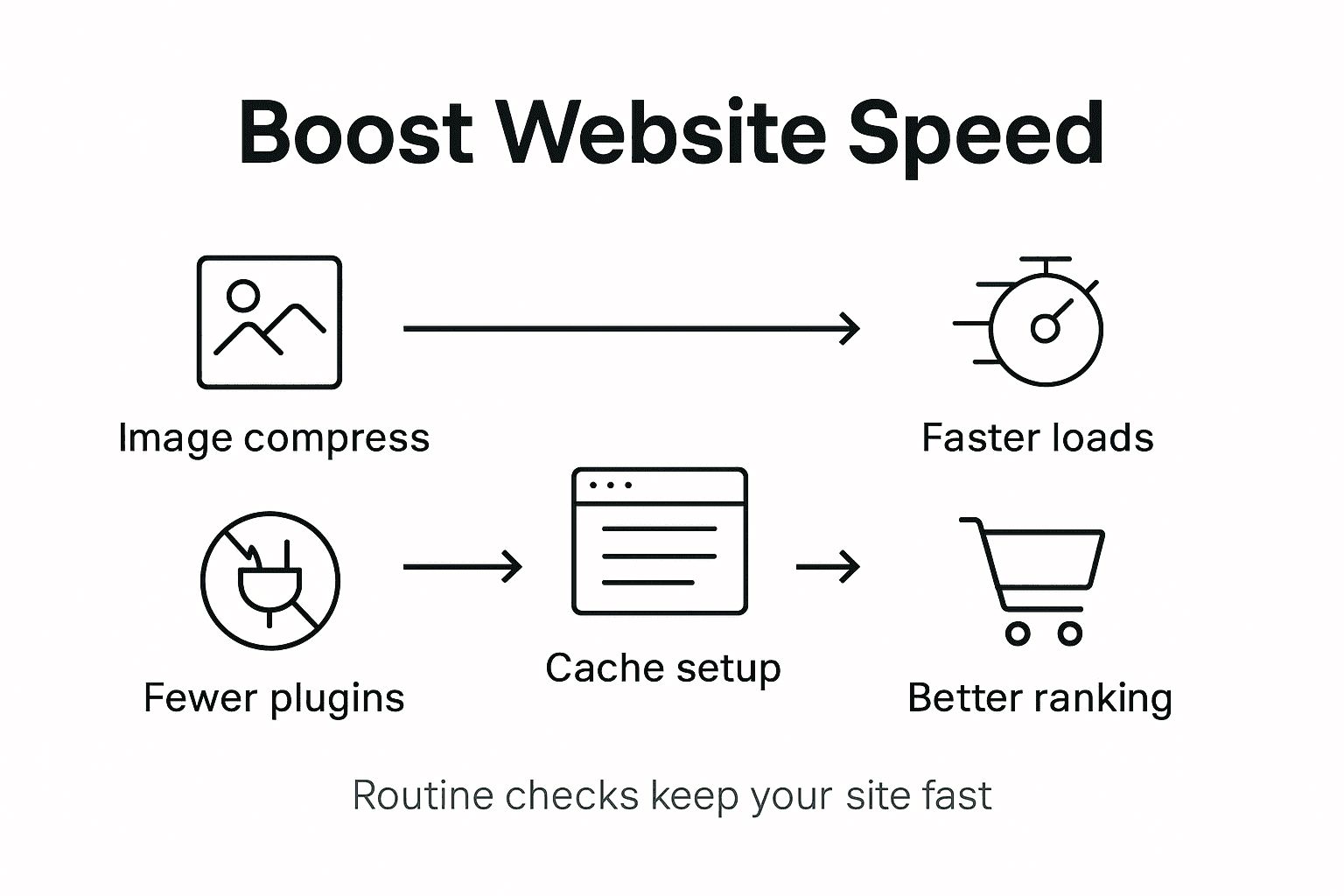
Critical speed optimization strategies include:
Below is a quick reference of technical actions and their impact on small business website performance:
| Optimization Strategy | Primary Benefit | Typical Tools |
|---|---|---|
| Image compression | Faster load times | TinyPNG, ImageOptim |
| Browser caching | Reduced repeat load latency | Google PageSpeed, WP Rocket |
| Minifying code | Smaller file size | UglifyJS, Minify Code |
| Content delivery networks | Faster global access | Cloudflare, AWS CloudFront |
- Image compression and optimization
- Minifying CSS, HTML, and JavaScript files
- Implementing browser caching
- Reducing server response times
- Creating mobile-responsive designs
- Eliminating unnecessary page elements
- Using content delivery networks (CDNs)
Technical optimization is not a one-time task but an ongoing process. Small businesses should regularly audit their website performance, understanding that even minor improvements can significantly impact user engagement and search engine rankings. A website that loads quickly demonstrates professionalism and respect for potential customers’ time.
Pro tip: Schedule monthly website speed audits using free tools like Google PageSpeed Insights, treating performance optimization as a continuous improvement process rather than a single project.
Unlock Lightning-Fast Website Speed and Local SEO Success for Your Florida SMB
The article highlights how slow website load times can drain your business revenue and weaken your local SEO standing. If you struggle with bounce rates, losing mobile visitors, or feel overwhelmed by technical speed optimization myths, you are not alone. Florida small businesses need a reliable way to boost site performance while managing local search visibility without the headache of juggling expensive tools or lengthy redesigns. Nimblo.ai understands these challenges and offers a streamlined solution that integrates rapid website performance, AI-powered local SEO, and automated marketing into one affordable SaaS platform.
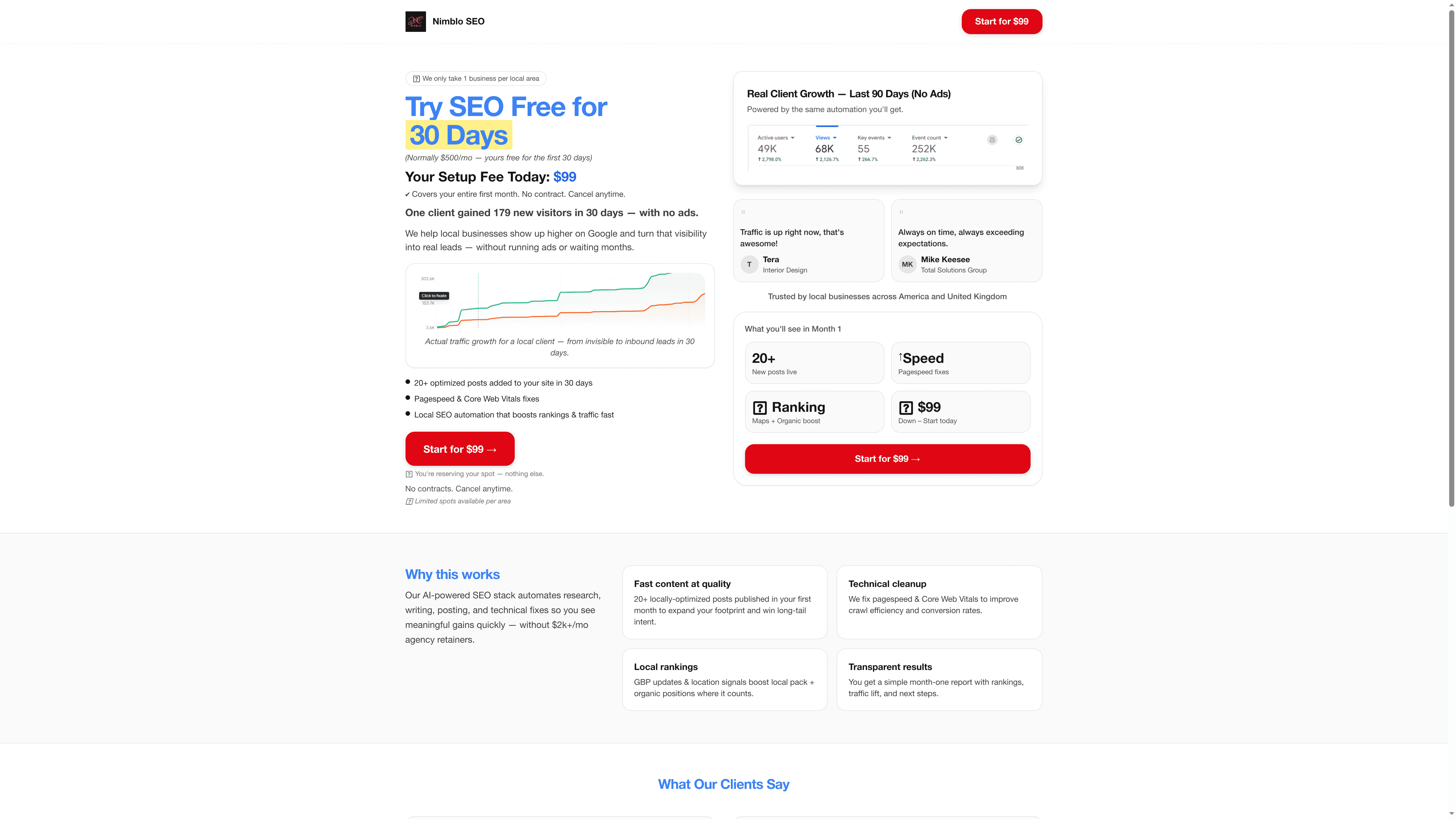
Don’t let slow websites and complicated tech hold you back. With Nimblo.ai, you get a conversion-optimized website built to load fast and rank higher in local search results. Our platform simplifies essential speed enhancements like caching, image optimization, and schema markup without sacrificing design or breaking your budget. See measurable lead growth and cost savings proven by local business testimonials. Take control of your digital presence with quick setup and local support designed just for Florida SMBs. Visit https://nimblo.ai/99down now to power your website to top speed and watch your local visibility soar.
Frequently Asked Questions
What does website speed mean for my business?
Website speed refers to the time it takes for a web page to load and become interactive, which directly impacts user experience and conversion rates.
How does website speed affect user experience?
Faster loading times lead to improved user satisfaction by allowing visitors to complete tasks efficiently, reducing cognitive load, and encouraging engagement with your website.
Are speed optimizations expensive and complex?
Most speed optimizations can be implemented at a low cost without requiring significant redesigns or technical expertise, making them accessible for small businesses.
Why is website speed important for search engine rankings?
Search engines prioritize websites that provide fast, seamless experiences to users; therefore, slow-loading sites can suffer from lower search visibility and reduced potential for customer acquisition.