
Many Florida small business owners believe SEO is too complicated or expensive to tackle without hiring an agency. The truth is that basic SEO can be surprisingly affordable and effective when you focus on proven fundamentals. In 2026, Florida SMBs face unique challenges managing local citations across 67 counties while adapting to AI-powered search trends. This guide breaks down simple, actionable SEO strategies designed specifically for small and medium businesses operating in Florida’s competitive digital landscape. You’ll discover practical steps to boost your website’s visibility, streamline your marketing efforts, and attract more customers without breaking the bank.
Table of Contents
- Why Basic SEO Matters For Florida SMBs In 2026
- Core Components Of Basic SEO For Your Website
- How To Adapt Your Basic SEO For 2026’s AI-Powered Search And Local Needs
- Practical Steps To Implement Basic SEO Affordably And Effectively
- Boost Your Florida SMB Website With Expert SEO Support
- FAQ
Key takeaways
| Point | Details |
|---|---|
| Foundation first | Setting up tracking tools and optimizing user experience forms the bedrock of effective SEO for SMBs. |
| Local complexity | Florida businesses must maintain consistent citations across multiple counties to rank in local search results. |
| AI adaptation | 2026 SEO requires structured data and answer-first content to succeed in AI-powered search environments. |
| Affordable execution | Following practical checklists and using budget-friendly tools delivers measurable results without agency costs. |
Why basic SEO matters for Florida SMBs in 2026
SEO drives affordable traffic to your website and expands your customer reach without the recurring costs of paid advertising. For Florida small and medium businesses, mastering basic SEO is no longer optional in 2026. Your competitors are already optimizing their online presence, and customers increasingly rely on search engines to find local services.
Florida’s unique market presents specific challenges that make SEO even more critical. Multi-location Florida SMBs must maintain consistent local citations across all 67 counties for optimal local SEO performance. This geographic complexity means a plumbing company serving both Miami-Dade and Broward counties needs precise citation management to rank in both markets. Missing or inconsistent business information across county-specific directories directly hurts your local search visibility.
The 2026 SEO landscape includes new AI search dynamics that require updated strategies. Search engines now prioritize direct answers and structured content over traditional keyword stuffing. This shift actually benefits SMBs because it levels the playing field. You don’t need massive budgets to compete, you need smart optimization focused on answering customer questions clearly and comprehensively.
Basic SEO becomes accessible when broken into manageable parts. Consider these foundational elements that every Florida SMB should prioritize:
- Tracking setup to measure what’s working
- Mobile-friendly website design for on-the-go customers
- Local citation consistency across Florida directories
- Answer-first content that directly addresses customer questions
“The biggest SEO mistake Florida SMBs make is thinking they need to do everything at once. Start with tracking and user experience, then build from there.”
Florida’s tourism and service-based economy means your potential customers are actively searching for solutions right now. When someone in Tampa searches for your service category, proper SEO ensures your business appears in those critical search results. Essential SEO tips for small businesses can transform your online visibility within months, not years.
Core components of basic SEO for your website
Every successful SEO strategy starts with proper tracking infrastructure. Avoid common DIY SEO pitfalls by setting up Google Search Console and Google Analytics 4 first. These free tools show you exactly how customers find your website, which pages perform best, and where technical issues exist. Without tracking, you’re flying blind and wasting effort on tactics that may not work for your specific business.
User experience directly impacts your SEO performance in 2026. Search engines prioritize websites that load quickly, work seamlessly on mobile devices, and provide intuitive navigation. Florida customers browsing on smartphones while traveling or commuting expect instant page loads. A three-second delay can cost you potential customers who bounce to faster competitors. Focus on compressing images, minimizing code bloat, and ensuring your site responds perfectly on all screen sizes.

Content optimization with targeted keywords forms the heart of basic SEO. Identify the specific phrases your Florida customers use when searching for your services. A Miami HVAC company should target “emergency AC repair Miami” rather than generic terms like “air conditioning.” Place these keywords naturally in your page titles, headings, and body content. More importantly, structure your content to answer customer questions immediately. Put the most valuable information at the top of each page, then provide supporting details below.
Local citations boost your visibility in geographic-specific searches. Maintain consistent business information across Google Business Profile, Yelp, Yellow Pages, and Florida-specific directories. Your business name, address, and phone number must match exactly across all platforms. Even minor variations like “St.” versus “Street” confuse search engines and dilute your local SEO strength.
Follow this systematic approach to improve your website’s SEO foundation:
- Install Google Search Console and verify your website ownership
- Set up Google Analytics 4 to track visitor behavior and conversions
- Audit your website speed using Google PageSpeed Insights
- Verify mobile-friendliness with Google’s Mobile-Friendly Test
- Research keywords your target customers actually use
- Optimize your most important pages with those keywords
- Claim and complete your Google Business Profile
- Build consistent citations across major directories
Pro Tip: Create a website checklist for Florida SMBs that you review monthly to catch issues before they impact rankings. Small, consistent improvements compound over time to deliver significant SEO gains.
Many Florida SMBs waste resources on advanced tactics before mastering these fundamentals. Schema markup and link building matter, but they won’t help if your tracking is broken or your site loads slowly. Master the basics first, then layer on sophisticated strategies. Avoid SEO mistakes by prioritizing foundation over flash.
How to adapt your basic SEO for 2026’s AI-powered search and local needs
AI search prioritizes structured data and direct answers over traditional SEO signals that dominated previous years. Search engines now use artificial intelligence to understand content context and user intent more deeply than ever before. This means your content must be organized in ways that AI can easily parse and present to users. Generic keyword placement no longer suffices when algorithms evaluate semantic meaning and comprehensive coverage of topics.
Schema markup helps search engines understand your content context and improves your chances of appearing in rich results. In 2026, combining schema markup with answer-first content is essential for optimizing AI search results. Schema is structured data code that labels different elements of your content, like business hours, service areas, prices, and reviews. When you add schema to your website, you’re essentially providing a roadmap that helps AI understand exactly what you offer and who you serve.
Local chains and multi-location businesses in Florida face unique challenges maintaining uniform citations across 67 counties. A restaurant group operating in Jacksonville, Orlando, and Fort Lauderdale must manage separate citations for each location while maintaining brand consistency. Citation inconsistencies confuse both customers and search engines, directly harming your local rankings. Specialized tools and processes become necessary when scaling beyond a single location.
Consider how traditional SEO differs from AI-focused optimization in 2026:
| Traditional SEO | AI-Focused SEO 2026 |
|---|---|
| Keyword density and placement | Semantic relevance and topic coverage |
| Backlink quantity | Content quality and E-E-A-T signals |
| Meta descriptions for clicks | Direct answer formats for AI summaries |
| Generic content targeting keywords | Comprehensive answers to specific questions |
| Basic contact information | Structured schema markup for all data |
Florida SMBs gain competitive advantages by implementing schema for SEO before competitors catch on. Search engines reward early adopters of new technologies with better visibility. Adding schema to your service pages, location information, and customer reviews signals that your business is technically sophisticated and trustworthy. This matters especially in competitive Florida markets where dozens of similar businesses vie for the same customers.
Pro Tip: Start with LocalBusiness schema for your main location, then add Service schema for each service you offer. This combination gives AI search engines comprehensive information about your business capabilities and service areas.
Multi-location local SEO strategies for SMBs require systematic citation management and location-specific content. Create dedicated pages for each service area that include unique, locally relevant content. A pest control company serving multiple Florida counties should develop separate pages discussing region-specific pest challenges, not duplicate content with only the city name changed. AI search engines detect and penalize thin, duplicated content across location pages.
The shift to AI search also means featured snippets and knowledge panels matter more than traditional blue link rankings. Structure your content to directly answer common questions in concise paragraphs of 40 to 60 words. Use clear headings that match question formats customers actually ask. When AI search engines pull answers for voice queries or summary boxes, properly formatted content gets selected more frequently.
Practical steps to implement basic SEO affordably and effectively
Follow a sequential checklist from setup to content improvement to avoid overwhelming yourself with too many simultaneous changes. Checklists yield 60% traffic growth in 4 months for SMBs following practical SEO steps. Start with technical foundation, then move to on-page optimization, and finally tackle ongoing content creation and citation management. This phased approach prevents analysis paralysis and delivers measurable progress at each stage.
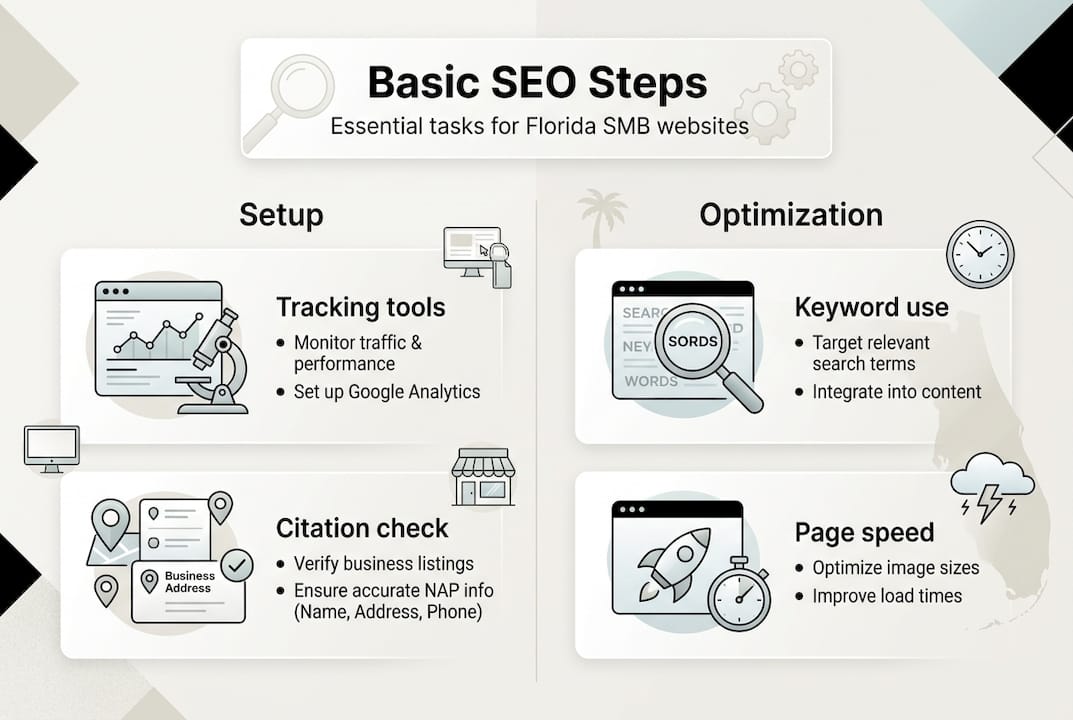
Affordable SEO tools tailored for SMBs eliminate the need for expensive agency contracts. Google Search Console and Google Analytics 4 provide free tracking and insights. Ubersuggest offers keyword research at budget-friendly prices. Yoast SEO or Rank Math plugins guide on-page optimization for WordPress sites. These tools cost a fraction of agency fees while delivering professional-grade capabilities that Florida SMBs can manage in-house.
Avoid typical SEO mistakes that waste time and resources:
- Neglecting mobile optimization when most Florida customers browse on smartphones
- Ignoring local citation consistency across county-specific directories
- Creating thin content that doesn’t fully answer customer questions
- Skipping schema markup implementation
- Failing to track results and adjust strategies based on data
This data summarizes actionable SEO steps with realistic effort estimates and tool recommendations:
| SEO Step | Estimated Effort | Affordable Tool Options | Expected Impact |
|---|---|---|---|
| Tracking setup | 2 hours initial | Google Search Console, GA4 (free) | Foundation for all optimization |
| Mobile optimization | 4 hours | Google Mobile-Friendly Test (free) | Improved rankings and user experience |
| Keyword research | 3 hours | Ubersuggest ($29/month), Google Keyword Planner (free) | Targeted traffic from right searches |
| On-page optimization | 6 hours | Yoast SEO (free), Rank Math (free) | Better rankings for target keywords |
| Citation building | 4 hours initial, 1 hour monthly | BrightLocal ($29/month), manual submission | Local search visibility boost |
| Schema implementation | 3 hours | Schema.org documentation (free), plugins | Enhanced search result appearance |
Pro Tip: Dedicate one hour weekly to SEO improvements rather than attempting everything at once. Consistent, focused effort delivers better results than sporadic intensive work sessions.
The best SEO tools for small business combine affordability with features specifically designed for SMB needs. Avoid enterprise-level tools with complexity and pricing that exceed your requirements. Many premium tools offer free trials, allowing you to test functionality before committing to subscriptions. Start with free tools, then upgrade selectively to paid options that solve specific bottlenecks in your SEO workflow.
Common SEO mistakes to avoid include obsessing over rankings instead of focusing on traffic and conversions. Your goal isn’t to rank number one for vanity keywords, it’s to attract qualified customers who convert into revenue. Track metrics that matter: organic traffic growth, conversion rates from organic visitors, and customer acquisition cost from SEO compared to paid advertising.
Integrating SEO with your broader digital marketing creates synergies that amplify results. Content created for SEO can be repurposed for email newsletters and social media. Customer questions identified through keyword research inform your FAQ pages and sales conversations. Digital marketing tools for SMBs work best when connected through a unified strategy rather than operating in isolation.
Consistent tracking and iteration maximize SEO gains on a small budget. Review your Google Search Console data monthly to identify which pages gain traction and which need improvement. Double down on content topics that resonate with your audience. Prune or improve pages that attract no traffic. This data-driven approach ensures you invest effort where it generates returns, not where it satisfies arbitrary best practices that may not apply to your specific Florida market.
Boost your Florida SMB website with expert SEO support
Implementing basic SEO delivers results, but professional guidance accelerates your progress and helps you avoid costly mistakes. Many Florida SMBs waste months experimenting with tactics that don’t fit their specific market or business model. Expert support provides customized strategies based on your industry, location, and competitive landscape.
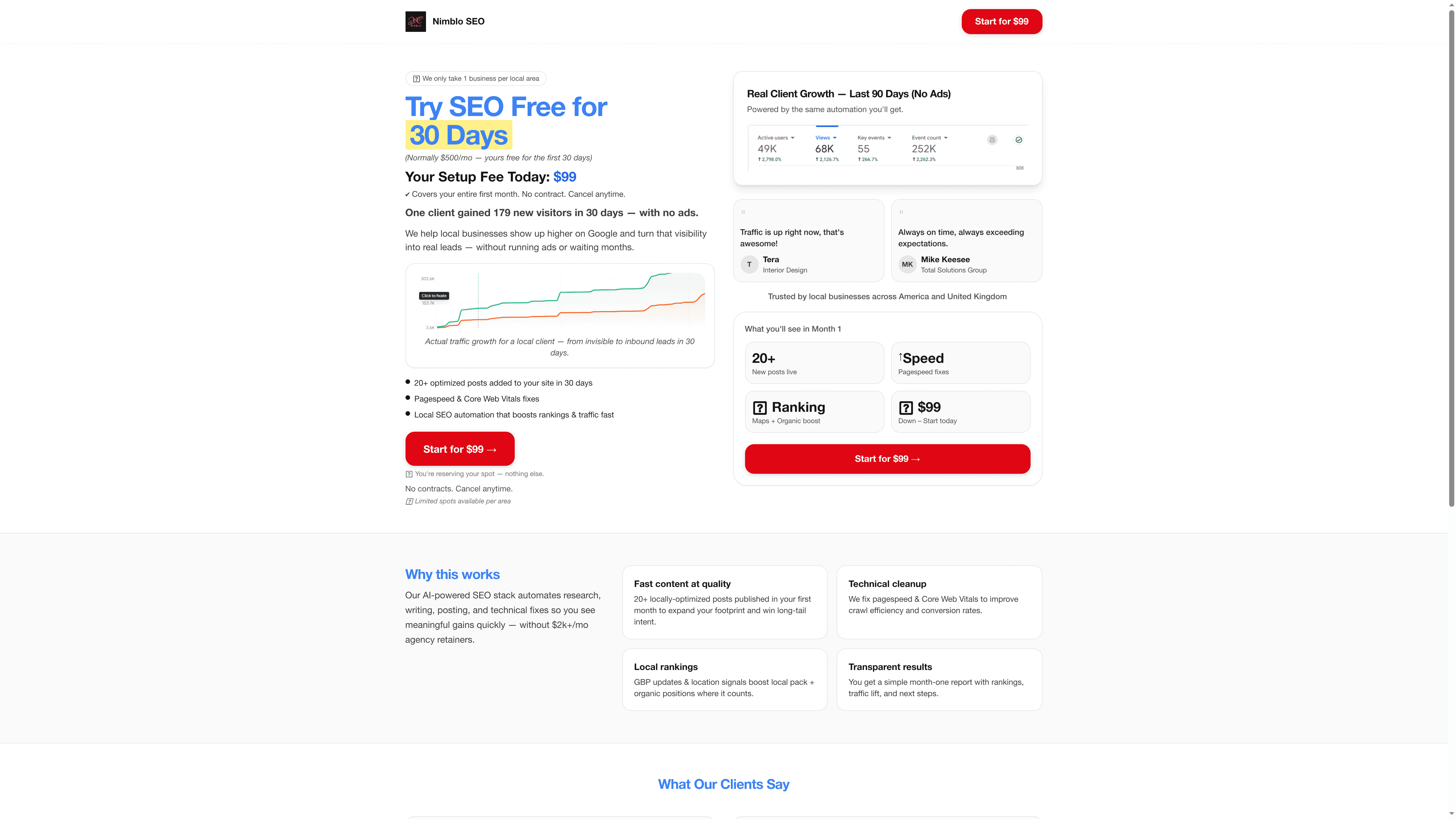
Nimblo specializes in affordable SEO services designed specifically for Florida small and medium businesses. Our platform combines SEO optimization, website performance, and local citation management in one streamlined solution. We understand the unique challenges of managing consistent business information across Florida’s 67 counties and optimizing for both traditional search and emerging AI-powered results. Affordable SEO services for SMBs eliminate the complexity of juggling multiple tools and vendors while delivering measurable improvements in your online visibility and lead generation.
FAQ
What is basic SEO for a small business website?
Basic SEO includes simple website optimizations like keyword use, tracking setup, and local citations to improve search engine visibility for SMBs. It focuses on foundational elements that deliver the highest return on effort: making your site technically sound, mobile-friendly, and filled with content that answers customer questions. These fundamentals cost little to implement but significantly impact how easily potential customers find your business online.
How can Florida SMBs optimize for local search across many counties?
Maintain consistent business information and citations across all relevant counties to rank locally in each market you serve. Use specialized local SEO strategies and citation management tools to track your listings across hundreds of directories. Create location-specific content that addresses unique needs and challenges in each county rather than duplicating generic pages. This approach signals to search engines that you genuinely serve multiple areas with local expertise. Check out this service area SEO guide for detailed implementation steps.
What are common SEO mistakes Florida SMBs should avoid?
Skipping tracking setup, neglecting mobile user experience, maintaining inconsistent citations, and ignoring new SEO trends are frequent mistakes that undermine results. Many SMBs also create thin content that fails to comprehensively answer customer questions or implement schema markup that helps AI search understand their offerings. Avoid these pitfalls to protect your SEO investment and accelerate progress. Review these common SEO mistakes to identify issues in your current approach.
How long does it take to see results from basic SEO?
Most Florida SMBs see initial traffic improvements within two to four months of implementing basic SEO correctly. Technical fixes like improving site speed and mobile-friendliness can show impact within weeks. Content optimization and citation building require more time as search engines gradually recognize and reward your improvements. Consistent effort compounds over time, with many SMBs experiencing 60% or greater traffic growth within six months of following systematic SEO checklists.
Do I need to hire an agency for basic SEO?
No, Florida SMBs can successfully implement basic SEO in-house using affordable tools and following proven checklists. Agencies make sense when you lack time or need advanced strategies beyond fundamentals. Many businesses start with DIY SEO to build foundational knowledge, then selectively hire experts for complex challenges like technical audits or competitive link building. The key is understanding which tasks you can handle internally versus which require specialized expertise.