
Standing out in the Florida service market means more than listing skills and prices online. If your website only speaks in general terms, your message risks fading among countless competitors. Focusing on a detailed customer profile lets your website copy reach the exact people who matter most. This guide shows how to shape every headline, benefit, and call-to-action to attract local leads and automate your sales process.
Table of Contents
- Step 1: Research Your Ideal Local Customer Profile
- Step 2: Define Unique Value And Service Benefits Clearly
- Step 3: Craft Headlines And Section Copy With Seo Keywords
- Step 4: Incorporate Calls-To-Action That Drive Lead Generation
- Step 5: Review, Revise, And Verify Copy For Effectiveness
Quick Summary
| Main Insight | Explanation |
|---|---|
| 1. Identify Your Ideal Customer | Analyze your best customers to create a detailed profile, ensuring your website copy addresses their specific needs and concerns. |
| 2. Define Your Unique Value | Clearly articulate what differentiates your business from competitors; focus on customer benefits rather than business features. |
| 3. Integrate SEO Keywords | Research and incorporate relevant keywords into your website copy to improve search engine visibility while maintaining clarity for readers. |
| 4. Use Effective Calls-to-Action | Implement clear, specific calls-to-action throughout your site to guide visitors toward taking actionable steps, such as booking services. |
| 5. Revise for Clarity and Accuracy | Regularly review and refine your copy based on customer feedback and performance metrics, ensuring it remains relevant and engaging. |
Step 1: Research your ideal local customer profile
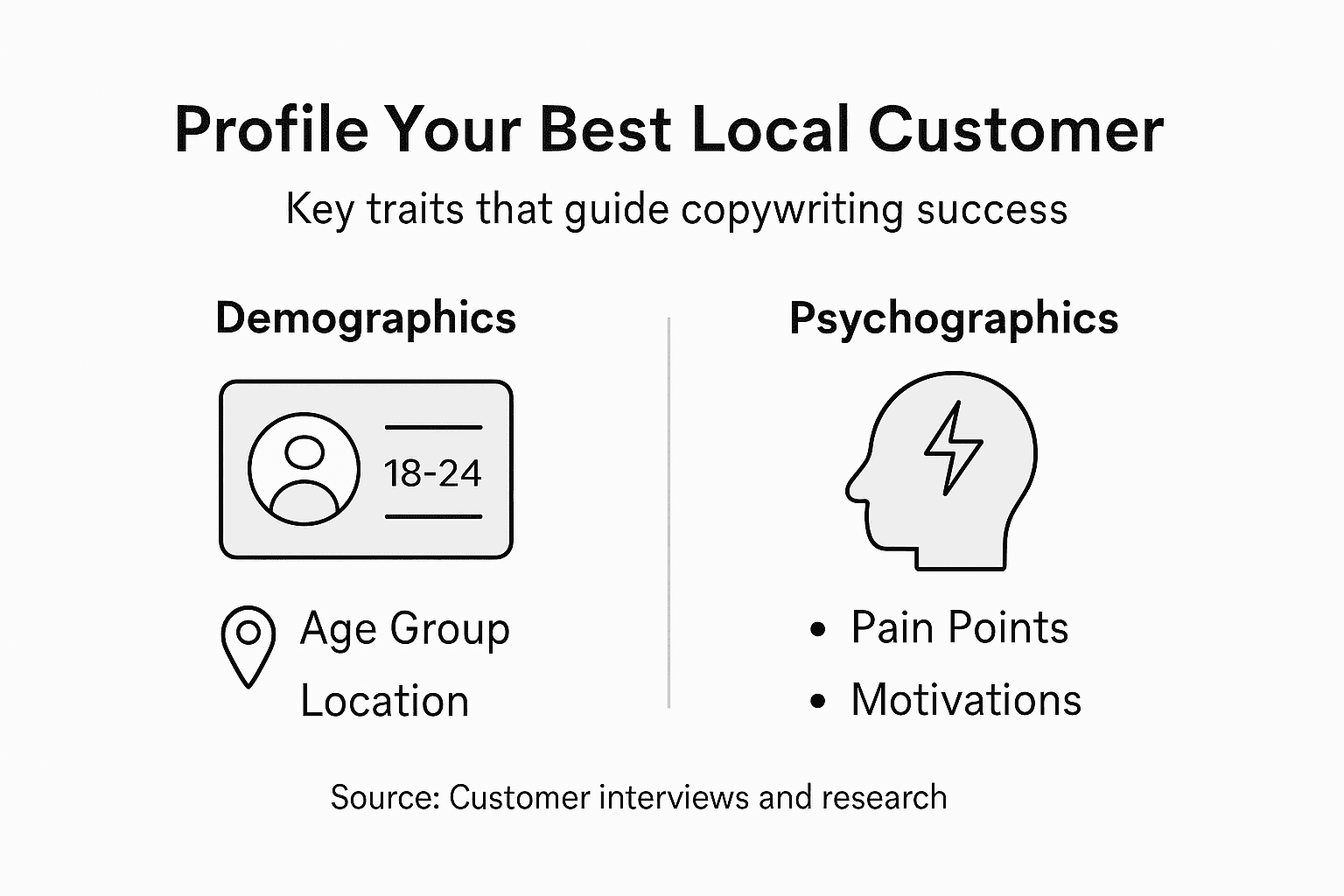
Knowing exactly who you’re trying to reach is the foundation of effective website copy. This step determines whether your message resonates with the right people or gets lost in the noise. By building a clear picture of your ideal local customer, you’ll write copy that speaks directly to their needs, concerns, and decision-making process.
Start by examining your best existing customers. Not every client is equally valuable. Look at the ones who pay on time, stick around long-term, and refer others to you. For a plumbing company in Tampa, this might be homeowners aged 35 to 55 with 1970s to 1990s homes who experience frequent plumbing issues. For a landscaping business in Jacksonville, it could be commercial property managers or residential customers with properties over a quarter acre. Write down what these customers have in common: their location, property type, income level, and the specific problems they face.
Next, conduct market research specific to your local area. Drive through neighborhoods where your best customers live. Visit local coffee shops and notice what people are discussing. Check online reviews of competitors to see what complaints and praise appear repeatedly. This local intelligence reveals what actually matters to customers in your specific community, not what some national marketing guide says should matter. Understanding how customers think about your service requires detailed customer behavior analysis that goes beyond surface demographics. You want to uncover their goals, pain points, and what influences their buying decisions.
Dig into psychographic details by interviewing past customers directly. Ask why they chose you, what frustrations they had before hiring you, and what success looks like to them. These conversations reveal the emotional drivers behind their decisions. A homeowner might hire a plumber not just to fix a pipe, but to avoid the embarrassment of having guests see water damage, or to prevent a bigger disaster. A business might need landscaping not just for curb appeal, but because an unkempt property reflects poorly on their brand.
Create a written profile of your ideal customer using the information you’ve gathered. Include their demographics, their primary problems, their communication preferences, and the outcome they’re hoping for. This profile becomes your north star when writing website copy. You’ll reference it constantly to ensure every headline, every benefit statement, and every call-to-action speaks to this specific person. The more detailed and specific your profile, the more targeted and effective your website copy becomes.
Pro tip: Survey your last 10 paying customers with three simple questions: “What problem were you trying to solve before hiring us?” “What other options did you consider?” and “What made you choose us?” Your answers will reveal the exact language and concerns your ideal customers use, which you can then mirror directly in your website copy.
Step 2: Define unique value and service benefits clearly
Your ideal customer profile is complete, but they need a reason to choose you over every other plumber or landscaper in your area. This step is where you identify and articulate what makes your business different and why that difference matters to the people you’re trying to reach. Without a clear unique value proposition, your website copy will sound like every other generic service business in Florida.

Start by listing what you actually do differently. This sounds simple, but most service businesses skip this step entirely. Maybe you offer same-day service when competitors take three to five days. Perhaps you guarantee your work for five years instead of one. You might be the only company in your area that uses eco-friendly products, or you specialize exclusively in older homes rather than trying to serve everyone. You could offer transparent upfront pricing when others hide costs until the job is done. These differences exist in your business right now. Write them down. Get specific. “Faster service” is vague. “We answer phones within 30 minutes and can usually arrive the same day” is concrete.
Next, connect these differences to what your ideal customers actually care about. This is where most business owners get it wrong. They think customers care about their credentials or how long they’ve been in business. Your customers care about outcomes and feelings. A homeowner doesn’t care that your plumbing company has 25 years of experience. They care that you’ll fix their leak without destroying their bathroom tile. A property manager doesn’t care about your landscaping awards. They care that you’ll keep their property looking professional so their tenants stay longer. Understanding how your unique value resonates with target customers means translating your business features into customer benefits. The feature is what you do. The benefit is what the customer gets as a result.
Write out three to five core benefits that matter most to your ideal customer profile. For a plumbing company targeting busy professionals, benefits might include “minimize time away from work,” “no surprise charges,” and “transparent communication about what’s wrong and how we’ll fix it.” For a landscaping company targeting commercial property managers, benefits might include “consistent, professional appearance year-round,” “reduces tenant complaints about property maintenance,” and “scalable service that grows with your portfolio.” These benefits become the backbone of your website copy. Every headline, every description, every call-to-action should echo back to one of these core benefits. Your website isn’t about you. It’s about what customers get when they hire you.
Here’s a breakdown of factors to consider when defining your unique value proposition:
| Differentiator Type | Example Feature | Customer Benefit | Business Impact |
|---|---|---|---|
| Speed of Service | Same-day arrival | Issue resolved without long wait | More positive reviews |
| Guarantee/Assurance | 5-year workmanship guarantee | Peace of mind, reduced risk | Increased referrals |
| Specialization | Focus on older homes | Expertise for unique needs | Higher satisfaction rates |
| Environmental Practices | Eco-friendly products | Healthier environment, less exposure | Attracts green-conscious |
| Transparency | Upfront, fixed pricing | No surprise costs, easier budgeting | Reduces complaints |
Pro tip: Ask three recent customers this question: “What’s the biggest difference working with us has made for you?” Write down their exact words and use that language in your website copy. Customers often articulate your value better and more authentically than you can.
Step 3: Craft headlines and section copy with SEO keywords
Your benefits are crystal clear, but if search engines cannot find your website, potential customers will never see them. This step bridges the gap between what your business offers and what local customers are actually searching for. You’ll weave SEO keywords naturally into your headlines and body copy so Google understands what you do while your words still speak directly to real people looking for solutions.
Start with keyword research specific to your local market. Google what customers in your area would type when looking for your service. If you’re a plumber in Miami, someone might search “emergency plumber Miami,” “24-hour plumbing Miami,” “burst pipe repair Miami,” or “toilet repair near me.” Use Google’s search suggestions by typing your service into the search bar and seeing what autofills appear. Check what competitors rank for by looking at their website titles and headers. You’re not trying to guess what keywords matter. Identifying specific terms your target audience uses requires looking at actual search behavior. Tools like Google Search Console show which keywords bring people to competitor sites. Local business directories and Google Business Profile insights reveal real customer language. This research becomes your keyword list.
Now craft headlines that accomplish two things at once. Your headline must contain a keyword your customers search for AND speak to one of your core benefits. Don’t just write “Plumbing Services Miami.” Instead write “Same-Day Emergency Plumber in Miami Open Until 10 PM” or “Professional Toilet Repair and Leak Detection in Miami.” The first headline sounds like every other plumber. The second tells someone exactly what you do and when you’re available. For a landscaping company, instead of “Landscaping Company Jacksonville,” write “Commercial Landscaping Jacksonville That Keeps Properties Tenant-Ready” or “Eco-Friendly Lawn Maintenance Jacksonville.” These headlines contain searchable keywords while also promising a specific benefit.
Apply the same thinking to section headers and body copy throughout your website. If you have a section about your plumbing services, the header might be “Plumbing Services Designed for Busy Professionals” instead of just “Our Services.” When describing your process, you naturally mention your keywords: “We start with a thorough leak inspection using advanced technology to identify hidden damage,” which includes your service plus keyword phrases. The key is integration. Your keywords should never feel forced or repeated awkwardly. Real customers will read your page. Google will scan it. Both need to understand what you’re offering.
Pro tip: Write your headline first without keywords, then overlay your keyword into it naturally. If the keyword doesn’t fit smoothly, choose a different keyword variation instead of forcing awkward phrasing. A headline that reads naturally will get clicked more often, and that matters more to Google than perfect keyword placement.
Step 4: Incorporate calls-to-action that drive lead generation
Your website copy is now optimized for search engines and speaks directly to your ideal customers. But without clear calls-to-action, visitors will read your brilliant copy and then leave without taking any action. This step transforms interested readers into actual leads by telling them exactly what to do next and making it ridiculously easy to do it.
Understand what you want visitors to do before you write a single call-to-action. The action should match where someone is in their decision-making process. Someone visiting your homepage might not be ready to book a service yet. They need a lower commitment action like signing up for your email list, downloading a pricing guide, or requesting a free inspection. Someone on your “Emergency Plumbing” page is already in crisis mode. They need a clear, urgent action like “Call now for same-day service” or “Book emergency repair in the next 30 minutes.” Someone reading your testimonials has moved further along. They might be ready for “Schedule your free consultation” or “Get your custom quote today.” Effective calls-to-action motivate prospects to take specific steps like providing contact information or scheduling appointments. Different page sections need different actions, all designed to move people toward becoming customers.
Make your calls-to-action visually prominent and impossible to miss. Button text should be action-oriented, specific, and benefit-focused. Instead of a vague “Submit,” write “Get My Free Plumbing Inspection” or “Schedule Landscape Consultation Now.” The button text tells people exactly what they’ll get when they click. Use contrasting colors so buttons stand out from the page background. Place them strategically throughout your website, not just at the very bottom. Someone reading your services section should see a call-to-action right there, not have to scroll back up to the hero section. Mobile visitors especially need easy-to-tap buttons positioned near relevant content. For local service businesses, phone numbers deserve special treatment. Make your phone number clickable on mobile devices. Consider adding a click-to-call button so someone can reach you immediately without typing.
Be specific about what happens next. When someone clicks “Schedule Consultation,” will they reach a calendar to book directly? Will they get connected to a team member? Will they receive an email confirmation? People hesitate to take action when they don’t know what to expect. Add supporting text near your call-to-action: “Schedule a 15-minute free consultation,” “Book your appointment instantly,” or “Call and speak with an owner within 5 minutes.” This removes friction and increases conversions. Test different call-to-action text, button colors, and placements over time. Track which ones actually generate leads using your website analytics. What works for a plumbing company might differ from what works for landscaping, and what works in Miami might differ from what works in smaller Florida towns.
To help ensure strong calls-to-action, compare the pros and cons of various CTA approaches:
| CTA Style | Best Use Cases | Benefit to Business | Common Pitfall |
|---|---|---|---|
| Action-Oriented | Scheduling, booking, direct calls | Drives immediate engagement | Vague or generic language |
| Educational | Download guides, email signups | Builds leads for nurturing | Low urgency, slow response |
| Urgent/Time-Based | Emergency services, limited slots | Increases conversions quickly | Can feel manipulative |
| Benefit-Focused | Free consultations, instant quotes | Highlights value up front | Too broad or unclear |
Pro tip: Add urgency language that matches reality without being manipulative. Instead of fake “limited time offers,” use honest urgency like “Call today to check our availability for this week” or “Book now for spring maintenance before we fill up.” People respond to real scarcity, not manufactured pressure, and honest urgency builds trust with the leads you actually want.
Step 5: Review, revise, and verify copy for effectiveness
You’ve built your website copy from the ground up with research, benefits, keywords, and calls-to-action. But raw first drafts rarely convert well. This step is about stepping back, viewing your copy with fresh eyes, and making sure every word earns its place on your page. You’ll catch unclear messaging, spot weak spots, and verify that your copy actually does what you need it to do.
Start by reading your copy aloud as if you were a customer visiting your website for the first time. You’ll immediately catch awkward phrasing that looked fine on screen but sounds stilted when spoken. Notice where you stumble or have to re-read sentences. If you’re tripping over words, so are your customers. Listen for claims that sound exaggerated or vague. Does a headline actually tell someone what you do, or does it just sound clever? When you describe your service, are you speaking your customer’s language or using jargon they wouldn’t use? Read through your pages on a phone too. Mobile visitors often struggle with dense paragraphs and tiny text. Sentences that seemed reasonable on a desktop monitor can feel overwhelming on a 4-inch screen. Evaluating the clarity of information ensures it meets your audience’s needs and addresses their actual concerns, not what you assume they care about.
Next, verify the accuracy of every claim you make. If you say you offer same-day service, can you actually deliver that every single day or just most days? If you mention a guarantee, is it actually guaranteed or does it have conditions? If you reference experience, testimonials, or certifications, double-check that everything is current and accurate. False claims destroy credibility the moment a customer discovers the truth. Local customers talk to each other. Word spreads fast. One exaggerated promise can cost you dozens of referrals. Check that your phone number, address, hours, and service areas are all correct. Nothing looks worse than a customer trying to call you at an outdated number or showing up at a closed location. Verify links work properly. Test your contact forms to make sure messages actually reach you. If a form looks like it submitted but you never receive the message, you’ll lose leads silently.
Get feedback from people outside your business. Show your website copy to a few recent customers and ask them directly: Does this sound like you understood what we needed? Is anything confusing? What would make you want to hire us based on reading this? Their honest reactions reveal what’s working and what’s missing. Revision informed by feedback improves clarity and persuasiveness and ensures your messaging actually resonates. You might discover that something you thought was crystal clear is completely misunderstood. You might find that customers care about benefits you never mentioned. This feedback is gold. Use it to refine your copy before it generates thousands of impressions.
Finally, establish a schedule to review and refresh your copy regularly. Website copy isn’t something you write once and forget. Seasonal services, new offerings, and customer feedback should trigger updates. Set a reminder every three months to reread your pages with critical eyes. Track which pages generate the most leads and which ones underperform. If your contact form shows that few people click on your calls-to-action, that copy needs revision. If certain pages drive tons of traffic but few conversions, the problem is likely in your messaging, not your traffic. Small tweaks often yield big improvements. One business might discover that changing “Free estimate” to “Free home inspection” increases conversions by 30 percent because it’s more specific. Another might find that moving a call-to-action button higher on the page increases clicks significantly.
Pro tip: Read your copy three days after writing it, not immediately. Fresh distance gives you objectivity. You’ll notice problems you missed when the words were still in your head. Keep a revision checklist: Does every headline have a keyword? Does every benefit statement connect to a customer problem? Is every call-to-action specific and easy to find? Run through this checklist before publishing any new copy.
Transform Your Website Copy Into a Lead-Generating Machine with Nimblo.ai
Struggling to write website copy that truly connects with your ideal local customers and drives real leads is a common challenge for Florida SMBs. This article explains how identifying your ideal customer, defining your unique value, and integrating local SEO keywords can boost your local lead generation fast. Yet executing these strategies consistently can feel overwhelming without the right tools. Key pain points include crafting targeted messaging that resonates, optimizing for local search terms, and incorporating clear, action-driving calls-to-action that actually convert visitors into customers.
That is where Nimblo.ai steps in. Our all-in-one platform is designed specifically for small and medium businesses in Florida that want an easy, affordable way to build SEO-optimized websites that speak directly to local audiences. With AI-powered local SEO, schema markup, and conversion-optimized design, Nimblo helps you implement the article’s core strategies effortlessly. You get rapid setup for a professional website featuring laser-focused copy that highlights your unique benefits and uses the keywords your customers actually search for. Plus, integrated CRM and marketing automation take your calls-to-action beyond words into automated, consistent lead generation. Don’t let generic copy hold you back from capturing your local market.
Take the first step toward transforming your website into a powerful lead magnet. Discover how Nimblo’s local marketing expertise and easy automation can save you time and unlock sustained lead growth.
Ready to write website copy that actually sells your services in your local Florida market?
Get started today with Nimblo.ai’s flat-rate all-in-one platform. Build your optimized website, boost your local SEO, and automate lead capture all in one place. Visit Nimblo.ai and turn your website visitors into loyal customers today.
Frequently Asked Questions
How can I identify my ideal local customer for my website copy?
To identify your ideal local customer, start by analyzing your best existing clients. Look for common traits such as location, demographics, and specific problems they face. Document these details to create a clear customer profile that can guide your website copy.
What are unique value propositions, and how do I define mine?
A unique value proposition highlights what makes your business stand out from competitors. To define yours, list specific features or services that differentiate you, then connect each to tangible benefits your ideal customers care about. This clarity will make your website more compelling and customer-focused.
How do I find SEO keywords that will boost my website visibility?
To find SEO keywords, conduct keyword research based on what potential customers are likely to search for in your service area. Use search suggestions and competitor analysis to develop a list of relevant keywords, then incorporate them naturally into your website copy to improve your search engine rankings.
What should I include in calls-to-action to increase lead generation?
Effective calls-to-action should be specific, action-oriented, and placed prominently throughout your site. Clearly state what the visitor should do next, such as “Schedule My Free Inspection.” This guidance will help convert website visitors into leads.
How often should I review and revise my website copy for effectiveness?
You should review and revise your website copy every three months to ensure it remains relevant and effective. Consider tracking your website’s performance metrics to identify underperforming pages and update them based on insights to enhance lead generation.
What common mistakes should I avoid when writing website copy?
Avoid vague language and jargon that may confuse potential customers. Instead, focus on clear, concise messaging that directly addresses customer pain points and communicates benefits. Regularly solicit feedback to ensure your copy resonates with your audience.
Recommended
- 7 Smart Ways to Increase Local Leads for Florida SMBs – Nimblo
- 7 Practical Examples of Lead Generation for Florida SMBs – Nimblo
- 7 Lead Generation Strategies for Florida SMB Success – Nimblo
- 7 Steps Lead Generation Checklist for Florida SMB Owners – Nimblo
- What Is Local SEO and Why It Drives Calls Fast
- The Anatomy of a High-Converting Local Business Website – City Web Company | Digital Marketing Agency
- Local SEO – 1on1 SEO