
Automated email campaigns achieve a 2,361% better conversion rate compared to standard scheduled campaigns. That dramatic difference reveals why Florida SMBs are rethinking manual marketing processes in 2026. This guide breaks down marketing automation versus manual methods, backed by current data, to help you decide which tasks to automate and which to keep human. You’ll discover proven ROI timelines, common pitfalls, and practical steps to transform your marketing efficiency.
Table of Contents
- What Is Marketing Automation Versus Manual Marketing?
- Benefits And Drawbacks: Marketing Automation Vs Manual
- How Marketing Automation Supports Florida SMB Growth: Real-World Impact And Trends
- Practical Steps To Evaluate And Implement Marketing Automation For Your SMB
- Unlock Efficient Marketing For Your Florida SMB With Nimblo
- Frequently Asked Questions
Key takeaways
| Point | Details |
|——-|———||
| Automation delivers superior results | Automated campaigns convert 2,361% better than manual scheduling and generate 544% ROI over three years. |
| Manual marketing still has value | Personalized interactions and complex customer relationships benefit from human touch and judgment. |
| Strategic selection matters | Choosing the right processes to automate determines success; not every task should be automated. |
| Quick ROI is achievable | 76% of companies see ROI within one year, with many experiencing revenue boosts in 6-9 months. |
What is marketing automation versus manual marketing?
Marketing automation uses software systems to handle repetitive tasks without constant manual input. Think email sequences triggered by customer actions, automatic lead scoring, or scheduled social media posts running while you sleep. Manual marketing requires humans to execute each task individually, from sending every email to updating spreadsheets with lead information.
Typical manual marketing tasks include:
- Writing and sending individual emails to prospects
- Following up with leads via phone or text
- Manually segmenting contact lists in spreadsheets
- Posting social media content one update at a time
- Tracking campaign performance across disconnected tools
Automation transforms these repetitive activities into systematic workflows. You design the process once, set parameters, and the system executes consistently. This shift requires upfront time investment but eliminates ongoing manual labor. Marketing automation for Florida SMBs focuses on workflows that drive leads while reducing the hours you spend on routine tasks.
The ROI calculation becomes straightforward. Compare the hours saved weekly against the cost of automation tools, then factor in improved conversion rates. Most SMBs discover that automating even basic email follow-ups pays for itself within months.
Benefits and drawbacks: marketing automation vs manual
Let’s examine concrete advantages and limitations of each approach, supported by 2026 data.
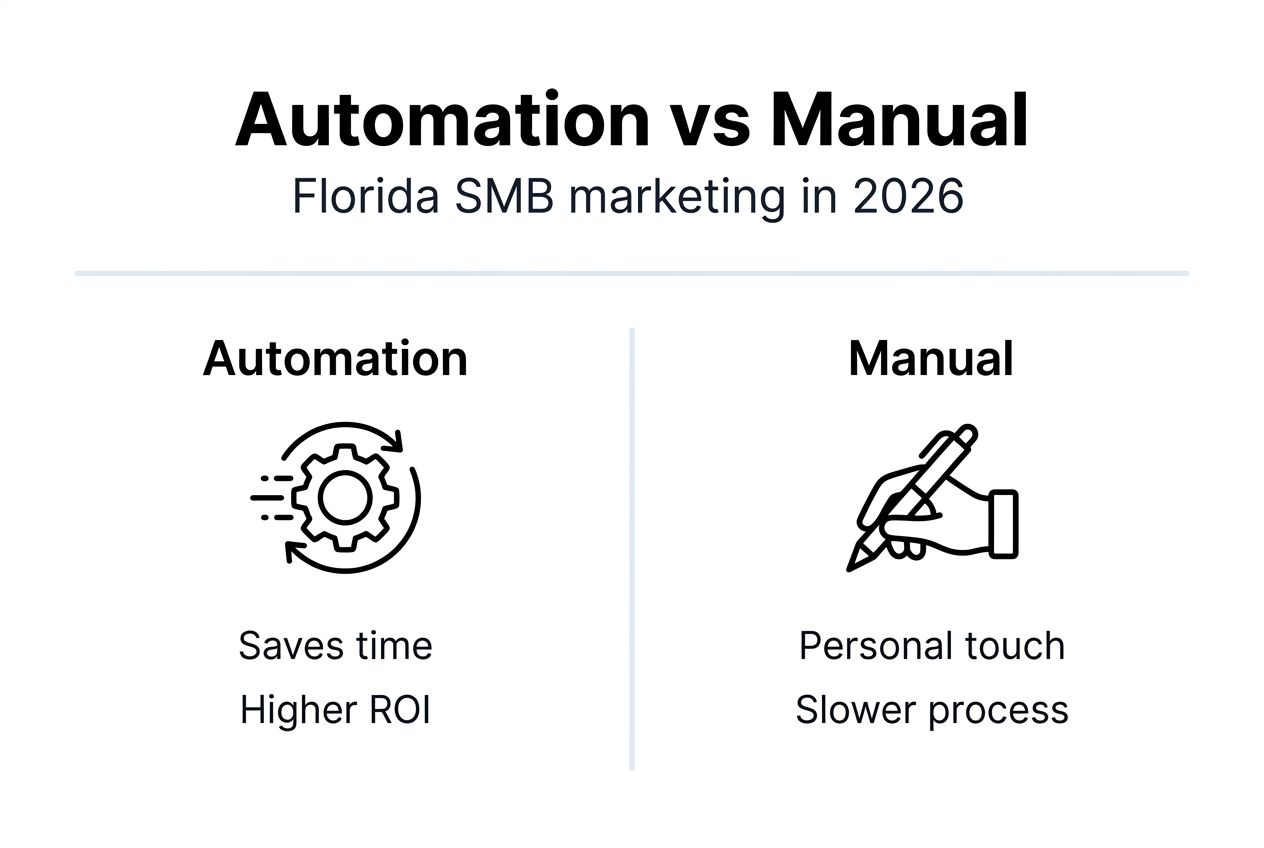
| Aspect | Marketing Automation | Manual Marketing |
|---|---|---|
| Conversion Rate | 2,361% better than standard campaigns | Baseline performance |
| ROI | 544% average over three years | Variable, labor-intensive |
| Lead Quality | Can increase qualified leads by 451% | Depends on individual effort |
| Scalability | Handles thousands of contacts effortlessly | Limited by human capacity |
| Personalization | Risk of generic messaging | Highly customized interactions |
| Speed | Instant, 24/7 execution | Business hours only |
| Error Rate | Consistent accuracy | Prone to human mistakes |
Marketing automation advantages:
- Eliminates repetitive manual work like data entry and email scheduling
- Delivers consistent messaging across all customer touchpoints
- Responds to customer actions instantly, capturing leads when interest peaks
- Provides detailed analytics showing exactly which campaigns drive revenue
- Scales effortlessly as your customer base grows
Check out marketing automation tips for Florida SMBs to maximize these benefits.
Marketing automation drawbacks:
- Over-automation creates impersonal experiences that alienate customers
- Requires clean data; garbage in equals garbage out
- Initial setup demands time and strategic thinking
- May feel overwhelming for teams unfamiliar with marketing automation statistics and best practices
Manual marketing advantages:
- Enables nuanced responses to complex customer situations
- Builds genuine relationships through personalized attention
- Adapts instantly to unexpected circumstances or feedback
- Requires no technical setup or software investment
Manual marketing drawbacks:
- Slower execution limits your competitive response time
- Human error leads to missed follow-ups and inconsistent messaging
- Doesn’t scale; growth requires hiring more staff
- Difficult to track ROI across fragmented activities
Pro Tip: Start by automating your most time-consuming repetitive tasks like email sequences and lead capture, while keeping complex negotiations and relationship-building manual. This hybrid approach maximizes efficiency without sacrificing the human touch that closes deals.
How marketing automation supports Florida SMB growth: real-world impact and trends
Florida SMBs increasingly adopt automation as a competitive necessity. 64% of small businesses use marketing automation to boost productivity and stay competitive. This trend accelerates in 2026 as businesses recognize that manual processes can’t match the speed and precision automation delivers.
Common marketing automation applications for Florida SMBs include:
- Welcome email sequences that nurture new leads automatically
- Abandoned cart reminders recovering lost sales
- Birthday or anniversary messages strengthening customer loyalty
- Lead scoring identifying your hottest prospects
- Social media scheduling maintaining consistent presence
- Automated reporting showing campaign performance at a glance
The results speak clearly. Businesses implementing automation report higher lead volume, better conversion rates, and more time for strategic activities. Instead of manually sending emails or chasing leads, owners focus on growth initiatives and customer service.

Challenges exist. Many SMBs struggle with integration gaps between existing tools and new automation platforms. Technology overwhelm stops some businesses before they start. Data quality issues undermine automation effectiveness when contact information is outdated or incomplete.
Pro Tip: Start small with one automated workflow, master it completely, then expand. Choose a process you repeat weekly, like follow-up emails to new inquiries. Build that automation, test thoroughly, and measure results before adding complexity. This approach prevents overwhelm and builds confidence.
Practical steps to evaluate and implement marketing automation for your SMB
Follow this systematic approach to automate effectively:
-
Identify automation candidates. List every repetitive marketing task you perform weekly. Email follow-ups, social posts, lead tracking, and appointment reminders top most lists. Focus on activities that are measurable, rule-based, and consume significant time.
-
Evaluate software options. Compare platforms based on ease of use, integration with your existing tools, cost, and customer support quality. Marketing automation for Florida SMBs requires solutions that don’t demand technical expertise or massive budgets.
-
Start with one workflow. Choose your highest-impact, most time-consuming process. Build it completely, including all decision points and contingencies. Test with a small segment before rolling out broadly.
-
Clean your data first. Automation multiplies the impact of data quality, good or bad. Remove duplicates, verify contact information, and segment your list properly before activating any automated campaigns.
-
Set success metrics. Define exactly what improvement looks like. Track open rates, click-throughs, conversions, and time saved. 76% of companies see ROI within one year, but you’ll need clear metrics to measure your progress.
-
Monitor and refine. Review performance weekly for the first month, then monthly thereafter. Adjust messaging, timing, and targeting based on real results. Automation isn’t set-and-forget; it requires ongoing optimization.
-
Preserve human touchpoints. Keep complex negotiations, complaint resolution, and relationship-building manual. Automation handles repetitive tasks brilliantly but struggles with nuanced human situations requiring empathy and judgment.
-
Scale gradually. Once your first workflow performs well, add another. Marketing automation workflow for Florida SMBs should expand systematically, not all at once. This prevents overwhelm and maintains quality.
Unlock efficient marketing for your Florida SMB with Nimblo
Ready to transform your marketing from manual grind to automated efficiency? Nimblo delivers marketing automation designed specifically for Florida SMBs, combining lead generation, email sequences, and campaign management in one platform. You get expert guidance avoiding common pitfalls while maximizing ROI.
Our system handles the technical complexity so you focus on growing your business. From strategic automation planning to cost-effective implementation, we provide everything Florida SMBs need to compete effectively in 2026.
Frequently asked questions
Is marketing automation suitable for every small business?
Marketing automation benefits most SMBs that handle repetitive marketing tasks and want to scale without proportional labor increases. Businesses with at least 100 contacts and regular lead flow see the clearest ROI. Very small operations with minimal customer volume may find manual methods sufficient initially. However, businesses planning growth should implement automation early to build scalable systems from the start.
What are common pitfalls when switching from manual to automated marketing?
Biggest mistakes include automating everything indiscriminately, which creates impersonal messaging and lost engagement. Poor data quality represents another critical failure point; messy data leads to poor decisions. Start with clean, segmented contact lists. Maintain human involvement in complex customer interactions requiring nuanced judgment. Test workflows thoroughly before full deployment to catch logic errors.
How soon can I expect ROI after implementing marketing automation?
Most companies achieve positive ROI within 12 months, with 76% seeing returns in one year. Many experience earlier gains, with revenue boosts appearing within 6-9 months. Timeline depends on implementation quality, chosen processes, and how well you optimize based on performance data. Email automation typically delivers fastest returns, while complex multi-channel campaigns require longer maturation periods.
Should I completely eliminate manual marketing when I automate?
No. Effective marketing blends automation for repetitive tasks with manual effort for complex interactions. Automate email sequences, social posting, and lead scoring. Keep manual your high-value negotiations, customer complaint resolution, and relationship-building with major accounts. This hybrid approach maximizes efficiency while preserving the personal touch that differentiates your business and closes important deals.
What size contact list justifies investing in marketing automation?
Businesses with 100+ contacts and regular new lead flow justify automation investment. Smaller lists may not generate sufficient ROI to offset costs and setup time. However, if you’re actively growing your contact base, implement automation early to handle expansion smoothly. The scalability advantage means your system grows effortlessly with your business, avoiding the scramble to automate later when manual processes collapse under volume.
Recommended
- Marketing Automation: Transforming Florida Small Businesses – Nimblo
- Marketing automation step by step guide for Florida SMBs – Nimblo
- 7 Examples of Marketing Automation for Florida SMBs – Nimblo
- 7 Essential Types of Marketing Automation for Florida SMBs – Nimblo
- Why Use Marketing Automation to Drive Business Growth – Jarrod Harman
- Email marketing how to: boost engagement and sales in 2026 – Lind Creative