
Many Florida business owners struggle with attracting new leads while juggling daily operations. The traditional idea of a sales funnel often feels outdated when modern customers hop between social media, review sites, and conversations before making decisions. Understanding the basics and common myths behind sales funnels helps you create a truly dynamic and personalized customer journey. This guide reveals practical strategies and tools to simplify lead generation and local SEO for your small business.
Table of Contents
- Sales Funnel Basics And Common Myths
- Stages And Types Of Sales Funnels
- How A Sales Funnel Works For SMBs
- Key Features: Automation And Tracking
- Cost, Risks, And Common Mistakes
- Comparing Alternatives To Sales Funnels
Key Takeaways
| Point | Details |
|---|---|
| Modern Sales Funnels Are Non-Linear | Customers navigate their buying journey through multiple channels, necessitating a flexible sales funnel model. |
| Personalization Is Key | Tailoring your marketing strategies to individual customer behaviors enhances engagement and conversion rates. |
| Automation Enhances Efficiency | Implementing marketing automation tools streamlines processes and improves tracking of customer interactions. |
| Continuous Optimization Is Essential | Regularly reviewing and refining your sales funnel can mitigate risks and improve overall performance. |
Sales funnel basics and common myths
The traditional sales funnel has long been misunderstood as a straightforward, linear process for converting potential customers. However, modern business dynamics reveal a far more complex reality. Modern buying involves non-linear customer journeys that challenge old-school marketing assumptions.
Traditionally, businesses viewed the sales funnel as a step-by-step progression through four key stages:
- Awareness: Initial contact and brand discovery
- Interest: Customer begins engaging with product information
- Desire: Developing emotional connection with potential solution
- Action: Making the final purchase decision
But this model oversimplifies customer behavior. Today’s buyers navigate multiple channels simultaneously, researching products through diverse touchpoints like social media, review sites, and direct conversations.
Common sales funnel myths include:
- Customers always move sequentially through stages
- All customers follow identical decision-making paths
- Marketing efforts work identically for every prospect
- The funnel ends after initial purchase
In reality, successful Florida small businesses recognize that customer journeys are dynamic and personalized. Each prospect brings unique motivations, constraints, and decision-making processes.

Pro tip: Treat your sales funnel as a flexible framework, not a rigid roadmap. Continuously adapt your approach based on individual customer interactions and feedback.
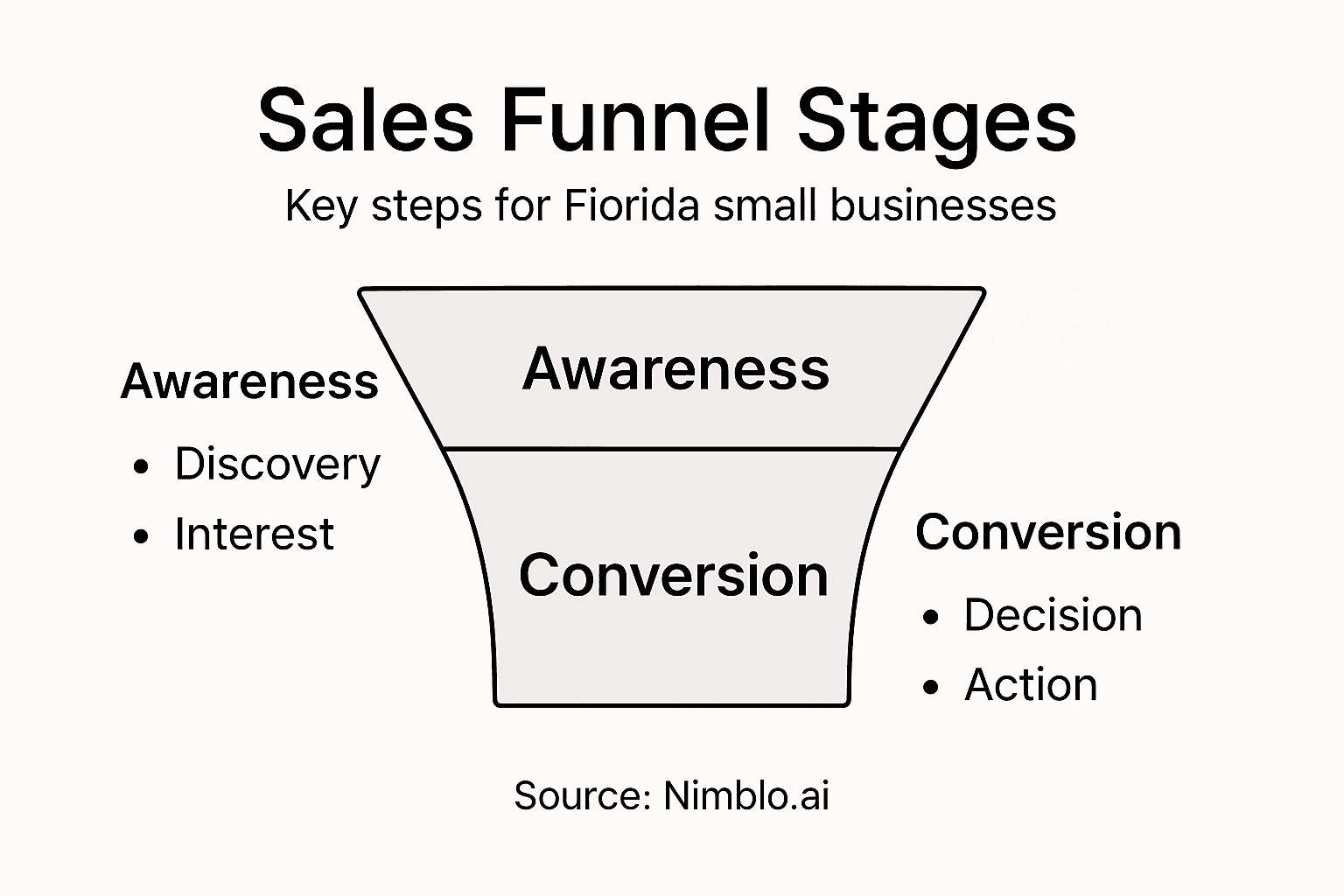
Stages and types of sales funnels
Sales funnels represent the customer’s journey from initial brand awareness to final purchase. Different types of sales funnels help businesses strategically map and optimize their marketing approaches for Florida small businesses.
Four primary sales funnel types emerge for local entrepreneurs:
- Awareness Funnel: Introducing brand and attracting potential leads
- Consideration Funnel: Providing detailed product information
- Conversion Funnel: Finalizing sales through targeted incentives
- Loyalty Funnel: Encouraging repeat business and customer retention
Each funnel type serves a distinct purpose in guiding potential customers through their purchasing decision. Small business owners must understand that customers don’t always progress linearly through these stages.
The traditional sales funnel stages typically include:
- Awareness: Potential customer discovers the brand
- Interest: Customer seeks more information
- Evaluation: Comparing options and solutions
- Decision: Preparing to make a purchase
- Purchase: Completing the transaction
Modern sales funnels recognize that customer journeys are complex and nonlinear. Successful marketing requires flexibility and personalized approaches that adapt to individual customer behaviors.
Pro tip: Design your sales funnel with multiple entry and exit points, recognizing that each customer’s path to purchase is unique.
How a sales funnel works for SMBs
Small businesses in Florida face unique challenges when implementing sales funnels. SMBs must align multiple marketing channels to create an effective customer experience that drives conversions and growth.
The sales funnel for small businesses typically involves several key components:
- Digital Presence: Establishing online visibility
- Lead Capture: Creating mechanisms to collect potential customer information
- Nurturing: Developing relationships with prospects
- Conversion: Turning interested leads into paying customers
- Retention: Maintaining customer relationships for repeat business
Digital marketing strategies play a crucial role in optimizing these funnel stages. Small businesses can leverage cost-effective tools to track and improve their customer journey:
- Search engine optimization (SEO) to increase brand visibility
- Social media marketing for targeted engagement
- Email marketing for lead nurturing
- Content marketing to demonstrate expertise
- Analytics to measure and refine marketing efforts
Unlike large corporations, Florida small businesses must be nimble and strategic. Each marketing dollar needs to work harder, making a well-designed sales funnel critical for sustainable growth.
Successful sales funnels transform random interactions into predictable revenue streams.
Pro tip: Map out your customer’s typical journey and create targeted content for each stage of the sales funnel to maximize conversion potential.
Key features: automation and tracking
Marketing automation technologies transform how small businesses manage their sales funnels, enabling precise tracking and personalized customer interactions across multiple channels.
Key automation features for Florida SMBs include:
- Lead Scoring: Automatically ranking prospect potential
- Behavioral Tracking: Monitoring customer interactions
- Personalized Messaging: Customizing communication based on individual actions
- Performance Analytics: Measuring campaign effectiveness
- Multichannel Integration: Connecting different marketing platforms
Automation tools offer significant advantages for small businesses by streamlining complex marketing processes:
- Reduce manual data entry and administrative tasks
- Create consistent, targeted customer communications
- Identify high-potential leads quickly
- Optimize marketing spend through data-driven insights
- Scale marketing efforts without increasing personnel costs
Tracking capabilities are crucial for understanding customer behavior. Small businesses can now collect and analyze detailed insights about their prospects’ journey, enabling more strategic decision-making.
Effective automation transforms scattered marketing efforts into a precision instrument for business growth.
Pro tip: Select automation tools that integrate seamlessly with your existing systems and provide clear, actionable analytics to maximize your marketing effectiveness.
Cost, risks, and common mistakes
Sales funnel strategies carry inherent risks that Florida small businesses must carefully navigate to avoid costly marketing missteps.
Common financial risks and expenses for SMBs include:
- Technology Costs: Investing in marketing automation tools
- Marketing Spend: Driving traffic and generating leads
- Training Expenses: Learning new marketing technologies
- Potential Revenue Loss: From ineffective funnel management
- Opportunity Costs: Misallocating marketing resources
Critical mistakes that can undermine sales funnel effectiveness:
- Assuming all customers follow a linear purchasing path
- Neglecting ongoing funnel optimization
- Failing to analyze drop-off points
- Using broad, untargeted marketing approaches
- Ignoring customer intent at different journey stages
Funnel leakage represents a significant risk for small businesses. Prospects can abandon the sales process at multiple points, resulting in lost potential revenue and wasted marketing investments.
Below is a summary of common risks and recommended mitigation tactics for Florida small businesses using sales funnels:
| Risk Type | Impact | Mitigation Strategy |
|---|---|---|
| Funnel Leakage | Lost sales, wasted spend | Analyze drop-off, optimize content |
| Untargeted Marketing | Poor conversion, missed opportunities | Segment audience, refine messaging |
| Technology Costs | Budget strain | Choose scalable, cost-effective tools |
| Insufficient Tracking | Missed insights, poor decisions | Implement analytics, review regularly |
Effective funnel management requires continuous monitoring, testing, and strategic refinement.
Pro tip: Regularly audit your sales funnel metrics, identifying and addressing conversion bottlenecks to minimize potential revenue losses.
Comparing alternatives to sales funnels
Traditional sales funnel models are evolving beyond linear customer journeys, presenting Florida small businesses with innovative approaches to understanding customer interactions.
Alternative models to the traditional sales funnel include:
- Customer Journey Framework: Mapping non-linear interactions
- Flywheel Model: Emphasizing continuous customer engagement
- Experience Chain Approach: Focusing on holistic customer interactions
- Omnichannel Strategy: Integrating multiple touchpoints
- Relationship-Centered Model: Prioritizing ongoing customer connections
Key differences between these alternative approaches and traditional sales funnels:
- Reject linear progression of customer interactions
- Emphasize continuous engagement over transactional thinking
- Recognize multiple entry and exit points in customer relationships
- Prioritize customer experience over pure conversion rates
- Allow for more flexible, adaptive marketing strategies
Electronic retail channels offer unique alternatives, such as agency selling and reselling structures that fundamentally reimagine how businesses approach customer interactions and pricing strategies.
Here’s a concise comparison of traditional sales funnels and modern customer journey models:
| Approach | Key Characteristics | Customer Behavior | Business Benefit |
|---|---|---|---|
| Traditional Sales Funnel | Linear, fixed stages | Predictable, step-by-step | Simple to manage, easy to track |
| Modern Journey Model | Dynamic, adaptive pathways | Multi-channel, nonlinear | Greater personalization, improved retention |
| Alternative Models | Focus on engagement & experience | Continuous, flexible entry points | Enhanced loyalty, better customer insights |
Modern marketing requires adaptable approaches that reflect the complexity of customer behavior.
Pro tip: Choose a customer interaction model that matches your specific business needs, allowing flexibility and continuous optimization of your marketing approach.
Transform Your Florida SMB Sales Funnel with Nimblo.ai
Navigating the complex and non-linear sales funnels discussed in the article can feel overwhelming for Florida small businesses striving to convert leads into loyal customers. Challenges like funnel leakage, ineffective multitouch engagement, and the need for automation to track and score leads are critical pain points that demand a seamless, integrated solution. Nimblo.ai is designed specifically to address these issues by consolidating powerful tools into one affordable platform. With features such as AI-powered local SEO, marketing automation, and conversion-optimized website design, you can build flexible sales funnels tailored to your unique customer journeys.
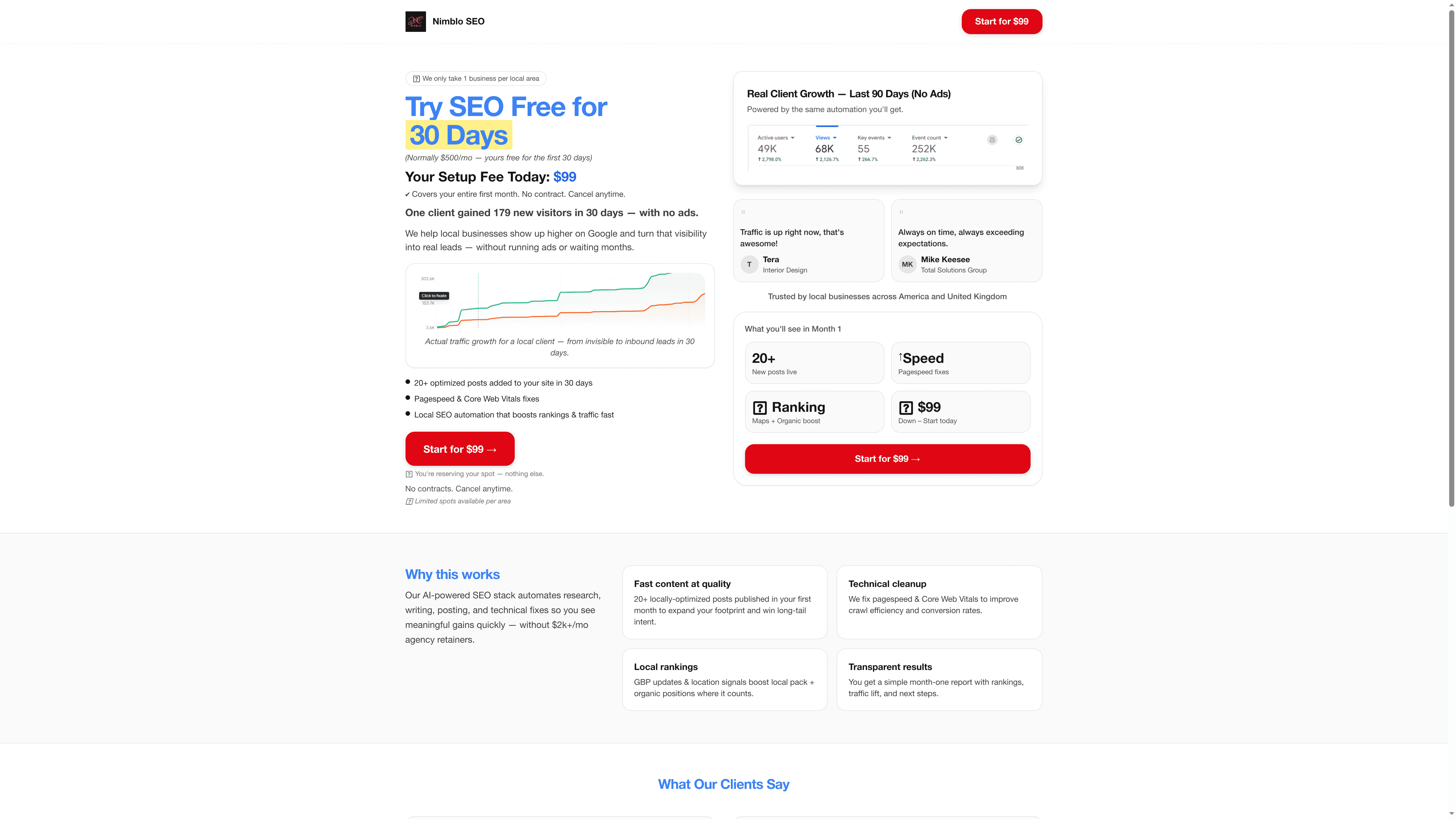
Ready to stop wasting marketing spend and start turning complex sales processes into predictable revenue streams? Discover how Nimblo.ai can help your Florida SMB automate lead capture, nurture personalized customer paths, and optimize your funnel with real-time analytics. Take control today by exploring Nimblo.ai’s all-in-one platform and learn why local businesses trust us for fast setup and measurable growth. Don’t wait to transform your marketing approach and achieve lasting success.
Frequently Asked Questions
What is a sales funnel?
A sales funnel is a marketing concept that represents the journey potential customers take from initial awareness of a brand to the final purchase decision. It consists of various stages, including awareness, interest, consideration, and action.
How do sales funnels work for small businesses?
Sales funnels for small businesses involve creating a structured approach to guide potential customers through their buying journey. This includes establishing an online presence, capturing leads, nurturing relationships, converting leads into sales, and retaining customers.
What are common myths about sales funnels?
Common myths about sales funnels include the belief that customers always move sequentially through stages, all customers follow identical paths, marketing efforts work identically for every prospect, and that the funnel ends after the initial purchase.
What are the key features of sales funnel automation?
Key features of sales funnel automation include lead scoring, behavioral tracking, personalized messaging, performance analytics, and multichannel integration, which help streamline marketing processes and improve customer interactions.
Recommended
- Marketing Funnel Explained: Accelerate Local Lead Growth – Nimblo
- How to Create Lead Magnets for Florida SMBs Easily – Nimblo
- Lead Tracking Explained: Boosting Florida SMB Growth – Nimblo
- How to Nurture Leads for Small Florida Businesses – Nimblo
- 7 Types of Marketing Funnels Every Entrepreneur Should Know
- Complete Guide to Marketing Funnels for E-Commerce
- How to Measure the True Profitability of Free Shipping Promotions