
Most American small business owners in Florida juggle marketing tasks that demand time and attention they simply do not have. Competition is fierce and local visibility often makes the difference between steady new leads and slow seasons. With nearly 90 percent of consumers searching online for local services, having an all-in-one solution to automate lead generation and maximize your local SEO is no longer a luxury. Discover practical strategies tailored for Florida service businesses ready to grow smarter and stand out.
Table of Contents
- Step 1: Assess Local Market And Define Business Goals
- Step 2: Map Customer Journey And Choose Target Channels
- Step 3: Set Up Digital Assets And Automate Lead Generation
- Step 4: Optimize Local Seo And Monitor Key Metrics
- Step 5: Verify Results And Adjust Your Strategy
Quick Summary
| Key Takeaway | Explanation |
|---|---|
| 1. Conduct Local Market Research | Understand specific customer preferences and behaviors to tailor your marketing strategy. |
| 2. Define Measurable Business Goals | Set specific, realistic, and time-bound objectives based on market insights for better guidance. |
| 3. Map Customer Journey | Analyze customer interactions to identify effective communication channels for your audience. |
| 4. Optimize Local SEO | Improve online visibility by refining local search strategies and monitoring search performance. |
| 5. Regularly Review and Adjust | Continuously evaluate marketing performance and adapt strategies based on data and feedback. |
Step 1: Assess local market and define business goals
Understanding your local Florida market landscape and establishing clear business goals are critical foundations for a successful small business marketing strategy. By taking a strategic approach to market assessment, you can develop targeted objectives that directly align with local customer needs and competitive dynamics.
Start by conducting thorough local market research that goes beyond basic demographics. Explore service area marketing strategies to identify specific customer segments, their preferences, pain points, and spending behaviors in your specific Florida region. Utilize resources like local chamber of commerce reports, economic development websites, and industry specific market data to gather insights. Focus on understanding not just who your potential customers are, but what motivates their purchasing decisions, what challenges they face, and how your business can uniquely solve their problems.
As you analyze market data, translate your findings into concrete, measurable business goals. These should be specific, realistic, and time-bound objectives that reflect both your market research and your business vision. For instance, rather than a vague goal like “grow my business,” define precise targets such as “acquire 50 new customers in Miami-Dade County within six months” or “increase local service area revenue by 25% through targeted digital marketing campaigns.” By grounding your goals in actual market insights, you create a strategic roadmap that can guide your marketing efforts with precision and purpose.
Pro tip: Consider scheduling quarterly market reassessments to ensure your goals remain aligned with evolving local business conditions and customer needs.
Step 2: Map customer journey and choose target channels
Successfully marketing your Florida small business requires a strategic approach to understanding your customers’ path to purchase and selecting the most effective communication channels. This step will help you create a comprehensive map of customer interactions and identify the platforms where your target audience is most likely to engage with your brand.
Developing a comprehensive marketing strategy starts with deeply understanding your customer’s experience from initial awareness through post purchase engagement. Break down the customer journey into distinct stages awareness, consideration, decision, and retention and analyze how potential customers in your local Florida market move through each phase. Consider creating detailed buyer personas that capture demographic information, pain points, motivations, and preferred communication methods. This will help you understand not just who your customers are, but how they think and make purchasing decisions.
Once you have mapped the customer journey, strategically select marketing channels that align with your audience’s preferences and behaviors. For Florida small businesses, this might include a mix of digital platforms like targeted social media advertising, local search engine optimization, email marketing, and traditional channels such as community event sponsorships or local print media. Prioritize channels where your specific customer segments are most active and receptive. Pay special attention to platforms that offer robust analytics and targeting capabilities, allowing you to track engagement and refine your approach over time.
Here’s a summary of key considerations when selecting marketing channels for Florida small businesses:
| Channel Type | Strengths | Ideal Use Case |
|---|---|---|
| Social Media Ads | Precise targeting and quick brand awareness | Reaching younger, mobile-first locals |
| Local SEO | High-intent search visibility, drives traffic | Attracting nearby customers online |
| Email Marketing | Cost-effective, highly personalized communication | Nurturing leads or promoting offers |
| Community Sponsorship | Builds trust and local brand presence | Engaging with event-focused audiences |
| Print Media | Tangible, supports brand legitimacy | Reaching less digitally active groups |
Pro tip: Create a simple spreadsheet tracking each marketing channel’s performance metrics to quickly identify which platforms deliver the best return on your marketing investment.
Step 3: Set up digital assets and automate lead generation
Building a strong digital foundation is crucial for Florida small businesses looking to attract and convert potential customers efficiently. This step focuses on creating essential digital infrastructure that will support your marketing efforts and streamline your lead generation process.
Establishing key digital marketing assets requires a strategic approach to developing your online presence. Begin by creating a professional website that clearly communicates your business value proposition and includes clear calls to action. Ensure your site is mobile responsive, loads quickly, and is optimized for local search results. Set up critical digital profiles including a Google Business Profile, relevant social media platforms, and professional directory listings that are specific to your Florida market and industry.

Next, implement marketing automation tools that can help you capture and nurture leads more effectively. This might include setting up lead capture forms on your website, creating automated email follow up sequences, and integrating customer relationship management (CRM) systems that track interactions and support personalized communication. Focus on developing content and automation workflows that provide value to potential customers at each stage of their buying journey. Use tracking tools and analytics to monitor engagement and continuously refine your approach, ensuring your digital assets are working hard to generate and convert potential leads.
Pro tip: Design your lead capture forms to be concise and offer clear value to encourage maximum visitor engagement and information sharing.
Step 4: Optimize local SEO and monitor key metrics
Optimizing your local search engine presence is crucial for attracting customers in your specific Florida market. This step will help you improve your online visibility and track the performance of your marketing efforts through strategic search engine optimization and comprehensive metric tracking.
Developing a robust local SEO strategy requires a multifaceted approach tailored to your specific business and geographic region. Start by ensuring your Google Business Profile is completely filled out with accurate information, high quality images, and updated business hours. Use location specific keywords throughout your website content that reflect how local customers might search for your services. This includes creating service pages that highlight your Florida market presence, adding location details to your metadata, and ensuring your business name, address, and phone number are consistent across all online directories.
Establishing a systematic approach to monitoring key performance indicators is essential for understanding the effectiveness of your marketing efforts. Set up tools like Google Analytics and Google Search Console to track website traffic, user engagement, and search rankings. Pay special attention to metrics such as organic search traffic, conversion rates, time spent on site, and local search visibility. Create a monthly reporting routine where you review these metrics, identify trends, and make data driven adjustments to your marketing strategy. This continuous optimization process will help you progressively improve your online presence and attract more qualified local customers.
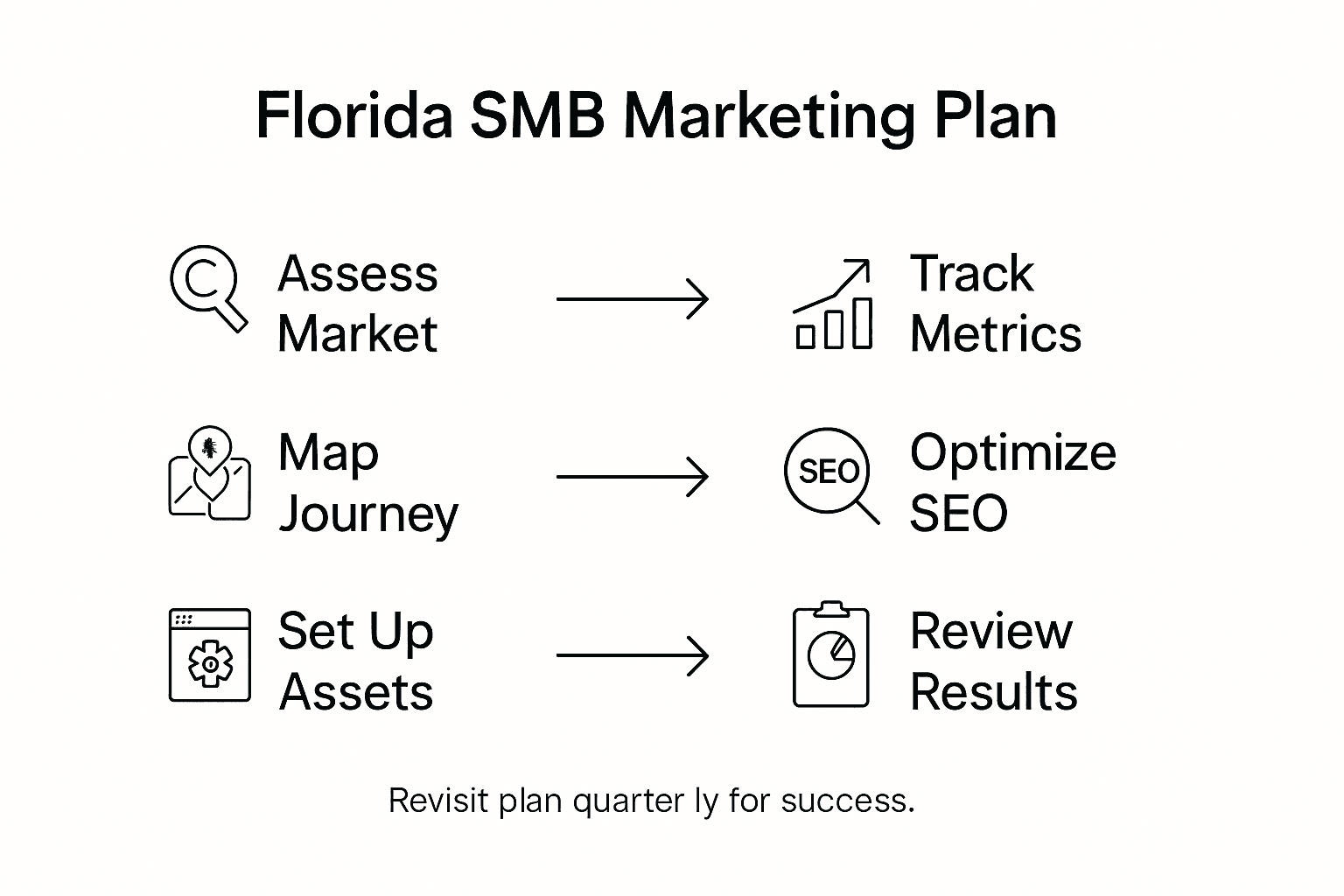
Pro tip: Schedule quarterly comprehensive reviews of your local SEO performance to identify long term trends and make strategic marketing adjustments.
Step 5: Verify results and adjust your strategy
Successful marketing is an ongoing process of measurement, analysis, and strategic refinement. This final step focuses on critically evaluating your marketing efforts and making data driven decisions to continuously improve your business performance.
Establishing a comprehensive marketing review process requires a systematic approach to tracking and interpreting your business metrics. Begin by comparing your actual performance against the initial goals you set at the beginning of your marketing plan. Look beyond surface level numbers and dive deep into the underlying trends. Analyze metrics such as customer acquisition cost, conversion rates, revenue per customer, and return on marketing investment. Pay special attention to which marketing channels are delivering the most qualified leads and generating the highest value customers for your Florida based business.
Develop a structured approach to strategy adjustment that allows for nimble and responsive marketing tactics. Create a quarterly review process where you not only examine performance data but also gather qualitative feedback from customers, sales teams, and frontline staff. This holistic approach will help you identify potential improvements that might not be immediately apparent in quantitative metrics. Be prepared to pivot quickly experimental marketing approaches that are not delivering results and double down on strategies that show promising outcomes. Remember that marketing is an iterative process where continuous learning and adaptation are key to long term success.
Use this table to guide your quarterly marketing review process:
| Metric Tracked | Why It Matters | Action Triggered |
|---|---|---|
| Customer Acquisition Cost | Measures efficiency of spend | Adjust campaigns if trending up |
| Conversion Rate | Reveals funnel effectiveness | Refine messaging or offers |
| Revenue Per Customer | Indicates customer value growth | Review upsell and retention efforts |
| ROI by Channel | Pinpoints highest performers | Scale top channels, reduce weak ones |
| Organic Search Traffic | Reflects SEO progress | Enhance SEO if declining |
Pro tip: Create a simple dashboard that visualizes your key performance indicators to make data analysis more intuitive and actionable.
Simplify Your Florida Small Business Marketing with Nimblo.ai
Building a targeted marketing plan for your Florida small business means tackling challenges like local SEO optimization, customer journey mapping, and automated lead generation. The article highlights how crucial it is to assess your market, set clear goals, and continuously track key metrics—all while managing multiple marketing tools can become overwhelming and costly. If you want to save time and reduce complexity, Nimblo.ai offers an all-in-one platform designed specifically for Florida SMBs that need powerful local SEO, a high-performance website, CRM, and marketing automation without breaking the bank.
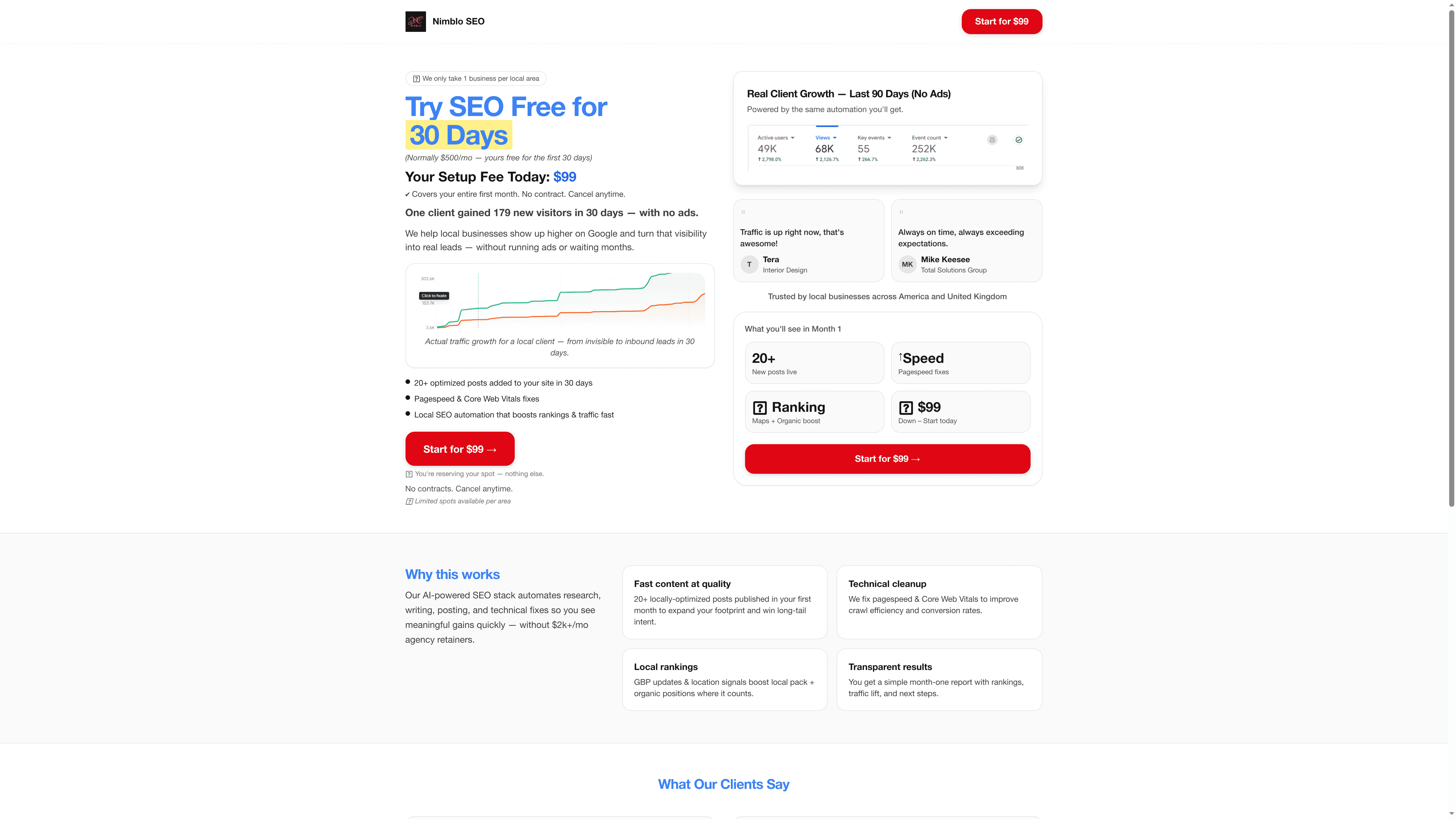
Discover how Nimblo.ai’s AI-powered local SEO and automated follow-up features help Florida businesses convert leads faster while saving money compared to expensive agencies or disconnected tools. Gain control over your marketing channels and instantly improve your local market presence by visiting Nimblo.ai’s 99Down solution. Ready to transform your marketing strategy and see measurable results now Get started today and unlock the potential of a streamlined, affordable marketing solution tailored for your Florida SMB.
Frequently Asked Questions
What steps should I take to assess my local market in Florida for a marketing plan?
To assess your local market, start by conducting comprehensive market research to identify customer segments, preferences, and spending behaviors. Utilize local resources like chamber of commerce reports and industry data to gather insights, then translate these findings into measurable business goals like acquiring a specific number of new customers within a defined timeframe.
How do I map the customer journey for my Florida small business?
Mapping the customer journey involves breaking down the stages of awareness, consideration, decision, and retention. Create detailed buyer personas to understand your customers better, then analyze how they interact with your brand at each stage, which will help you choose effective marketing channels.
What digital assets do I need to set up for my small business in Florida?
Essential digital assets include a professional website, a Google Business Profile, and social media profiles specific to your market. Ensure your website is mobile responsive and optimized for local search, allowing you to capture potential leads effectively through clear calls to action.
How can I optimize my local SEO to attract more customers?
To optimize local SEO, make sure your Google Business Profile is complete with accurate information, including location-specific keywords throughout your website. Regularly review and update your business listings to ensure consistency across all online directories.
What metrics should I monitor to evaluate my small business marketing efforts?
Key metrics to track include customer acquisition cost, conversion rates, and revenue per customer. Set up a routine to analyze these metrics monthly to identify trends and make informed adjustments to your marketing strategy.
How often should I reassess my marketing plan for a Florida small business?
Schedule quarterly reassessments to review your marketing performance against established goals. This practice will ensure your strategy stays aligned with evolving market conditions and customer needs, allowing for timely adjustments as necessary.